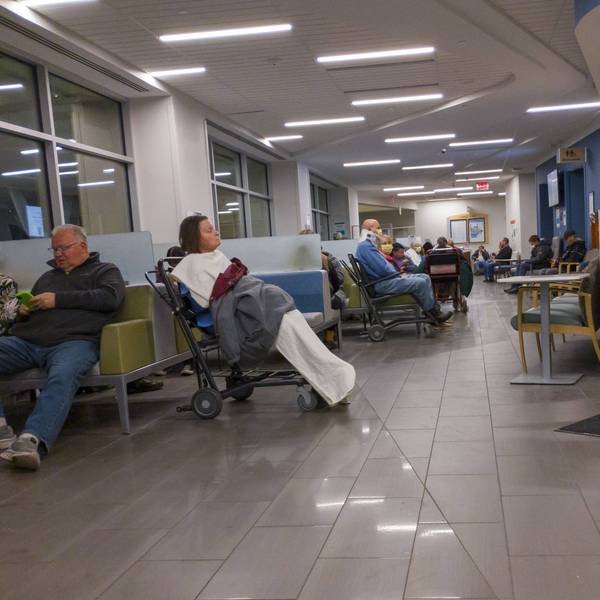
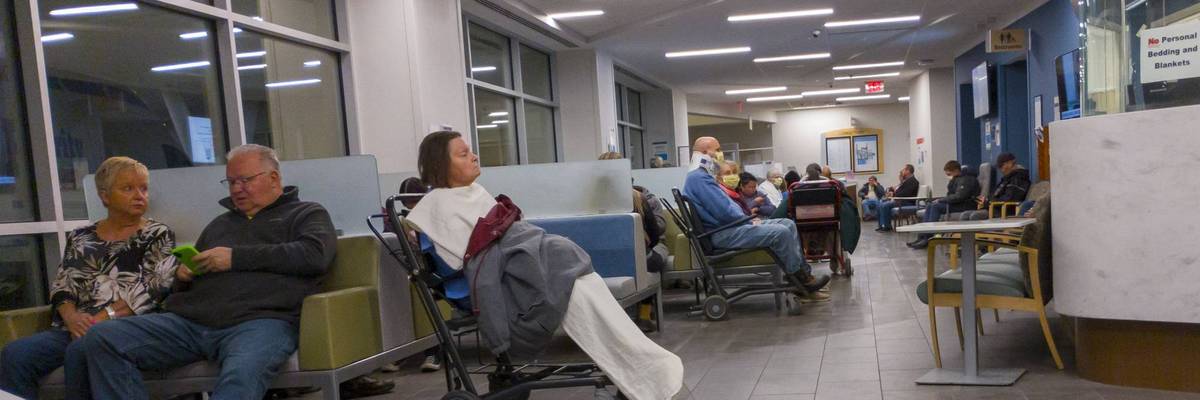
People wait for care in an over crowded hospital emergency room in Coon Rapids, Minnesota on December 18, 2025.
Hospitals See Massive Surge in Uninsured Patients After GOP's Healthcare Cuts
"We’re really crushing people who are desperately trying to pay their bills," said a chief executive at a nonprofit hospital group.
Months after congressional Republicans refused to extend enhanced subsidies for Americans who receive their health insurance through the Affordable Care Act, hospitals across the US are seeing a surge in uninsured patients seeking emergency medical care.
According to a Thursday report in The New York Times, executives at large hospital systems have been raising alarms over "the unexpectedly sharp rise in uninsured patients and the costs associated with treating them."
With many uninsured patients unable to pay their hospital bills, the Times noted, hospitals are seeing "lost revenues amounting to hundreds of millions of dollars across the country's vast health systems."
The Times linked this surge in uninsured patients directly to the Republican-controlled Congress allowing more generous subsidies for plans purchased through the ACA to lapse at the end of 2025. Enrollment in the program has fallen by about 3 million people since last year.
"What that tells me is that there are patients who are completely unable to pay," Laura Kaiser, chief executive of Catholic nonprofit hospital group SSM Health, told the Times. "We’re really crushing people who are desperately trying to pay their bills."
Executives at Universal Health Services (UHS), a for-profit hospital operator, said during an earnings call on Tuesday that the losses they expect to incur from treating uninsured patients have been significantly higher than their initial projects.
As reported by Healthcare Dive on Wednesday, UHS had initially projected that some patients who dropped their coverage provided by the ACA would find another way to get health insurance.
However, UHS CFO Steve Filton told investors that "it felt like virtually everyone who lost their exchange coverage became an uninsured patient."
UHS is hardly alone in suffering losses due to lapsed ACA subsidies, as Axios reported on Tuesday that HCA Healthcare, the largest for-profit hospital chain in the US, is projecting a $400 million hit to revenue that is tied partially to "an influx of uninsured patients."
HCA CEO Sam Hazen said the increase in uninsured patients was a direct consequence of the GOP's refusal to extend the ACA subsidies.
"The effects, as expected, were that many people became uninsured and still needed emergency care from hospitals," Hazen said. "As we look at the first half of the year, our expectations proved accurate, although the impact was greater than our estimates."
An increase in uninsured patients is bad both for hospitals' finances and patients themselves.
As KFF explained in a June report, people without insurance are more likely to avoid seeking medical treatment until their situation becomes too dire to ignore.
"People without health coverage are more likely to be hospitalized for avoidable health problems," KFF wrote, "and to experience declines in their overall health as a consequence of having undiagnosed conditions and a lower likelihood of receiving preventive and chronic disease management care. When they are hospitalized, uninsured people receive fewer diagnostic and therapeutic services and also have higher mortality rates than those with insurance."
We are at a crossroads
This country and this world are at a monumental crossroads. In a few short weeks, US voters will have an opportunity to beat back the forces of fascism and confront the billionaires who are rigging the economy, our media system, and our democracy, making it increasingly impossible for ordinary people to get by. We’re not just talking about the election. We’re talking about what must be done once these fascist elements are vanquished from power. We need a bolder set of solutions than what either major party has so far been willing to offer and a working-class movement ready to fight like hell for it. Trump didn't emerge from nowhere. The conditions that fueled MAGA authoritarianism were created by decades of radical neoliberal economic policies and a corrupt political system dominated by corporate interests. They slashed taxes on the super-rich, promising that the benefits would trickle down. They said giveaways to the corporate titans would make life more affordable for the rest of us. It was all bullshit. And when a bitter, betrayed populace searches for someone to blame, right-wing demagogues have little trouble finding scapegoats. People know when they're being lied to, but you won't hear any of this from the corporate media. Only independent journalism—powered and funded by people who believe in building a better world—can deliver truly trustworthy daily news. Our Fall Campaign is underway, and we need your help. To power our newsroom through the rest of the year, we need to raise $125,000 by midnight on October 31. So if you share our vision, please contribute whatever you can to sustain our work. |
Months after congressional Republicans refused to extend enhanced subsidies for Americans who receive their health insurance through the Affordable Care Act, hospitals across the US are seeing a surge in uninsured patients seeking emergency medical care.
According to a Thursday report in The New York Times, executives at large hospital systems have been raising alarms over "the unexpectedly sharp rise in uninsured patients and the costs associated with treating them."
With many uninsured patients unable to pay their hospital bills, the Times noted, hospitals are seeing "lost revenues amounting to hundreds of millions of dollars across the country's vast health systems."
The Times linked this surge in uninsured patients directly to the Republican-controlled Congress allowing more generous subsidies for plans purchased through the ACA to lapse at the end of 2025. Enrollment in the program has fallen by about 3 million people since last year.
"What that tells me is that there are patients who are completely unable to pay," Laura Kaiser, chief executive of Catholic nonprofit hospital group SSM Health, told the Times. "We’re really crushing people who are desperately trying to pay their bills."
Executives at Universal Health Services (UHS), a for-profit hospital operator, said during an earnings call on Tuesday that the losses they expect to incur from treating uninsured patients have been significantly higher than their initial projects.
As reported by Healthcare Dive on Wednesday, UHS had initially projected that some patients who dropped their coverage provided by the ACA would find another way to get health insurance.
However, UHS CFO Steve Filton told investors that "it felt like virtually everyone who lost their exchange coverage became an uninsured patient."
UHS is hardly alone in suffering losses due to lapsed ACA subsidies, as Axios reported on Tuesday that HCA Healthcare, the largest for-profit hospital chain in the US, is projecting a $400 million hit to revenue that is tied partially to "an influx of uninsured patients."
HCA CEO Sam Hazen said the increase in uninsured patients was a direct consequence of the GOP's refusal to extend the ACA subsidies.
"The effects, as expected, were that many people became uninsured and still needed emergency care from hospitals," Hazen said. "As we look at the first half of the year, our expectations proved accurate, although the impact was greater than our estimates."
An increase in uninsured patients is bad both for hospitals' finances and patients themselves.
As KFF explained in a June report, people without insurance are more likely to avoid seeking medical treatment until their situation becomes too dire to ignore.
"People without health coverage are more likely to be hospitalized for avoidable health problems," KFF wrote, "and to experience declines in their overall health as a consequence of having undiagnosed conditions and a lower likelihood of receiving preventive and chronic disease management care. When they are hospitalized, uninsured people receive fewer diagnostic and therapeutic services and also have higher mortality rates than those with insurance."
- Millions of Americans Joining the Ranks of the Uninsured Thanks to Trump-GOP Cuts in 2025 ›
- 'This Was No Accident': Trump-GOP Policies Blamed as Health Insurers Prepare to Jack Up Premiums ›
- American Healthcare Horror Stories: An Incomplete Inventory ›
- 'Utterly Unsustainable': Employer-Sponsored Healthcare Costs Set to Keep Surging | Common Dreams ›