
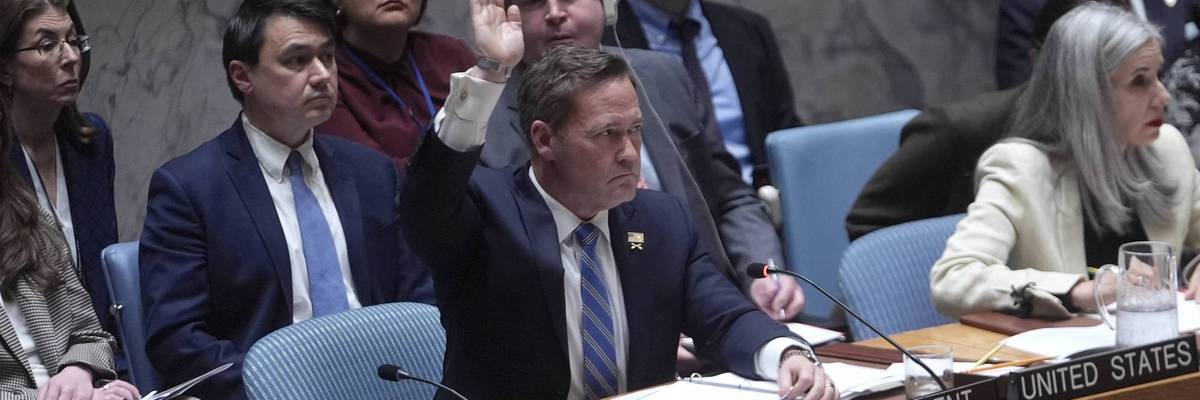
Mike Waltz, US ambassador to the United Nations, raises his hand during a UN Security Council meeting in New York on March 11, 2026.
With No Mention of US-Israeli Aggression, UN Security Council Condemns Iranian Retaliation
"The very purpose of this biased and politically motivated text, which was pushed by the Israeli regime and the United States, is clear: to reverse the roles of victim and aggressor," said Iran's ambassador to the UN.
The United Nations Security Council on Wednesday adopted a resolution condemning Iran's retaliatory attacks on Gulf nations without denouncing—or even mentioning—the illegal US and Israeli bombing campaign that started the war, which has hurled the region into conflict and destabilized the global economy.
The resolution, sponsored by council member and US ally Bahrain, "condemns in the strongest terms the egregious attacks by the Islamic Republic of Iran against the territories of Bahrain, Kuwait, Oman, Qatar, Saudi Arabia, the United Arab Emirates, and Jordan," nations that host US military bases. The text calls Iranian strikes "a breach of international law and a serious threat to international peace and security," but contains no mention of the US or Israel, nations that have been accused of grave war crimes.
The council adopted Bahrain's measure by a vote of 13-0, with two abstentions—China and Russia. Both nations have veto power but declined to use it. Neither Iran nor Israel is currently a member of the Security Council.
The UN body also voted on a competing resolution, sponsored by Russia, that would have implored "all parties"—without naming any of them—to stop their military operations and avoid escalating the conflict. The resolution did not receive the nine votes necessary for adoption, with the US and Latvia voting against it and Bahrain, Colombia, the Democratic Republic of the Congo, Denmark, France, Greece, Liberia, Panama, and the United Kingdom abstaining.
Amir Saeid Iravani, Iran's ambassador to the UN, said the body's adoption of Bahrain's resolution marks "a serious setback to the council’s credibility and leaves a lasting stain on its record."
"Today’s action represents a blatant misuse of the Security Council’s mandate in pursuit of the political agendas of certain members," said Iravani. "The very state responsible for this brutal war of aggression against my country—the regime of the United States—sits on the other side of this chamber as president of the council, abusing its position while obstructing every effort to bring an end to this barbaric war against the Iranian people and preventing the Council from fulfilling its Charter-based responsibilities."
"This resolution is a manifest injustice against my country, the main victim of a clear act of aggression. It distorts the realities on the ground and deliberately ignores the root causes of the current crisis," he continued. "The very purpose of this biased and politically motivated text, which was pushed by the Israeli regime and the United States, is clear: to reverse the roles of victim and aggressor. It rewards the regimes of the United States and Israel, which have violated the UN Charter and committed acts of aggression. In doing so, it establishes impunity and sends a wrong message to the international community—emboldening the aggressors to commit further crimes."
"The UN and International Criminal Court were created for moments like this, when the most powerful decide the rules do not apply to them."
Ahead of the vote on Bahrain's resolution, which accuses Iran of "deliberate targeting of civilians and civilian objects," Iravani said US-Israeli bombing has killed more than 1,300 civilians in Iran and destroyed nearly 10,000 civilian structures across the country, including around 8,000 homes and dozens of schools and healthcare facilities.
Earlier on Wednesday, the New York Times reported that the Pentagon has reached the preliminary conclusion that US forces were responsible for the February 28 bombing of an Iranian elementary school, an attack that killed around 175 people—mostly young children.
DAWN, a nonprofit that supports human rights and democracy in the Middle East, said Wednesday that "mounting evidence" shows US and Israeli forces "have committed multiple war crimes" in Iran and Lebanon—which is facing a rapidly worsening humanitarian disaster due to Israeli attacks.
"In mere days, US and Israel forces have launched a war of choice, killed hundreds of civilians, displaced hundreds of thousands, bombed scores of schools, health facilities, and fuel depots, and dropped white phosphorus on civilian communities," Omar Shakir, DAWN's executive director, said in a statement. "The international community's failure to act when the most fundamental norms of international law are being challenged risks plunging the world further into a lawless era in which civilians across the globe are at risk."
"The UN and International Criminal Court were created for moments like this, when the most powerful decide the rules do not apply to them," said Shakir. "Governments unwilling to invoke international law when their allies commit crimes have no credibility when they invoke it against rivals."
We are at a crossroads
This country and this world are at a monumental crossroads. In a few short weeks, US voters will have an opportunity to beat back the forces of fascism and confront the billionaires who are rigging the economy, our media system, and our democracy, making it increasingly impossible for ordinary people to get by. We’re not just talking about the election. We’re talking about what must be done once these fascist elements are vanquished from power. We need a bolder set of solutions than what either major party has so far been willing to offer and a working-class movement ready to fight like hell for it. Trump didn't emerge from nowhere. The conditions that fueled MAGA authoritarianism were created by decades of radical neoliberal economic policies and a corrupt political system dominated by corporate interests. They slashed taxes on the super-rich, promising that the benefits would trickle down. They said giveaways to the corporate titans would make life more affordable for the rest of us. It was all bullshit. And when a bitter, betrayed populace searches for someone to blame, right-wing demagogues have little trouble finding scapegoats. People know when they're being lied to, but you won't hear any of this from the corporate media. Only independent journalism—powered and funded by people who believe in building a better world—can deliver truly trustworthy daily news. Our Fall Campaign is underway, and we need your help. To power our newsroom through the rest of the year, we need to raise $125,000 by midnight on October 31. So if you share our vision, please contribute whatever you can to sustain our work. |
The United Nations Security Council on Wednesday adopted a resolution condemning Iran's retaliatory attacks on Gulf nations without denouncing—or even mentioning—the illegal US and Israeli bombing campaign that started the war, which has hurled the region into conflict and destabilized the global economy.
The resolution, sponsored by council member and US ally Bahrain, "condemns in the strongest terms the egregious attacks by the Islamic Republic of Iran against the territories of Bahrain, Kuwait, Oman, Qatar, Saudi Arabia, the United Arab Emirates, and Jordan," nations that host US military bases. The text calls Iranian strikes "a breach of international law and a serious threat to international peace and security," but contains no mention of the US or Israel, nations that have been accused of grave war crimes.
The council adopted Bahrain's measure by a vote of 13-0, with two abstentions—China and Russia. Both nations have veto power but declined to use it. Neither Iran nor Israel is currently a member of the Security Council.
The UN body also voted on a competing resolution, sponsored by Russia, that would have implored "all parties"—without naming any of them—to stop their military operations and avoid escalating the conflict. The resolution did not receive the nine votes necessary for adoption, with the US and Latvia voting against it and Bahrain, Colombia, the Democratic Republic of the Congo, Denmark, France, Greece, Liberia, Panama, and the United Kingdom abstaining.
Amir Saeid Iravani, Iran's ambassador to the UN, said the body's adoption of Bahrain's resolution marks "a serious setback to the council’s credibility and leaves a lasting stain on its record."
"Today’s action represents a blatant misuse of the Security Council’s mandate in pursuit of the political agendas of certain members," said Iravani. "The very state responsible for this brutal war of aggression against my country—the regime of the United States—sits on the other side of this chamber as president of the council, abusing its position while obstructing every effort to bring an end to this barbaric war against the Iranian people and preventing the Council from fulfilling its Charter-based responsibilities."
"This resolution is a manifest injustice against my country, the main victim of a clear act of aggression. It distorts the realities on the ground and deliberately ignores the root causes of the current crisis," he continued. "The very purpose of this biased and politically motivated text, which was pushed by the Israeli regime and the United States, is clear: to reverse the roles of victim and aggressor. It rewards the regimes of the United States and Israel, which have violated the UN Charter and committed acts of aggression. In doing so, it establishes impunity and sends a wrong message to the international community—emboldening the aggressors to commit further crimes."
"The UN and International Criminal Court were created for moments like this, when the most powerful decide the rules do not apply to them."
Ahead of the vote on Bahrain's resolution, which accuses Iran of "deliberate targeting of civilians and civilian objects," Iravani said US-Israeli bombing has killed more than 1,300 civilians in Iran and destroyed nearly 10,000 civilian structures across the country, including around 8,000 homes and dozens of schools and healthcare facilities.
Earlier on Wednesday, the New York Times reported that the Pentagon has reached the preliminary conclusion that US forces were responsible for the February 28 bombing of an Iranian elementary school, an attack that killed around 175 people—mostly young children.
DAWN, a nonprofit that supports human rights and democracy in the Middle East, said Wednesday that "mounting evidence" shows US and Israeli forces "have committed multiple war crimes" in Iran and Lebanon—which is facing a rapidly worsening humanitarian disaster due to Israeli attacks.
"In mere days, US and Israel forces have launched a war of choice, killed hundreds of civilians, displaced hundreds of thousands, bombed scores of schools, health facilities, and fuel depots, and dropped white phosphorus on civilian communities," Omar Shakir, DAWN's executive director, said in a statement. "The international community's failure to act when the most fundamental norms of international law are being challenged risks plunging the world further into a lawless era in which civilians across the globe are at risk."
"The UN and International Criminal Court were created for moments like this, when the most powerful decide the rules do not apply to them," said Shakir. "Governments unwilling to invoke international law when their allies commit crimes have no credibility when they invoke it against rivals."
The United Nations Security Council on Wednesday adopted a resolution condemning Iran's retaliatory attacks on Gulf nations without denouncing—or even mentioning—the illegal US and Israeli bombing campaign that started the war, which has hurled the region into conflict and destabilized the global economy.
The resolution, sponsored by council member and US ally Bahrain, "condemns in the strongest terms the egregious attacks by the Islamic Republic of Iran against the territories of Bahrain, Kuwait, Oman, Qatar, Saudi Arabia, the United Arab Emirates, and Jordan," nations that host US military bases. The text calls Iranian strikes "a breach of international law and a serious threat to international peace and security," but contains no mention of the US or Israel, nations that have been accused of grave war crimes.
The council adopted Bahrain's measure by a vote of 13-0, with two abstentions—China and Russia. Both nations have veto power but declined to use it. Neither Iran nor Israel is currently a member of the Security Council.
The UN body also voted on a competing resolution, sponsored by Russia, that would have implored "all parties"—without naming any of them—to stop their military operations and avoid escalating the conflict. The resolution did not receive the nine votes necessary for adoption, with the US and Latvia voting against it and Bahrain, Colombia, the Democratic Republic of the Congo, Denmark, France, Greece, Liberia, Panama, and the United Kingdom abstaining.
Amir Saeid Iravani, Iran's ambassador to the UN, said the body's adoption of Bahrain's resolution marks "a serious setback to the council’s credibility and leaves a lasting stain on its record."
"Today’s action represents a blatant misuse of the Security Council’s mandate in pursuit of the political agendas of certain members," said Iravani. "The very state responsible for this brutal war of aggression against my country—the regime of the United States—sits on the other side of this chamber as president of the council, abusing its position while obstructing every effort to bring an end to this barbaric war against the Iranian people and preventing the Council from fulfilling its Charter-based responsibilities."
"This resolution is a manifest injustice against my country, the main victim of a clear act of aggression. It distorts the realities on the ground and deliberately ignores the root causes of the current crisis," he continued. "The very purpose of this biased and politically motivated text, which was pushed by the Israeli regime and the United States, is clear: to reverse the roles of victim and aggressor. It rewards the regimes of the United States and Israel, which have violated the UN Charter and committed acts of aggression. In doing so, it establishes impunity and sends a wrong message to the international community—emboldening the aggressors to commit further crimes."
"The UN and International Criminal Court were created for moments like this, when the most powerful decide the rules do not apply to them."
Ahead of the vote on Bahrain's resolution, which accuses Iran of "deliberate targeting of civilians and civilian objects," Iravani said US-Israeli bombing has killed more than 1,300 civilians in Iran and destroyed nearly 10,000 civilian structures across the country, including around 8,000 homes and dozens of schools and healthcare facilities.
Earlier on Wednesday, the New York Times reported that the Pentagon has reached the preliminary conclusion that US forces were responsible for the February 28 bombing of an Iranian elementary school, an attack that killed around 175 people—mostly young children.
DAWN, a nonprofit that supports human rights and democracy in the Middle East, said Wednesday that "mounting evidence" shows US and Israeli forces "have committed multiple war crimes" in Iran and Lebanon—which is facing a rapidly worsening humanitarian disaster due to Israeli attacks.
"In mere days, US and Israel forces have launched a war of choice, killed hundreds of civilians, displaced hundreds of thousands, bombed scores of schools, health facilities, and fuel depots, and dropped white phosphorus on civilian communities," Omar Shakir, DAWN's executive director, said in a statement. "The international community's failure to act when the most fundamental norms of international law are being challenged risks plunging the world further into a lawless era in which civilians across the globe are at risk."
"The UN and International Criminal Court were created for moments like this, when the most powerful decide the rules do not apply to them," said Shakir. "Governments unwilling to invoke international law when their allies commit crimes have no credibility when they invoke it against rivals."