SUBSCRIBE TO OUR FREE NEWSLETTER
Daily news & progressive opinion—funded by the people, not the corporations—delivered straight to your inbox.
5
#000000
#FFFFFF
To donate by check, phone, or other method, see our More Ways to Give page.
Daily news & progressive opinion—funded by the people, not the corporations—delivered straight to your inbox.
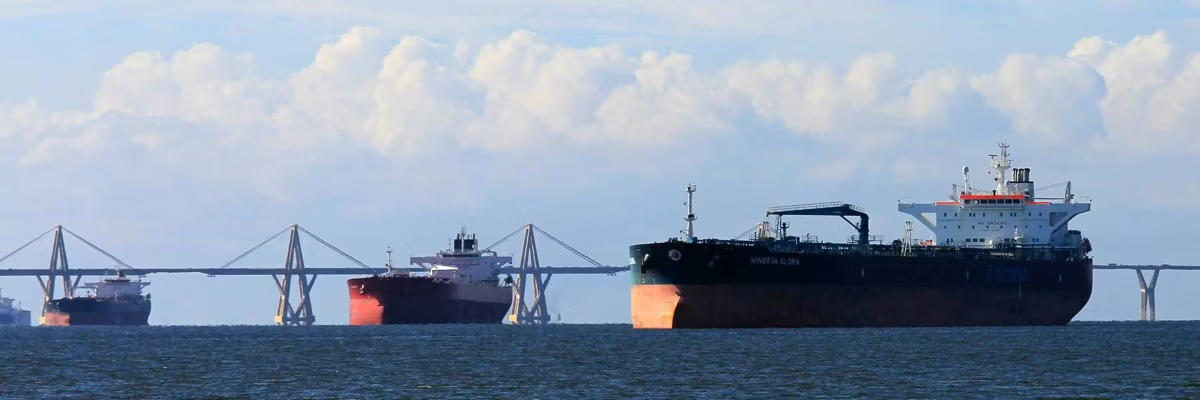
Oil tankers are seen anchored in Lake Maracaibo, Venezuela on December 4, 2025.
"Economic strangulation is warfare and civilians always pay the price," lamented CodePink.
President Donald Trump has ordered US military forces to further escalate their aggression against Venezuela by enforcing a "quarantine" on the South American nation's oil—by far its main export—in what one peace group called an attempted act of "economic strangulation."
"While military options still exist, the focus is to first use economic pressure by enforcing sanctions to reach the outcome the White House is looking [for]," a US official, who spoke on condition of anonymity, told Reuters.
The move follows the deployment of an armada of US warships and thousands of troops to the region, threats to invade Venezuela, oil tanker seizures off the Venezuelan coast, Trump's authorization of covert CIA action against the socialist government of Venezuelan President Nicolás Maduro, and airstrikes against boats allegedly running drugs in the Caribbean Sea and Pacific Ocean that have killed more than 100 people in what critics say are murders and likely war crimes.
This, atop existing economic sanctions that experts say have killed tens of thousands of Venezuelans since they were first imposed during the first Trump administration in 2017.
"The efforts so far have put tremendous pressure on Maduro, and the belief is that by late January, Venezuela will be facing an economic calamity unless it agrees to make significant concessions to the US," the official told Reuters.
The official's use of the word "quarantine" evoked the 1962 Cuban Missile Crisis, an existential standoff that occurred after the John F. Kennedy administration imposed a naval blockade around Cuba to prevent Soviet nuclear missiles from being deployed on the island, even as the US was surrounding the Soviet Union with nuclear weapons.
"This is an illegal blockade," the women-led peace group CodePink said in response to the Reuters report. "Calling it a 'quarantine' doesn’t change the reality. The US regime is using hunger as a weapon of war to force regime change in Venezuela. Economic strangulation is warfare and civilians always pay the price. The US is a regime of terror."
Critics have also compared Trump's aggression to the George W. Bush administration's buildup to the invasion and occupation of Iraq, initially referred to as Operation Iraqi Liberation (OIL). But unlike Bush, Trump—who derided Bush for not seizing Iraq's petroleum resources as spoils of war—has openly acknowledged his desire to take Venezuela's oil.
"Maybe we will sell it, maybe we will keep it,” he Trump said on Monday. “Maybe we’ll use it in the strategic reserves. We’re keeping the ships also.”
On Wednesday, a panel of United Nations experts said that the US blockade and boat strikes constitute "illegal armed aggression" against Venezuela.
Multiple efforts by US lawmakers—mostly Democrats, but also a handful of anti-war Republicans—to pass a war powers resolution blocking the Trump administration from bombing boats or attacking Venezuela have failed.
The blockade and vessel seizures have paralyzed Venezuela's oil exports. Ports are clogged with full tankers whose operators are fearful of entering international waters. Venezuela-bound tankers have also turned back for fear of seizure. Although Venezuelan military vessels are accompanying tankers, the escorts stop once the ships reach international waters.
According to the New York Times, Venezuela is considering putting armed troops aboard tankers bound for China, which, along with Russia, has pledged its support—but little more—for Caracas.
Dear Common Dreams reader, It’s been nearly 30 years since I co-founded Common Dreams with my late wife, Lina Newhouser. We had the radical notion that journalism should serve the public good, not corporate profits. It was clear to us from the outset what it would take to build such a project. No paid advertisements. No corporate sponsors. No millionaire publisher telling us what to think or do. Many people said we wouldn't last a year, but we proved those doubters wrong. Together with a tremendous team of journalists and dedicated staff, we built an independent media outlet free from the constraints of profits and corporate control. Our mission has always been simple: To inform. To inspire. To ignite change for the common good. Building Common Dreams was not easy. Our survival was never guaranteed. When you take on the most powerful forces—Wall Street greed, fossil fuel industry destruction, Big Tech lobbyists, and uber-rich oligarchs who have spent billions upon billions rigging the economy and democracy in their favor—the only bulwark you have is supporters who believe in your work. But here’s the urgent message from me today. It's never been this bad out there. And it's never been this hard to keep us going. At the very moment Common Dreams is most needed, the threats we face are intensifying. We need your support now more than ever. We don't accept corporate advertising and never will. We don't have a paywall because we don't think people should be blocked from critical news based on their ability to pay. Everything we do is funded by the donations of readers like you. When everyone does the little they can afford, we are strong. But if that support retreats or dries up, so do we. Will you donate now to make sure Common Dreams not only survives but thrives? —Craig Brown, Co-founder |
President Donald Trump has ordered US military forces to further escalate their aggression against Venezuela by enforcing a "quarantine" on the South American nation's oil—by far its main export—in what one peace group called an attempted act of "economic strangulation."
"While military options still exist, the focus is to first use economic pressure by enforcing sanctions to reach the outcome the White House is looking [for]," a US official, who spoke on condition of anonymity, told Reuters.
The move follows the deployment of an armada of US warships and thousands of troops to the region, threats to invade Venezuela, oil tanker seizures off the Venezuelan coast, Trump's authorization of covert CIA action against the socialist government of Venezuelan President Nicolás Maduro, and airstrikes against boats allegedly running drugs in the Caribbean Sea and Pacific Ocean that have killed more than 100 people in what critics say are murders and likely war crimes.
This, atop existing economic sanctions that experts say have killed tens of thousands of Venezuelans since they were first imposed during the first Trump administration in 2017.
"The efforts so far have put tremendous pressure on Maduro, and the belief is that by late January, Venezuela will be facing an economic calamity unless it agrees to make significant concessions to the US," the official told Reuters.
The official's use of the word "quarantine" evoked the 1962 Cuban Missile Crisis, an existential standoff that occurred after the John F. Kennedy administration imposed a naval blockade around Cuba to prevent Soviet nuclear missiles from being deployed on the island, even as the US was surrounding the Soviet Union with nuclear weapons.
"This is an illegal blockade," the women-led peace group CodePink said in response to the Reuters report. "Calling it a 'quarantine' doesn’t change the reality. The US regime is using hunger as a weapon of war to force regime change in Venezuela. Economic strangulation is warfare and civilians always pay the price. The US is a regime of terror."
Critics have also compared Trump's aggression to the George W. Bush administration's buildup to the invasion and occupation of Iraq, initially referred to as Operation Iraqi Liberation (OIL). But unlike Bush, Trump—who derided Bush for not seizing Iraq's petroleum resources as spoils of war—has openly acknowledged his desire to take Venezuela's oil.
"Maybe we will sell it, maybe we will keep it,” he Trump said on Monday. “Maybe we’ll use it in the strategic reserves. We’re keeping the ships also.”
On Wednesday, a panel of United Nations experts said that the US blockade and boat strikes constitute "illegal armed aggression" against Venezuela.
Multiple efforts by US lawmakers—mostly Democrats, but also a handful of anti-war Republicans—to pass a war powers resolution blocking the Trump administration from bombing boats or attacking Venezuela have failed.
The blockade and vessel seizures have paralyzed Venezuela's oil exports. Ports are clogged with full tankers whose operators are fearful of entering international waters. Venezuela-bound tankers have also turned back for fear of seizure. Although Venezuelan military vessels are accompanying tankers, the escorts stop once the ships reach international waters.
According to the New York Times, Venezuela is considering putting armed troops aboard tankers bound for China, which, along with Russia, has pledged its support—but little more—for Caracas.
President Donald Trump has ordered US military forces to further escalate their aggression against Venezuela by enforcing a "quarantine" on the South American nation's oil—by far its main export—in what one peace group called an attempted act of "economic strangulation."
"While military options still exist, the focus is to first use economic pressure by enforcing sanctions to reach the outcome the White House is looking [for]," a US official, who spoke on condition of anonymity, told Reuters.
The move follows the deployment of an armada of US warships and thousands of troops to the region, threats to invade Venezuela, oil tanker seizures off the Venezuelan coast, Trump's authorization of covert CIA action against the socialist government of Venezuelan President Nicolás Maduro, and airstrikes against boats allegedly running drugs in the Caribbean Sea and Pacific Ocean that have killed more than 100 people in what critics say are murders and likely war crimes.
This, atop existing economic sanctions that experts say have killed tens of thousands of Venezuelans since they were first imposed during the first Trump administration in 2017.
"The efforts so far have put tremendous pressure on Maduro, and the belief is that by late January, Venezuela will be facing an economic calamity unless it agrees to make significant concessions to the US," the official told Reuters.
The official's use of the word "quarantine" evoked the 1962 Cuban Missile Crisis, an existential standoff that occurred after the John F. Kennedy administration imposed a naval blockade around Cuba to prevent Soviet nuclear missiles from being deployed on the island, even as the US was surrounding the Soviet Union with nuclear weapons.
"This is an illegal blockade," the women-led peace group CodePink said in response to the Reuters report. "Calling it a 'quarantine' doesn’t change the reality. The US regime is using hunger as a weapon of war to force regime change in Venezuela. Economic strangulation is warfare and civilians always pay the price. The US is a regime of terror."
Critics have also compared Trump's aggression to the George W. Bush administration's buildup to the invasion and occupation of Iraq, initially referred to as Operation Iraqi Liberation (OIL). But unlike Bush, Trump—who derided Bush for not seizing Iraq's petroleum resources as spoils of war—has openly acknowledged his desire to take Venezuela's oil.
"Maybe we will sell it, maybe we will keep it,” he Trump said on Monday. “Maybe we’ll use it in the strategic reserves. We’re keeping the ships also.”
On Wednesday, a panel of United Nations experts said that the US blockade and boat strikes constitute "illegal armed aggression" against Venezuela.
Multiple efforts by US lawmakers—mostly Democrats, but also a handful of anti-war Republicans—to pass a war powers resolution blocking the Trump administration from bombing boats or attacking Venezuela have failed.
The blockade and vessel seizures have paralyzed Venezuela's oil exports. Ports are clogged with full tankers whose operators are fearful of entering international waters. Venezuela-bound tankers have also turned back for fear of seizure. Although Venezuelan military vessels are accompanying tankers, the escorts stop once the ships reach international waters.
According to the New York Times, Venezuela is considering putting armed troops aboard tankers bound for China, which, along with Russia, has pledged its support—but little more—for Caracas.