SUBSCRIBE TO OUR FREE NEWSLETTER
Daily news & progressive opinion—funded by the people, not the corporations—delivered straight to your inbox.
5
#000000
#FFFFFF
To donate by check, phone, or other method, see our More Ways to Give page.
Daily news & progressive opinion—funded by the people, not the corporations—delivered straight to your inbox.
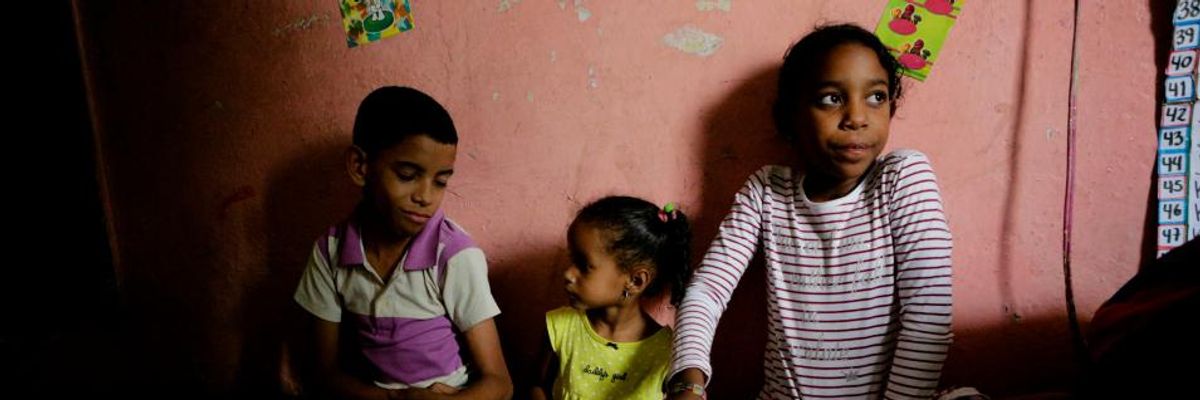
Children of Barrio Union Sector Las Casitas eat soup prepared and donated by Alto Restaurant in the house of a neighbor on April 12, 2019 in Caracas, Venezuela. (Photo: Eva Marie Uzcategui/Getty Images)
Two American economists warn that U.S. sanctions targeting Venezuela "are a death sentence for tens of thousands of people" and that the nation's humanitarian crisis will worsen as long as the sanctions continue.
Since August of 2017, President Donald Trump has imposed sanctions that "have inflicted, and increasingly inflict, very serious harm to human life and health, including an estimated more than 40,000 deaths from 2017-2018," write Mark Weisbrot and Jeffrey Sachs.
Their paper--entitled Economic Sanctions as Collective Punishment: The Case of Venezuela (pdf)--was published Thursday by the Center for Economic and Policy Research (CEPR), and comes as Trump continues to back opposition leader Juan Guaido's effort to oust Venezuelan President Nicolas Maduro.
The broad sanctions Trump imposed in 2017 fueled a sharp decline in oil production that impeded the Maduro government's ability to "import medicine, food, medical equipment, spare parts and equipment needed for electricity generation, water systems, or transportation," and the U.S. president has ramped up economic pressure since offering his support to Guaido earlier this year.
In late January, as Common Dreams reported, the Trump administration announced sanctions against Petroleos de Venezuela, S.A. (PdVSA), the state-run oil company that serves as "a primary source of income and foreign currency for the country." Earlier this month, U.S. Vice President Mike Pence unveiled more sanctions targeting the Maduro government as well as companies that transport Venezuelan oil to Cuba.
Overall, Trump's sanctions have "exacerbated Venezuela's economic crisis and made it nearly impossible to stabilize the economy, contributing further to excess deaths," write Weisbrot and Sachs. "All of these impacts disproportionately harmed the poorest and most vulnerable Venezuelans."
"These sanctions would fit the definition of collective punishment of the civilian population as described in both the Geneva and Hague international conventions, to which the U.S. is a signatory," the economists say. "They are also illegal under international law and treaties which the U.S. has signed, and would appear to violate U.S. law as well."
"The sanctions are depriving Venezuelans of lifesaving medicines, medical equipment, food, and other essential imports... Congress should move to stop it."
--Mark Weisbrot, American economist
Given the toll Trump's economic policies are taking on Venezuela's civilian population, Weisbrot, in a statement Thursday, called on federal lawmakers to take action.
"The sanctions are depriving Venezuelans of lifesaving medicines, medical equipment, food, and other essential imports," he said. "This is illegal under U.S. and international law, and treaties that the U.S. has signed. Congress should move to stop it."
As Sachs put it, "Venezuela's economic crisis is routinely blamed all on Venezuela... But it is much more than that."
"American sanctions are deliberately aiming to wreck Venezuela's economy and thereby lead to regime change," he said. "It's a fruitless, heartless, illegal, and failed policy, causing grave harm to the Venezuelan people."
Dear Common Dreams reader, It’s been nearly 30 years since I co-founded Common Dreams with my late wife, Lina Newhouser. We had the radical notion that journalism should serve the public good, not corporate profits. It was clear to us from the outset what it would take to build such a project. No paid advertisements. No corporate sponsors. No millionaire publisher telling us what to think or do. Many people said we wouldn't last a year, but we proved those doubters wrong. Together with a tremendous team of journalists and dedicated staff, we built an independent media outlet free from the constraints of profits and corporate control. Our mission has always been simple: To inform. To inspire. To ignite change for the common good. Building Common Dreams was not easy. Our survival was never guaranteed. When you take on the most powerful forces—Wall Street greed, fossil fuel industry destruction, Big Tech lobbyists, and uber-rich oligarchs who have spent billions upon billions rigging the economy and democracy in their favor—the only bulwark you have is supporters who believe in your work. But here’s the urgent message from me today. It's never been this bad out there. And it's never been this hard to keep us going. At the very moment Common Dreams is most needed, the threats we face are intensifying. We need your support now more than ever. We don't accept corporate advertising and never will. We don't have a paywall because we don't think people should be blocked from critical news based on their ability to pay. Everything we do is funded by the donations of readers like you. When everyone does the little they can afford, we are strong. But if that support retreats or dries up, so do we. Will you donate now to make sure Common Dreams not only survives but thrives? —Craig Brown, Co-founder |
Two American economists warn that U.S. sanctions targeting Venezuela "are a death sentence for tens of thousands of people" and that the nation's humanitarian crisis will worsen as long as the sanctions continue.
Since August of 2017, President Donald Trump has imposed sanctions that "have inflicted, and increasingly inflict, very serious harm to human life and health, including an estimated more than 40,000 deaths from 2017-2018," write Mark Weisbrot and Jeffrey Sachs.
Their paper--entitled Economic Sanctions as Collective Punishment: The Case of Venezuela (pdf)--was published Thursday by the Center for Economic and Policy Research (CEPR), and comes as Trump continues to back opposition leader Juan Guaido's effort to oust Venezuelan President Nicolas Maduro.
The broad sanctions Trump imposed in 2017 fueled a sharp decline in oil production that impeded the Maduro government's ability to "import medicine, food, medical equipment, spare parts and equipment needed for electricity generation, water systems, or transportation," and the U.S. president has ramped up economic pressure since offering his support to Guaido earlier this year.
In late January, as Common Dreams reported, the Trump administration announced sanctions against Petroleos de Venezuela, S.A. (PdVSA), the state-run oil company that serves as "a primary source of income and foreign currency for the country." Earlier this month, U.S. Vice President Mike Pence unveiled more sanctions targeting the Maduro government as well as companies that transport Venezuelan oil to Cuba.
Overall, Trump's sanctions have "exacerbated Venezuela's economic crisis and made it nearly impossible to stabilize the economy, contributing further to excess deaths," write Weisbrot and Sachs. "All of these impacts disproportionately harmed the poorest and most vulnerable Venezuelans."
"These sanctions would fit the definition of collective punishment of the civilian population as described in both the Geneva and Hague international conventions, to which the U.S. is a signatory," the economists say. "They are also illegal under international law and treaties which the U.S. has signed, and would appear to violate U.S. law as well."
"The sanctions are depriving Venezuelans of lifesaving medicines, medical equipment, food, and other essential imports... Congress should move to stop it."
--Mark Weisbrot, American economist
Given the toll Trump's economic policies are taking on Venezuela's civilian population, Weisbrot, in a statement Thursday, called on federal lawmakers to take action.
"The sanctions are depriving Venezuelans of lifesaving medicines, medical equipment, food, and other essential imports," he said. "This is illegal under U.S. and international law, and treaties that the U.S. has signed. Congress should move to stop it."
As Sachs put it, "Venezuela's economic crisis is routinely blamed all on Venezuela... But it is much more than that."
"American sanctions are deliberately aiming to wreck Venezuela's economy and thereby lead to regime change," he said. "It's a fruitless, heartless, illegal, and failed policy, causing grave harm to the Venezuelan people."
Two American economists warn that U.S. sanctions targeting Venezuela "are a death sentence for tens of thousands of people" and that the nation's humanitarian crisis will worsen as long as the sanctions continue.
Since August of 2017, President Donald Trump has imposed sanctions that "have inflicted, and increasingly inflict, very serious harm to human life and health, including an estimated more than 40,000 deaths from 2017-2018," write Mark Weisbrot and Jeffrey Sachs.
Their paper--entitled Economic Sanctions as Collective Punishment: The Case of Venezuela (pdf)--was published Thursday by the Center for Economic and Policy Research (CEPR), and comes as Trump continues to back opposition leader Juan Guaido's effort to oust Venezuelan President Nicolas Maduro.
The broad sanctions Trump imposed in 2017 fueled a sharp decline in oil production that impeded the Maduro government's ability to "import medicine, food, medical equipment, spare parts and equipment needed for electricity generation, water systems, or transportation," and the U.S. president has ramped up economic pressure since offering his support to Guaido earlier this year.
In late January, as Common Dreams reported, the Trump administration announced sanctions against Petroleos de Venezuela, S.A. (PdVSA), the state-run oil company that serves as "a primary source of income and foreign currency for the country." Earlier this month, U.S. Vice President Mike Pence unveiled more sanctions targeting the Maduro government as well as companies that transport Venezuelan oil to Cuba.
Overall, Trump's sanctions have "exacerbated Venezuela's economic crisis and made it nearly impossible to stabilize the economy, contributing further to excess deaths," write Weisbrot and Sachs. "All of these impacts disproportionately harmed the poorest and most vulnerable Venezuelans."
"These sanctions would fit the definition of collective punishment of the civilian population as described in both the Geneva and Hague international conventions, to which the U.S. is a signatory," the economists say. "They are also illegal under international law and treaties which the U.S. has signed, and would appear to violate U.S. law as well."
"The sanctions are depriving Venezuelans of lifesaving medicines, medical equipment, food, and other essential imports... Congress should move to stop it."
--Mark Weisbrot, American economist
Given the toll Trump's economic policies are taking on Venezuela's civilian population, Weisbrot, in a statement Thursday, called on federal lawmakers to take action.
"The sanctions are depriving Venezuelans of lifesaving medicines, medical equipment, food, and other essential imports," he said. "This is illegal under U.S. and international law, and treaties that the U.S. has signed. Congress should move to stop it."
As Sachs put it, "Venezuela's economic crisis is routinely blamed all on Venezuela... But it is much more than that."
"American sanctions are deliberately aiming to wreck Venezuela's economy and thereby lead to regime change," he said. "It's a fruitless, heartless, illegal, and failed policy, causing grave harm to the Venezuelan people."