5
#000000
#FFFFFF
To donate by check, phone, or other method, see our More Ways to Give page.
Daily news & progressive opinion—funded by the people, not the corporations—delivered straight to your inbox.
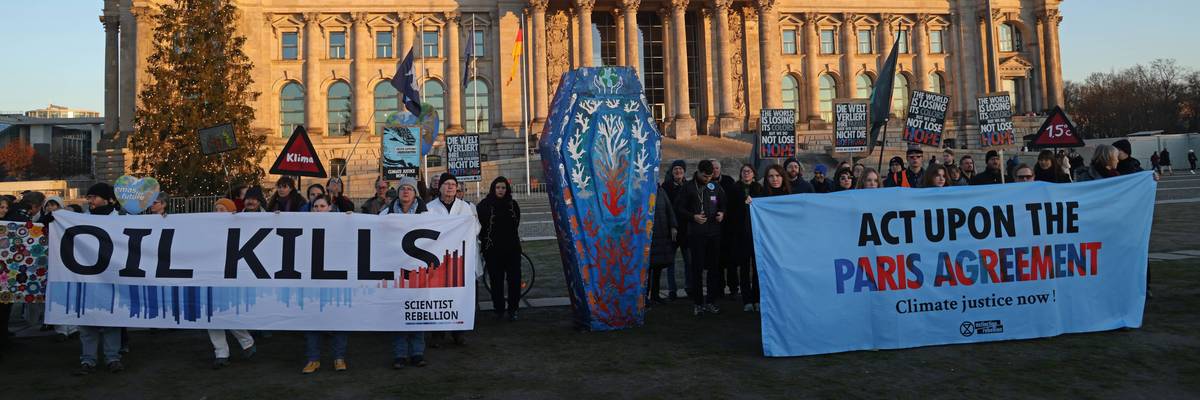
Activists stand with a coffin to symbolize the dying of coral reefs in Berlin, Germany on December 12, 2025, a decade after the signing of the Paris Agreement.
"Trump is trying to drag the rest of the world backwards by launching conflicts for oil and bullying other countries into deepening their reliance on dirty, dangerous fossil fuels," warned one campaigner.
President Donald Trump faced a fresh flood of fury on Tuesday as he formally withdrew the United States from the Paris Agreement a second time, part of the broader anti-climate agenda he's pursued since returning to power.
The US initially completed the one-year withdrawal process in November 2020, as ballots from the general election were still being counted. After winning the race, former President Joe Biden swiftly rejoined the climate treaty, but Trump reclaimed the White House four years later—with help from Big Oil—and moved to abandon the pact again on his first day back in the Oval Office.
"Thanks to President Trump, the US has officially escaped from the Paris Climate Agreement, which undermined American values and priorities, wasted hard-earned taxpayer dollars, and stifled economic growth," a White House spokesperson, Taylor Rogers, said in a Tuesday statement celebrating the "America First victory."
Advocates for ambitious action on the fossil fuel-driven climate emergency struck a much different tone about the president exiting the 2015 deal, which aims to limit global temperature rise this century to 1.5ºC, relative to preindustrial levels. Oil Change International US campaign manager Allie Rosenbluth declared that "Trump's withdrawal from the Paris Agreement is a betrayal of the communities at risk from climate disaster, especially those on the frontlines of the crisis in the Global South."
"Trump is entrenching petro imperialism and enriching his fossil fuel CEO donors, at the cost of a livable planet," she said. "The US is the largest historic emitter and the current planet-wrecker-in chief, responsible for a greater increase in oil and gas extraction than any other country since the Paris Agreement. Now, Trump is pulling out of the agreement that commits it to help solve a crisis it largely created—deepening global risk of climate-fueled hurricanes, wildfires, droughts, and floods."
Rosenbluth argued that "under Trump, the US is becoming a pariah on the world stage and should be treated as such by the countries claiming to defend climate multilateralism and international cooperation. It is clinging to fossil fuel dependency as many other nations embrace the clean, affordable energy sources of the future. Trump is trying to drag the rest of the world backwards by launching conflicts for oil and bullying other countries into deepening their reliance on dirty, dangerous fossil fuels."
"Trump can withdraw the US from the Paris Agreement, but can't change that millions of people will fight for climate justice, including leaders from the Global South and US states and localities," she added. "While Trump turns the US into a rogue state, we must redouble global efforts to end the fossil era and fight for safety and dignity for all."
In an interview with the Guardian, Basav Sen, climate justice project director at the Institute for Policy Studies, suggested that US disengagement has already encouraged others to take action.
At the United Nations Climate Change Conference (COP30) in Brazil last November—which the Trump administration did not attend—Colombia, the Netherlands, and Pacific Island nations announced plans to host historic talks on phasing out fossil fuels. Sen said, "I have to believe that the reactionary position of the US acted as further impetus for those countries to step up."
Still, the Trump administration's position means "it will be that much harder for low-income countries, who are very dependent on fossil fuel production and exports, to be able to make their transitions with the US saying that we won't fund any of it," he said. Sen also stressed that "if the domestic market in the US continues to be dominated by fossil fuels through the fiat of an authoritarian government, that will continue to have an impact on the rest of the world."
In the lead-up to COP30, Amnesty International secretary general Agnès Callamard urged other governments "to resist aligning with the Trump administration's denial of the accelerating climate crisis and instead demonstrate true climate leadership."
On Tuesday, Marta Schaaf, Amnesty's program director for climate, economic and social justice, and corporate accountability, said that "the US withdrawal from the Paris Agreement sets a disturbing precedent that seeks to instigate a race to the bottom, and, along with its withdrawal from other major global climate pacts, aims to dismantle the global system of cooperation on climate action."
Despite "increasingly deadly and expensive" weather disasters, Trump has left not only the Paris Agreement but also dozens of other international treaties and organizations intended to coordinate on key issues, including human rights and the climate crisis.
"The US is one of several powerful anti-climate actors," Schaaf acknowledged, "but as an influential superpower, this decision, along with acts of coercion and bullying of other countries and powerful actors to double down on fossil fuels, causes particular harm and threatens to reverse more than a decade of global climate progress under the agreement."
"While the US may no longer be a party to the Paris Agreement, it still has legal obligations to protect humanity from the worsening impacts of climate change as confirmed by the International Court of Justice in its landmark 2025 advisory opinion," she emphasized. "US-based climate advocates and activists now find themselves on the frontlines of a fight with implications for current and future generations everywhere."
"Global solidarity and support to ensure accelerating momentum to address climate change has never been more urgent," Schaaf added. "Those who witness the harms caused by climate change and who can speak safely—must speak up. Other governments too must push back against all coercive efforts by the US. Ceding ground now risks losing it for years. Neither the planet nor the people living on the frontlines of proliferating unnatural disasters have that much time."
Dear Common Dreams reader, The U.S. is on a fast track to authoritarianism like nothing I've ever seen. Meanwhile, corporate news outlets are utterly capitulating to Trump, twisting their coverage to avoid drawing his ire while lining up to stuff cash in his pockets. That's why I believe that Common Dreams is doing the best and most consequential reporting that we've ever done. Our small but mighty team is a progressive reporting powerhouse, covering the news every day that the corporate media never will. Our mission has always been simple: To inform. To inspire. And to ignite change for the common good. Now here's the key piece that I want all our readers to understand: None of this would be possible without your financial support. That's not just some fundraising cliche. It's the absolute and literal truth. We don't accept corporate advertising and never will. We don't have a paywall because we don't think people should be blocked from critical news based on their ability to pay. Everything we do is funded by the donations of readers like you. Will you donate now to help power the nonprofit, independent reporting of Common Dreams? Thank you for being a vital member of our community. Together, we can keep independent journalism alive when it’s needed most. - Craig Brown, Co-founder |
President Donald Trump faced a fresh flood of fury on Tuesday as he formally withdrew the United States from the Paris Agreement a second time, part of the broader anti-climate agenda he's pursued since returning to power.
The US initially completed the one-year withdrawal process in November 2020, as ballots from the general election were still being counted. After winning the race, former President Joe Biden swiftly rejoined the climate treaty, but Trump reclaimed the White House four years later—with help from Big Oil—and moved to abandon the pact again on his first day back in the Oval Office.
"Thanks to President Trump, the US has officially escaped from the Paris Climate Agreement, which undermined American values and priorities, wasted hard-earned taxpayer dollars, and stifled economic growth," a White House spokesperson, Taylor Rogers, said in a Tuesday statement celebrating the "America First victory."
Advocates for ambitious action on the fossil fuel-driven climate emergency struck a much different tone about the president exiting the 2015 deal, which aims to limit global temperature rise this century to 1.5ºC, relative to preindustrial levels. Oil Change International US campaign manager Allie Rosenbluth declared that "Trump's withdrawal from the Paris Agreement is a betrayal of the communities at risk from climate disaster, especially those on the frontlines of the crisis in the Global South."
"Trump is entrenching petro imperialism and enriching his fossil fuel CEO donors, at the cost of a livable planet," she said. "The US is the largest historic emitter and the current planet-wrecker-in chief, responsible for a greater increase in oil and gas extraction than any other country since the Paris Agreement. Now, Trump is pulling out of the agreement that commits it to help solve a crisis it largely created—deepening global risk of climate-fueled hurricanes, wildfires, droughts, and floods."
Rosenbluth argued that "under Trump, the US is becoming a pariah on the world stage and should be treated as such by the countries claiming to defend climate multilateralism and international cooperation. It is clinging to fossil fuel dependency as many other nations embrace the clean, affordable energy sources of the future. Trump is trying to drag the rest of the world backwards by launching conflicts for oil and bullying other countries into deepening their reliance on dirty, dangerous fossil fuels."
"Trump can withdraw the US from the Paris Agreement, but can't change that millions of people will fight for climate justice, including leaders from the Global South and US states and localities," she added. "While Trump turns the US into a rogue state, we must redouble global efforts to end the fossil era and fight for safety and dignity for all."
In an interview with the Guardian, Basav Sen, climate justice project director at the Institute for Policy Studies, suggested that US disengagement has already encouraged others to take action.
At the United Nations Climate Change Conference (COP30) in Brazil last November—which the Trump administration did not attend—Colombia, the Netherlands, and Pacific Island nations announced plans to host historic talks on phasing out fossil fuels. Sen said, "I have to believe that the reactionary position of the US acted as further impetus for those countries to step up."
Still, the Trump administration's position means "it will be that much harder for low-income countries, who are very dependent on fossil fuel production and exports, to be able to make their transitions with the US saying that we won't fund any of it," he said. Sen also stressed that "if the domestic market in the US continues to be dominated by fossil fuels through the fiat of an authoritarian government, that will continue to have an impact on the rest of the world."
In the lead-up to COP30, Amnesty International secretary general Agnès Callamard urged other governments "to resist aligning with the Trump administration's denial of the accelerating climate crisis and instead demonstrate true climate leadership."
On Tuesday, Marta Schaaf, Amnesty's program director for climate, economic and social justice, and corporate accountability, said that "the US withdrawal from the Paris Agreement sets a disturbing precedent that seeks to instigate a race to the bottom, and, along with its withdrawal from other major global climate pacts, aims to dismantle the global system of cooperation on climate action."
Despite "increasingly deadly and expensive" weather disasters, Trump has left not only the Paris Agreement but also dozens of other international treaties and organizations intended to coordinate on key issues, including human rights and the climate crisis.
"The US is one of several powerful anti-climate actors," Schaaf acknowledged, "but as an influential superpower, this decision, along with acts of coercion and bullying of other countries and powerful actors to double down on fossil fuels, causes particular harm and threatens to reverse more than a decade of global climate progress under the agreement."
"While the US may no longer be a party to the Paris Agreement, it still has legal obligations to protect humanity from the worsening impacts of climate change as confirmed by the International Court of Justice in its landmark 2025 advisory opinion," she emphasized. "US-based climate advocates and activists now find themselves on the frontlines of a fight with implications for current and future generations everywhere."
"Global solidarity and support to ensure accelerating momentum to address climate change has never been more urgent," Schaaf added. "Those who witness the harms caused by climate change and who can speak safely—must speak up. Other governments too must push back against all coercive efforts by the US. Ceding ground now risks losing it for years. Neither the planet nor the people living on the frontlines of proliferating unnatural disasters have that much time."
President Donald Trump faced a fresh flood of fury on Tuesday as he formally withdrew the United States from the Paris Agreement a second time, part of the broader anti-climate agenda he's pursued since returning to power.
The US initially completed the one-year withdrawal process in November 2020, as ballots from the general election were still being counted. After winning the race, former President Joe Biden swiftly rejoined the climate treaty, but Trump reclaimed the White House four years later—with help from Big Oil—and moved to abandon the pact again on his first day back in the Oval Office.
"Thanks to President Trump, the US has officially escaped from the Paris Climate Agreement, which undermined American values and priorities, wasted hard-earned taxpayer dollars, and stifled economic growth," a White House spokesperson, Taylor Rogers, said in a Tuesday statement celebrating the "America First victory."
Advocates for ambitious action on the fossil fuel-driven climate emergency struck a much different tone about the president exiting the 2015 deal, which aims to limit global temperature rise this century to 1.5ºC, relative to preindustrial levels. Oil Change International US campaign manager Allie Rosenbluth declared that "Trump's withdrawal from the Paris Agreement is a betrayal of the communities at risk from climate disaster, especially those on the frontlines of the crisis in the Global South."
"Trump is entrenching petro imperialism and enriching his fossil fuel CEO donors, at the cost of a livable planet," she said. "The US is the largest historic emitter and the current planet-wrecker-in chief, responsible for a greater increase in oil and gas extraction than any other country since the Paris Agreement. Now, Trump is pulling out of the agreement that commits it to help solve a crisis it largely created—deepening global risk of climate-fueled hurricanes, wildfires, droughts, and floods."
Rosenbluth argued that "under Trump, the US is becoming a pariah on the world stage and should be treated as such by the countries claiming to defend climate multilateralism and international cooperation. It is clinging to fossil fuel dependency as many other nations embrace the clean, affordable energy sources of the future. Trump is trying to drag the rest of the world backwards by launching conflicts for oil and bullying other countries into deepening their reliance on dirty, dangerous fossil fuels."
"Trump can withdraw the US from the Paris Agreement, but can't change that millions of people will fight for climate justice, including leaders from the Global South and US states and localities," she added. "While Trump turns the US into a rogue state, we must redouble global efforts to end the fossil era and fight for safety and dignity for all."
In an interview with the Guardian, Basav Sen, climate justice project director at the Institute for Policy Studies, suggested that US disengagement has already encouraged others to take action.
At the United Nations Climate Change Conference (COP30) in Brazil last November—which the Trump administration did not attend—Colombia, the Netherlands, and Pacific Island nations announced plans to host historic talks on phasing out fossil fuels. Sen said, "I have to believe that the reactionary position of the US acted as further impetus for those countries to step up."
Still, the Trump administration's position means "it will be that much harder for low-income countries, who are very dependent on fossil fuel production and exports, to be able to make their transitions with the US saying that we won't fund any of it," he said. Sen also stressed that "if the domestic market in the US continues to be dominated by fossil fuels through the fiat of an authoritarian government, that will continue to have an impact on the rest of the world."
In the lead-up to COP30, Amnesty International secretary general Agnès Callamard urged other governments "to resist aligning with the Trump administration's denial of the accelerating climate crisis and instead demonstrate true climate leadership."
On Tuesday, Marta Schaaf, Amnesty's program director for climate, economic and social justice, and corporate accountability, said that "the US withdrawal from the Paris Agreement sets a disturbing precedent that seeks to instigate a race to the bottom, and, along with its withdrawal from other major global climate pacts, aims to dismantle the global system of cooperation on climate action."
Despite "increasingly deadly and expensive" weather disasters, Trump has left not only the Paris Agreement but also dozens of other international treaties and organizations intended to coordinate on key issues, including human rights and the climate crisis.
"The US is one of several powerful anti-climate actors," Schaaf acknowledged, "but as an influential superpower, this decision, along with acts of coercion and bullying of other countries and powerful actors to double down on fossil fuels, causes particular harm and threatens to reverse more than a decade of global climate progress under the agreement."
"While the US may no longer be a party to the Paris Agreement, it still has legal obligations to protect humanity from the worsening impacts of climate change as confirmed by the International Court of Justice in its landmark 2025 advisory opinion," she emphasized. "US-based climate advocates and activists now find themselves on the frontlines of a fight with implications for current and future generations everywhere."
"Global solidarity and support to ensure accelerating momentum to address climate change has never been more urgent," Schaaf added. "Those who witness the harms caused by climate change and who can speak safely—must speak up. Other governments too must push back against all coercive efforts by the US. Ceding ground now risks losing it for years. Neither the planet nor the people living on the frontlines of proliferating unnatural disasters have that much time."