SUBSCRIBE TO OUR FREE NEWSLETTER
Daily news & progressive opinion—funded by the people, not the corporations—delivered straight to your inbox.
5
#000000
#FFFFFF
To donate by check, phone, or other method, see our More Ways to Give page.
Daily news & progressive opinion—funded by the people, not the corporations—delivered straight to your inbox.
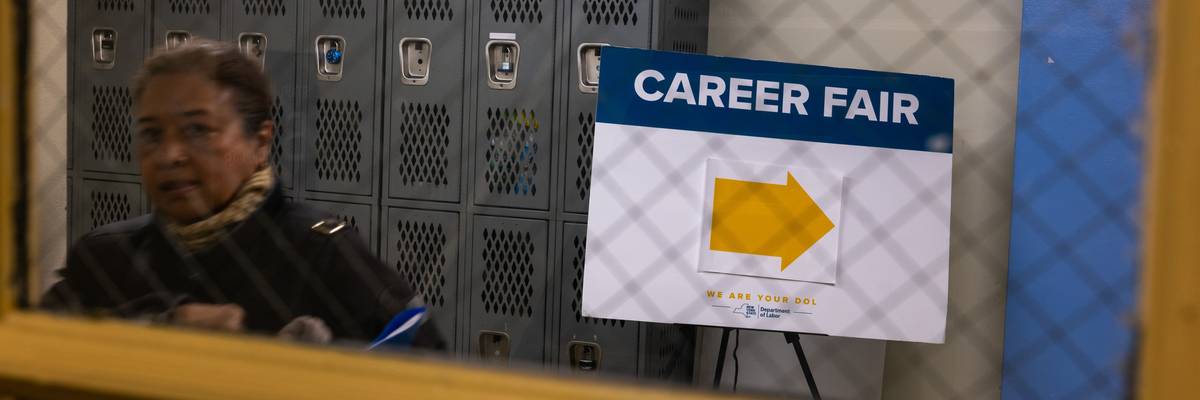
Job seekers attend a career fair in Harlem hosted by Assemblymember Jordan Wright on December 10, 2025, in New York City.
"Hiring was ice cold in February," said one economist.
New data from the US Bureau of Labor Statistics released on Tuesday continued to show weakness in the American jobs market.
The latest Job Openings and Labor Turnover Survey (JOLTS) shows that the number of new hires in February decreased to 4.8 million, which was roughly 400,000 fewer hires than were recorded in February 2025.
The report also shows that the US hiring rate in February fell to just 3.1%, which is the lowest rate since April 2020, when the economy was shut down due to the global Covid-19 pandemic.
The good news in the report is that the number of quits and layoffs remained relatively steady, meaning that people who already have jobs are retaining them at a healthy clip.
But Heather Long, chief economist at Navy Federal Credit Union, noted that these bad hiring numbers came before President Donald Trump launched an illegal war with Iran, which has since destabilized global energy markets and raised prices for oil, gasoline, and diesel fuel.
"This is a hiring recession," Long wrote in a social media post. "And Americans are feeling it. There were notable hiring pullbacks in February in hospitality and construction. Bottom line: The job market was already frozen before the war in Iran began. It's worrying that a 'no hire, no fire' situation could turn into a 'no hire, start to fire' job market quickly if there isn't a resolution soon."
Long's analysis was echoed by Laura Ullrich, director of economic research at hiring site Indeed, who wrote in a research note flagged by Axios that hiring in the US "was stuck in neutral going into this [Iran] conflict," and "getting it into gear just got harder" thanks to the war.
Guy Berger, director of economic research at the Burning Glass Institute, noted that hiring rates in the US hit 3.1% or lower the last two times the country was in a severe recession.
"3.1% is not only comparable to the Covid low point—it's also comparable to late 2009 and early 2010, when the unemployment rate was around 10%," Berger explained. "Hiring was ice cold in February."
Scott Lincicome, a senior fellow at the libertarian Cato Institute who has been a harsh critic of Trump's tariffs, found that the February JOLTS report wiped out an unexpected January increase in manufacturing job openings that the president's allies attributed to his trade policies.
"Alas, the perils of cherry-picking," Lincicome commented.
The new data on hiring in the US job market comes weeks after a BLS report estimated that the economy lost 92,000 jobs in February. On the whole, the American economy has posted a net loss of jobs since Trump announced his “liberation day” global tariffs in April 2025.
Dear Common Dreams reader, It’s been nearly 30 years since I co-founded Common Dreams with my late wife, Lina Newhouser. We had the radical notion that journalism should serve the public good, not corporate profits. It was clear to us from the outset what it would take to build such a project. No paid advertisements. No corporate sponsors. No millionaire publisher telling us what to think or do. Many people said we wouldn't last a year, but we proved those doubters wrong. Together with a tremendous team of journalists and dedicated staff, we built an independent media outlet free from the constraints of profits and corporate control. Our mission has always been simple: To inform. To inspire. To ignite change for the common good. Building Common Dreams was not easy. Our survival was never guaranteed. When you take on the most powerful forces—Wall Street greed, fossil fuel industry destruction, Big Tech lobbyists, and uber-rich oligarchs who have spent billions upon billions rigging the economy and democracy in their favor—the only bulwark you have is supporters who believe in your work. But here’s the urgent message from me today. It's never been this bad out there. And it's never been this hard to keep us going. At the very moment Common Dreams is most needed, the threats we face are intensifying. We need your support now more than ever. We don't accept corporate advertising and never will. We don't have a paywall because we don't think people should be blocked from critical news based on their ability to pay. Everything we do is funded by the donations of readers like you. When everyone does the little they can afford, we are strong. But if that support retreats or dries up, so do we. Will you donate now to make sure Common Dreams not only survives but thrives? —Craig Brown, Co-founder |
New data from the US Bureau of Labor Statistics released on Tuesday continued to show weakness in the American jobs market.
The latest Job Openings and Labor Turnover Survey (JOLTS) shows that the number of new hires in February decreased to 4.8 million, which was roughly 400,000 fewer hires than were recorded in February 2025.
The report also shows that the US hiring rate in February fell to just 3.1%, which is the lowest rate since April 2020, when the economy was shut down due to the global Covid-19 pandemic.
The good news in the report is that the number of quits and layoffs remained relatively steady, meaning that people who already have jobs are retaining them at a healthy clip.
But Heather Long, chief economist at Navy Federal Credit Union, noted that these bad hiring numbers came before President Donald Trump launched an illegal war with Iran, which has since destabilized global energy markets and raised prices for oil, gasoline, and diesel fuel.
"This is a hiring recession," Long wrote in a social media post. "And Americans are feeling it. There were notable hiring pullbacks in February in hospitality and construction. Bottom line: The job market was already frozen before the war in Iran began. It's worrying that a 'no hire, no fire' situation could turn into a 'no hire, start to fire' job market quickly if there isn't a resolution soon."
Long's analysis was echoed by Laura Ullrich, director of economic research at hiring site Indeed, who wrote in a research note flagged by Axios that hiring in the US "was stuck in neutral going into this [Iran] conflict," and "getting it into gear just got harder" thanks to the war.
Guy Berger, director of economic research at the Burning Glass Institute, noted that hiring rates in the US hit 3.1% or lower the last two times the country was in a severe recession.
"3.1% is not only comparable to the Covid low point—it's also comparable to late 2009 and early 2010, when the unemployment rate was around 10%," Berger explained. "Hiring was ice cold in February."
Scott Lincicome, a senior fellow at the libertarian Cato Institute who has been a harsh critic of Trump's tariffs, found that the February JOLTS report wiped out an unexpected January increase in manufacturing job openings that the president's allies attributed to his trade policies.
"Alas, the perils of cherry-picking," Lincicome commented.
The new data on hiring in the US job market comes weeks after a BLS report estimated that the economy lost 92,000 jobs in February. On the whole, the American economy has posted a net loss of jobs since Trump announced his “liberation day” global tariffs in April 2025.
New data from the US Bureau of Labor Statistics released on Tuesday continued to show weakness in the American jobs market.
The latest Job Openings and Labor Turnover Survey (JOLTS) shows that the number of new hires in February decreased to 4.8 million, which was roughly 400,000 fewer hires than were recorded in February 2025.
The report also shows that the US hiring rate in February fell to just 3.1%, which is the lowest rate since April 2020, when the economy was shut down due to the global Covid-19 pandemic.
The good news in the report is that the number of quits and layoffs remained relatively steady, meaning that people who already have jobs are retaining them at a healthy clip.
But Heather Long, chief economist at Navy Federal Credit Union, noted that these bad hiring numbers came before President Donald Trump launched an illegal war with Iran, which has since destabilized global energy markets and raised prices for oil, gasoline, and diesel fuel.
"This is a hiring recession," Long wrote in a social media post. "And Americans are feeling it. There were notable hiring pullbacks in February in hospitality and construction. Bottom line: The job market was already frozen before the war in Iran began. It's worrying that a 'no hire, no fire' situation could turn into a 'no hire, start to fire' job market quickly if there isn't a resolution soon."
Long's analysis was echoed by Laura Ullrich, director of economic research at hiring site Indeed, who wrote in a research note flagged by Axios that hiring in the US "was stuck in neutral going into this [Iran] conflict," and "getting it into gear just got harder" thanks to the war.
Guy Berger, director of economic research at the Burning Glass Institute, noted that hiring rates in the US hit 3.1% or lower the last two times the country was in a severe recession.
"3.1% is not only comparable to the Covid low point—it's also comparable to late 2009 and early 2010, when the unemployment rate was around 10%," Berger explained. "Hiring was ice cold in February."
Scott Lincicome, a senior fellow at the libertarian Cato Institute who has been a harsh critic of Trump's tariffs, found that the February JOLTS report wiped out an unexpected January increase in manufacturing job openings that the president's allies attributed to his trade policies.
"Alas, the perils of cherry-picking," Lincicome commented.
The new data on hiring in the US job market comes weeks after a BLS report estimated that the economy lost 92,000 jobs in February. On the whole, the American economy has posted a net loss of jobs since Trump announced his “liberation day” global tariffs in April 2025.