5
#000000
#FFFFFF
To donate by check, phone, or other method, see our More Ways to Give page.
Daily news & progressive opinion—funded by the people, not the corporations—delivered straight to your inbox.
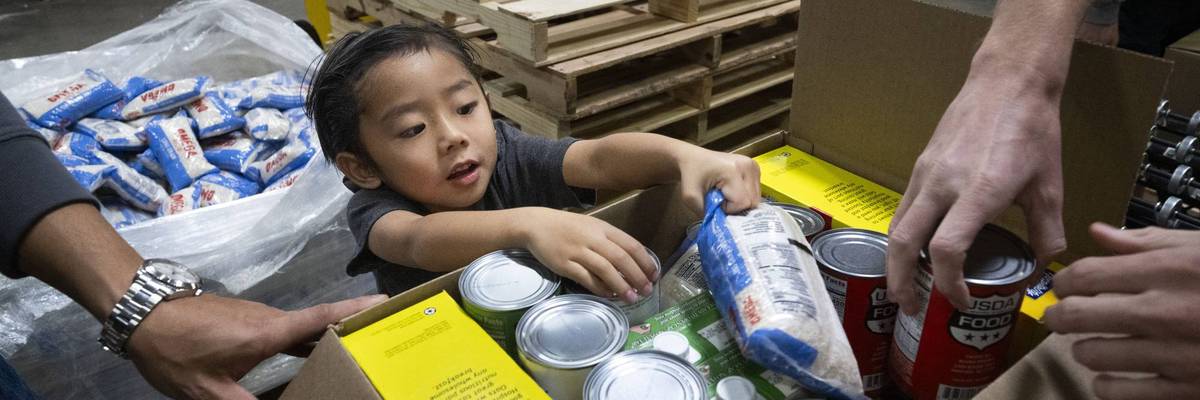
A child helps load food boxes in Garden Grove, California on January 19, 2026.
"Americans can't afford their groceries, they can't afford their medicine, they can't afford the cost of living, and yet we're dropping a billion dollars of bombs, it seems, every day in Iran," said one Senate Democrat.
The Trump administration is quietly pursuing a regulatory change that would strip federal nutrition assistance from an estimated 6 million low-income Americans—including nearly two million children—as it spends billions on an illegal, open-ended war on Iran that has killed more than a thousand people and plunged the global economy into chaos.
The change sought by the US Department of Agriculture would curb broad-based categorical eligibility in the Supplemental Nutrition Assistance Program (SNAP). Broad-based categorical eligibility allows states to automatically qualify residents for SNAP if they are already enrolled in other aid programs, such as Temporary Assistance for Needy Families, thus reducing administrative hurdles and costs.
The Center on Budget and Policy Priorities (CBPP) estimated in a blog post published late last month—the day before President Donald Trump announced the joint US-Israeli assault on Iran—that gutting broad-based categorical eligibility would likely strip modest federal food aid from around 6 million people, including nearly 2 million children.
"The people losing access to food assistance from SNAP, school meals, and [the Women, Infants, and Children Program] would mainly be working families, older adults, and people with disabilities," the think tank noted. "In other words, the change would primarily harm groups that federal and state policymakers from across the political spectrum have long sought to help: people who work but are living near poverty; older adults and people with disabilities with low, fixed incomes; and people trying to build modest savings in order to become more economically independent."
The Congressional Budget Office has projected that restricting broad-based categorical eligibility would result in roughly $11 billion in savings over a 10-year period—or just over $1 billion a year.
The Trump administration is currently spending around $1 billion per day in US taxpayer money waging war on Iran—a price tag that would be enough to cover the daily costs of SNAP benefits for the more than 40 million Americans on the program.
Over just the first two days of the military onslaught, the Pentagon "burned through $5.6 billion worth of munitions," according to figures reported late Monday by the Washington Post.
"Americans can't afford their groceries, they can't afford their medicine, they can't afford the cost of living, and yet we're dropping a billion dollars of bombs, it seems, every day in Iran," US Sen. Adam Schiff (D-Calif.) said in a CNN appearance on Monday.
During Trump's first White House term, his administration proposed a rule that would have curtailed states' option to use broad-based categorical eligibility for SNAP, but the rule was never finalized and the Biden administration later rescinded it.
The Trump Agriculture Department revived the effort late last year, submitting a rule purportedly aimed at ensuring that "categorical eligibility is extended only to households that have sufficiently demonstrated eligibility."
"The end result," CBPP's Katie Bergh recently warned, "will be more hunger and hardship."
The Trump administration's new push comes months after the president signed into law the largest SNAP cuts in US history—around $187 billion over the next decade.
Trump bragged about the cuts during his State of the Union address last month, declaring that his administration has "lifted 2.4 million Americans" off SNAP—a euphemistic description of kicking people off the critical anti-poverty program.
Last week, Republicans on the House Agriculture Committee advanced a farm bill that would do nothing to mitigate the reverberating impacts of the Trump-GOP SNAP cuts.
"Instead of prioritizing the health and well-being of tens of millions of Americans, the committee failed to reverse course and continued down a path that will strip food from the tables of children, veterans, caregivers, older adults, and people experiencing homelessness," said Crystal FitzSimons, president of the Food Research & Action Center.
Dear Common Dreams reader, It’s been nearly 30 years since I co-founded Common Dreams with my late wife, Lina Newhouser. We had the radical notion that journalism should serve the public good, not corporate profits. It was clear to us from the outset what it would take to build such a project. No paid advertisements. No corporate sponsors. No millionaire publisher telling us what to think or do. Many people said we wouldn't last a year, but we proved those doubters wrong. Together with a tremendous team of journalists and dedicated staff, we built an independent media outlet free from the constraints of profits and corporate control. Our mission has always been simple: To inform. To inspire. To ignite change for the common good. Building Common Dreams was not easy. Our survival was never guaranteed. When you take on the most powerful forces—Wall Street greed, fossil fuel industry destruction, Big Tech lobbyists, and uber-rich oligarchs who have spent billions upon billions rigging the economy and democracy in their favor—the only bulwark you have is supporters who believe in your work. But here’s the urgent message from me today. It's never been this bad out there. And it's never been this hard to keep us going. At the very moment Common Dreams is most needed, the threats we face are intensifying. We need your support now more than ever. We don't accept corporate advertising and never will. We don't have a paywall because we don't think people should be blocked from critical news based on their ability to pay. Everything we do is funded by the donations of readers like you. When everyone does the little they can afford, we are strong. But if that support retreats or dries up, so do we. Will you donate now to make sure Common Dreams not only survives but thrives? —Craig Brown, Co-founder |
The Trump administration is quietly pursuing a regulatory change that would strip federal nutrition assistance from an estimated 6 million low-income Americans—including nearly two million children—as it spends billions on an illegal, open-ended war on Iran that has killed more than a thousand people and plunged the global economy into chaos.
The change sought by the US Department of Agriculture would curb broad-based categorical eligibility in the Supplemental Nutrition Assistance Program (SNAP). Broad-based categorical eligibility allows states to automatically qualify residents for SNAP if they are already enrolled in other aid programs, such as Temporary Assistance for Needy Families, thus reducing administrative hurdles and costs.
The Center on Budget and Policy Priorities (CBPP) estimated in a blog post published late last month—the day before President Donald Trump announced the joint US-Israeli assault on Iran—that gutting broad-based categorical eligibility would likely strip modest federal food aid from around 6 million people, including nearly 2 million children.
"The people losing access to food assistance from SNAP, school meals, and [the Women, Infants, and Children Program] would mainly be working families, older adults, and people with disabilities," the think tank noted. "In other words, the change would primarily harm groups that federal and state policymakers from across the political spectrum have long sought to help: people who work but are living near poverty; older adults and people with disabilities with low, fixed incomes; and people trying to build modest savings in order to become more economically independent."
The Congressional Budget Office has projected that restricting broad-based categorical eligibility would result in roughly $11 billion in savings over a 10-year period—or just over $1 billion a year.
The Trump administration is currently spending around $1 billion per day in US taxpayer money waging war on Iran—a price tag that would be enough to cover the daily costs of SNAP benefits for the more than 40 million Americans on the program.
Over just the first two days of the military onslaught, the Pentagon "burned through $5.6 billion worth of munitions," according to figures reported late Monday by the Washington Post.
"Americans can't afford their groceries, they can't afford their medicine, they can't afford the cost of living, and yet we're dropping a billion dollars of bombs, it seems, every day in Iran," US Sen. Adam Schiff (D-Calif.) said in a CNN appearance on Monday.
During Trump's first White House term, his administration proposed a rule that would have curtailed states' option to use broad-based categorical eligibility for SNAP, but the rule was never finalized and the Biden administration later rescinded it.
The Trump Agriculture Department revived the effort late last year, submitting a rule purportedly aimed at ensuring that "categorical eligibility is extended only to households that have sufficiently demonstrated eligibility."
"The end result," CBPP's Katie Bergh recently warned, "will be more hunger and hardship."
The Trump administration's new push comes months after the president signed into law the largest SNAP cuts in US history—around $187 billion over the next decade.
Trump bragged about the cuts during his State of the Union address last month, declaring that his administration has "lifted 2.4 million Americans" off SNAP—a euphemistic description of kicking people off the critical anti-poverty program.
Last week, Republicans on the House Agriculture Committee advanced a farm bill that would do nothing to mitigate the reverberating impacts of the Trump-GOP SNAP cuts.
"Instead of prioritizing the health and well-being of tens of millions of Americans, the committee failed to reverse course and continued down a path that will strip food from the tables of children, veterans, caregivers, older adults, and people experiencing homelessness," said Crystal FitzSimons, president of the Food Research & Action Center.
The Trump administration is quietly pursuing a regulatory change that would strip federal nutrition assistance from an estimated 6 million low-income Americans—including nearly two million children—as it spends billions on an illegal, open-ended war on Iran that has killed more than a thousand people and plunged the global economy into chaos.
The change sought by the US Department of Agriculture would curb broad-based categorical eligibility in the Supplemental Nutrition Assistance Program (SNAP). Broad-based categorical eligibility allows states to automatically qualify residents for SNAP if they are already enrolled in other aid programs, such as Temporary Assistance for Needy Families, thus reducing administrative hurdles and costs.
The Center on Budget and Policy Priorities (CBPP) estimated in a blog post published late last month—the day before President Donald Trump announced the joint US-Israeli assault on Iran—that gutting broad-based categorical eligibility would likely strip modest federal food aid from around 6 million people, including nearly 2 million children.
"The people losing access to food assistance from SNAP, school meals, and [the Women, Infants, and Children Program] would mainly be working families, older adults, and people with disabilities," the think tank noted. "In other words, the change would primarily harm groups that federal and state policymakers from across the political spectrum have long sought to help: people who work but are living near poverty; older adults and people with disabilities with low, fixed incomes; and people trying to build modest savings in order to become more economically independent."
The Congressional Budget Office has projected that restricting broad-based categorical eligibility would result in roughly $11 billion in savings over a 10-year period—or just over $1 billion a year.
The Trump administration is currently spending around $1 billion per day in US taxpayer money waging war on Iran—a price tag that would be enough to cover the daily costs of SNAP benefits for the more than 40 million Americans on the program.
Over just the first two days of the military onslaught, the Pentagon "burned through $5.6 billion worth of munitions," according to figures reported late Monday by the Washington Post.
"Americans can't afford their groceries, they can't afford their medicine, they can't afford the cost of living, and yet we're dropping a billion dollars of bombs, it seems, every day in Iran," US Sen. Adam Schiff (D-Calif.) said in a CNN appearance on Monday.
During Trump's first White House term, his administration proposed a rule that would have curtailed states' option to use broad-based categorical eligibility for SNAP, but the rule was never finalized and the Biden administration later rescinded it.
The Trump Agriculture Department revived the effort late last year, submitting a rule purportedly aimed at ensuring that "categorical eligibility is extended only to households that have sufficiently demonstrated eligibility."
"The end result," CBPP's Katie Bergh recently warned, "will be more hunger and hardship."
The Trump administration's new push comes months after the president signed into law the largest SNAP cuts in US history—around $187 billion over the next decade.
Trump bragged about the cuts during his State of the Union address last month, declaring that his administration has "lifted 2.4 million Americans" off SNAP—a euphemistic description of kicking people off the critical anti-poverty program.
Last week, Republicans on the House Agriculture Committee advanced a farm bill that would do nothing to mitigate the reverberating impacts of the Trump-GOP SNAP cuts.
"Instead of prioritizing the health and well-being of tens of millions of Americans, the committee failed to reverse course and continued down a path that will strip food from the tables of children, veterans, caregivers, older adults, and people experiencing homelessness," said Crystal FitzSimons, president of the Food Research & Action Center.