SUBSCRIBE TO OUR FREE NEWSLETTER
Daily news & progressive opinion—funded by the people, not the corporations—delivered straight to your inbox.
5
#000000
#FFFFFF
To donate by check, phone, or other method, see our More Ways to Give page.
Daily news & progressive opinion—funded by the people, not the corporations—delivered straight to your inbox.
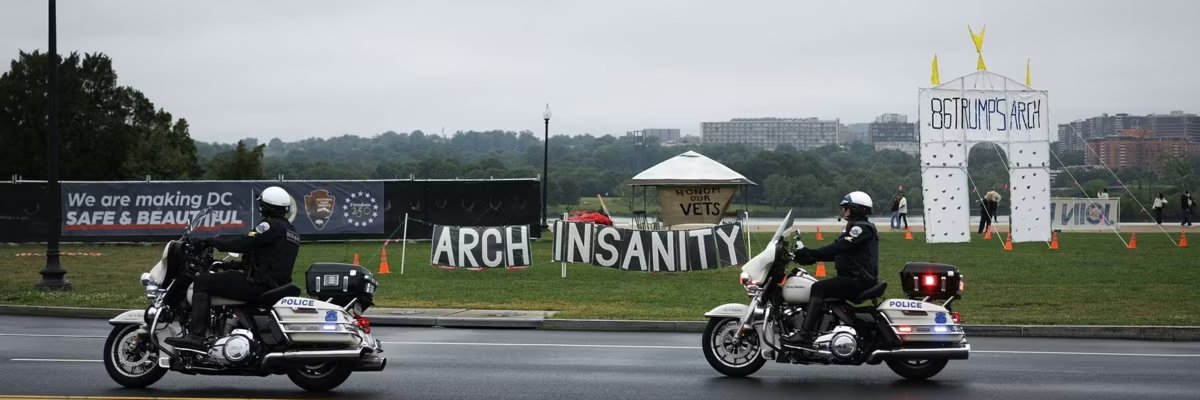
Washington, DC Metropolitan Police Department motorcycle police ride past a demonstration in protest of President Trump's proposed arch planned to be erected near Arlington National Cemetery, near the Lincoln Memorial on May 24, 2026, in Washington, DC.
By abruptly closing public consultation on the massive project, the administration “decided the public’s role is meaningless, unimportant, and of no value whatsoever," said critics.
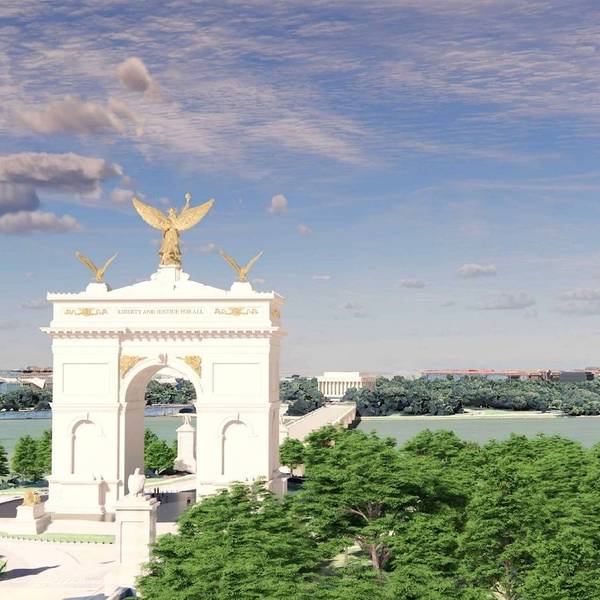
A historical preservation group said it was "gobsmacked" on Monday after the Trump administration said it was closing down its consultation with experts about President Donald Trump's plan for a triumphal arch in Washington, DC, because addressing their concerns and those from the general public would require them to deviate from the president's vision for the project.
On Thursday, Travis Voyles, the Trump-appointed vice chairman of the Advisory Council on Historic Preservation (ACHP), sent a letter informing civil society and historic preservation groups that it was ending the federal review of how the 250-foot-tall arch would harm nearby historical sites.
That review is required under Section 106 of the National Historic Preservation Act, which mandates that federal agencies, including the National Park Service (NPS), consider how a project will affect historic properties and seek ways to "avoid, minimize, or mitigate” the harms of a planned project.
The federal regulations governing the Section 106 process explicitly state that "the views of the public are essential to informed federal decisionmaking,” and require agencies to “seek and consider” those views.
The administration, via the NPS, has acknowledged that the Triumphal Arch would have "adverse effects" on historical sites, disrupting views of Arlington National Cemetery, the Lincoln Memorial, and dozens of others. Meanwhile, the proposal has received over 107,000 public comments, most of which are negative, according to a sample from the DC Preservation Office.
But rather than taking the public concern as a reason to reevaluate or scale back the project, Voyles explained that the ACHP was choosing to end public consultation altogether because taking it into account would require changing the “fundamental nature” of the project in a way that the administration would never accept.
"It is clear that the proposed undertaking and its potential effects on historic properties have raised significant public interest, and the NPS stated in its September 22, 2026 correspondence that it believes additional consultation on the existing proposal is unlikely to result in agreement... to resolve adverse effects," he wrote.
"Further, the NPS stated that implementation of alternatives to avoid or minimize the adverse effects would alter the fundamental nature of the proposed undertaking and fail to achieve its goals," he continued, explaining that "in recognition of the public’s significant concerns," they were "hereby terminating" consultation.
Voyles said the ACHP would create its own recommendations and deliver them by October 7 to Interior Secretary Doug Burgum, whose office is overseeing the project. Burgum is legally required to consider and formally respond to those recommendations, but unlike a legally binding memorandum of agreement, he does not have to follow them.
The ACHP has set a deadline for public comments for Tuesday night at 11:59 pm and said it planned another meeting with consulting parties.
One of the outside groups involved in the consultation process was The Cultural Landscape Foundation (TCLF), a national historic-landscape preservation nonprofit, whose founder and CEO, Charles Birnbaum, worked at the NPS for 15 years and was the principal author of the federal guidelines for cultural landscapes.
Section 106 requires consultation to begin “at the early stages of project planning.” But TCLF says the review began only after the Commission of Fine Arts had approved the arch’s design.
Meanwhile, the TCLF has said that it and other relevant preservation groups were invited to only a single meeting on September 9, just weeks before public consultation was terminated. They said this indicated that any real alternative proposals had essentially been taken off the table.
On Monday, Scott MacFarlane of MeidasTouch News published a letter from the TCLF savaging the administration's "extraordinary" reasoning for canceling the public consultation.
"Mr. Voyles has written a singularly audacious letter," it said. "Rather than address the 'public's significant concerns regarding the adverse effects' on one of the nation's most revered and symbolically important cultural landscapes through an authentic public engagement process that doesn't foreclose avoidance as a precondition, the administration, through its proxy, the ACHP, has decided the public's role is meaningless, unimportant, and of no value whatsoever."
The question of historical preservation is one of numerous legal issues facing Trump's effort to build the arch, which is estimated to cost at least $100 million, though the administration has not published an official price tag.
Although it will be partially funded by taxpayers, Congress has not yet authorized the project, leading to a federal lawsuit seeking to block construction.
Outcry over the public funding for the project led Trump last week to propose using the monument as a "military complex" that would house drones, ammunition, and snipers. He has similarly attempted to justify his taxpayer-funded White House ballroom project by giving it a dual national security purpose.
Dear Common Dreams reader, It’s been nearly 30 years since I co-founded Common Dreams with my late wife, Lina Newhouser. We had the radical notion that journalism should serve the public good, not corporate profits. It was clear to us from the outset what it would take to build such a project. No paid advertisements. No corporate sponsors. No millionaire publisher telling us what to think or do. Many people said we wouldn't last a year, but we proved those doubters wrong. Together with a tremendous team of journalists and dedicated staff, we built an independent media outlet free from the constraints of profits and corporate control. Our mission has always been simple: To inform. To inspire. To ignite change for the common good. Building Common Dreams was not easy. Our survival was never guaranteed. When you take on the most powerful forces—Wall Street greed, fossil fuel industry destruction, Big Tech lobbyists, and uber-rich oligarchs who have spent billions upon billions rigging the economy and democracy in their favor—the only bulwark you have is supporters who believe in your work. But here’s the urgent message from me today. It's never been this bad out there. And it's never been this hard to keep us going. At the very moment Common Dreams is most needed, the threats we face are intensifying. We need your support now more than ever. We don't accept corporate advertising and never will. We don't have a paywall because we don't think people should be blocked from critical news based on their ability to pay. Everything we do is funded by the donations of readers like you. When everyone does the little they can afford, we are strong. But if that support retreats or dries up, so do we. Will you donate now to make sure Common Dreams not only survives but thrives? —Craig Brown, Co-founder |
A historical preservation group said it was "gobsmacked" on Monday after the Trump administration said it was closing down its consultation with experts about President Donald Trump's plan for a triumphal arch in Washington, DC, because addressing their concerns and those from the general public would require them to deviate from the president's vision for the project.
On Thursday, Travis Voyles, the Trump-appointed vice chairman of the Advisory Council on Historic Preservation (ACHP), sent a letter informing civil society and historic preservation groups that it was ending the federal review of how the 250-foot-tall arch would harm nearby historical sites.
That review is required under Section 106 of the National Historic Preservation Act, which mandates that federal agencies, including the National Park Service (NPS), consider how a project will affect historic properties and seek ways to "avoid, minimize, or mitigate” the harms of a planned project.
The federal regulations governing the Section 106 process explicitly state that "the views of the public are essential to informed federal decisionmaking,” and require agencies to “seek and consider” those views.
The administration, via the NPS, has acknowledged that the Triumphal Arch would have "adverse effects" on historical sites, disrupting views of Arlington National Cemetery, the Lincoln Memorial, and dozens of others. Meanwhile, the proposal has received over 107,000 public comments, most of which are negative, according to a sample from the DC Preservation Office.
But rather than taking the public concern as a reason to reevaluate or scale back the project, Voyles explained that the ACHP was choosing to end public consultation altogether because taking it into account would require changing the “fundamental nature” of the project in a way that the administration would never accept.
"It is clear that the proposed undertaking and its potential effects on historic properties have raised significant public interest, and the NPS stated in its September 22, 2026 correspondence that it believes additional consultation on the existing proposal is unlikely to result in agreement... to resolve adverse effects," he wrote.
"Further, the NPS stated that implementation of alternatives to avoid or minimize the adverse effects would alter the fundamental nature of the proposed undertaking and fail to achieve its goals," he continued, explaining that "in recognition of the public’s significant concerns," they were "hereby terminating" consultation.
Voyles said the ACHP would create its own recommendations and deliver them by October 7 to Interior Secretary Doug Burgum, whose office is overseeing the project. Burgum is legally required to consider and formally respond to those recommendations, but unlike a legally binding memorandum of agreement, he does not have to follow them.
The ACHP has set a deadline for public comments for Tuesday night at 11:59 pm and said it planned another meeting with consulting parties.
One of the outside groups involved in the consultation process was The Cultural Landscape Foundation (TCLF), a national historic-landscape preservation nonprofit, whose founder and CEO, Charles Birnbaum, worked at the NPS for 15 years and was the principal author of the federal guidelines for cultural landscapes.
Section 106 requires consultation to begin “at the early stages of project planning.” But TCLF says the review began only after the Commission of Fine Arts had approved the arch’s design.
Meanwhile, the TCLF has said that it and other relevant preservation groups were invited to only a single meeting on September 9, just weeks before public consultation was terminated. They said this indicated that any real alternative proposals had essentially been taken off the table.
On Monday, Scott MacFarlane of MeidasTouch News published a letter from the TCLF savaging the administration's "extraordinary" reasoning for canceling the public consultation.
"Mr. Voyles has written a singularly audacious letter," it said. "Rather than address the 'public's significant concerns regarding the adverse effects' on one of the nation's most revered and symbolically important cultural landscapes through an authentic public engagement process that doesn't foreclose avoidance as a precondition, the administration, through its proxy, the ACHP, has decided the public's role is meaningless, unimportant, and of no value whatsoever."
The question of historical preservation is one of numerous legal issues facing Trump's effort to build the arch, which is estimated to cost at least $100 million, though the administration has not published an official price tag.
Although it will be partially funded by taxpayers, Congress has not yet authorized the project, leading to a federal lawsuit seeking to block construction.
Outcry over the public funding for the project led Trump last week to propose using the monument as a "military complex" that would house drones, ammunition, and snipers. He has similarly attempted to justify his taxpayer-funded White House ballroom project by giving it a dual national security purpose.
A historical preservation group said it was "gobsmacked" on Monday after the Trump administration said it was closing down its consultation with experts about President Donald Trump's plan for a triumphal arch in Washington, DC, because addressing their concerns and those from the general public would require them to deviate from the president's vision for the project.
On Thursday, Travis Voyles, the Trump-appointed vice chairman of the Advisory Council on Historic Preservation (ACHP), sent a letter informing civil society and historic preservation groups that it was ending the federal review of how the 250-foot-tall arch would harm nearby historical sites.
That review is required under Section 106 of the National Historic Preservation Act, which mandates that federal agencies, including the National Park Service (NPS), consider how a project will affect historic properties and seek ways to "avoid, minimize, or mitigate” the harms of a planned project.
The federal regulations governing the Section 106 process explicitly state that "the views of the public are essential to informed federal decisionmaking,” and require agencies to “seek and consider” those views.
The administration, via the NPS, has acknowledged that the Triumphal Arch would have "adverse effects" on historical sites, disrupting views of Arlington National Cemetery, the Lincoln Memorial, and dozens of others. Meanwhile, the proposal has received over 107,000 public comments, most of which are negative, according to a sample from the DC Preservation Office.
But rather than taking the public concern as a reason to reevaluate or scale back the project, Voyles explained that the ACHP was choosing to end public consultation altogether because taking it into account would require changing the “fundamental nature” of the project in a way that the administration would never accept.
"It is clear that the proposed undertaking and its potential effects on historic properties have raised significant public interest, and the NPS stated in its September 22, 2026 correspondence that it believes additional consultation on the existing proposal is unlikely to result in agreement... to resolve adverse effects," he wrote.
"Further, the NPS stated that implementation of alternatives to avoid or minimize the adverse effects would alter the fundamental nature of the proposed undertaking and fail to achieve its goals," he continued, explaining that "in recognition of the public’s significant concerns," they were "hereby terminating" consultation.
Voyles said the ACHP would create its own recommendations and deliver them by October 7 to Interior Secretary Doug Burgum, whose office is overseeing the project. Burgum is legally required to consider and formally respond to those recommendations, but unlike a legally binding memorandum of agreement, he does not have to follow them.
The ACHP has set a deadline for public comments for Tuesday night at 11:59 pm and said it planned another meeting with consulting parties.
One of the outside groups involved in the consultation process was The Cultural Landscape Foundation (TCLF), a national historic-landscape preservation nonprofit, whose founder and CEO, Charles Birnbaum, worked at the NPS for 15 years and was the principal author of the federal guidelines for cultural landscapes.
Section 106 requires consultation to begin “at the early stages of project planning.” But TCLF says the review began only after the Commission of Fine Arts had approved the arch’s design.
Meanwhile, the TCLF has said that it and other relevant preservation groups were invited to only a single meeting on September 9, just weeks before public consultation was terminated. They said this indicated that any real alternative proposals had essentially been taken off the table.
On Monday, Scott MacFarlane of MeidasTouch News published a letter from the TCLF savaging the administration's "extraordinary" reasoning for canceling the public consultation.
"Mr. Voyles has written a singularly audacious letter," it said. "Rather than address the 'public's significant concerns regarding the adverse effects' on one of the nation's most revered and symbolically important cultural landscapes through an authentic public engagement process that doesn't foreclose avoidance as a precondition, the administration, through its proxy, the ACHP, has decided the public's role is meaningless, unimportant, and of no value whatsoever."
The question of historical preservation is one of numerous legal issues facing Trump's effort to build the arch, which is estimated to cost at least $100 million, though the administration has not published an official price tag.
Although it will be partially funded by taxpayers, Congress has not yet authorized the project, leading to a federal lawsuit seeking to block construction.
Outcry over the public funding for the project led Trump last week to propose using the monument as a "military complex" that would house drones, ammunition, and snipers. He has similarly attempted to justify his taxpayer-funded White House ballroom project by giving it a dual national security purpose.