SUBSCRIBE TO OUR FREE NEWSLETTER
Daily news & progressive opinion—funded by the people, not the corporations—delivered straight to your inbox.
5
#000000
#FFFFFF
To donate by check, phone, or other method, see our More Ways to Give page.
Daily news & progressive opinion—funded by the people, not the corporations—delivered straight to your inbox.
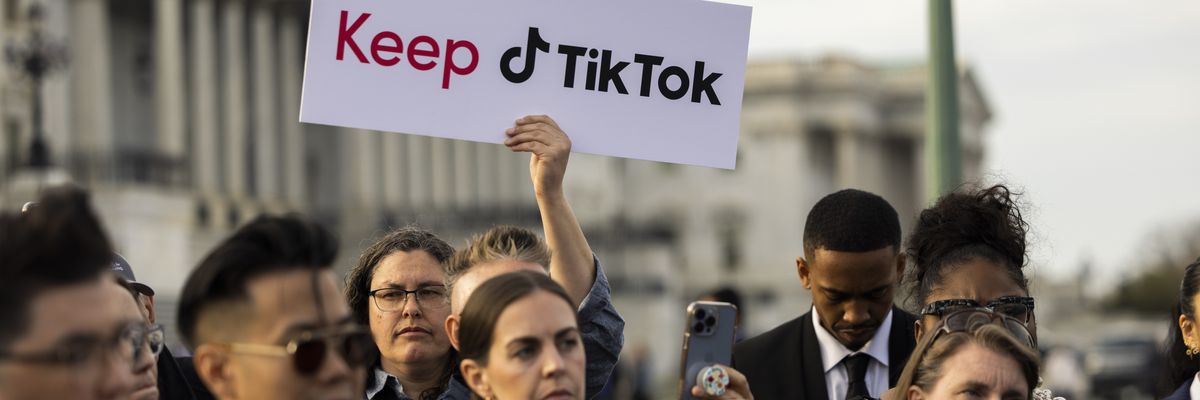
TikTok content creators gather outside the U.S. Capitol to voice their opposition to a potential ban on the app, highlighting the platform's impact on their livelihoods and communities in Washington D.C. on March 22, 2023.
One expert said legislators' admissions "that the ban was motivated by a desire to suppress content about the Israel-Gaza conflict will make the law especially difficult for the government to defend," said one First Amendment expert.
A top First Amendment expert on Tuesday said TikTok has a strong case against the U.S. government as the social media platform filed a federal lawsuit against a potential ban—particularly since proponents of the law have admitted it is aimed at blocking Americans' access to news out of Gaza.
The platform filed the lawsuit against U.S. Attorney General Merrick Garland in the U.S. Court of Appeals for the District of Columbia Circuit nearly two weeks after President Joe Biden signed the Protecting Americans From Foreign Adversaries Act into law as part of a larger foreign aid package.
Under the law, TikTok parent company ByteDance, a Chinese firm, has 270 days to sell the platform, allowing it to continue operating in the U.S. If it does not sell TikTok, the app will no longer be available on U.S. networks and app stores.
As Common Dreams reported Monday, Republican lawmakers including U.S. Rep. Mike Lawler (R-N.Y.) and Sen. Mitt Romney (R-Utah) have linked TikTok to the burgeoning anti-war protest movement spreading across the U.S., with the latter saying in an interview with Secretary of State Antony Blinken last Friday that "there was such overwhelming support" in Congress to shut down TikTok because of the frequent posting of Palestine-related content on the app.
"Restricting citizens' access to media from abroad is a practice that has long been associated with repressive regimes, so it's sad and alarming to see our own government going down this road," said Jameel Jaffer, executive director of the Knight First Amendment Institute at Columbia University, on Tuesday. "TikTok's challenge to the ban is important, and we expect it to succeed. The First Amendment means the government can't restrict Americans' access to ideas, information, or media from abroad without a very good reason for it—and no such reason exists here."
"The fact that some legislators have acknowledged that the ban was motivated by a desire to suppress content about the Israel-Gaza conflict will make the law especially difficult for the government to defend," Jaffer added.
The law's sponsors claim it "is not a ban because it offers ByteDance a choice: divest TikTok's U.S. business or be shut down," reads the lawsuit. "But in reality, there is no choice. The 'qualified divestiture' demanded by the act to allow TikTok to continue operating in the United States is simply not possible: not commercially, not technologically, not legally."
Even if selling the app within the time frame was feasible, added TikTok and ByteDance, the law "would still be an extraordinary and unconstitutional assertion of power," ultimately allowing Congress to "circumvent the First Amendment by invoking national security and ordering the publisher of any individual newspaper or website to sell to avoid being shut down."
"And for TikTok, any such divestiture would disconnect Americans from the rest of the global community on a platform devoted to shared content—an outcome fundamentally at odds with the Constitution's commitment to both free speech and individual liberty," the plaintiffs continued.
At The Philadelphia Inquirer on Tuesday, columnist Will Bunch noted that about a third of Americans between the ages of 18-29 get their news from TikTok, according to a recent Pew survey—as Romney openly stated he fears last week.
As Bunch wrote:
During the war in Gaza, most mainstream Western journalists have been blocked from entering the war zone. The best source of real-time information is often the phone video of airstrikes and their aftermath either shot by Palestinian journalists—more than 90 of whom have been killed—or civilian bystanders. Look, there's disinformation about every issue on social media—it's a serious problem. I'm a clueless boomer myself about TikTok, but I do spend way too much time on X/Twitter and I can tell you exactly what is radicalizing young people about Gaza.
The reason so many under-30 folks have adopted the Palestinian cause isn't disinformation, from Hamas or China or anyone else. They've been radicalized by the truth—daily videos of young children, some of them bloodied, some of them already dead, covered in dust and targeted by 2,000-pound dumb bombs made right here in America.
"If the real motivation for zapping TikTok from your phone is to silence legitimate political speech, just because a lot of members of Congress don't like it," wrote Bunch, "then this bill is the worst attack on the First Amendment since the government was sending World War I critics like Eugene V. Debs and Kate Richards O'Hare to prison, more than 100 years ago."
Dear Common Dreams reader, It’s been nearly 30 years since I co-founded Common Dreams with my late wife, Lina Newhouser. We had the radical notion that journalism should serve the public good, not corporate profits. It was clear to us from the outset what it would take to build such a project. No paid advertisements. No corporate sponsors. No millionaire publisher telling us what to think or do. Many people said we wouldn't last a year, but we proved those doubters wrong. Together with a tremendous team of journalists and dedicated staff, we built an independent media outlet free from the constraints of profits and corporate control. Our mission has always been simple: To inform. To inspire. To ignite change for the common good. Building Common Dreams was not easy. Our survival was never guaranteed. When you take on the most powerful forces—Wall Street greed, fossil fuel industry destruction, Big Tech lobbyists, and uber-rich oligarchs who have spent billions upon billions rigging the economy and democracy in their favor—the only bulwark you have is supporters who believe in your work. But here’s the urgent message from me today. It's never been this bad out there. And it's never been this hard to keep us going. At the very moment Common Dreams is most needed, the threats we face are intensifying. We need your support now more than ever. We don't accept corporate advertising and never will. We don't have a paywall because we don't think people should be blocked from critical news based on their ability to pay. Everything we do is funded by the donations of readers like you. When everyone does the little they can afford, we are strong. But if that support retreats or dries up, so do we. Will you donate now to make sure Common Dreams not only survives but thrives? —Craig Brown, Co-founder |
A top First Amendment expert on Tuesday said TikTok has a strong case against the U.S. government as the social media platform filed a federal lawsuit against a potential ban—particularly since proponents of the law have admitted it is aimed at blocking Americans' access to news out of Gaza.
The platform filed the lawsuit against U.S. Attorney General Merrick Garland in the U.S. Court of Appeals for the District of Columbia Circuit nearly two weeks after President Joe Biden signed the Protecting Americans From Foreign Adversaries Act into law as part of a larger foreign aid package.
Under the law, TikTok parent company ByteDance, a Chinese firm, has 270 days to sell the platform, allowing it to continue operating in the U.S. If it does not sell TikTok, the app will no longer be available on U.S. networks and app stores.
As Common Dreams reported Monday, Republican lawmakers including U.S. Rep. Mike Lawler (R-N.Y.) and Sen. Mitt Romney (R-Utah) have linked TikTok to the burgeoning anti-war protest movement spreading across the U.S., with the latter saying in an interview with Secretary of State Antony Blinken last Friday that "there was such overwhelming support" in Congress to shut down TikTok because of the frequent posting of Palestine-related content on the app.
"Restricting citizens' access to media from abroad is a practice that has long been associated with repressive regimes, so it's sad and alarming to see our own government going down this road," said Jameel Jaffer, executive director of the Knight First Amendment Institute at Columbia University, on Tuesday. "TikTok's challenge to the ban is important, and we expect it to succeed. The First Amendment means the government can't restrict Americans' access to ideas, information, or media from abroad without a very good reason for it—and no such reason exists here."
"The fact that some legislators have acknowledged that the ban was motivated by a desire to suppress content about the Israel-Gaza conflict will make the law especially difficult for the government to defend," Jaffer added.
The law's sponsors claim it "is not a ban because it offers ByteDance a choice: divest TikTok's U.S. business or be shut down," reads the lawsuit. "But in reality, there is no choice. The 'qualified divestiture' demanded by the act to allow TikTok to continue operating in the United States is simply not possible: not commercially, not technologically, not legally."
Even if selling the app within the time frame was feasible, added TikTok and ByteDance, the law "would still be an extraordinary and unconstitutional assertion of power," ultimately allowing Congress to "circumvent the First Amendment by invoking national security and ordering the publisher of any individual newspaper or website to sell to avoid being shut down."
"And for TikTok, any such divestiture would disconnect Americans from the rest of the global community on a platform devoted to shared content—an outcome fundamentally at odds with the Constitution's commitment to both free speech and individual liberty," the plaintiffs continued.
At The Philadelphia Inquirer on Tuesday, columnist Will Bunch noted that about a third of Americans between the ages of 18-29 get their news from TikTok, according to a recent Pew survey—as Romney openly stated he fears last week.
As Bunch wrote:
During the war in Gaza, most mainstream Western journalists have been blocked from entering the war zone. The best source of real-time information is often the phone video of airstrikes and their aftermath either shot by Palestinian journalists—more than 90 of whom have been killed—or civilian bystanders. Look, there's disinformation about every issue on social media—it's a serious problem. I'm a clueless boomer myself about TikTok, but I do spend way too much time on X/Twitter and I can tell you exactly what is radicalizing young people about Gaza.
The reason so many under-30 folks have adopted the Palestinian cause isn't disinformation, from Hamas or China or anyone else. They've been radicalized by the truth—daily videos of young children, some of them bloodied, some of them already dead, covered in dust and targeted by 2,000-pound dumb bombs made right here in America.
"If the real motivation for zapping TikTok from your phone is to silence legitimate political speech, just because a lot of members of Congress don't like it," wrote Bunch, "then this bill is the worst attack on the First Amendment since the government was sending World War I critics like Eugene V. Debs and Kate Richards O'Hare to prison, more than 100 years ago."
A top First Amendment expert on Tuesday said TikTok has a strong case against the U.S. government as the social media platform filed a federal lawsuit against a potential ban—particularly since proponents of the law have admitted it is aimed at blocking Americans' access to news out of Gaza.
The platform filed the lawsuit against U.S. Attorney General Merrick Garland in the U.S. Court of Appeals for the District of Columbia Circuit nearly two weeks after President Joe Biden signed the Protecting Americans From Foreign Adversaries Act into law as part of a larger foreign aid package.
Under the law, TikTok parent company ByteDance, a Chinese firm, has 270 days to sell the platform, allowing it to continue operating in the U.S. If it does not sell TikTok, the app will no longer be available on U.S. networks and app stores.
As Common Dreams reported Monday, Republican lawmakers including U.S. Rep. Mike Lawler (R-N.Y.) and Sen. Mitt Romney (R-Utah) have linked TikTok to the burgeoning anti-war protest movement spreading across the U.S., with the latter saying in an interview with Secretary of State Antony Blinken last Friday that "there was such overwhelming support" in Congress to shut down TikTok because of the frequent posting of Palestine-related content on the app.
"Restricting citizens' access to media from abroad is a practice that has long been associated with repressive regimes, so it's sad and alarming to see our own government going down this road," said Jameel Jaffer, executive director of the Knight First Amendment Institute at Columbia University, on Tuesday. "TikTok's challenge to the ban is important, and we expect it to succeed. The First Amendment means the government can't restrict Americans' access to ideas, information, or media from abroad without a very good reason for it—and no such reason exists here."
"The fact that some legislators have acknowledged that the ban was motivated by a desire to suppress content about the Israel-Gaza conflict will make the law especially difficult for the government to defend," Jaffer added.
The law's sponsors claim it "is not a ban because it offers ByteDance a choice: divest TikTok's U.S. business or be shut down," reads the lawsuit. "But in reality, there is no choice. The 'qualified divestiture' demanded by the act to allow TikTok to continue operating in the United States is simply not possible: not commercially, not technologically, not legally."
Even if selling the app within the time frame was feasible, added TikTok and ByteDance, the law "would still be an extraordinary and unconstitutional assertion of power," ultimately allowing Congress to "circumvent the First Amendment by invoking national security and ordering the publisher of any individual newspaper or website to sell to avoid being shut down."
"And for TikTok, any such divestiture would disconnect Americans from the rest of the global community on a platform devoted to shared content—an outcome fundamentally at odds with the Constitution's commitment to both free speech and individual liberty," the plaintiffs continued.
At The Philadelphia Inquirer on Tuesday, columnist Will Bunch noted that about a third of Americans between the ages of 18-29 get their news from TikTok, according to a recent Pew survey—as Romney openly stated he fears last week.
As Bunch wrote:
During the war in Gaza, most mainstream Western journalists have been blocked from entering the war zone. The best source of real-time information is often the phone video of airstrikes and their aftermath either shot by Palestinian journalists—more than 90 of whom have been killed—or civilian bystanders. Look, there's disinformation about every issue on social media—it's a serious problem. I'm a clueless boomer myself about TikTok, but I do spend way too much time on X/Twitter and I can tell you exactly what is radicalizing young people about Gaza.
The reason so many under-30 folks have adopted the Palestinian cause isn't disinformation, from Hamas or China or anyone else. They've been radicalized by the truth—daily videos of young children, some of them bloodied, some of them already dead, covered in dust and targeted by 2,000-pound dumb bombs made right here in America.
"If the real motivation for zapping TikTok from your phone is to silence legitimate political speech, just because a lot of members of Congress don't like it," wrote Bunch, "then this bill is the worst attack on the First Amendment since the government was sending World War I critics like Eugene V. Debs and Kate Richards O'Hare to prison, more than 100 years ago."