

SUBSCRIBE TO OUR FREE NEWSLETTER
Daily news & progressive opinion—funded by the people, not the corporations—delivered straight to your inbox.
5
#000000
#FFFFFF
To donate by check, phone, or other method, see our More Ways to Give page.
Daily news & progressive opinion—funded by the people, not the corporations—delivered straight to your inbox.
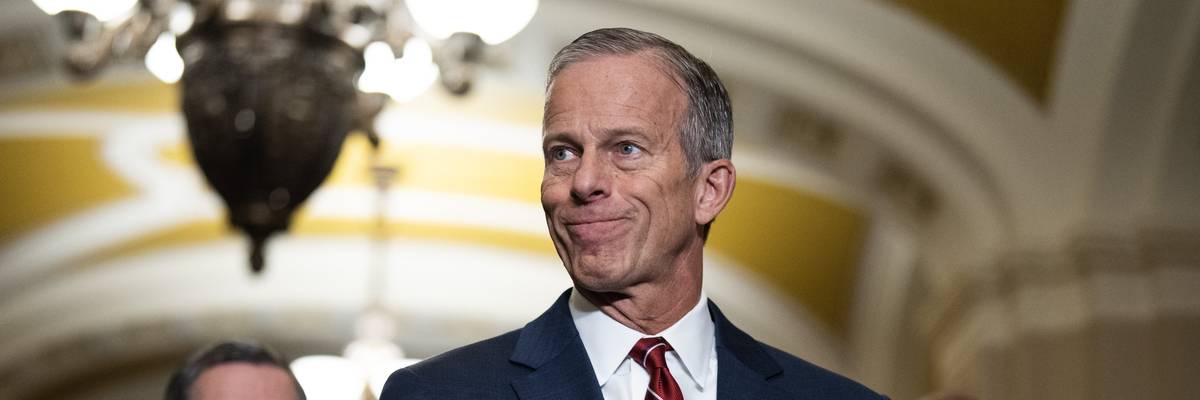
Senate Majority Leader John Thune (R-S.D.), conducts a news conference in the U.S. Capitol on April 1, 2025.
"No parliamentary tricks will change the fact that Trump, Musk, and his allies in Congress are trying to give a huge handout to the ultrawealthy while forcing the rest of us to foot the bill," wrote one watchdog.
Watchdogs and other critics swiftly denounced a budget blueprint unveiled by Senate Republicans on Wednesday that endeavors to get the GOP one step closer to delivering additional spending and trillions in tax cuts desired by U.S. President Donald Trump.
Observers are also condemning Republicans' plans to skirt the Senate parliamentarian and use a controversial gimmick to make an extension of provisions from Trump's 2017 Tax Cuts and Jobs Act look "free"—even the cost of extending those cuts would be nearly $4 trillion over 10 years, and the Senate proposal includes a total of $5.3 trillion in tax cuts.
"Let's be clear: Trump and his allies in Congress are cooking the books in broad daylight. They don't want Americans to know that their scam of a tax bill, which gives trillions in giveaways to their billionaire and corporate donors, costs over $5 trillion," said David Kass, the executive director of the advocacy group Americans for Tax Fairness (ATF), in a statement on Wednesday.
Lisa Gilbert, co-president of the watchdog group Public Citizen, referenced Trump's billionaire adviser Elon Musk when declaring that "Republicans have chosen to prioritize the Trump-Musk agenda of picking the pockets of everyday people to shower billionaires with tax giveaways."
The Senate budget blueprint would increase the country's debt limit by $5 trillion and permanently extend tax cuts passed through Trump's 2017 Tax Cuts and Jobs Act, according to NPR.
Extending those tax cuts would primarily benefit the wealthy. According to a 2024 analysis from the Tax Policy Center, households making about $450,000 or more a year would receive nearly half of the benefits of extending key provisions of Trump's 2017 tax cuts.
According to a February report from ATF, the wealthiest Republicans on tax writing panels could save themselves millions through extending these cuts, particularly by keeping in place a higher estate tax exemption.
The Senate budget blueprint includes the $4.5 trillion tax plan passed by the House of Representatives in February, according to NPR. The House plan is crafted so the only way to achieve the requirements of the budget resolution is to enact steep cuts to Medicaid. The budget resolution also makes cuts to the Supplemental Nutrition Assistance Program (SNAP) all but certain.
Sharon Parrott, the president of the nonpartisan research organization the Center on Budget and Policy Priorities, framed the Senate budget plan like this: "Congress is speeding down a path to a deeply harmful budget and tax 'reconciliation' bill that showers tax cuts on millionaires, billionaires, and corporations—and pays for it in part by raising healthcare and food costs through cuts in Medicaid and SNAP, increasing hardship and leaving millions without health coverage."
In order to move the legislation forward, Senate Republicans are planning on bypassing the Senate parliamentarian—who has sway over whether legislation can be sped up through the filibuster-free reconciliation process—on a crucial budgeting matter, according to Wednesday reporting from The New York Times.
By asserting that Sen. Lindsey Graham (R-S.C.), chairman of the Senate Budget Committee, can decide the cost of legislation Republicans are angling not to get the parliamentarian's sign-off on their claim that extending the tax cuts will be free, per the Times.
The GOP is attempting to make the tax cut extension appear free by using the "current policy" baseline rather than the "current law" baseline. One expert who spoke to the Times compared it to "taking an expensive weeklong vacation and then assuming you can spend an extra $1,000 per day forever since you are no longer staying at the Plaza."
A trio of experts writing for the Center for American Progress wrote that the approach is unprecedented in the past five decades since the Congressional Budget Office was formed and lawmakers acted within the current budget framework.
"Don't be fooled: the only way Senate Republicans can pay for their tax cuts to the wealthy is by taking a chainsaw to Medicaid, school lunches for kids, and driving up the cost of groceries and housing," said the executive director of the watchdog Accoutable.US, Tony Carrk, on Wednesday. "The math doesn't add up, and no parliamentary tricks will change the fact that Trump, Musk, and his allies in Congress are trying to give a huge handout to the ultrawealthy while forcing the rest of us to foot the bill."
Republicans narrowly control both chambers of Congress. According to Politico, the Senate will vote as soon as Thursday to consider the blueprint, which if adopted, would allow the House to try to adopt it before breaking for a two week recess.
Dear Common Dreams reader, It’s been nearly 30 years since I co-founded Common Dreams with my late wife, Lina Newhouser. We had the radical notion that journalism should serve the public good, not corporate profits. It was clear to us from the outset what it would take to build such a project. No paid advertisements. No corporate sponsors. No millionaire publisher telling us what to think or do. Many people said we wouldn't last a year, but we proved those doubters wrong. Together with a tremendous team of journalists and dedicated staff, we built an independent media outlet free from the constraints of profits and corporate control. Our mission has always been simple: To inform. To inspire. To ignite change for the common good. Building Common Dreams was not easy. Our survival was never guaranteed. When you take on the most powerful forces—Wall Street greed, fossil fuel industry destruction, Big Tech lobbyists, and uber-rich oligarchs who have spent billions upon billions rigging the economy and democracy in their favor—the only bulwark you have is supporters who believe in your work. But here’s the urgent message from me today. It's never been this bad out there. And it's never been this hard to keep us going. At the very moment Common Dreams is most needed, the threats we face are intensifying. We need your support now more than ever. We don't accept corporate advertising and never will. We don't have a paywall because we don't think people should be blocked from critical news based on their ability to pay. Everything we do is funded by the donations of readers like you. When everyone does the little they can afford, we are strong. But if that support retreats or dries up, so do we. Will you donate now to make sure Common Dreams not only survives but thrives? —Craig Brown, Co-founder |
Watchdogs and other critics swiftly denounced a budget blueprint unveiled by Senate Republicans on Wednesday that endeavors to get the GOP one step closer to delivering additional spending and trillions in tax cuts desired by U.S. President Donald Trump.
Observers are also condemning Republicans' plans to skirt the Senate parliamentarian and use a controversial gimmick to make an extension of provisions from Trump's 2017 Tax Cuts and Jobs Act look "free"—even the cost of extending those cuts would be nearly $4 trillion over 10 years, and the Senate proposal includes a total of $5.3 trillion in tax cuts.
"Let's be clear: Trump and his allies in Congress are cooking the books in broad daylight. They don't want Americans to know that their scam of a tax bill, which gives trillions in giveaways to their billionaire and corporate donors, costs over $5 trillion," said David Kass, the executive director of the advocacy group Americans for Tax Fairness (ATF), in a statement on Wednesday.
Lisa Gilbert, co-president of the watchdog group Public Citizen, referenced Trump's billionaire adviser Elon Musk when declaring that "Republicans have chosen to prioritize the Trump-Musk agenda of picking the pockets of everyday people to shower billionaires with tax giveaways."
The Senate budget blueprint would increase the country's debt limit by $5 trillion and permanently extend tax cuts passed through Trump's 2017 Tax Cuts and Jobs Act, according to NPR.
Extending those tax cuts would primarily benefit the wealthy. According to a 2024 analysis from the Tax Policy Center, households making about $450,000 or more a year would receive nearly half of the benefits of extending key provisions of Trump's 2017 tax cuts.
According to a February report from ATF, the wealthiest Republicans on tax writing panels could save themselves millions through extending these cuts, particularly by keeping in place a higher estate tax exemption.
The Senate budget blueprint includes the $4.5 trillion tax plan passed by the House of Representatives in February, according to NPR. The House plan is crafted so the only way to achieve the requirements of the budget resolution is to enact steep cuts to Medicaid. The budget resolution also makes cuts to the Supplemental Nutrition Assistance Program (SNAP) all but certain.
Sharon Parrott, the president of the nonpartisan research organization the Center on Budget and Policy Priorities, framed the Senate budget plan like this: "Congress is speeding down a path to a deeply harmful budget and tax 'reconciliation' bill that showers tax cuts on millionaires, billionaires, and corporations—and pays for it in part by raising healthcare and food costs through cuts in Medicaid and SNAP, increasing hardship and leaving millions without health coverage."
In order to move the legislation forward, Senate Republicans are planning on bypassing the Senate parliamentarian—who has sway over whether legislation can be sped up through the filibuster-free reconciliation process—on a crucial budgeting matter, according to Wednesday reporting from The New York Times.
By asserting that Sen. Lindsey Graham (R-S.C.), chairman of the Senate Budget Committee, can decide the cost of legislation Republicans are angling not to get the parliamentarian's sign-off on their claim that extending the tax cuts will be free, per the Times.
The GOP is attempting to make the tax cut extension appear free by using the "current policy" baseline rather than the "current law" baseline. One expert who spoke to the Times compared it to "taking an expensive weeklong vacation and then assuming you can spend an extra $1,000 per day forever since you are no longer staying at the Plaza."
A trio of experts writing for the Center for American Progress wrote that the approach is unprecedented in the past five decades since the Congressional Budget Office was formed and lawmakers acted within the current budget framework.
"Don't be fooled: the only way Senate Republicans can pay for their tax cuts to the wealthy is by taking a chainsaw to Medicaid, school lunches for kids, and driving up the cost of groceries and housing," said the executive director of the watchdog Accoutable.US, Tony Carrk, on Wednesday. "The math doesn't add up, and no parliamentary tricks will change the fact that Trump, Musk, and his allies in Congress are trying to give a huge handout to the ultrawealthy while forcing the rest of us to foot the bill."
Republicans narrowly control both chambers of Congress. According to Politico, the Senate will vote as soon as Thursday to consider the blueprint, which if adopted, would allow the House to try to adopt it before breaking for a two week recess.
Watchdogs and other critics swiftly denounced a budget blueprint unveiled by Senate Republicans on Wednesday that endeavors to get the GOP one step closer to delivering additional spending and trillions in tax cuts desired by U.S. President Donald Trump.
Observers are also condemning Republicans' plans to skirt the Senate parliamentarian and use a controversial gimmick to make an extension of provisions from Trump's 2017 Tax Cuts and Jobs Act look "free"—even the cost of extending those cuts would be nearly $4 trillion over 10 years, and the Senate proposal includes a total of $5.3 trillion in tax cuts.
"Let's be clear: Trump and his allies in Congress are cooking the books in broad daylight. They don't want Americans to know that their scam of a tax bill, which gives trillions in giveaways to their billionaire and corporate donors, costs over $5 trillion," said David Kass, the executive director of the advocacy group Americans for Tax Fairness (ATF), in a statement on Wednesday.
Lisa Gilbert, co-president of the watchdog group Public Citizen, referenced Trump's billionaire adviser Elon Musk when declaring that "Republicans have chosen to prioritize the Trump-Musk agenda of picking the pockets of everyday people to shower billionaires with tax giveaways."
The Senate budget blueprint would increase the country's debt limit by $5 trillion and permanently extend tax cuts passed through Trump's 2017 Tax Cuts and Jobs Act, according to NPR.
Extending those tax cuts would primarily benefit the wealthy. According to a 2024 analysis from the Tax Policy Center, households making about $450,000 or more a year would receive nearly half of the benefits of extending key provisions of Trump's 2017 tax cuts.
According to a February report from ATF, the wealthiest Republicans on tax writing panels could save themselves millions through extending these cuts, particularly by keeping in place a higher estate tax exemption.
The Senate budget blueprint includes the $4.5 trillion tax plan passed by the House of Representatives in February, according to NPR. The House plan is crafted so the only way to achieve the requirements of the budget resolution is to enact steep cuts to Medicaid. The budget resolution also makes cuts to the Supplemental Nutrition Assistance Program (SNAP) all but certain.
Sharon Parrott, the president of the nonpartisan research organization the Center on Budget and Policy Priorities, framed the Senate budget plan like this: "Congress is speeding down a path to a deeply harmful budget and tax 'reconciliation' bill that showers tax cuts on millionaires, billionaires, and corporations—and pays for it in part by raising healthcare and food costs through cuts in Medicaid and SNAP, increasing hardship and leaving millions without health coverage."
In order to move the legislation forward, Senate Republicans are planning on bypassing the Senate parliamentarian—who has sway over whether legislation can be sped up through the filibuster-free reconciliation process—on a crucial budgeting matter, according to Wednesday reporting from The New York Times.
By asserting that Sen. Lindsey Graham (R-S.C.), chairman of the Senate Budget Committee, can decide the cost of legislation Republicans are angling not to get the parliamentarian's sign-off on their claim that extending the tax cuts will be free, per the Times.
The GOP is attempting to make the tax cut extension appear free by using the "current policy" baseline rather than the "current law" baseline. One expert who spoke to the Times compared it to "taking an expensive weeklong vacation and then assuming you can spend an extra $1,000 per day forever since you are no longer staying at the Plaza."
A trio of experts writing for the Center for American Progress wrote that the approach is unprecedented in the past five decades since the Congressional Budget Office was formed and lawmakers acted within the current budget framework.
"Don't be fooled: the only way Senate Republicans can pay for their tax cuts to the wealthy is by taking a chainsaw to Medicaid, school lunches for kids, and driving up the cost of groceries and housing," said the executive director of the watchdog Accoutable.US, Tony Carrk, on Wednesday. "The math doesn't add up, and no parliamentary tricks will change the fact that Trump, Musk, and his allies in Congress are trying to give a huge handout to the ultrawealthy while forcing the rest of us to foot the bill."
Republicans narrowly control both chambers of Congress. According to Politico, the Senate will vote as soon as Thursday to consider the blueprint, which if adopted, would allow the House to try to adopt it before breaking for a two week recess.

