

SUBSCRIBE TO OUR FREE NEWSLETTER
Daily news & progressive opinion—funded by the people, not the corporations—delivered straight to your inbox.
5
#000000
#FFFFFF
To donate by check, phone, or other method, see our More Ways to Give page.
Daily news & progressive opinion—funded by the people, not the corporations—delivered straight to your inbox.
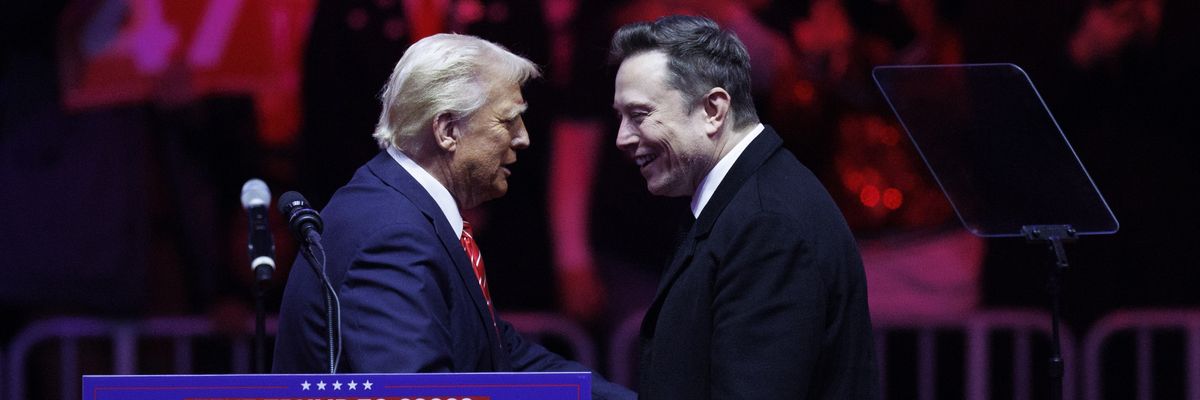
Tesla CEO Elon Musk stands on stage with President-elect Donald Trump during a rally at Capital One Arena in Washington, D.C. on January 19, 2025.
"We are seeing the rise of an oligarchy... And yet here we are talking about dismantling the estate tax, the one tax at the federal level that actually slows this concentration of wealth and power," said one expert.
Americans for Tax Fairness has crunched the numbers and found that a Republican push to do away with the federal estate tax—a measure that's been described as an "aristocracy prevention act"—could yield billions for the families of U.S. President Donald Trump and his billionaire adviser Elon Musk, according to a report from the advocacy group published Thursday.
Abolishing the estate tax, a tax on the wealth of the richest Americans when they die, could save Musk's family up to roughly $132 billion, and could save Trump's heirs up to around $2 billion, according to ATF, which made its calculation using recent estimates of each man's net worth. The top federal estate tax rate is 40%.
The group noted that "both the Trump and Musk families have undoubtedly set up elaborate estate-tax-avoidance schemes, as most superwealthy families do. Since we do not know what tax-avoidance schemes they have undertaken, we have calculated the maximum amount that would be due if the estate tax were fully repealed."
The estate tax has long been in Republicans' crosshairs.
According to Bloomberg, Senate Majority Leader John Thune (R-S.D) on Wednesday endorsed the estate tax being repealed entirely, placing the repeal of the tax at the center of current negotiations over GOP efforts to approve a multitrillion-dollar tax bill that would extend provisions in Trump's 2017 Tax Cuts and Jobs Act (TCJA) that primarily benefited the wealthy.
Thune was also among 45 senators who introduced a bill in February that would repeal the federal estate tax.
Trump already did wealthy Americans a favor with the passage of the TCJA, which in effect doubled the estate tax exemption amount, which as of 2025 is $14 million for individuals and twice that for married couples filing jointly. If this TCJA exemption were to expire, the exemption would drop down to $7 million per individual, meaning more millionaires would be forced to pay federal estate tax.
According to Daniel Willing, a senior wealth strategist with U.S. Bank Private Wealth Management, of all the aspects of the TCJA expiration, this drop in the estate tax exemption may have the largest impact on wealthy families.
According to ATF, "If the more generous exemption amount is retained instead of being allowed to expire, the Musk and Trump families could each save up to about $5.6 million in estate taxes."
Chuck Collins, a director at the progressive organization Institute for Policy Studies, highlighted the stakes of this kind of wealth accumulation in a video from More Perfect Union about the estate tax that was released in early March.
"We are in the second Gilded Age. You know, we are seeing the rise of an oligarchy... And yet here we are talking about dismantling the estate tax, the one tax at the federal level that actually slows this concentration of wealth and power," said Collins.
In addition to focusing on the estate tax, ATF's analysis also highlights that one of the TCJA's components that's set to expire is a set of lower tax rates on "ordinary income."
Musk had an average annual taxable income of roughly $179 million between 2013 and 2018—and 99% of it was "ordinary" income, according to the report, which cites data from ProPublica.
"Assuming he had the same average taxable income in each of the first 10 years of an extension of the Trump law's lower tax rates (and this may be a conservative assumption, since he's many times richer now), Musk could save a total of around $50 million in income taxes," per ATF.
Based on Trump's available tax returns, according to ATF, Trump received on average roughly $10 million a year in wages, taxable interest, ordinary dividends, and taxable pensions and annuities, which ATF deems his "predictable" sources of ordinary income.
"Just considering those four sources of ordinary income, over the first 10 years of an extension of his lower tax rates Trump could save a total of up to roughly $2.7 million in income taxes," according to the report.
Dear Common Dreams reader, It’s been nearly 30 years since I co-founded Common Dreams with my late wife, Lina Newhouser. We had the radical notion that journalism should serve the public good, not corporate profits. It was clear to us from the outset what it would take to build such a project. No paid advertisements. No corporate sponsors. No millionaire publisher telling us what to think or do. Many people said we wouldn't last a year, but we proved those doubters wrong. Together with a tremendous team of journalists and dedicated staff, we built an independent media outlet free from the constraints of profits and corporate control. Our mission has always been simple: To inform. To inspire. To ignite change for the common good. Building Common Dreams was not easy. Our survival was never guaranteed. When you take on the most powerful forces—Wall Street greed, fossil fuel industry destruction, Big Tech lobbyists, and uber-rich oligarchs who have spent billions upon billions rigging the economy and democracy in their favor—the only bulwark you have is supporters who believe in your work. But here’s the urgent message from me today. It's never been this bad out there. And it's never been this hard to keep us going. At the very moment Common Dreams is most needed, the threats we face are intensifying. We need your support now more than ever. We don't accept corporate advertising and never will. We don't have a paywall because we don't think people should be blocked from critical news based on their ability to pay. Everything we do is funded by the donations of readers like you. When everyone does the little they can afford, we are strong. But if that support retreats or dries up, so do we. Will you donate now to make sure Common Dreams not only survives but thrives? —Craig Brown, Co-founder |
Americans for Tax Fairness has crunched the numbers and found that a Republican push to do away with the federal estate tax—a measure that's been described as an "aristocracy prevention act"—could yield billions for the families of U.S. President Donald Trump and his billionaire adviser Elon Musk, according to a report from the advocacy group published Thursday.
Abolishing the estate tax, a tax on the wealth of the richest Americans when they die, could save Musk's family up to roughly $132 billion, and could save Trump's heirs up to around $2 billion, according to ATF, which made its calculation using recent estimates of each man's net worth. The top federal estate tax rate is 40%.
The group noted that "both the Trump and Musk families have undoubtedly set up elaborate estate-tax-avoidance schemes, as most superwealthy families do. Since we do not know what tax-avoidance schemes they have undertaken, we have calculated the maximum amount that would be due if the estate tax were fully repealed."
The estate tax has long been in Republicans' crosshairs.
According to Bloomberg, Senate Majority Leader John Thune (R-S.D) on Wednesday endorsed the estate tax being repealed entirely, placing the repeal of the tax at the center of current negotiations over GOP efforts to approve a multitrillion-dollar tax bill that would extend provisions in Trump's 2017 Tax Cuts and Jobs Act (TCJA) that primarily benefited the wealthy.
Thune was also among 45 senators who introduced a bill in February that would repeal the federal estate tax.
Trump already did wealthy Americans a favor with the passage of the TCJA, which in effect doubled the estate tax exemption amount, which as of 2025 is $14 million for individuals and twice that for married couples filing jointly. If this TCJA exemption were to expire, the exemption would drop down to $7 million per individual, meaning more millionaires would be forced to pay federal estate tax.
According to Daniel Willing, a senior wealth strategist with U.S. Bank Private Wealth Management, of all the aspects of the TCJA expiration, this drop in the estate tax exemption may have the largest impact on wealthy families.
According to ATF, "If the more generous exemption amount is retained instead of being allowed to expire, the Musk and Trump families could each save up to about $5.6 million in estate taxes."
Chuck Collins, a director at the progressive organization Institute for Policy Studies, highlighted the stakes of this kind of wealth accumulation in a video from More Perfect Union about the estate tax that was released in early March.
"We are in the second Gilded Age. You know, we are seeing the rise of an oligarchy... And yet here we are talking about dismantling the estate tax, the one tax at the federal level that actually slows this concentration of wealth and power," said Collins.
In addition to focusing on the estate tax, ATF's analysis also highlights that one of the TCJA's components that's set to expire is a set of lower tax rates on "ordinary income."
Musk had an average annual taxable income of roughly $179 million between 2013 and 2018—and 99% of it was "ordinary" income, according to the report, which cites data from ProPublica.
"Assuming he had the same average taxable income in each of the first 10 years of an extension of the Trump law's lower tax rates (and this may be a conservative assumption, since he's many times richer now), Musk could save a total of around $50 million in income taxes," per ATF.
Based on Trump's available tax returns, according to ATF, Trump received on average roughly $10 million a year in wages, taxable interest, ordinary dividends, and taxable pensions and annuities, which ATF deems his "predictable" sources of ordinary income.
"Just considering those four sources of ordinary income, over the first 10 years of an extension of his lower tax rates Trump could save a total of up to roughly $2.7 million in income taxes," according to the report.
Americans for Tax Fairness has crunched the numbers and found that a Republican push to do away with the federal estate tax—a measure that's been described as an "aristocracy prevention act"—could yield billions for the families of U.S. President Donald Trump and his billionaire adviser Elon Musk, according to a report from the advocacy group published Thursday.
Abolishing the estate tax, a tax on the wealth of the richest Americans when they die, could save Musk's family up to roughly $132 billion, and could save Trump's heirs up to around $2 billion, according to ATF, which made its calculation using recent estimates of each man's net worth. The top federal estate tax rate is 40%.
The group noted that "both the Trump and Musk families have undoubtedly set up elaborate estate-tax-avoidance schemes, as most superwealthy families do. Since we do not know what tax-avoidance schemes they have undertaken, we have calculated the maximum amount that would be due if the estate tax were fully repealed."
The estate tax has long been in Republicans' crosshairs.
According to Bloomberg, Senate Majority Leader John Thune (R-S.D) on Wednesday endorsed the estate tax being repealed entirely, placing the repeal of the tax at the center of current negotiations over GOP efforts to approve a multitrillion-dollar tax bill that would extend provisions in Trump's 2017 Tax Cuts and Jobs Act (TCJA) that primarily benefited the wealthy.
Thune was also among 45 senators who introduced a bill in February that would repeal the federal estate tax.
Trump already did wealthy Americans a favor with the passage of the TCJA, which in effect doubled the estate tax exemption amount, which as of 2025 is $14 million for individuals and twice that for married couples filing jointly. If this TCJA exemption were to expire, the exemption would drop down to $7 million per individual, meaning more millionaires would be forced to pay federal estate tax.
According to Daniel Willing, a senior wealth strategist with U.S. Bank Private Wealth Management, of all the aspects of the TCJA expiration, this drop in the estate tax exemption may have the largest impact on wealthy families.
According to ATF, "If the more generous exemption amount is retained instead of being allowed to expire, the Musk and Trump families could each save up to about $5.6 million in estate taxes."
Chuck Collins, a director at the progressive organization Institute for Policy Studies, highlighted the stakes of this kind of wealth accumulation in a video from More Perfect Union about the estate tax that was released in early March.
"We are in the second Gilded Age. You know, we are seeing the rise of an oligarchy... And yet here we are talking about dismantling the estate tax, the one tax at the federal level that actually slows this concentration of wealth and power," said Collins.
In addition to focusing on the estate tax, ATF's analysis also highlights that one of the TCJA's components that's set to expire is a set of lower tax rates on "ordinary income."
Musk had an average annual taxable income of roughly $179 million between 2013 and 2018—and 99% of it was "ordinary" income, according to the report, which cites data from ProPublica.
"Assuming he had the same average taxable income in each of the first 10 years of an extension of the Trump law's lower tax rates (and this may be a conservative assumption, since he's many times richer now), Musk could save a total of around $50 million in income taxes," per ATF.
Based on Trump's available tax returns, according to ATF, Trump received on average roughly $10 million a year in wages, taxable interest, ordinary dividends, and taxable pensions and annuities, which ATF deems his "predictable" sources of ordinary income.
"Just considering those four sources of ordinary income, over the first 10 years of an extension of his lower tax rates Trump could save a total of up to roughly $2.7 million in income taxes," according to the report.

