SUBSCRIBE TO OUR FREE NEWSLETTER
Daily news & progressive opinion—funded by the people, not the corporations—delivered straight to your inbox.
5
#000000
#FFFFFF
To donate by check, phone, or other method, see our More Ways to Give page.
Daily news & progressive opinion—funded by the people, not the corporations—delivered straight to your inbox.
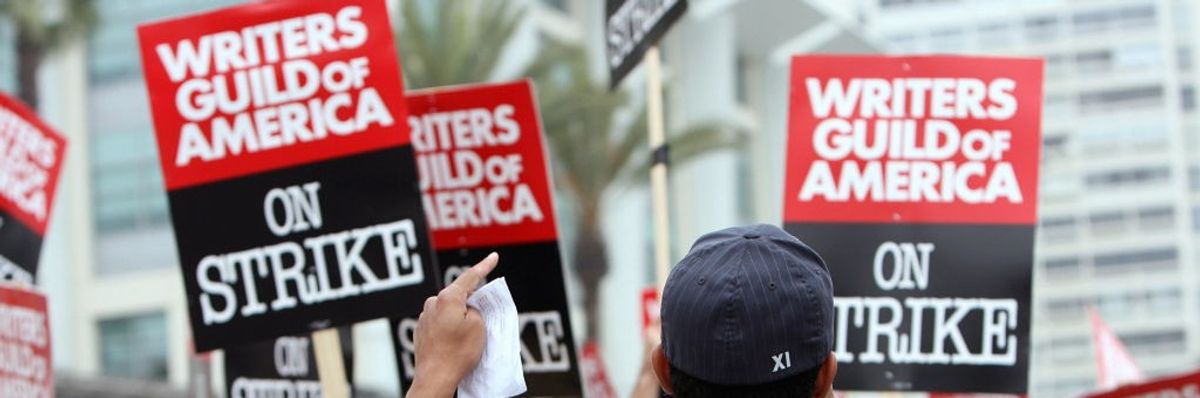
Writers participates at a demonstration in front of the Fox studio in Los Angeles, California, 05 November 2007.
"The companies have broken this business. They have taken so much from the very people, the writers, who have made them wealthy."
Unionized film and television writers are on strike Tuesday after a midnight deadline came without a deal with executives of the major producers and streaming giants in Hollywood.
The negotiating committee representing both the East and West Coast branches of the Writers Guild of America said in a statement that the strike would be in effect as of 12:01 am and that members—who voted last month to authorize a strike if one became necessary—would be on the picket line beginning Tuesday afternoon in both Los Angeles and New York.
"Though we negotiated intent on making a fair deal—and though your strike vote gave us the leverage to make some gains—the studios' responses to our proposals have been wholly insufficient, given the existential crisis writers are facing," the WGA said in a statement. "The companies' behavior has created a gig economy inside a union workforce, and their immovable stance in this negotiation has betrayed a commitment to further devaluing the profession of writing."
"We had hoped to do this through reasonable conversation. Now we will do it through struggle." —Writers Guild of America
At issue are pay scales, residual fees, and base employment guarantees from producers for writers working in the era of online streaming and the new distribution models created by giants like Disney, Netflix, Apple, Amazon, NBC Universal, Paramount, Sony, and Discover-Warner—some of the largest and most profitable companies in the entertainment industry—under the umbrella of the Alliance of Motion Picture and Television Producers (AMPTP).
"If they could do without us, they would," said television writer David Slack, in support of the union. "If they could break us, they would. They can't. They won't."
According to the Los Angeles Times:
Although streaming has been a boon for television, it has upended how writers are compensated. Writers say that they work longer hours for less pay and that they no longer can rely on a steady stream of residual income they used to get in the days of broadcast TV, when successful shows lived on for years in syndicated reruns or the once-lucrative home video market.
The median weekly pay for writer-producers declined 23% over the last decade when adjusting for inflation, according to a WGA survey. When accounting for inflation, screenwriter pay declined 14% in the last five years, the report said.
The WGA said because of the producers' unwillingness to budge on key demands, "We must now exert the maximum leverage possible to get a fair contract by withholding our labor."
David Goodman, co-chair of the negotiating committee, told the LA Times that the need for a strike became increasingly evident over recent days of bargaining.
"It was really very clear that the companies were unwilling to move on many of the very important issues we raised," Goodman said. "They kept wanting us to give up things that we just wanted to talk about and so as a result, we realized that they didn't want to make a deal."
The union said the exploitation they suffer as writers is clear to see, but that it will not be tolerated any longer by an industry that disregards the key role they play in creating the shows and movies that audiences pay to enjoy.
"Here is what all writers know: the companies have broken this business," the WGA committee said. "They have taken so much from the very people, the writers, who have made them wealthy. But what they cannot take from us is each other, our solidarity, our mutual commitment to save ourselves and this profession that we love."
"We had hoped to do this through reasonable conversation," the statement continued. "Now we will do it through struggle. For the sake of our present and our future, we have been given no other choice."
Dear Common Dreams reader, It’s been nearly 30 years since I co-founded Common Dreams with my late wife, Lina Newhouser. We had the radical notion that journalism should serve the public good, not corporate profits. It was clear to us from the outset what it would take to build such a project. No paid advertisements. No corporate sponsors. No millionaire publisher telling us what to think or do. Many people said we wouldn't last a year, but we proved those doubters wrong. Together with a tremendous team of journalists and dedicated staff, we built an independent media outlet free from the constraints of profits and corporate control. Our mission has always been simple: To inform. To inspire. To ignite change for the common good. Building Common Dreams was not easy. Our survival was never guaranteed. When you take on the most powerful forces—Wall Street greed, fossil fuel industry destruction, Big Tech lobbyists, and uber-rich oligarchs who have spent billions upon billions rigging the economy and democracy in their favor—the only bulwark you have is supporters who believe in your work. But here’s the urgent message from me today. It's never been this bad out there. And it's never been this hard to keep us going. At the very moment Common Dreams is most needed, the threats we face are intensifying. We need your support now more than ever. We don't accept corporate advertising and never will. We don't have a paywall because we don't think people should be blocked from critical news based on their ability to pay. Everything we do is funded by the donations of readers like you. When everyone does the little they can afford, we are strong. But if that support retreats or dries up, so do we. Will you donate now to make sure Common Dreams not only survives but thrives? —Craig Brown, Co-founder |
Unionized film and television writers are on strike Tuesday after a midnight deadline came without a deal with executives of the major producers and streaming giants in Hollywood.
The negotiating committee representing both the East and West Coast branches of the Writers Guild of America said in a statement that the strike would be in effect as of 12:01 am and that members—who voted last month to authorize a strike if one became necessary—would be on the picket line beginning Tuesday afternoon in both Los Angeles and New York.
"Though we negotiated intent on making a fair deal—and though your strike vote gave us the leverage to make some gains—the studios' responses to our proposals have been wholly insufficient, given the existential crisis writers are facing," the WGA said in a statement. "The companies' behavior has created a gig economy inside a union workforce, and their immovable stance in this negotiation has betrayed a commitment to further devaluing the profession of writing."
"We had hoped to do this through reasonable conversation. Now we will do it through struggle." —Writers Guild of America
At issue are pay scales, residual fees, and base employment guarantees from producers for writers working in the era of online streaming and the new distribution models created by giants like Disney, Netflix, Apple, Amazon, NBC Universal, Paramount, Sony, and Discover-Warner—some of the largest and most profitable companies in the entertainment industry—under the umbrella of the Alliance of Motion Picture and Television Producers (AMPTP).
"If they could do without us, they would," said television writer David Slack, in support of the union. "If they could break us, they would. They can't. They won't."
According to the Los Angeles Times:
Although streaming has been a boon for television, it has upended how writers are compensated. Writers say that they work longer hours for less pay and that they no longer can rely on a steady stream of residual income they used to get in the days of broadcast TV, when successful shows lived on for years in syndicated reruns or the once-lucrative home video market.
The median weekly pay for writer-producers declined 23% over the last decade when adjusting for inflation, according to a WGA survey. When accounting for inflation, screenwriter pay declined 14% in the last five years, the report said.
The WGA said because of the producers' unwillingness to budge on key demands, "We must now exert the maximum leverage possible to get a fair contract by withholding our labor."
David Goodman, co-chair of the negotiating committee, told the LA Times that the need for a strike became increasingly evident over recent days of bargaining.
"It was really very clear that the companies were unwilling to move on many of the very important issues we raised," Goodman said. "They kept wanting us to give up things that we just wanted to talk about and so as a result, we realized that they didn't want to make a deal."
The union said the exploitation they suffer as writers is clear to see, but that it will not be tolerated any longer by an industry that disregards the key role they play in creating the shows and movies that audiences pay to enjoy.
"Here is what all writers know: the companies have broken this business," the WGA committee said. "They have taken so much from the very people, the writers, who have made them wealthy. But what they cannot take from us is each other, our solidarity, our mutual commitment to save ourselves and this profession that we love."
"We had hoped to do this through reasonable conversation," the statement continued. "Now we will do it through struggle. For the sake of our present and our future, we have been given no other choice."
Unionized film and television writers are on strike Tuesday after a midnight deadline came without a deal with executives of the major producers and streaming giants in Hollywood.
The negotiating committee representing both the East and West Coast branches of the Writers Guild of America said in a statement that the strike would be in effect as of 12:01 am and that members—who voted last month to authorize a strike if one became necessary—would be on the picket line beginning Tuesday afternoon in both Los Angeles and New York.
"Though we negotiated intent on making a fair deal—and though your strike vote gave us the leverage to make some gains—the studios' responses to our proposals have been wholly insufficient, given the existential crisis writers are facing," the WGA said in a statement. "The companies' behavior has created a gig economy inside a union workforce, and their immovable stance in this negotiation has betrayed a commitment to further devaluing the profession of writing."
"We had hoped to do this through reasonable conversation. Now we will do it through struggle." —Writers Guild of America
At issue are pay scales, residual fees, and base employment guarantees from producers for writers working in the era of online streaming and the new distribution models created by giants like Disney, Netflix, Apple, Amazon, NBC Universal, Paramount, Sony, and Discover-Warner—some of the largest and most profitable companies in the entertainment industry—under the umbrella of the Alliance of Motion Picture and Television Producers (AMPTP).
"If they could do without us, they would," said television writer David Slack, in support of the union. "If they could break us, they would. They can't. They won't."
According to the Los Angeles Times:
Although streaming has been a boon for television, it has upended how writers are compensated. Writers say that they work longer hours for less pay and that they no longer can rely on a steady stream of residual income they used to get in the days of broadcast TV, when successful shows lived on for years in syndicated reruns or the once-lucrative home video market.
The median weekly pay for writer-producers declined 23% over the last decade when adjusting for inflation, according to a WGA survey. When accounting for inflation, screenwriter pay declined 14% in the last five years, the report said.
The WGA said because of the producers' unwillingness to budge on key demands, "We must now exert the maximum leverage possible to get a fair contract by withholding our labor."
David Goodman, co-chair of the negotiating committee, told the LA Times that the need for a strike became increasingly evident over recent days of bargaining.
"It was really very clear that the companies were unwilling to move on many of the very important issues we raised," Goodman said. "They kept wanting us to give up things that we just wanted to talk about and so as a result, we realized that they didn't want to make a deal."
The union said the exploitation they suffer as writers is clear to see, but that it will not be tolerated any longer by an industry that disregards the key role they play in creating the shows and movies that audiences pay to enjoy.
"Here is what all writers know: the companies have broken this business," the WGA committee said. "They have taken so much from the very people, the writers, who have made them wealthy. But what they cannot take from us is each other, our solidarity, our mutual commitment to save ourselves and this profession that we love."
"We had hoped to do this through reasonable conversation," the statement continued. "Now we will do it through struggle. For the sake of our present and our future, we have been given no other choice."