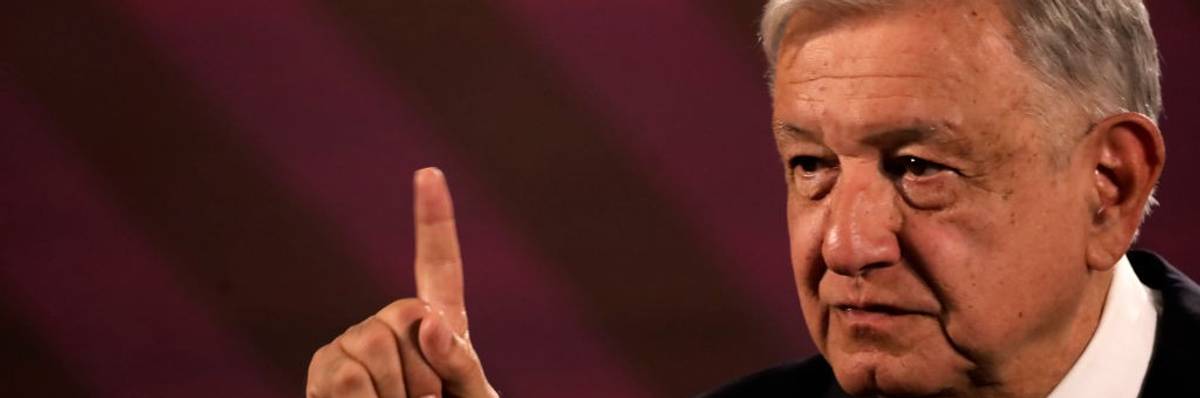
Mexican President Andrés Manuel López Obrador speaks at a press conference at the National Palace in Mexico City on June 14, 2024.
Blasting US 'Recklessness,' Mexico Pauses Embassy Relations Over Judicial Reform Meddling
"They have to learn to respect Mexico's sovereignty," Mexican President Andrés Manuel López Obrador said of the U.S. and Canada after their ambassadors weighed in on his controversial proposal.
Outgoing Mexican President Andrés Manuel López Obrador put the embassies of the United States and Canada on time out Tuesday after their top diplomats and other influential figures weighed in against controversial proposed reforms to Mexico's judicial system.
"The relationship with Ken Salazar is good, but it's on pause. We're going to give ourselves our time," López Obrador—who is widely known as AMLO— said during his morning press conference, referring to the U.S. ambassador. The president said the "pause" also applies to Canada, whose ambassador, Graeme Clark, voiced alarm over the proposed reforms.
"They have to learn to respect Mexico's sovereignty, because we are not going to give them advice there, nor to say that it is okay and what is wrong," he added. "We want them to be respectful, there is a reciprocal relationship in terms of sovereignty."
López Obrador's move came after Salazar asserted last week that "popular direct election of judges is a major risk to the functioning of Mexico's democracy."
"We understand the importance of Mexico's fight against judicial corruption. But direct political election of judges, in my view, would not address judicial corruption nor would it strengthen the judicial branch of government," the ambassador continued. "It would also weaken the efforts to make North American economic integration a reality and would create turbulence as the debate over direct election will continue over the next several years."
"I believe faith and trust in the rule of law are one of the many shared values which unite our nations, while for the private sector, they lay the groundwork for building confidence and inspiring investment in a stable and predictable environment," Salazar added.
Clark subsequently said that Canadian "investors are concerned; they want stability, they want a judicial system that works if there are problems."
López Obrador accused the ambassadors of "recklessness" during his Tuesday press conference, adding that "there are things that only concern our country."
It's not just the ambassadors. On Tuesday, U.S. Senate Foreign Relations Committee Chair Ben Cardin (D-Md.), Ranking Member James Risch (R-Idaho), and Sens. Tim Kaine (D-Va.) and Marco Rubio (R-Fla.) said in a joint statement that they "are deeply concerned that the proposed judicial reforms in Mexico would undermine the independence and transparency of the country's judiciary, jeopardizing critical economic and security interests shared by our two nations."
"We are also alarmed that several other constitutional reforms currently under discussion may contradict commitments made in the U.S.-Mexico-Canada Trade Agreement, which is scheduled for review in 2026," the senators added.
The Global Enterprise Council, the Mexico City-based lobbyist for 63 multinational corporations operating in Mexico—including Walmart, American Express, AT&T, General Motors, Microsoft, and ExxonMobil—is also opposing the proposed judicial reforms, as are other organizations including the New York City Bar Association and the Washington Post editorial board.
López Obrador's "Plan C" proposes a sweeping overhaul of Mexico's corruption-ridden judiciary. The plan's most controversial reform would make judges at all levels of the judiciary—who are currently appointed—elected officials. All current sitting judges would be up for election in 2025 and 2027.
The president argues these reforms are necessary to combat corruption and impunity in Mexico's judicial system. He has
accused Mexican Supreme Court justices of being "supporters of the oligarchy, not of democracy" and says they oppose Plan C because "they do not want a government of the people."
Plan C—which came after an earlier proposal was blocked by the Supreme Court—has sparked nationwide protests by opponents, who say López Obrador is trying to weaken the judiciary and the National Electoral Institute and entrench his ruling Morena party as former Mexico City Mayor Claudia Sheinbaum, a close ally of the president, prepares to replace him on October 1 after winning June's election in a landslide.
Tensions between Mexico and the United States have been mounting for months over Mexican perceptions of U.S. meddling, including dubiously timed corporate media
reports of alleged links between López Obrador and drug cartels.
Last week, López Obrador said that Salazar's statement "expressing a position on this strictly domestic matter of the Mexican state represents unacceptable interference, contravenes the sovereignty of the United Mexican States, and does not reflect the degree of mutual respect that characterizes the relations between our governments."
"This is an overtly interventionist attitude; I hope it does not happen again," he added.
In separate remarks last week, López Obrador also accused the U.S. of funding organizations working to undermine the Mexican government under the guise of human rights.
For example, the U.S. Agency for International Development—whose decadeslong history of meddling in Latin America runs the gamut from
kidnapping and torturing unhoused Uruguayans to death for instructional purposes to an attempt at toppling Cuba's revolutionary government by infiltrating the island's hip-hop scene—has financially supported Mexicans Against Corruption and Impunity, a frequent critic of the López Obrador administration.
During his Tuesday press conference, López Obrador reminded Mexicans of centuries of U.S. aggression and meddling in Mexico's internal affairs.
"For many years… the United States has applied an interventionist policy throughout America, ever since it established the Monroe Doctrine," he said.
López Obrador recounted how Mexico lost half its territory as a result of the 1846-48 U.S. invasion—carried out on false pretexts decried by a young congressman from Illinois named Abraham Lincoln—and endured seven months of U.S. occupation of Veracruz in 1914.
The president stressed that having trade agreements with the U.S. does not mean that Washington has the right to meddle in Mexican affairs.
"The treaty is not for us to cede our sovereignty, the treaty is about trade, about forging good economic and commercial ties that suit both nations," he said Tuesday. "But that doesn't mean Mexico must become an appendix, a colony, or a protectorate."
We are at a crossroads
This country and this world are at a monumental crossroads. In a few short weeks, US voters will have an opportunity to beat back the forces of fascism and confront the billionaires who are rigging the economy, our media system, and our democracy, making it increasingly impossible for ordinary people to get by. We’re not just talking about the election. We’re talking about what must be done once these fascist elements are vanquished from power. We need a bolder set of solutions than what either major party has so far been willing to offer and a working-class movement ready to fight like hell for it. Trump didn't emerge from nowhere. The conditions that fueled MAGA authoritarianism were created by decades of radical neoliberal economic policies and a corrupt political system dominated by corporate interests. They slashed taxes on the super-rich, promising that the benefits would trickle down. They said giveaways to the corporate titans would make life more affordable for the rest of us. It was all bullshit. And when a bitter, betrayed populace searches for someone to blame, right-wing demagogues have little trouble finding scapegoats. People know when they're being lied to, but you won't hear any of this from the corporate media. Only independent journalism—powered and funded by people who believe in building a better world—can deliver truly trustworthy daily news. Our Fall Campaign is underway, and we need your help. To power our newsroom through the rest of the year, we need to raise $125,000 by midnight on October 31. So if you share our vision, please contribute whatever you can to sustain our work. |
Outgoing Mexican President Andrés Manuel López Obrador put the embassies of the United States and Canada on time out Tuesday after their top diplomats and other influential figures weighed in against controversial proposed reforms to Mexico's judicial system.
"The relationship with Ken Salazar is good, but it's on pause. We're going to give ourselves our time," López Obrador—who is widely known as AMLO— said during his morning press conference, referring to the U.S. ambassador. The president said the "pause" also applies to Canada, whose ambassador, Graeme Clark, voiced alarm over the proposed reforms.
"They have to learn to respect Mexico's sovereignty, because we are not going to give them advice there, nor to say that it is okay and what is wrong," he added. "We want them to be respectful, there is a reciprocal relationship in terms of sovereignty."
López Obrador's move came after Salazar asserted last week that "popular direct election of judges is a major risk to the functioning of Mexico's democracy."
"We understand the importance of Mexico's fight against judicial corruption. But direct political election of judges, in my view, would not address judicial corruption nor would it strengthen the judicial branch of government," the ambassador continued. "It would also weaken the efforts to make North American economic integration a reality and would create turbulence as the debate over direct election will continue over the next several years."
"I believe faith and trust in the rule of law are one of the many shared values which unite our nations, while for the private sector, they lay the groundwork for building confidence and inspiring investment in a stable and predictable environment," Salazar added.
Clark subsequently said that Canadian "investors are concerned; they want stability, they want a judicial system that works if there are problems."
López Obrador accused the ambassadors of "recklessness" during his Tuesday press conference, adding that "there are things that only concern our country."
It's not just the ambassadors. On Tuesday, U.S. Senate Foreign Relations Committee Chair Ben Cardin (D-Md.), Ranking Member James Risch (R-Idaho), and Sens. Tim Kaine (D-Va.) and Marco Rubio (R-Fla.) said in a joint statement that they "are deeply concerned that the proposed judicial reforms in Mexico would undermine the independence and transparency of the country's judiciary, jeopardizing critical economic and security interests shared by our two nations."
"We are also alarmed that several other constitutional reforms currently under discussion may contradict commitments made in the U.S.-Mexico-Canada Trade Agreement, which is scheduled for review in 2026," the senators added.
The Global Enterprise Council, the Mexico City-based lobbyist for 63 multinational corporations operating in Mexico—including Walmart, American Express, AT&T, General Motors, Microsoft, and ExxonMobil—is also opposing the proposed judicial reforms, as are other organizations including the New York City Bar Association and the Washington Post editorial board.
López Obrador's "Plan C" proposes a sweeping overhaul of Mexico's corruption-ridden judiciary. The plan's most controversial reform would make judges at all levels of the judiciary—who are currently appointed—elected officials. All current sitting judges would be up for election in 2025 and 2027.
The president argues these reforms are necessary to combat corruption and impunity in Mexico's judicial system. He has
accused Mexican Supreme Court justices of being "supporters of the oligarchy, not of democracy" and says they oppose Plan C because "they do not want a government of the people."
Plan C—which came after an earlier proposal was blocked by the Supreme Court—has sparked nationwide protests by opponents, who say López Obrador is trying to weaken the judiciary and the National Electoral Institute and entrench his ruling Morena party as former Mexico City Mayor Claudia Sheinbaum, a close ally of the president, prepares to replace him on October 1 after winning June's election in a landslide.
Tensions between Mexico and the United States have been mounting for months over Mexican perceptions of U.S. meddling, including dubiously timed corporate media
reports of alleged links between López Obrador and drug cartels.
Last week, López Obrador said that Salazar's statement "expressing a position on this strictly domestic matter of the Mexican state represents unacceptable interference, contravenes the sovereignty of the United Mexican States, and does not reflect the degree of mutual respect that characterizes the relations between our governments."
"This is an overtly interventionist attitude; I hope it does not happen again," he added.
In separate remarks last week, López Obrador also accused the U.S. of funding organizations working to undermine the Mexican government under the guise of human rights.
For example, the U.S. Agency for International Development—whose decadeslong history of meddling in Latin America runs the gamut from
kidnapping and torturing unhoused Uruguayans to death for instructional purposes to an attempt at toppling Cuba's revolutionary government by infiltrating the island's hip-hop scene—has financially supported Mexicans Against Corruption and Impunity, a frequent critic of the López Obrador administration.
During his Tuesday press conference, López Obrador reminded Mexicans of centuries of U.S. aggression and meddling in Mexico's internal affairs.
"For many years… the United States has applied an interventionist policy throughout America, ever since it established the Monroe Doctrine," he said.
López Obrador recounted how Mexico lost half its territory as a result of the 1846-48 U.S. invasion—carried out on false pretexts decried by a young congressman from Illinois named Abraham Lincoln—and endured seven months of U.S. occupation of Veracruz in 1914.
The president stressed that having trade agreements with the U.S. does not mean that Washington has the right to meddle in Mexican affairs.
"The treaty is not for us to cede our sovereignty, the treaty is about trade, about forging good economic and commercial ties that suit both nations," he said Tuesday. "But that doesn't mean Mexico must become an appendix, a colony, or a protectorate."
- In 'Assault' on Mexican Food Sovereignty, US Ramps Up Fight Over GM Corn ›
- Mexican President Urges US to Stop Fueling Migration With Sanctions on Cuba, Venezuela ›
- Mexican President Vows Global Push to End 'Inhumane' US Embargo of Cuba ›
- Mexico's 'Bernie Sanders' Wins in a Huge Historic Landslide With Mandate to Reshape the Nation ›
- Latin America Is Now Dominated by Progressive Governments, But Are They Losing Touch? ›
- AMLO vs Bolso: Opposing Views on Development ›
- Massive Demonstration of Support for Lopez Obrador in Mexico City ›
- Opinion | The US Has No Business Telling Mexico Not to Reform Its Judiciary | Common Dreams ›
Outgoing Mexican President Andrés Manuel López Obrador put the embassies of the United States and Canada on time out Tuesday after their top diplomats and other influential figures weighed in against controversial proposed reforms to Mexico's judicial system.
"The relationship with Ken Salazar is good, but it's on pause. We're going to give ourselves our time," López Obrador—who is widely known as AMLO— said during his morning press conference, referring to the U.S. ambassador. The president said the "pause" also applies to Canada, whose ambassador, Graeme Clark, voiced alarm over the proposed reforms.
"They have to learn to respect Mexico's sovereignty, because we are not going to give them advice there, nor to say that it is okay and what is wrong," he added. "We want them to be respectful, there is a reciprocal relationship in terms of sovereignty."
López Obrador's move came after Salazar asserted last week that "popular direct election of judges is a major risk to the functioning of Mexico's democracy."
"We understand the importance of Mexico's fight against judicial corruption. But direct political election of judges, in my view, would not address judicial corruption nor would it strengthen the judicial branch of government," the ambassador continued. "It would also weaken the efforts to make North American economic integration a reality and would create turbulence as the debate over direct election will continue over the next several years."
"I believe faith and trust in the rule of law are one of the many shared values which unite our nations, while for the private sector, they lay the groundwork for building confidence and inspiring investment in a stable and predictable environment," Salazar added.
Clark subsequently said that Canadian "investors are concerned; they want stability, they want a judicial system that works if there are problems."
López Obrador accused the ambassadors of "recklessness" during his Tuesday press conference, adding that "there are things that only concern our country."
It's not just the ambassadors. On Tuesday, U.S. Senate Foreign Relations Committee Chair Ben Cardin (D-Md.), Ranking Member James Risch (R-Idaho), and Sens. Tim Kaine (D-Va.) and Marco Rubio (R-Fla.) said in a joint statement that they "are deeply concerned that the proposed judicial reforms in Mexico would undermine the independence and transparency of the country's judiciary, jeopardizing critical economic and security interests shared by our two nations."
"We are also alarmed that several other constitutional reforms currently under discussion may contradict commitments made in the U.S.-Mexico-Canada Trade Agreement, which is scheduled for review in 2026," the senators added.
The Global Enterprise Council, the Mexico City-based lobbyist for 63 multinational corporations operating in Mexico—including Walmart, American Express, AT&T, General Motors, Microsoft, and ExxonMobil—is also opposing the proposed judicial reforms, as are other organizations including the New York City Bar Association and the Washington Post editorial board.
López Obrador's "Plan C" proposes a sweeping overhaul of Mexico's corruption-ridden judiciary. The plan's most controversial reform would make judges at all levels of the judiciary—who are currently appointed—elected officials. All current sitting judges would be up for election in 2025 and 2027.
The president argues these reforms are necessary to combat corruption and impunity in Mexico's judicial system. He has
accused Mexican Supreme Court justices of being "supporters of the oligarchy, not of democracy" and says they oppose Plan C because "they do not want a government of the people."
Plan C—which came after an earlier proposal was blocked by the Supreme Court—has sparked nationwide protests by opponents, who say López Obrador is trying to weaken the judiciary and the National Electoral Institute and entrench his ruling Morena party as former Mexico City Mayor Claudia Sheinbaum, a close ally of the president, prepares to replace him on October 1 after winning June's election in a landslide.
Tensions between Mexico and the United States have been mounting for months over Mexican perceptions of U.S. meddling, including dubiously timed corporate media
reports of alleged links between López Obrador and drug cartels.
Last week, López Obrador said that Salazar's statement "expressing a position on this strictly domestic matter of the Mexican state represents unacceptable interference, contravenes the sovereignty of the United Mexican States, and does not reflect the degree of mutual respect that characterizes the relations between our governments."
"This is an overtly interventionist attitude; I hope it does not happen again," he added.
In separate remarks last week, López Obrador also accused the U.S. of funding organizations working to undermine the Mexican government under the guise of human rights.
For example, the U.S. Agency for International Development—whose decadeslong history of meddling in Latin America runs the gamut from
kidnapping and torturing unhoused Uruguayans to death for instructional purposes to an attempt at toppling Cuba's revolutionary government by infiltrating the island's hip-hop scene—has financially supported Mexicans Against Corruption and Impunity, a frequent critic of the López Obrador administration.
During his Tuesday press conference, López Obrador reminded Mexicans of centuries of U.S. aggression and meddling in Mexico's internal affairs.
"For many years… the United States has applied an interventionist policy throughout America, ever since it established the Monroe Doctrine," he said.
López Obrador recounted how Mexico lost half its territory as a result of the 1846-48 U.S. invasion—carried out on false pretexts decried by a young congressman from Illinois named Abraham Lincoln—and endured seven months of U.S. occupation of Veracruz in 1914.
The president stressed that having trade agreements with the U.S. does not mean that Washington has the right to meddle in Mexican affairs.
"The treaty is not for us to cede our sovereignty, the treaty is about trade, about forging good economic and commercial ties that suit both nations," he said Tuesday. "But that doesn't mean Mexico must become an appendix, a colony, or a protectorate."
- In 'Assault' on Mexican Food Sovereignty, US Ramps Up Fight Over GM Corn ›
- Mexican President Urges US to Stop Fueling Migration With Sanctions on Cuba, Venezuela ›
- Mexican President Vows Global Push to End 'Inhumane' US Embargo of Cuba ›
- Mexico's 'Bernie Sanders' Wins in a Huge Historic Landslide With Mandate to Reshape the Nation ›
- Latin America Is Now Dominated by Progressive Governments, But Are They Losing Touch? ›
- AMLO vs Bolso: Opposing Views on Development ›
- Massive Demonstration of Support for Lopez Obrador in Mexico City ›
- Opinion | The US Has No Business Telling Mexico Not to Reform Its Judiciary | Common Dreams ›