SUBSCRIBE TO OUR FREE NEWSLETTER
Daily news & progressive opinion—funded by the people, not the corporations—delivered straight to your inbox.
5
#000000
#FFFFFF
To donate by check, phone, or other method, see our More Ways to Give page.
Daily news & progressive opinion—funded by the people, not the corporations—delivered straight to your inbox.
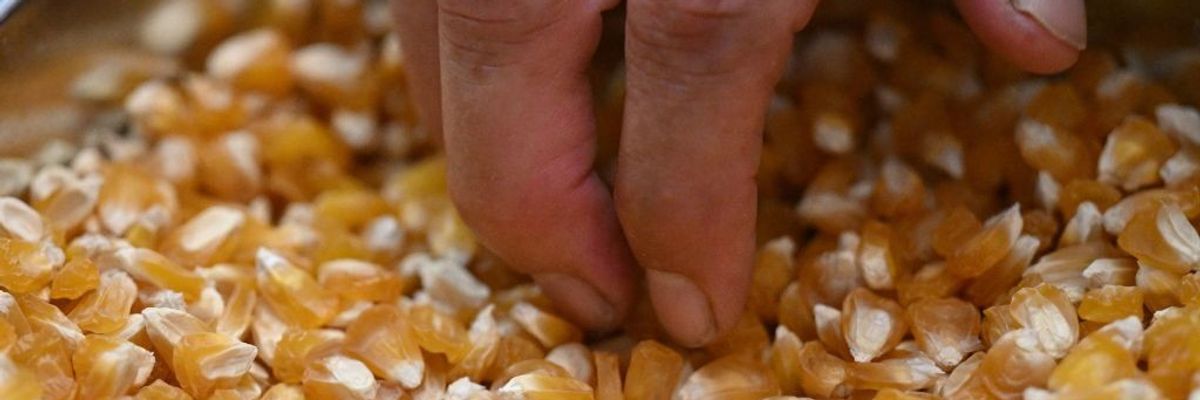
A visitor takes a handfull of non-GMO heirloom True Gold Sweet Corn at the Seed Swap on September 13, 2023 at the 10th National Heirloom Exposition at the Ventura County Fairgrounds in Ventura, California.
There is a mountain of evidence that both GM corn and its accompanying herbicides, including glyphosate, may cause serious health problems.
The three-member trade panel hearing the U.S. complaint over Mexico’s restrictions on the use of genetically modified corn in tortillas will no doubt need some scientific advice to evaluate the technical evidence presented by the Mexican government on the risks associated with GM corn and their accompanying herbicide residues. They got some on April 23 from a panel of experts assembled by the Institute for Agriculture and Trade Policy (IATP) in the first of three webinars on the GM corn dispute.
Their message could not have been clearer. The Mexican government is right to doubt U.S. assurances that GM corn is safe to eat given the lax regulatory processes for GM crops in the U.S. There is a mountain of evidence that both GM corn and its accompanying herbicides, including glyphosate, may cause serious health problems. And those risks are magnified for Mexicans, who eat more than ten times the corn we eat in the U.S. and do so in minimally processed form, not processed foods.
"Has the U.S. government provided sufficient evidence to the Mexican government to assure the safety of GM corn, which is routinely sprayed with multiple herbicides known to be associated with reproductive problems, metabolic syndrome, and cancer?” asked pesticide expert Dr. Charles Benbrook in his remarks during the webinar. “No, because the studies have never been done."
Benbrook and his fellow panelists all were invited to submit formal comments to the trade panel hearing the dispute, a year-long process expected to be resolved by the end of the year. The eight submissions from U.S. and Mexican non-governmental organizations were published by the tribunal earlier this month. They offer a range of evidence that supports Mexico’s presidential decree, issued in February 2023, phasing out glyphosate use in Mexico and restricting the use of GM corn in tortillas and other minimally processed corn products. (The submitted comments are available in English and Spanish on this IATP resource page.)
Dr. Benbrook co-authored technical comments for Friends of the Earth, which focused on the rising toxicity of GM corn, particularly the insecticidal Bt varieties, and the failure of U.S. regulators to test them for safety.
“Mexico is correct to state that it cannot rely on the U.S. government to ensure the safety of GM crops.”
"The first GM corn varieties in the late 1990s expressed 2 ppm to 6 ppm of one or two Bt toxins in corn kernels, the part of the plant people eat,” said Dr. Benbrook. “Today's leading GM corn varieties express four to seven toxins in corn kernels and at much higher levels, 50 ppm to 100 ppm. Why the big increase? Because target insects become more tolerant to Bt toxins over time, and eventually fully resistant. This forces the seed-biotech industry to add in new GM toxins and engineer the plants to express them at much higher levels. That might help kill more insects for a short time, but it also steadily increases human food safety risks."
Bill Freese, Science Director at the U.S.-based Center for Food Safety, emphasized just how weak U.S. regulations are, allowing companies to introduce new products with no required safety testing. He referred to is as a “deregulatory regime” rather than proper regulation.
“U.S. regulation of GM crops does not even comply with the U.S.-Mexico-Canada trade agreement (USMCA) because it is weak and voluntary, not mandatory,” he said, claiming U.S. agencies have facilitated the rising toxicity in fields of GM crops. As Freese explained, “The Environmental Protection Agency has raised the permissible level of glyphosate on corn by 50-fold since the mid-1990s to facilitate introduction of GM corn, which is sprayed directly with glyphosate.”
Monsanto and new parent company Bayer are now paying out billions of dollars in damages to people who have suffered cancer and other ailments from glyphosate exposure.
Lucy Sharratt, coordinator of the Canadian Biotechnology Action Network (CBAN), highlighted Mexico’s strong rationale for its precautionary measures. CBAN was invited to offer comments to the trade panel but was later disinvited because it is a Canadian, not a U.S. or Mexican, organization. CBAN published its technical comments anyway.
"U.S. and Canadian government safety assessments of GM corn do not necessarily transfer readily to an assessment of safety in the Mexican context,” Sharratt explained to the webinar’s large online audience. “The U.S. and Canada argue that there is a long history of safe use of GM corn, but this is not the case in Mexico. The use of white corn in Mexico is entirely different from the history of the use of GM corn in processed food ingredients across North America. Mexico is largely self-sufficient in white corn, which is a staple of the diet, and has been mostly non-GM. Additionally, there is no post-market monitoring to validate safety of any use."
Mexican lawyer Javier Zuñiga, from the NGO Poder del Consumidor (Consumer Power), closed the expert panel, explaining that Mexico’s decree is both justified and legal under existing trade rules. “The Mexican government is obligated by its own constitution to take precautionary and preventive action to ensure the right to health, food, and a clean environment,” Zuñiga said. “Mexico's presidential decree is legal in the Mexican context and also under the USMCA, which includes exceptions for matters of public health.”
This scientific panel urged the trade tribunal to consider the evidence, listen to experts who do not have industry ties or conflicts of interest, and acknowledge that Mexico has the right to take precautionary measures to protect public health and the environment. It has done so in the least trade-distorting manner possible entirely consistent with USMCA guidelines.
As Freese concluded, “Mexico is correct to state that it cannot rely on the U.S. government to ensure the safety of GM crops.”
Two more webinars on other aspects of the trade dispute are scheduled May 2, on biodiversity and cultural rights, and May 7, with farmers’ perspectives on non-GM corn opportunities. The recording of this panel will be available April 25 here
Dear Common Dreams reader, It’s been nearly 30 years since I co-founded Common Dreams with my late wife, Lina Newhouser. We had the radical notion that journalism should serve the public good, not corporate profits. It was clear to us from the outset what it would take to build such a project. No paid advertisements. No corporate sponsors. No millionaire publisher telling us what to think or do. Many people said we wouldn't last a year, but we proved those doubters wrong. Together with a tremendous team of journalists and dedicated staff, we built an independent media outlet free from the constraints of profits and corporate control. Our mission has always been simple: To inform. To inspire. To ignite change for the common good. Building Common Dreams was not easy. Our survival was never guaranteed. When you take on the most powerful forces—Wall Street greed, fossil fuel industry destruction, Big Tech lobbyists, and uber-rich oligarchs who have spent billions upon billions rigging the economy and democracy in their favor—the only bulwark you have is supporters who believe in your work. But here’s the urgent message from me today. It's never been this bad out there. And it's never been this hard to keep us going. At the very moment Common Dreams is most needed, the threats we face are intensifying. We need your support now more than ever. We don't accept corporate advertising and never will. We don't have a paywall because we don't think people should be blocked from critical news based on their ability to pay. Everything we do is funded by the donations of readers like you. When everyone does the little they can afford, we are strong. But if that support retreats or dries up, so do we. Will you donate now to make sure Common Dreams not only survives but thrives? —Craig Brown, Co-founder |
The three-member trade panel hearing the U.S. complaint over Mexico’s restrictions on the use of genetically modified corn in tortillas will no doubt need some scientific advice to evaluate the technical evidence presented by the Mexican government on the risks associated with GM corn and their accompanying herbicide residues. They got some on April 23 from a panel of experts assembled by the Institute for Agriculture and Trade Policy (IATP) in the first of three webinars on the GM corn dispute.
Their message could not have been clearer. The Mexican government is right to doubt U.S. assurances that GM corn is safe to eat given the lax regulatory processes for GM crops in the U.S. There is a mountain of evidence that both GM corn and its accompanying herbicides, including glyphosate, may cause serious health problems. And those risks are magnified for Mexicans, who eat more than ten times the corn we eat in the U.S. and do so in minimally processed form, not processed foods.
"Has the U.S. government provided sufficient evidence to the Mexican government to assure the safety of GM corn, which is routinely sprayed with multiple herbicides known to be associated with reproductive problems, metabolic syndrome, and cancer?” asked pesticide expert Dr. Charles Benbrook in his remarks during the webinar. “No, because the studies have never been done."
Benbrook and his fellow panelists all were invited to submit formal comments to the trade panel hearing the dispute, a year-long process expected to be resolved by the end of the year. The eight submissions from U.S. and Mexican non-governmental organizations were published by the tribunal earlier this month. They offer a range of evidence that supports Mexico’s presidential decree, issued in February 2023, phasing out glyphosate use in Mexico and restricting the use of GM corn in tortillas and other minimally processed corn products. (The submitted comments are available in English and Spanish on this IATP resource page.)
Dr. Benbrook co-authored technical comments for Friends of the Earth, which focused on the rising toxicity of GM corn, particularly the insecticidal Bt varieties, and the failure of U.S. regulators to test them for safety.
“Mexico is correct to state that it cannot rely on the U.S. government to ensure the safety of GM crops.”
"The first GM corn varieties in the late 1990s expressed 2 ppm to 6 ppm of one or two Bt toxins in corn kernels, the part of the plant people eat,” said Dr. Benbrook. “Today's leading GM corn varieties express four to seven toxins in corn kernels and at much higher levels, 50 ppm to 100 ppm. Why the big increase? Because target insects become more tolerant to Bt toxins over time, and eventually fully resistant. This forces the seed-biotech industry to add in new GM toxins and engineer the plants to express them at much higher levels. That might help kill more insects for a short time, but it also steadily increases human food safety risks."
Bill Freese, Science Director at the U.S.-based Center for Food Safety, emphasized just how weak U.S. regulations are, allowing companies to introduce new products with no required safety testing. He referred to is as a “deregulatory regime” rather than proper regulation.
“U.S. regulation of GM crops does not even comply with the U.S.-Mexico-Canada trade agreement (USMCA) because it is weak and voluntary, not mandatory,” he said, claiming U.S. agencies have facilitated the rising toxicity in fields of GM crops. As Freese explained, “The Environmental Protection Agency has raised the permissible level of glyphosate on corn by 50-fold since the mid-1990s to facilitate introduction of GM corn, which is sprayed directly with glyphosate.”
Monsanto and new parent company Bayer are now paying out billions of dollars in damages to people who have suffered cancer and other ailments from glyphosate exposure.
Lucy Sharratt, coordinator of the Canadian Biotechnology Action Network (CBAN), highlighted Mexico’s strong rationale for its precautionary measures. CBAN was invited to offer comments to the trade panel but was later disinvited because it is a Canadian, not a U.S. or Mexican, organization. CBAN published its technical comments anyway.
"U.S. and Canadian government safety assessments of GM corn do not necessarily transfer readily to an assessment of safety in the Mexican context,” Sharratt explained to the webinar’s large online audience. “The U.S. and Canada argue that there is a long history of safe use of GM corn, but this is not the case in Mexico. The use of white corn in Mexico is entirely different from the history of the use of GM corn in processed food ingredients across North America. Mexico is largely self-sufficient in white corn, which is a staple of the diet, and has been mostly non-GM. Additionally, there is no post-market monitoring to validate safety of any use."
Mexican lawyer Javier Zuñiga, from the NGO Poder del Consumidor (Consumer Power), closed the expert panel, explaining that Mexico’s decree is both justified and legal under existing trade rules. “The Mexican government is obligated by its own constitution to take precautionary and preventive action to ensure the right to health, food, and a clean environment,” Zuñiga said. “Mexico's presidential decree is legal in the Mexican context and also under the USMCA, which includes exceptions for matters of public health.”
This scientific panel urged the trade tribunal to consider the evidence, listen to experts who do not have industry ties or conflicts of interest, and acknowledge that Mexico has the right to take precautionary measures to protect public health and the environment. It has done so in the least trade-distorting manner possible entirely consistent with USMCA guidelines.
As Freese concluded, “Mexico is correct to state that it cannot rely on the U.S. government to ensure the safety of GM crops.”
Two more webinars on other aspects of the trade dispute are scheduled May 2, on biodiversity and cultural rights, and May 7, with farmers’ perspectives on non-GM corn opportunities. The recording of this panel will be available April 25 here
The three-member trade panel hearing the U.S. complaint over Mexico’s restrictions on the use of genetically modified corn in tortillas will no doubt need some scientific advice to evaluate the technical evidence presented by the Mexican government on the risks associated with GM corn and their accompanying herbicide residues. They got some on April 23 from a panel of experts assembled by the Institute for Agriculture and Trade Policy (IATP) in the first of three webinars on the GM corn dispute.
Their message could not have been clearer. The Mexican government is right to doubt U.S. assurances that GM corn is safe to eat given the lax regulatory processes for GM crops in the U.S. There is a mountain of evidence that both GM corn and its accompanying herbicides, including glyphosate, may cause serious health problems. And those risks are magnified for Mexicans, who eat more than ten times the corn we eat in the U.S. and do so in minimally processed form, not processed foods.
"Has the U.S. government provided sufficient evidence to the Mexican government to assure the safety of GM corn, which is routinely sprayed with multiple herbicides known to be associated with reproductive problems, metabolic syndrome, and cancer?” asked pesticide expert Dr. Charles Benbrook in his remarks during the webinar. “No, because the studies have never been done."
Benbrook and his fellow panelists all were invited to submit formal comments to the trade panel hearing the dispute, a year-long process expected to be resolved by the end of the year. The eight submissions from U.S. and Mexican non-governmental organizations were published by the tribunal earlier this month. They offer a range of evidence that supports Mexico’s presidential decree, issued in February 2023, phasing out glyphosate use in Mexico and restricting the use of GM corn in tortillas and other minimally processed corn products. (The submitted comments are available in English and Spanish on this IATP resource page.)
Dr. Benbrook co-authored technical comments for Friends of the Earth, which focused on the rising toxicity of GM corn, particularly the insecticidal Bt varieties, and the failure of U.S. regulators to test them for safety.
“Mexico is correct to state that it cannot rely on the U.S. government to ensure the safety of GM crops.”
"The first GM corn varieties in the late 1990s expressed 2 ppm to 6 ppm of one or two Bt toxins in corn kernels, the part of the plant people eat,” said Dr. Benbrook. “Today's leading GM corn varieties express four to seven toxins in corn kernels and at much higher levels, 50 ppm to 100 ppm. Why the big increase? Because target insects become more tolerant to Bt toxins over time, and eventually fully resistant. This forces the seed-biotech industry to add in new GM toxins and engineer the plants to express them at much higher levels. That might help kill more insects for a short time, but it also steadily increases human food safety risks."
Bill Freese, Science Director at the U.S.-based Center for Food Safety, emphasized just how weak U.S. regulations are, allowing companies to introduce new products with no required safety testing. He referred to is as a “deregulatory regime” rather than proper regulation.
“U.S. regulation of GM crops does not even comply with the U.S.-Mexico-Canada trade agreement (USMCA) because it is weak and voluntary, not mandatory,” he said, claiming U.S. agencies have facilitated the rising toxicity in fields of GM crops. As Freese explained, “The Environmental Protection Agency has raised the permissible level of glyphosate on corn by 50-fold since the mid-1990s to facilitate introduction of GM corn, which is sprayed directly with glyphosate.”
Monsanto and new parent company Bayer are now paying out billions of dollars in damages to people who have suffered cancer and other ailments from glyphosate exposure.
Lucy Sharratt, coordinator of the Canadian Biotechnology Action Network (CBAN), highlighted Mexico’s strong rationale for its precautionary measures. CBAN was invited to offer comments to the trade panel but was later disinvited because it is a Canadian, not a U.S. or Mexican, organization. CBAN published its technical comments anyway.
"U.S. and Canadian government safety assessments of GM corn do not necessarily transfer readily to an assessment of safety in the Mexican context,” Sharratt explained to the webinar’s large online audience. “The U.S. and Canada argue that there is a long history of safe use of GM corn, but this is not the case in Mexico. The use of white corn in Mexico is entirely different from the history of the use of GM corn in processed food ingredients across North America. Mexico is largely self-sufficient in white corn, which is a staple of the diet, and has been mostly non-GM. Additionally, there is no post-market monitoring to validate safety of any use."
Mexican lawyer Javier Zuñiga, from the NGO Poder del Consumidor (Consumer Power), closed the expert panel, explaining that Mexico’s decree is both justified and legal under existing trade rules. “The Mexican government is obligated by its own constitution to take precautionary and preventive action to ensure the right to health, food, and a clean environment,” Zuñiga said. “Mexico's presidential decree is legal in the Mexican context and also under the USMCA, which includes exceptions for matters of public health.”
This scientific panel urged the trade tribunal to consider the evidence, listen to experts who do not have industry ties or conflicts of interest, and acknowledge that Mexico has the right to take precautionary measures to protect public health and the environment. It has done so in the least trade-distorting manner possible entirely consistent with USMCA guidelines.
As Freese concluded, “Mexico is correct to state that it cannot rely on the U.S. government to ensure the safety of GM crops.”
Two more webinars on other aspects of the trade dispute are scheduled May 2, on biodiversity and cultural rights, and May 7, with farmers’ perspectives on non-GM corn opportunities. The recording of this panel will be available April 25 here