

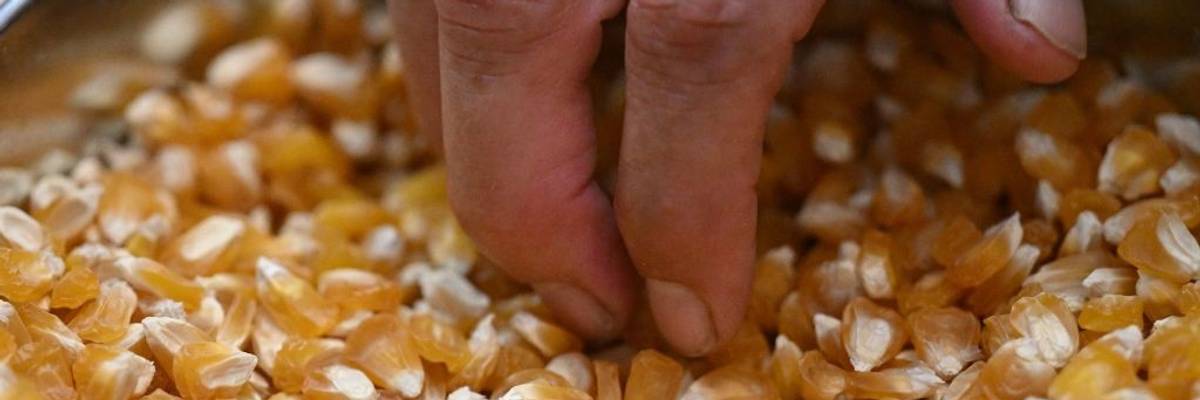
A visitor takes a handfull of non-GMO heirloom True Gold Sweet Corn at the Seed Swap on September 13, 2023 at the 10th National Heirloom Exposition at the Ventura County Fairgrounds in Ventura, California.
What a Ruling Against Mexico’s GMO Corn Ban Could Mean for the Future of the USMCA
The pro-U.S. ruling raises questions about the fairness of tri-national trade agreement itself, which has now legitimized the use of the agreement’s dispute process to challenge a domestic policy that barely affected trade.
A tribunal of trade arbitrators has ruled in favor of the United States in its complaint that Mexico’s restrictions on genetically modified corn violate the terms of the U.S.-Mexico-Canada trade agreement, or USMCA. The long-awaited ruling in the 16-month trade dispute is unlikely to settle the questions raised by Mexico about the safety of consuming GM corn and its associated herbicide.
Indeed, the pro-U.S. ruling raises questions about the fairness of the USMCA itself, which has now legitimized the use of the agreement’s dispute process to challenge a domestic policy that barely affected trade. U.S. President-elect Donald Trump is now openly threatening Mexico with 25% tariffs on all Mexican exports, a blatant violation of the USMCA that Trump himself renegotiated and signed in 2018. Yet the treaty appears impotent to challenge such unilateral U.S. trade measures just as its tribunal slaps Mexico’s hand for its public health policies.
According to the U.S. government, the final report from the tribunal, announced December 20, ruled that “Mexico’s measures are not based on science and undermine the market access that Mexico agreed to provide in the USMCA.” In fact, the trade panel’s ruling was more limited, demanding that Mexico comply with the trade agreement’s procedures for carrying out risk assessments based on “relevant international scientific principles.”
Countries considering entering into trade agreements with the United States may now be more reluctant to do so if their domestic policies can be challenged in a trade court.
The Mexican government defended its position but vowed to comply with the ruling. “The Government of Mexico does not share the panel’s determination, as it considers that the measures in question are in line with the principles of protection of public health and the rights of Indigenous peoples, established in national legislation and in the international treaties to which it is a party,” read a statement following the ruling.
The ruling will not settle the debate over the health and environmental risks of GM corn and its associated herbicides, In the course of the dispute, Mexico produced extensive peer-reviewed scientific evidence that showed ample cause for precaution given the risks associated with both GM corn and its associated herbicide glyphosate. Recent studies have shown negative health impacts to the gastrointestinal tract and potential damage to the liver, kidneys, and other organs.
“[We] did an exhaustive review of the scientific literature,” explained María Elena Àlvarez-Buylla, the molecular geneticist who led Mexico’s national science agency, CONAHCYT, until October. “We concluded that the evidence was more than sufficient to restrict, out of precaution, the use of GM corn and its associated agro-chemical, glyphosate, in the country’s food supply chains.”
That evidence was presented in great detail to the tribunal in Mexico’s formal filings during the process, and it has now been published as a “Science Dossier.” It represents one of the most comprehensive reviews of the scientific evidence of the risks of GM corn and glyphosate to public health and the environment.
For its part, the U.S. government declined to present evidence that its GM corn with glyphosate residues is safe to eat in Mexico, where corn is consumed at more than 10 times the levels as in the United States and in minimally processed forms such as tortillas, not in processed foods.
“The research on the part of the U.S. was quite poor,” says Dr. Álvarez-Buylla, noting that U.S. research was outdated, ignored many recent studies, and depended on science that is “full of conflicts of interest.”
The U.S. government also failed to produce any evidence that Mexico’s February 2023 presidential decree had any meaningful impacts on U.S. exporters. U.S. corn exports have increased since the decree was enacted, not shrunk. The measures restricted only GM white corn use in tortillas, less than 1% of the U.S. corn exported to Mexico.
Early on in the dispute, Mexican Economy Minister Raquel Buenrostro stated that the U.S. needed to show “quantitatively, with numbers, something that has not occurred: that the corn decree has commercially affected” U.S. exporters. The U.S. has yet to produce any such evidence.
Meanwhile, president-elect Trump’s threatened tariffs are blatantly illegal under the USMCA and promise to inflict massive economic harm on Mexican exporters, and on U.S.-based firms that produce in Mexico.
The pro-U.S., pro-agrochemical industry ruling will ripple far beyond this dispute. Mexico’s documentation of the evidence of risk from GM corn and glyphosate should prompt consumers and governments the world over to take a closer look at these controversial products, and at the lax U.S. regulatory processes exposed by Mexico.
Countries considering entering into trade agreements with the United States may now be more reluctant to do so if their domestic policies can be challenged in a trade court. Kenya has been negotiating a trade agreement with the United States. Kenyans are already concerned the agreement will open Kenya to GM animal feeds, says Anne Maina of the Kenya Biodiversity and Biosafety Association. If the agreement can be used to challenge domestic policies, she says, it will be even less palatable.
It remains to be seen how the Mexican government will comply with the ruling. It has 45 days to respond. Already, President Claudia Sheinbaum has reiterated her support for a constitutional amendment to enshrine a ban on GM corn cultivation and consumption in tortillas. A “Right to Food” law passed last year mandates labeling of foods containing GMOs. No tortilla seller wants such a label on its products, because Mexican consumers are clear that they do not want GM corn in their tortillas.
The tribunal’s ruling will not undo the fact that Mexico’s precautionary policies are indeed justified by a wealth of scientific evidence. By allowing the trade agreement to undermine a domestic policy that barely affects trade, it will further tarnish the legitimacy of an agreement already seen as favoring multinational corporations over public health and the environment.
We are at a crossroads
This country and this world are at a monumental crossroads. In a few short weeks, US voters will have an opportunity to beat back the forces of fascism and confront the billionaires who are rigging the economy, our media system, and our democracy, making it increasingly impossible for ordinary people to get by. We’re not just talking about the election. We’re talking about what must be done once these fascist elements are vanquished from power. We need a bolder set of solutions than what either major party has so far been willing to offer and a working-class movement ready to fight like hell for it. Trump didn't emerge from nowhere. The conditions that fueled MAGA authoritarianism were created by decades of radical neoliberal economic policies and a corrupt political system dominated by corporate interests. They slashed taxes on the super-rich, promising that the benefits would trickle down. They said giveaways to the corporate titans would make life more affordable for the rest of us. It was all bullshit. And when a bitter, betrayed populace searches for someone to blame, right-wing demagogues have little trouble finding scapegoats. People know when they're being lied to, but you won't hear any of this from the corporate media. Only independent journalism—powered and funded by people who believe in building a better world—can deliver truly trustworthy daily news. Our Fall Campaign is underway, and we need your help. To power our newsroom through the rest of the year, we need to raise $125,000 by midnight on October 31. So if you share our vision, please contribute whatever you can to sustain our work. |
A tribunal of trade arbitrators has ruled in favor of the United States in its complaint that Mexico’s restrictions on genetically modified corn violate the terms of the U.S.-Mexico-Canada trade agreement, or USMCA. The long-awaited ruling in the 16-month trade dispute is unlikely to settle the questions raised by Mexico about the safety of consuming GM corn and its associated herbicide.
Indeed, the pro-U.S. ruling raises questions about the fairness of the USMCA itself, which has now legitimized the use of the agreement’s dispute process to challenge a domestic policy that barely affected trade. U.S. President-elect Donald Trump is now openly threatening Mexico with 25% tariffs on all Mexican exports, a blatant violation of the USMCA that Trump himself renegotiated and signed in 2018. Yet the treaty appears impotent to challenge such unilateral U.S. trade measures just as its tribunal slaps Mexico’s hand for its public health policies.
According to the U.S. government, the final report from the tribunal, announced December 20, ruled that “Mexico’s measures are not based on science and undermine the market access that Mexico agreed to provide in the USMCA.” In fact, the trade panel’s ruling was more limited, demanding that Mexico comply with the trade agreement’s procedures for carrying out risk assessments based on “relevant international scientific principles.”
Countries considering entering into trade agreements with the United States may now be more reluctant to do so if their domestic policies can be challenged in a trade court.
The Mexican government defended its position but vowed to comply with the ruling. “The Government of Mexico does not share the panel’s determination, as it considers that the measures in question are in line with the principles of protection of public health and the rights of Indigenous peoples, established in national legislation and in the international treaties to which it is a party,” read a statement following the ruling.
The ruling will not settle the debate over the health and environmental risks of GM corn and its associated herbicides, In the course of the dispute, Mexico produced extensive peer-reviewed scientific evidence that showed ample cause for precaution given the risks associated with both GM corn and its associated herbicide glyphosate. Recent studies have shown negative health impacts to the gastrointestinal tract and potential damage to the liver, kidneys, and other organs.
“[We] did an exhaustive review of the scientific literature,” explained María Elena Àlvarez-Buylla, the molecular geneticist who led Mexico’s national science agency, CONAHCYT, until October. “We concluded that the evidence was more than sufficient to restrict, out of precaution, the use of GM corn and its associated agro-chemical, glyphosate, in the country’s food supply chains.”
That evidence was presented in great detail to the tribunal in Mexico’s formal filings during the process, and it has now been published as a “Science Dossier.” It represents one of the most comprehensive reviews of the scientific evidence of the risks of GM corn and glyphosate to public health and the environment.
For its part, the U.S. government declined to present evidence that its GM corn with glyphosate residues is safe to eat in Mexico, where corn is consumed at more than 10 times the levels as in the United States and in minimally processed forms such as tortillas, not in processed foods.
“The research on the part of the U.S. was quite poor,” says Dr. Álvarez-Buylla, noting that U.S. research was outdated, ignored many recent studies, and depended on science that is “full of conflicts of interest.”
The U.S. government also failed to produce any evidence that Mexico’s February 2023 presidential decree had any meaningful impacts on U.S. exporters. U.S. corn exports have increased since the decree was enacted, not shrunk. The measures restricted only GM white corn use in tortillas, less than 1% of the U.S. corn exported to Mexico.
Early on in the dispute, Mexican Economy Minister Raquel Buenrostro stated that the U.S. needed to show “quantitatively, with numbers, something that has not occurred: that the corn decree has commercially affected” U.S. exporters. The U.S. has yet to produce any such evidence.
Meanwhile, president-elect Trump’s threatened tariffs are blatantly illegal under the USMCA and promise to inflict massive economic harm on Mexican exporters, and on U.S.-based firms that produce in Mexico.
The pro-U.S., pro-agrochemical industry ruling will ripple far beyond this dispute. Mexico’s documentation of the evidence of risk from GM corn and glyphosate should prompt consumers and governments the world over to take a closer look at these controversial products, and at the lax U.S. regulatory processes exposed by Mexico.
Countries considering entering into trade agreements with the United States may now be more reluctant to do so if their domestic policies can be challenged in a trade court. Kenya has been negotiating a trade agreement with the United States. Kenyans are already concerned the agreement will open Kenya to GM animal feeds, says Anne Maina of the Kenya Biodiversity and Biosafety Association. If the agreement can be used to challenge domestic policies, she says, it will be even less palatable.
It remains to be seen how the Mexican government will comply with the ruling. It has 45 days to respond. Already, President Claudia Sheinbaum has reiterated her support for a constitutional amendment to enshrine a ban on GM corn cultivation and consumption in tortillas. A “Right to Food” law passed last year mandates labeling of foods containing GMOs. No tortilla seller wants such a label on its products, because Mexican consumers are clear that they do not want GM corn in their tortillas.
The tribunal’s ruling will not undo the fact that Mexico’s precautionary policies are indeed justified by a wealth of scientific evidence. By allowing the trade agreement to undermine a domestic policy that barely affects trade, it will further tarnish the legitimacy of an agreement already seen as favoring multinational corporations over public health and the environment.
- In Win for Agribusiness, Trade Panel Backs US Challenge to Mexican GM Corn Ban ›
- Mexico Brings Science to a Trade Fight Over GMO Corn ›
- In 'Assault' on Mexican Food Sovereignty, US Ramps Up Fight Over GM Corn ›
- Expert Panel to Mexico GM Corn Tribunal: Respect the Science ›
- Law Is Not on the US Side in GMO Corn Fight With Mexico ›
- Early US Fumbles in Tortilla War With Mexico Over GMO Corn ›
A tribunal of trade arbitrators has ruled in favor of the United States in its complaint that Mexico’s restrictions on genetically modified corn violate the terms of the U.S.-Mexico-Canada trade agreement, or USMCA. The long-awaited ruling in the 16-month trade dispute is unlikely to settle the questions raised by Mexico about the safety of consuming GM corn and its associated herbicide.
Indeed, the pro-U.S. ruling raises questions about the fairness of the USMCA itself, which has now legitimized the use of the agreement’s dispute process to challenge a domestic policy that barely affected trade. U.S. President-elect Donald Trump is now openly threatening Mexico with 25% tariffs on all Mexican exports, a blatant violation of the USMCA that Trump himself renegotiated and signed in 2018. Yet the treaty appears impotent to challenge such unilateral U.S. trade measures just as its tribunal slaps Mexico’s hand for its public health policies.
According to the U.S. government, the final report from the tribunal, announced December 20, ruled that “Mexico’s measures are not based on science and undermine the market access that Mexico agreed to provide in the USMCA.” In fact, the trade panel’s ruling was more limited, demanding that Mexico comply with the trade agreement’s procedures for carrying out risk assessments based on “relevant international scientific principles.”
Countries considering entering into trade agreements with the United States may now be more reluctant to do so if their domestic policies can be challenged in a trade court.
The Mexican government defended its position but vowed to comply with the ruling. “The Government of Mexico does not share the panel’s determination, as it considers that the measures in question are in line with the principles of protection of public health and the rights of Indigenous peoples, established in national legislation and in the international treaties to which it is a party,” read a statement following the ruling.
The ruling will not settle the debate over the health and environmental risks of GM corn and its associated herbicides, In the course of the dispute, Mexico produced extensive peer-reviewed scientific evidence that showed ample cause for precaution given the risks associated with both GM corn and its associated herbicide glyphosate. Recent studies have shown negative health impacts to the gastrointestinal tract and potential damage to the liver, kidneys, and other organs.
“[We] did an exhaustive review of the scientific literature,” explained María Elena Àlvarez-Buylla, the molecular geneticist who led Mexico’s national science agency, CONAHCYT, until October. “We concluded that the evidence was more than sufficient to restrict, out of precaution, the use of GM corn and its associated agro-chemical, glyphosate, in the country’s food supply chains.”
That evidence was presented in great detail to the tribunal in Mexico’s formal filings during the process, and it has now been published as a “Science Dossier.” It represents one of the most comprehensive reviews of the scientific evidence of the risks of GM corn and glyphosate to public health and the environment.
For its part, the U.S. government declined to present evidence that its GM corn with glyphosate residues is safe to eat in Mexico, where corn is consumed at more than 10 times the levels as in the United States and in minimally processed forms such as tortillas, not in processed foods.
“The research on the part of the U.S. was quite poor,” says Dr. Álvarez-Buylla, noting that U.S. research was outdated, ignored many recent studies, and depended on science that is “full of conflicts of interest.”
The U.S. government also failed to produce any evidence that Mexico’s February 2023 presidential decree had any meaningful impacts on U.S. exporters. U.S. corn exports have increased since the decree was enacted, not shrunk. The measures restricted only GM white corn use in tortillas, less than 1% of the U.S. corn exported to Mexico.
Early on in the dispute, Mexican Economy Minister Raquel Buenrostro stated that the U.S. needed to show “quantitatively, with numbers, something that has not occurred: that the corn decree has commercially affected” U.S. exporters. The U.S. has yet to produce any such evidence.
Meanwhile, president-elect Trump’s threatened tariffs are blatantly illegal under the USMCA and promise to inflict massive economic harm on Mexican exporters, and on U.S.-based firms that produce in Mexico.
The pro-U.S., pro-agrochemical industry ruling will ripple far beyond this dispute. Mexico’s documentation of the evidence of risk from GM corn and glyphosate should prompt consumers and governments the world over to take a closer look at these controversial products, and at the lax U.S. regulatory processes exposed by Mexico.
Countries considering entering into trade agreements with the United States may now be more reluctant to do so if their domestic policies can be challenged in a trade court. Kenya has been negotiating a trade agreement with the United States. Kenyans are already concerned the agreement will open Kenya to GM animal feeds, says Anne Maina of the Kenya Biodiversity and Biosafety Association. If the agreement can be used to challenge domestic policies, she says, it will be even less palatable.
It remains to be seen how the Mexican government will comply with the ruling. It has 45 days to respond. Already, President Claudia Sheinbaum has reiterated her support for a constitutional amendment to enshrine a ban on GM corn cultivation and consumption in tortillas. A “Right to Food” law passed last year mandates labeling of foods containing GMOs. No tortilla seller wants such a label on its products, because Mexican consumers are clear that they do not want GM corn in their tortillas.
The tribunal’s ruling will not undo the fact that Mexico’s precautionary policies are indeed justified by a wealth of scientific evidence. By allowing the trade agreement to undermine a domestic policy that barely affects trade, it will further tarnish the legitimacy of an agreement already seen as favoring multinational corporations over public health and the environment.
- In Win for Agribusiness, Trade Panel Backs US Challenge to Mexican GM Corn Ban ›
- Mexico Brings Science to a Trade Fight Over GMO Corn ›
- In 'Assault' on Mexican Food Sovereignty, US Ramps Up Fight Over GM Corn ›
- Expert Panel to Mexico GM Corn Tribunal: Respect the Science ›
- Law Is Not on the US Side in GMO Corn Fight With Mexico ›
- Early US Fumbles in Tortilla War With Mexico Over GMO Corn ›