5
#000000
#FFFFFF
To donate by check, phone, or other method, see our More Ways to Give page.
Daily news & progressive opinion—funded by the people, not the corporations—delivered straight to your inbox.
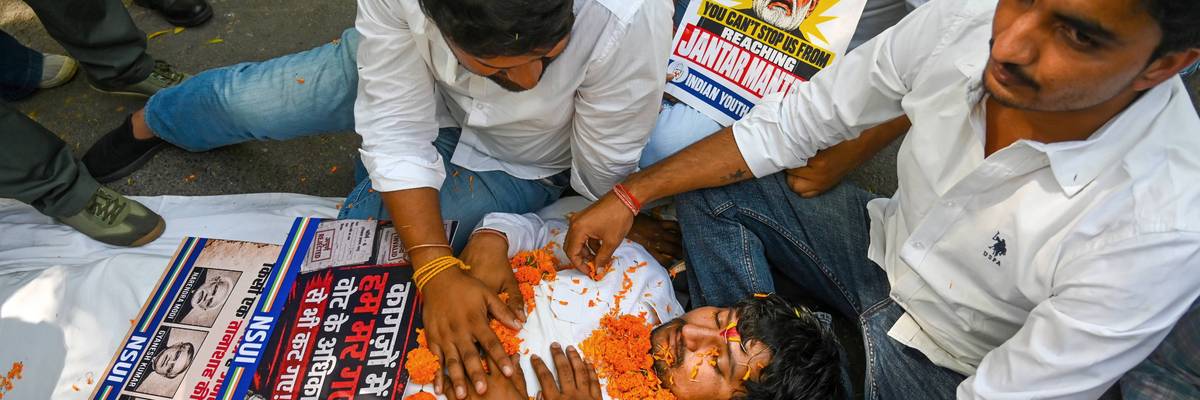
The National Students' Union of India (NSUI) holds a symbolic protest with demonstrators posing as voters who were kicked off of voter rolls on October 5, 2026 in New Delhi, India.
Hundreds of people have been arrested in recent days at youth-led protests over the removal of more than 130 million names from voter rolls.
As one advocate warned India's Supreme Court on Monday that "this country will burn" unless action is taken to stop what thousands of protesters have denounced as an illegal purge of voters by the head of the country's Election Commission, the court demanded accountability from Prime Minister Narendra Modi's government.
Chief Justice Surya Kant said in a hearing that the court had not approved changes to a new form used by the Election Commission of India for registering new voters, contradicting a statement from the ECI last month which said the document had been upheld by the court.
"Modified Form 6 has not been approved by us, let us be very clear," said Kant.
The court called on Modi's government, the ECI, and the head of the commission, Gyanesh Kumar, to answer "in a clear, transparent manner” for the massive upheaval of the national voter rolls, from which more than 130 million names have been removed in recent months.
The changes to the voter list have sparked calls for Kumar's resignation, particularly at protests that have erupted across the country, led by student groups and the Cockroach Janta Party (CJP), a political movement led by young people whom Kant compared to cockroaches earlier this year.
The group's website declares, "Gyanesh, it's done, bro," and thousands of people have joined protests like those that forced the resignation of India's education minister over the summer.
Last week, hundreds of protesters were detained, with journalists reportedly among those who were arrested—prompting outcry from Amnesty International over the government's "blatant attack on the rights to liberty and freedom of peaceful assembly."
In New Delhi in particular, police have been denounced for their aggressive response to the uprising, forcing hundreds of people into police vehicles. Authorities said they were investigating reports that officers had sexually assaulted three journalists at the protests over the weekend.
The Supreme Court took up two petitions Monday, questioning the credibility of the ECI's efforts to "purify" the voter rolls, as the commission has said, and calling for an independent inquiry into Kumar's management of the "special intensive revision" (SIR) process.
Another hearing will be held later this week.
Kant said the court wanted a response from Kumar and the commission about allegations that decisions about the SIR were made unilaterally by Kumar. Media reports last month said the two other ECI commissioners had objected to the revision of voter rolls, which the government has claimed is aimed at eliminating duplicates and the names of dead and ineligible voters, as well as "illegal infiltrators."
People across Delhi and states including Bihar and West Bengal have said they were wrongly removed from voter rolls, and protesters have said the revision appeared to target Muslim voters, who have opposed Modi's Bharatiya Janata Party.
Protesters on Monday symbolically posed as dead people to show that voters have been wrongly eliminated from voter rolls, despite still being alive and eligible to participate in elections.
“Deletions of voters have been made in the largest democracy,” Menaka Guruswamy, a lawyer for one of the petitioners who brought the cases to the Supreme Court, told The Guardian. “We have grown up with free and fair elections, that is not the case now.”
This country and this world are at a monumental crossroads. US voters have an opportunity to beat back the forces of fascism and confront the billionaires who are rigging the economy, our media system, and our democracy, making it increasingly impossible for ordinary people to get by. We’re not just talking about the election. We’re talking about what must be done once these fascist elements are vanquished from power. We need a bolder set of solutions than what either major party has so far been willing to offer and a working-class movement ready to fight like hell for it. Trump didn't emerge from nowhere. The conditions that fueled MAGA authoritarianism were created by decades of radical neoliberal economic policies and a corrupt political system dominated by corporate interests. They slashed taxes on the super-rich, promising that the benefits would trickle down. They said giveaways to the corporate titans would make life more affordable for the rest of us. It was all bullshit. And when a bitter, betrayed populace searches for someone to blame, right-wing demagogues have little trouble finding scapegoats. People know when they're being lied to, but you won't hear any of this from the corporate media. Only independent journalism—powered and funded by people who believe in building a better world—can deliver truly trustworthy daily news. If you share our vision, please contribute whatever you can to sustain our work. |
As one advocate warned India's Supreme Court on Monday that "this country will burn" unless action is taken to stop what thousands of protesters have denounced as an illegal purge of voters by the head of the country's Election Commission, the court demanded accountability from Prime Minister Narendra Modi's government.
Chief Justice Surya Kant said in a hearing that the court had not approved changes to a new form used by the Election Commission of India for registering new voters, contradicting a statement from the ECI last month which said the document had been upheld by the court.
"Modified Form 6 has not been approved by us, let us be very clear," said Kant.
The court called on Modi's government, the ECI, and the head of the commission, Gyanesh Kumar, to answer "in a clear, transparent manner” for the massive upheaval of the national voter rolls, from which more than 130 million names have been removed in recent months.
The changes to the voter list have sparked calls for Kumar's resignation, particularly at protests that have erupted across the country, led by student groups and the Cockroach Janta Party (CJP), a political movement led by young people whom Kant compared to cockroaches earlier this year.
The group's website declares, "Gyanesh, it's done, bro," and thousands of people have joined protests like those that forced the resignation of India's education minister over the summer.
Last week, hundreds of protesters were detained, with journalists reportedly among those who were arrested—prompting outcry from Amnesty International over the government's "blatant attack on the rights to liberty and freedom of peaceful assembly."
In New Delhi in particular, police have been denounced for their aggressive response to the uprising, forcing hundreds of people into police vehicles. Authorities said they were investigating reports that officers had sexually assaulted three journalists at the protests over the weekend.
The Supreme Court took up two petitions Monday, questioning the credibility of the ECI's efforts to "purify" the voter rolls, as the commission has said, and calling for an independent inquiry into Kumar's management of the "special intensive revision" (SIR) process.
Another hearing will be held later this week.
Kant said the court wanted a response from Kumar and the commission about allegations that decisions about the SIR were made unilaterally by Kumar. Media reports last month said the two other ECI commissioners had objected to the revision of voter rolls, which the government has claimed is aimed at eliminating duplicates and the names of dead and ineligible voters, as well as "illegal infiltrators."
People across Delhi and states including Bihar and West Bengal have said they were wrongly removed from voter rolls, and protesters have said the revision appeared to target Muslim voters, who have opposed Modi's Bharatiya Janata Party.
Protesters on Monday symbolically posed as dead people to show that voters have been wrongly eliminated from voter rolls, despite still being alive and eligible to participate in elections.
“Deletions of voters have been made in the largest democracy,” Menaka Guruswamy, a lawyer for one of the petitioners who brought the cases to the Supreme Court, told The Guardian. “We have grown up with free and fair elections, that is not the case now.”