SUBSCRIBE TO OUR FREE NEWSLETTER
Daily news & progressive opinion—funded by the people, not the corporations—delivered straight to your inbox.
5
#000000
#FFFFFF
To donate by check, phone, or other method, see our More Ways to Give page.
Daily news & progressive opinion—funded by the people, not the corporations—delivered straight to your inbox.
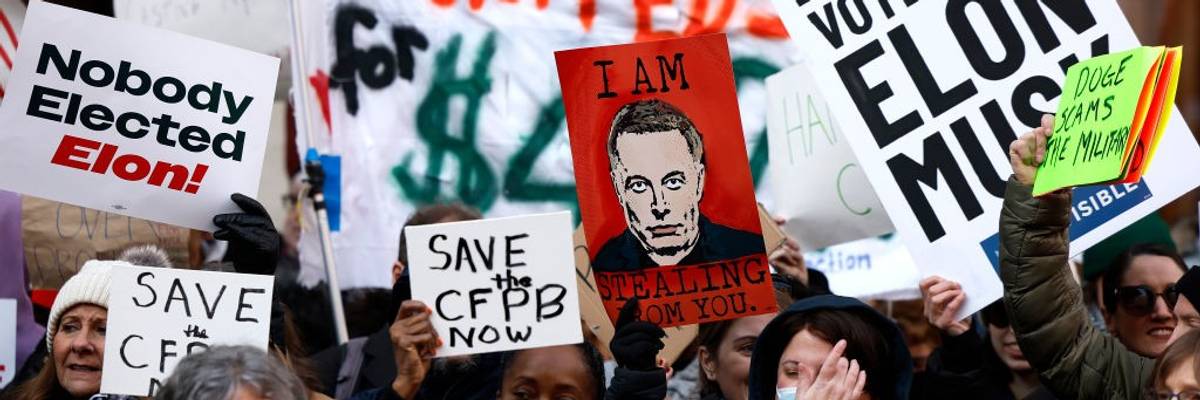
Protesters rally outside the Consumer Financial Protection Bureau (CFPB) on February 10, 2025 in Washington, D.C. in an angry reaction to Elon Musk's attack on the agency.
"The U.S. Senate just gave Elon Musk a green light to throw consumers to the online wolves."
Despite warnings of a "blatant gift" that would be bestowed on the world's richest man while harming everyday consumers, the GOP majority in the U.S. Senate on Wednesday passed a resolution that would block the government's Consumer Financial Protection Bureau from regulating online payment systems like Venmo, Google Pay, Apple Pay, and—when it comes to Elon Musk—his proposed X Money, an extension of the social media giant he owns.
The vote on the resolution in the Republican-controlled Senate was 51 to 47, with two senators not voting. Every member of the Democratic caucus, including Independent Sens. Bernie Sanders of Vermont and Angus King of Maine, voted against the measure while every Republican but one, Sen. Josh Hawley of Missouri, voted in favor.
The legislation, if also approved by the GOP-controlled House and signed by President Donald Trump, would nullify a rule put forth by the Biden administration allowing the CFPB to more closely monitor the growing army of online payment services.
Critics of Republican efforts to destroy the rule, as well as broader efforts to undermine the CFPB's ability to serve as a watchdog for the financial industry, have said that restricting the agency's oversight in this sector would be a direct giveaway to Musk due to his pronounced personal interest in the online payment space that could be worth billions of dollars in future profits.
"The U.S. Senate just gave Elon Musk a green light to throw consumers to the online wolves," said Emily Peterson-Cassin, corporate power director at Demand Progress, a progressive advocacy group.
"In no way should X, a platform already swarming with bots and crypto scams, be allowed to accept real-time payments without having to follow the same consumer protection oversight that major banks have to follow," Peterson-Cassin added. "Without CFPB supervision, X Money users who are hacked, scammed, or want to dispute fraudulent payments could be left to fend for themselves. We call on the House to stand on the side of consumers, and not online scammers, by voting against this corrupt, reckless bill."
In a statement on Wednesday following the vote, Sens. Elizabeth Warren (D-Mass.) and Adam Schiff (D-Calif.) said the resolution was akin to a "Get Out of Jail Free Card" for Musk.
In a joint letter to acting director of the Office of Government Ethics, Secretary Doug Collins, Warren and Schiff demanded answers about Musk's conflicts of interest as he spearheads the Trump-invented Department of Government Efficiency, or DOGE, while that pseudo agency targets the CFPB.
According to the letter:
In addition to his role as head of DOGE, Mr. Musk is the primary owner of the social media company X. Since purchasing X, Mr. Musk has considered expanding the social media platform into digital payments. On January 28, X announced a partnership with Visa to process peer-to-peer payments and launch a digital wallet. Notably, the CFPB has taken steps in recent years to protect consumers from fraud on digital payment apps and collects proprietary information from the digital payment industry. Mr. Musk is also the founder and CEO of Tesla, which offers customers the option of working with Tesla to finance their auto purchases. The CFPB plays a critical role in supervising the auto lending industry and protecting consumers from corporate malfeasance and scams. Therefore, actions by Mr. Musk and DOGE at the CFPB have the potential to directly benefit X, Visa, and Tesla—and by extension, Mr. Musk.
Warren and Schiff argued that "potential criminal consequences" could be on the table for Musk, noting in their letter that if the right-wing billionaire "has taken actions in his federal role that will benefit his financial interests without receiving appropriate waivers and approvals, he may have violated the criminal conflict of interest statute."
Dear Common Dreams reader, It’s been nearly 30 years since I co-founded Common Dreams with my late wife, Lina Newhouser. We had the radical notion that journalism should serve the public good, not corporate profits. It was clear to us from the outset what it would take to build such a project. No paid advertisements. No corporate sponsors. No millionaire publisher telling us what to think or do. Many people said we wouldn't last a year, but we proved those doubters wrong. Together with a tremendous team of journalists and dedicated staff, we built an independent media outlet free from the constraints of profits and corporate control. Our mission has always been simple: To inform. To inspire. To ignite change for the common good. Building Common Dreams was not easy. Our survival was never guaranteed. When you take on the most powerful forces—Wall Street greed, fossil fuel industry destruction, Big Tech lobbyists, and uber-rich oligarchs who have spent billions upon billions rigging the economy and democracy in their favor—the only bulwark you have is supporters who believe in your work. But here’s the urgent message from me today. It's never been this bad out there. And it's never been this hard to keep us going. At the very moment Common Dreams is most needed, the threats we face are intensifying. We need your support now more than ever. We don't accept corporate advertising and never will. We don't have a paywall because we don't think people should be blocked from critical news based on their ability to pay. Everything we do is funded by the donations of readers like you. When everyone does the little they can afford, we are strong. But if that support retreats or dries up, so do we. Will you donate now to make sure Common Dreams not only survives but thrives? —Craig Brown, Co-founder |
Despite warnings of a "blatant gift" that would be bestowed on the world's richest man while harming everyday consumers, the GOP majority in the U.S. Senate on Wednesday passed a resolution that would block the government's Consumer Financial Protection Bureau from regulating online payment systems like Venmo, Google Pay, Apple Pay, and—when it comes to Elon Musk—his proposed X Money, an extension of the social media giant he owns.
The vote on the resolution in the Republican-controlled Senate was 51 to 47, with two senators not voting. Every member of the Democratic caucus, including Independent Sens. Bernie Sanders of Vermont and Angus King of Maine, voted against the measure while every Republican but one, Sen. Josh Hawley of Missouri, voted in favor.
The legislation, if also approved by the GOP-controlled House and signed by President Donald Trump, would nullify a rule put forth by the Biden administration allowing the CFPB to more closely monitor the growing army of online payment services.
Critics of Republican efforts to destroy the rule, as well as broader efforts to undermine the CFPB's ability to serve as a watchdog for the financial industry, have said that restricting the agency's oversight in this sector would be a direct giveaway to Musk due to his pronounced personal interest in the online payment space that could be worth billions of dollars in future profits.
"The U.S. Senate just gave Elon Musk a green light to throw consumers to the online wolves," said Emily Peterson-Cassin, corporate power director at Demand Progress, a progressive advocacy group.
"In no way should X, a platform already swarming with bots and crypto scams, be allowed to accept real-time payments without having to follow the same consumer protection oversight that major banks have to follow," Peterson-Cassin added. "Without CFPB supervision, X Money users who are hacked, scammed, or want to dispute fraudulent payments could be left to fend for themselves. We call on the House to stand on the side of consumers, and not online scammers, by voting against this corrupt, reckless bill."
In a statement on Wednesday following the vote, Sens. Elizabeth Warren (D-Mass.) and Adam Schiff (D-Calif.) said the resolution was akin to a "Get Out of Jail Free Card" for Musk.
In a joint letter to acting director of the Office of Government Ethics, Secretary Doug Collins, Warren and Schiff demanded answers about Musk's conflicts of interest as he spearheads the Trump-invented Department of Government Efficiency, or DOGE, while that pseudo agency targets the CFPB.
According to the letter:
In addition to his role as head of DOGE, Mr. Musk is the primary owner of the social media company X. Since purchasing X, Mr. Musk has considered expanding the social media platform into digital payments. On January 28, X announced a partnership with Visa to process peer-to-peer payments and launch a digital wallet. Notably, the CFPB has taken steps in recent years to protect consumers from fraud on digital payment apps and collects proprietary information from the digital payment industry. Mr. Musk is also the founder and CEO of Tesla, which offers customers the option of working with Tesla to finance their auto purchases. The CFPB plays a critical role in supervising the auto lending industry and protecting consumers from corporate malfeasance and scams. Therefore, actions by Mr. Musk and DOGE at the CFPB have the potential to directly benefit X, Visa, and Tesla—and by extension, Mr. Musk.
Warren and Schiff argued that "potential criminal consequences" could be on the table for Musk, noting in their letter that if the right-wing billionaire "has taken actions in his federal role that will benefit his financial interests without receiving appropriate waivers and approvals, he may have violated the criminal conflict of interest statute."
Despite warnings of a "blatant gift" that would be bestowed on the world's richest man while harming everyday consumers, the GOP majority in the U.S. Senate on Wednesday passed a resolution that would block the government's Consumer Financial Protection Bureau from regulating online payment systems like Venmo, Google Pay, Apple Pay, and—when it comes to Elon Musk—his proposed X Money, an extension of the social media giant he owns.
The vote on the resolution in the Republican-controlled Senate was 51 to 47, with two senators not voting. Every member of the Democratic caucus, including Independent Sens. Bernie Sanders of Vermont and Angus King of Maine, voted against the measure while every Republican but one, Sen. Josh Hawley of Missouri, voted in favor.
The legislation, if also approved by the GOP-controlled House and signed by President Donald Trump, would nullify a rule put forth by the Biden administration allowing the CFPB to more closely monitor the growing army of online payment services.
Critics of Republican efforts to destroy the rule, as well as broader efforts to undermine the CFPB's ability to serve as a watchdog for the financial industry, have said that restricting the agency's oversight in this sector would be a direct giveaway to Musk due to his pronounced personal interest in the online payment space that could be worth billions of dollars in future profits.
"The U.S. Senate just gave Elon Musk a green light to throw consumers to the online wolves," said Emily Peterson-Cassin, corporate power director at Demand Progress, a progressive advocacy group.
"In no way should X, a platform already swarming with bots and crypto scams, be allowed to accept real-time payments without having to follow the same consumer protection oversight that major banks have to follow," Peterson-Cassin added. "Without CFPB supervision, X Money users who are hacked, scammed, or want to dispute fraudulent payments could be left to fend for themselves. We call on the House to stand on the side of consumers, and not online scammers, by voting against this corrupt, reckless bill."
In a statement on Wednesday following the vote, Sens. Elizabeth Warren (D-Mass.) and Adam Schiff (D-Calif.) said the resolution was akin to a "Get Out of Jail Free Card" for Musk.
In a joint letter to acting director of the Office of Government Ethics, Secretary Doug Collins, Warren and Schiff demanded answers about Musk's conflicts of interest as he spearheads the Trump-invented Department of Government Efficiency, or DOGE, while that pseudo agency targets the CFPB.
According to the letter:
In addition to his role as head of DOGE, Mr. Musk is the primary owner of the social media company X. Since purchasing X, Mr. Musk has considered expanding the social media platform into digital payments. On January 28, X announced a partnership with Visa to process peer-to-peer payments and launch a digital wallet. Notably, the CFPB has taken steps in recent years to protect consumers from fraud on digital payment apps and collects proprietary information from the digital payment industry. Mr. Musk is also the founder and CEO of Tesla, which offers customers the option of working with Tesla to finance their auto purchases. The CFPB plays a critical role in supervising the auto lending industry and protecting consumers from corporate malfeasance and scams. Therefore, actions by Mr. Musk and DOGE at the CFPB have the potential to directly benefit X, Visa, and Tesla—and by extension, Mr. Musk.
Warren and Schiff argued that "potential criminal consequences" could be on the table for Musk, noting in their letter that if the right-wing billionaire "has taken actions in his federal role that will benefit his financial interests without receiving appropriate waivers and approvals, he may have violated the criminal conflict of interest statute."