SUBSCRIBE TO OUR FREE NEWSLETTER
Daily news & progressive opinion—funded by the people, not the corporations—delivered straight to your inbox.
5
#000000
#FFFFFF
To donate by check, phone, or other method, see our More Ways to Give page.
Daily news & progressive opinion—funded by the people, not the corporations—delivered straight to your inbox.
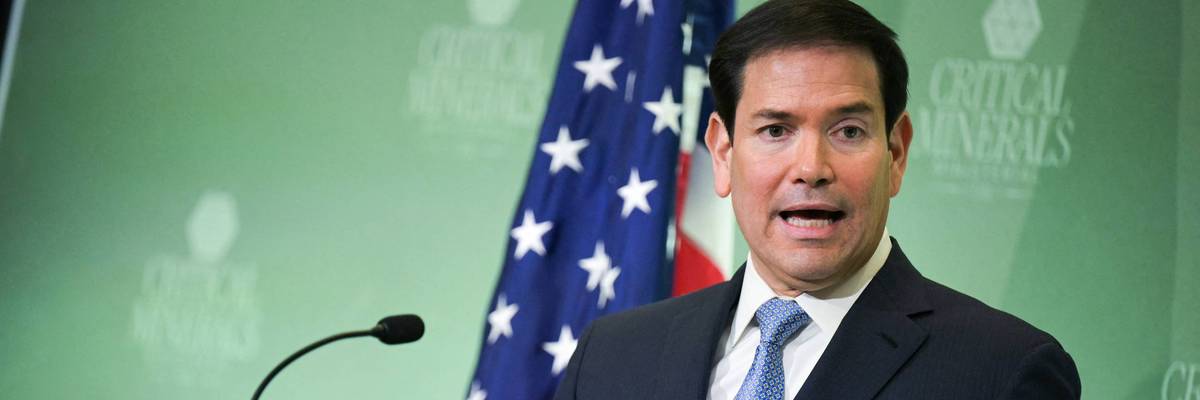
US Secretary of State Marco Rubio speaks during a press conference at the Sate Department in Washington, DC, on February 4, 2026.
"Trump, Putin, and Xi can and must put the world on a safer path by taking commonsense actions to build down the nuclear danger," said one campaigner.
Secretary of State Marco Rubio on Wednesday implicitly confirmed that New START—a key arms control treaty between the United States and Russia—will expire Thursday, prompting renewed demands for what one group called "a more coherent approach from the Trump administration" toward nuclear nonproliferation.
Asked about the impending expiration of New START during a Wednesday press conference, Rubio said he didn't "have any announcement" on the matter, and that President Donald Trump "will opine on it later."
"Obviously, the president’s been clear in the past that in order to have true arms control in the 21st century, it’s impossible to do something that doesn’t include China because of their vast and rapidly growing stockpile," Rubio said.
🇺🇸🇷🇺🇨🇳 Secretary of State Marco Rubio:
I don't have any announcement on New START right now. I think the President will opine on it later.
The President has been clear in the past that in order to have true arms control in the 21st century, it's impossible to do something that… pic.twitter.com/8pxi3bfdsy
— Visioner (@visionergeo) February 4, 2026
New START, signed in 2010, committed the United States and Russia to halving the number of strategic nuclear missile launchers in their arsenals. While the treaty did not limit the size of the countries' actual nuclear arsenals, proponents pointed to its robust verification regime and other transparency features as mutually beneficial highlights of the agreement.
“We have known that New START would end for 15 years, but no one has shown the necessary leadership to be prepared for its expiration,” said John Erath, senior policy director at the Center for Arms Control and Non-Proliferation and former longtime State Department official.
“The treaty limited the number of nuclear weapons the United States and Russia could have, but perhaps more importantly, New START also provided each country with unprecedented insights into the other’s arsenal so that Washington and Moscow could make decisions based on real information rather than speculation," Erath added.
The last remaining major treaty limiting the world's two largest nuclear arsenals expires Feb. 5. Does this mean the end of nuclear arms control? Not necessarily. Read our statement.armscontrolcenter.org/statement-on...
[image or embed]
— Nukes of Hazard (@nukesofhazard.bsky.social) February 4, 2026 at 2:04 PM
Daryl G. Kimball, executive director of the Arms Control Association, said Wednesday that "the end of New START requires a more coherent approach from the Trump administration."
"If President Trump and Secretary Rubio are serious, they should make a serious proposal for bilateral (not trilateral) talks with Beijing," he asserted. "Despite Trump’s talk about involving China in nuclear negotiations, there is no indication that Trump or his team have taken the time to propose risk reduction or arms control talks with China since returning to office in 2025."
Kimball continued:
Furthermore, there is no reason why the United States and Russia should not and cannot continue, as [Russian President Vladimir] Putin suggested on September 22, to respect the central limits of New START and begin the hard work of negotiating a new framework agreement involving verifiable limits on strategic, intermediate-range, and short-range nuclear weapons, as well as strategic missile defenses.
At the same time, if he is serious about involving China in “denuclearization” talks, he could and should invite [Chinese President Xi Jinping] when they meet later this year, to agree to regular bilateral talks on risk reduction and arms control involving senior Chinese and US officials.
"With the end of New START, Trump, Putin, and Xi can and must put the world on a safer path by taking commonsense actions to build down the nuclear danger," Kimball added.
Erath lamented that "with New START’s expiration, we have not only lost unprecedented verification measures that our military and decision-makers depended on, but we have ended more than five decades of painstaking diplomacy that successfully avoided nuclear catastrophe."
"Agreements preceding New START helped reduce the global nuclear arsenal by more than 80% since the height of the Cold War,"
he noted. "Now, both Russia and the United States have no legal obstacle to building their arsenals back up, and we could find ourselves reliving the Cold War."
Last week, the Bulletin of the Atomic Scientists’ Science and Security Board advanced its symbolic Doomsday Clock to 85 seconds to midnight, the closest it has ever been to global thermonuclear annihilation, citing developments including failure to extend New START, China's growing arsenal, and Russian weapons tests—to which Trump has vowed to respond in kind.
"The good news is," said Erath, is that "the end of New START does not have to mean the end of nuclear arms control."
"While New START can’t be extended beyond today, Presidents Donald Trump and Vladimir Putin could decide to respect the numerical limits the treaty set on nuclear arsenals," he explained. "They could also resume the treaty’s data exchanges and on-site inspections, in addition to implementing verification measures from other previous arms control treaties."
"Further, they could instruct their administrations to begin immediate talks on a new treaty to cover existing and novel systems and potentially bring in other nuclear powers, like China," Erath continued. "Meanwhile, Congress could—and should—fund nonproliferation and global monitoring efforts while refusing to fund dangerous new nuclear weapons systems."
Last December, US Sens. Ed Markey (D-Mass.) and Jeff Merkley (D-Ore.) and Reps. Don Beyer (D-Va.), John Garamendi (D-Calif.), and Jim McGovern (D-Mass.) reintroduced the bicameral Hastening Arms Limitation Talks (HALT) Act, "legislation outlining a vision for a 21st century freeze on the testing, production, and deployment of nuclear weapons."
"The Doomsday Clock is at 85 seconds to midnight," Markey—who co-chairs the congressional Nuclear Weapons and Arms Control Working Group—said Wednesday ahead of a press conference with HALT Act co-sponsors. "We need to replace New START now."
Dear Common Dreams reader, It’s been nearly 30 years since I co-founded Common Dreams with my late wife, Lina Newhouser. We had the radical notion that journalism should serve the public good, not corporate profits. It was clear to us from the outset what it would take to build such a project. No paid advertisements. No corporate sponsors. No millionaire publisher telling us what to think or do. Many people said we wouldn't last a year, but we proved those doubters wrong. Together with a tremendous team of journalists and dedicated staff, we built an independent media outlet free from the constraints of profits and corporate control. Our mission has always been simple: To inform. To inspire. To ignite change for the common good. Building Common Dreams was not easy. Our survival was never guaranteed. When you take on the most powerful forces—Wall Street greed, fossil fuel industry destruction, Big Tech lobbyists, and uber-rich oligarchs who have spent billions upon billions rigging the economy and democracy in their favor—the only bulwark you have is supporters who believe in your work. But here’s the urgent message from me today. It's never been this bad out there. And it's never been this hard to keep us going. At the very moment Common Dreams is most needed, the threats we face are intensifying. We need your support now more than ever. We don't accept corporate advertising and never will. We don't have a paywall because we don't think people should be blocked from critical news based on their ability to pay. Everything we do is funded by the donations of readers like you. When everyone does the little they can afford, we are strong. But if that support retreats or dries up, so do we. Will you donate now to make sure Common Dreams not only survives but thrives? —Craig Brown, Co-founder |
Secretary of State Marco Rubio on Wednesday implicitly confirmed that New START—a key arms control treaty between the United States and Russia—will expire Thursday, prompting renewed demands for what one group called "a more coherent approach from the Trump administration" toward nuclear nonproliferation.
Asked about the impending expiration of New START during a Wednesday press conference, Rubio said he didn't "have any announcement" on the matter, and that President Donald Trump "will opine on it later."
"Obviously, the president’s been clear in the past that in order to have true arms control in the 21st century, it’s impossible to do something that doesn’t include China because of their vast and rapidly growing stockpile," Rubio said.
🇺🇸🇷🇺🇨🇳 Secretary of State Marco Rubio:
I don't have any announcement on New START right now. I think the President will opine on it later.
The President has been clear in the past that in order to have true arms control in the 21st century, it's impossible to do something that… pic.twitter.com/8pxi3bfdsy
— Visioner (@visionergeo) February 4, 2026
New START, signed in 2010, committed the United States and Russia to halving the number of strategic nuclear missile launchers in their arsenals. While the treaty did not limit the size of the countries' actual nuclear arsenals, proponents pointed to its robust verification regime and other transparency features as mutually beneficial highlights of the agreement.
“We have known that New START would end for 15 years, but no one has shown the necessary leadership to be prepared for its expiration,” said John Erath, senior policy director at the Center for Arms Control and Non-Proliferation and former longtime State Department official.
“The treaty limited the number of nuclear weapons the United States and Russia could have, but perhaps more importantly, New START also provided each country with unprecedented insights into the other’s arsenal so that Washington and Moscow could make decisions based on real information rather than speculation," Erath added.
The last remaining major treaty limiting the world's two largest nuclear arsenals expires Feb. 5. Does this mean the end of nuclear arms control? Not necessarily. Read our statement.armscontrolcenter.org/statement-on...
[image or embed]
— Nukes of Hazard (@nukesofhazard.bsky.social) February 4, 2026 at 2:04 PM
Daryl G. Kimball, executive director of the Arms Control Association, said Wednesday that "the end of New START requires a more coherent approach from the Trump administration."
"If President Trump and Secretary Rubio are serious, they should make a serious proposal for bilateral (not trilateral) talks with Beijing," he asserted. "Despite Trump’s talk about involving China in nuclear negotiations, there is no indication that Trump or his team have taken the time to propose risk reduction or arms control talks with China since returning to office in 2025."
Kimball continued:
Furthermore, there is no reason why the United States and Russia should not and cannot continue, as [Russian President Vladimir] Putin suggested on September 22, to respect the central limits of New START and begin the hard work of negotiating a new framework agreement involving verifiable limits on strategic, intermediate-range, and short-range nuclear weapons, as well as strategic missile defenses.
At the same time, if he is serious about involving China in “denuclearization” talks, he could and should invite [Chinese President Xi Jinping] when they meet later this year, to agree to regular bilateral talks on risk reduction and arms control involving senior Chinese and US officials.
"With the end of New START, Trump, Putin, and Xi can and must put the world on a safer path by taking commonsense actions to build down the nuclear danger," Kimball added.
Erath lamented that "with New START’s expiration, we have not only lost unprecedented verification measures that our military and decision-makers depended on, but we have ended more than five decades of painstaking diplomacy that successfully avoided nuclear catastrophe."
"Agreements preceding New START helped reduce the global nuclear arsenal by more than 80% since the height of the Cold War,"
he noted. "Now, both Russia and the United States have no legal obstacle to building their arsenals back up, and we could find ourselves reliving the Cold War."
Last week, the Bulletin of the Atomic Scientists’ Science and Security Board advanced its symbolic Doomsday Clock to 85 seconds to midnight, the closest it has ever been to global thermonuclear annihilation, citing developments including failure to extend New START, China's growing arsenal, and Russian weapons tests—to which Trump has vowed to respond in kind.
"The good news is," said Erath, is that "the end of New START does not have to mean the end of nuclear arms control."
"While New START can’t be extended beyond today, Presidents Donald Trump and Vladimir Putin could decide to respect the numerical limits the treaty set on nuclear arsenals," he explained. "They could also resume the treaty’s data exchanges and on-site inspections, in addition to implementing verification measures from other previous arms control treaties."
"Further, they could instruct their administrations to begin immediate talks on a new treaty to cover existing and novel systems and potentially bring in other nuclear powers, like China," Erath continued. "Meanwhile, Congress could—and should—fund nonproliferation and global monitoring efforts while refusing to fund dangerous new nuclear weapons systems."
Last December, US Sens. Ed Markey (D-Mass.) and Jeff Merkley (D-Ore.) and Reps. Don Beyer (D-Va.), John Garamendi (D-Calif.), and Jim McGovern (D-Mass.) reintroduced the bicameral Hastening Arms Limitation Talks (HALT) Act, "legislation outlining a vision for a 21st century freeze on the testing, production, and deployment of nuclear weapons."
"The Doomsday Clock is at 85 seconds to midnight," Markey—who co-chairs the congressional Nuclear Weapons and Arms Control Working Group—said Wednesday ahead of a press conference with HALT Act co-sponsors. "We need to replace New START now."
Secretary of State Marco Rubio on Wednesday implicitly confirmed that New START—a key arms control treaty between the United States and Russia—will expire Thursday, prompting renewed demands for what one group called "a more coherent approach from the Trump administration" toward nuclear nonproliferation.
Asked about the impending expiration of New START during a Wednesday press conference, Rubio said he didn't "have any announcement" on the matter, and that President Donald Trump "will opine on it later."
"Obviously, the president’s been clear in the past that in order to have true arms control in the 21st century, it’s impossible to do something that doesn’t include China because of their vast and rapidly growing stockpile," Rubio said.
🇺🇸🇷🇺🇨🇳 Secretary of State Marco Rubio:
I don't have any announcement on New START right now. I think the President will opine on it later.
The President has been clear in the past that in order to have true arms control in the 21st century, it's impossible to do something that… pic.twitter.com/8pxi3bfdsy
— Visioner (@visionergeo) February 4, 2026
New START, signed in 2010, committed the United States and Russia to halving the number of strategic nuclear missile launchers in their arsenals. While the treaty did not limit the size of the countries' actual nuclear arsenals, proponents pointed to its robust verification regime and other transparency features as mutually beneficial highlights of the agreement.
“We have known that New START would end for 15 years, but no one has shown the necessary leadership to be prepared for its expiration,” said John Erath, senior policy director at the Center for Arms Control and Non-Proliferation and former longtime State Department official.
“The treaty limited the number of nuclear weapons the United States and Russia could have, but perhaps more importantly, New START also provided each country with unprecedented insights into the other’s arsenal so that Washington and Moscow could make decisions based on real information rather than speculation," Erath added.
The last remaining major treaty limiting the world's two largest nuclear arsenals expires Feb. 5. Does this mean the end of nuclear arms control? Not necessarily. Read our statement.armscontrolcenter.org/statement-on...
[image or embed]
— Nukes of Hazard (@nukesofhazard.bsky.social) February 4, 2026 at 2:04 PM
Daryl G. Kimball, executive director of the Arms Control Association, said Wednesday that "the end of New START requires a more coherent approach from the Trump administration."
"If President Trump and Secretary Rubio are serious, they should make a serious proposal for bilateral (not trilateral) talks with Beijing," he asserted. "Despite Trump’s talk about involving China in nuclear negotiations, there is no indication that Trump or his team have taken the time to propose risk reduction or arms control talks with China since returning to office in 2025."
Kimball continued:
Furthermore, there is no reason why the United States and Russia should not and cannot continue, as [Russian President Vladimir] Putin suggested on September 22, to respect the central limits of New START and begin the hard work of negotiating a new framework agreement involving verifiable limits on strategic, intermediate-range, and short-range nuclear weapons, as well as strategic missile defenses.
At the same time, if he is serious about involving China in “denuclearization” talks, he could and should invite [Chinese President Xi Jinping] when they meet later this year, to agree to regular bilateral talks on risk reduction and arms control involving senior Chinese and US officials.
"With the end of New START, Trump, Putin, and Xi can and must put the world on a safer path by taking commonsense actions to build down the nuclear danger," Kimball added.
Erath lamented that "with New START’s expiration, we have not only lost unprecedented verification measures that our military and decision-makers depended on, but we have ended more than five decades of painstaking diplomacy that successfully avoided nuclear catastrophe."
"Agreements preceding New START helped reduce the global nuclear arsenal by more than 80% since the height of the Cold War,"
he noted. "Now, both Russia and the United States have no legal obstacle to building their arsenals back up, and we could find ourselves reliving the Cold War."
Last week, the Bulletin of the Atomic Scientists’ Science and Security Board advanced its symbolic Doomsday Clock to 85 seconds to midnight, the closest it has ever been to global thermonuclear annihilation, citing developments including failure to extend New START, China's growing arsenal, and Russian weapons tests—to which Trump has vowed to respond in kind.
"The good news is," said Erath, is that "the end of New START does not have to mean the end of nuclear arms control."
"While New START can’t be extended beyond today, Presidents Donald Trump and Vladimir Putin could decide to respect the numerical limits the treaty set on nuclear arsenals," he explained. "They could also resume the treaty’s data exchanges and on-site inspections, in addition to implementing verification measures from other previous arms control treaties."
"Further, they could instruct their administrations to begin immediate talks on a new treaty to cover existing and novel systems and potentially bring in other nuclear powers, like China," Erath continued. "Meanwhile, Congress could—and should—fund nonproliferation and global monitoring efforts while refusing to fund dangerous new nuclear weapons systems."
Last December, US Sens. Ed Markey (D-Mass.) and Jeff Merkley (D-Ore.) and Reps. Don Beyer (D-Va.), John Garamendi (D-Calif.), and Jim McGovern (D-Mass.) reintroduced the bicameral Hastening Arms Limitation Talks (HALT) Act, "legislation outlining a vision for a 21st century freeze on the testing, production, and deployment of nuclear weapons."
"The Doomsday Clock is at 85 seconds to midnight," Markey—who co-chairs the congressional Nuclear Weapons and Arms Control Working Group—said Wednesday ahead of a press conference with HALT Act co-sponsors. "We need to replace New START now."