SUBSCRIBE TO OUR FREE NEWSLETTER
Daily news & progressive opinion—funded by the people, not the corporations—delivered straight to your inbox.
5
#000000
#FFFFFF
To donate by check, phone, or other method, see our More Ways to Give page.
Daily news & progressive opinion—funded by the people, not the corporations—delivered straight to your inbox.
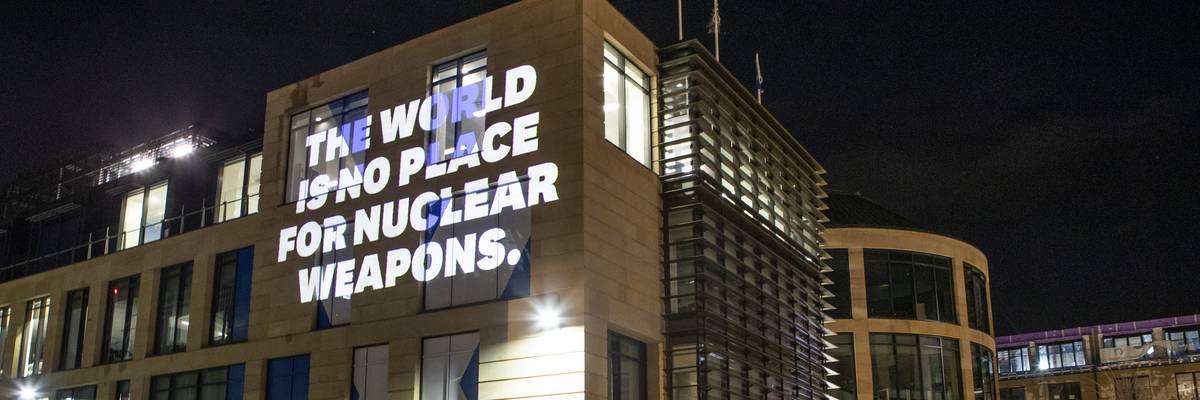
"The World Is No Place For Nuclear Weapons" was projected onto the side of Queen Elizabeth House, the new flagship UK Government Hub, in Edinburgh, to celebrate that the Treaty on the Prohibition of Nuclear Weapons enters into force as international law on January 22, 2021.
When major powers abandon restraint in the nuclear field, they send a dangerous message: that international commitments are optional, norms are negotiable, and humanitarian principles can be sidelined.
In January 2026, I published an article warning that the world was approaching the final hours of the New START Treaty. On February 5, 2026, that warning has become reality. For the first time since the early 1970s, no legally binding limits exist on US-Russian strategic nuclear forces. This moment is not only a failure of arms control; it is a profound threat to human security, humanitarian disarmament, and the credibility of multilateral commitments across all fields.
New START was the last surviving pillar of bilateral nuclear restraint. Its expiration removes the ceilings on deployed strategic warheads and delivery systems, eliminates inspections and data exchanges, and forces both sides to operate in an environment of opacity and worst‑case assumptions. In my earlier article, I argued that this collapse would deepen the crisis of credibility facing the Nuclear Non‑Proliferation Treaty (NPT), especially the long‑neglected obligations under Article VI. That analysis stands even more firmly today. A world without New START is a world where the NPT’s disarmament pillar is no longer eroding slowly—it is cracking openly.
But the consequences extend far beyond the nuclear domain. The end of New START is a blow to humanitarian disarmament as a whole. Treaties such as the Mine Ban Treaty (MBT) and the Convention on Cluster Munitions (CMC) were built on the belief that international law can restrain the most harmful weapons and protect civilians. When major powers abandon restraint in the nuclear field, they send a dangerous message: that international commitments are optional, norms are negotiable, and humanitarian principles can be sidelined when politically inconvenient.
This erosion of respect for international commitments is not isolated. It is part of a wider pattern visible in multiple conflicts, where the use of explosive weapons in populated areas, attacks on medical facilities, and disregard for civilian protection have become disturbingly normalized. The collapse of New START reinforces this trend by weakening the broader culture of compliance that humanitarian disarmament depends on.
Strengthening humanitarian disarmament—from nuclear weapons to landmines, cluster munitions, and all weapons that devastate civilian life—is now an urgent moral responsibility.
The humanitarian and medical consequences of this moment cannot be overstated. Nuclear weapons are not abstract strategic tools; they are instruments of mass suffering. Their use—even once—would overwhelm health systems, destroy infrastructure, contaminate environments, and inflict irreversible harm on generations. The expiration of New START increases the likelihood of miscalculation, escalation, and arms racing at a time when global humanitarian systems are already stretched beyond capacity.
This is why the Treaty on the Prohibition of Nuclear Weapons (TPNW) has gained renewed relevance. Its humanitarian logic—grounded in the lived experiences of survivors and the realities of medical response—offers a principled alternative to the paralysis of traditional arms control. As nuclear‑armed states retreat from their obligations, the TPNW stands as a reminder that disarmament is not only a legal duty but a moral imperative.
Today’s moment demands more than observation. It requires action.
Governments must restore restraint and rebuild trust in multilateral commitments.
Civil society must raise its voice with renewed urgency.
Humanitarian and medical organizations must continue to highlight the human cost of nuclear policies.
And the media must stop treating nuclear risks as distant or technical; they are immediate threats to human life and dignity.
The expiration of New START is not the end of arms control—but it is a warning. A warning that the international system is drifting toward a world where the most destructive weapons are unconstrained, humanitarian norms are weakened, and global commitments lose their meaning.
Strengthening humanitarian disarmament—from nuclear weapons to landmines, cluster munitions, and all weapons that devastate civilian life—is now an urgent moral responsibility, more than ever.
Dear Common Dreams reader, It’s been nearly 30 years since I co-founded Common Dreams with my late wife, Lina Newhouser. We had the radical notion that journalism should serve the public good, not corporate profits. It was clear to us from the outset what it would take to build such a project. No paid advertisements. No corporate sponsors. No millionaire publisher telling us what to think or do. Many people said we wouldn't last a year, but we proved those doubters wrong. Together with a tremendous team of journalists and dedicated staff, we built an independent media outlet free from the constraints of profits and corporate control. Our mission has always been simple: To inform. To inspire. To ignite change for the common good. Building Common Dreams was not easy. Our survival was never guaranteed. When you take on the most powerful forces—Wall Street greed, fossil fuel industry destruction, Big Tech lobbyists, and uber-rich oligarchs who have spent billions upon billions rigging the economy and democracy in their favor—the only bulwark you have is supporters who believe in your work. But here’s the urgent message from me today. It's never been this bad out there. And it's never been this hard to keep us going. At the very moment Common Dreams is most needed, the threats we face are intensifying. We need your support now more than ever. We don't accept corporate advertising and never will. We don't have a paywall because we don't think people should be blocked from critical news based on their ability to pay. Everything we do is funded by the donations of readers like you. When everyone does the little they can afford, we are strong. But if that support retreats or dries up, so do we. Will you donate now to make sure Common Dreams not only survives but thrives? —Craig Brown, Co-founder |
In January 2026, I published an article warning that the world was approaching the final hours of the New START Treaty. On February 5, 2026, that warning has become reality. For the first time since the early 1970s, no legally binding limits exist on US-Russian strategic nuclear forces. This moment is not only a failure of arms control; it is a profound threat to human security, humanitarian disarmament, and the credibility of multilateral commitments across all fields.
New START was the last surviving pillar of bilateral nuclear restraint. Its expiration removes the ceilings on deployed strategic warheads and delivery systems, eliminates inspections and data exchanges, and forces both sides to operate in an environment of opacity and worst‑case assumptions. In my earlier article, I argued that this collapse would deepen the crisis of credibility facing the Nuclear Non‑Proliferation Treaty (NPT), especially the long‑neglected obligations under Article VI. That analysis stands even more firmly today. A world without New START is a world where the NPT’s disarmament pillar is no longer eroding slowly—it is cracking openly.
But the consequences extend far beyond the nuclear domain. The end of New START is a blow to humanitarian disarmament as a whole. Treaties such as the Mine Ban Treaty (MBT) and the Convention on Cluster Munitions (CMC) were built on the belief that international law can restrain the most harmful weapons and protect civilians. When major powers abandon restraint in the nuclear field, they send a dangerous message: that international commitments are optional, norms are negotiable, and humanitarian principles can be sidelined when politically inconvenient.
This erosion of respect for international commitments is not isolated. It is part of a wider pattern visible in multiple conflicts, where the use of explosive weapons in populated areas, attacks on medical facilities, and disregard for civilian protection have become disturbingly normalized. The collapse of New START reinforces this trend by weakening the broader culture of compliance that humanitarian disarmament depends on.
Strengthening humanitarian disarmament—from nuclear weapons to landmines, cluster munitions, and all weapons that devastate civilian life—is now an urgent moral responsibility.
The humanitarian and medical consequences of this moment cannot be overstated. Nuclear weapons are not abstract strategic tools; they are instruments of mass suffering. Their use—even once—would overwhelm health systems, destroy infrastructure, contaminate environments, and inflict irreversible harm on generations. The expiration of New START increases the likelihood of miscalculation, escalation, and arms racing at a time when global humanitarian systems are already stretched beyond capacity.
This is why the Treaty on the Prohibition of Nuclear Weapons (TPNW) has gained renewed relevance. Its humanitarian logic—grounded in the lived experiences of survivors and the realities of medical response—offers a principled alternative to the paralysis of traditional arms control. As nuclear‑armed states retreat from their obligations, the TPNW stands as a reminder that disarmament is not only a legal duty but a moral imperative.
Today’s moment demands more than observation. It requires action.
Governments must restore restraint and rebuild trust in multilateral commitments.
Civil society must raise its voice with renewed urgency.
Humanitarian and medical organizations must continue to highlight the human cost of nuclear policies.
And the media must stop treating nuclear risks as distant or technical; they are immediate threats to human life and dignity.
The expiration of New START is not the end of arms control—but it is a warning. A warning that the international system is drifting toward a world where the most destructive weapons are unconstrained, humanitarian norms are weakened, and global commitments lose their meaning.
Strengthening humanitarian disarmament—from nuclear weapons to landmines, cluster munitions, and all weapons that devastate civilian life—is now an urgent moral responsibility, more than ever.
In January 2026, I published an article warning that the world was approaching the final hours of the New START Treaty. On February 5, 2026, that warning has become reality. For the first time since the early 1970s, no legally binding limits exist on US-Russian strategic nuclear forces. This moment is not only a failure of arms control; it is a profound threat to human security, humanitarian disarmament, and the credibility of multilateral commitments across all fields.
New START was the last surviving pillar of bilateral nuclear restraint. Its expiration removes the ceilings on deployed strategic warheads and delivery systems, eliminates inspections and data exchanges, and forces both sides to operate in an environment of opacity and worst‑case assumptions. In my earlier article, I argued that this collapse would deepen the crisis of credibility facing the Nuclear Non‑Proliferation Treaty (NPT), especially the long‑neglected obligations under Article VI. That analysis stands even more firmly today. A world without New START is a world where the NPT’s disarmament pillar is no longer eroding slowly—it is cracking openly.
But the consequences extend far beyond the nuclear domain. The end of New START is a blow to humanitarian disarmament as a whole. Treaties such as the Mine Ban Treaty (MBT) and the Convention on Cluster Munitions (CMC) were built on the belief that international law can restrain the most harmful weapons and protect civilians. When major powers abandon restraint in the nuclear field, they send a dangerous message: that international commitments are optional, norms are negotiable, and humanitarian principles can be sidelined when politically inconvenient.
This erosion of respect for international commitments is not isolated. It is part of a wider pattern visible in multiple conflicts, where the use of explosive weapons in populated areas, attacks on medical facilities, and disregard for civilian protection have become disturbingly normalized. The collapse of New START reinforces this trend by weakening the broader culture of compliance that humanitarian disarmament depends on.
Strengthening humanitarian disarmament—from nuclear weapons to landmines, cluster munitions, and all weapons that devastate civilian life—is now an urgent moral responsibility.
The humanitarian and medical consequences of this moment cannot be overstated. Nuclear weapons are not abstract strategic tools; they are instruments of mass suffering. Their use—even once—would overwhelm health systems, destroy infrastructure, contaminate environments, and inflict irreversible harm on generations. The expiration of New START increases the likelihood of miscalculation, escalation, and arms racing at a time when global humanitarian systems are already stretched beyond capacity.
This is why the Treaty on the Prohibition of Nuclear Weapons (TPNW) has gained renewed relevance. Its humanitarian logic—grounded in the lived experiences of survivors and the realities of medical response—offers a principled alternative to the paralysis of traditional arms control. As nuclear‑armed states retreat from their obligations, the TPNW stands as a reminder that disarmament is not only a legal duty but a moral imperative.
Today’s moment demands more than observation. It requires action.
Governments must restore restraint and rebuild trust in multilateral commitments.
Civil society must raise its voice with renewed urgency.
Humanitarian and medical organizations must continue to highlight the human cost of nuclear policies.
And the media must stop treating nuclear risks as distant or technical; they are immediate threats to human life and dignity.
The expiration of New START is not the end of arms control—but it is a warning. A warning that the international system is drifting toward a world where the most destructive weapons are unconstrained, humanitarian norms are weakened, and global commitments lose their meaning.
Strengthening humanitarian disarmament—from nuclear weapons to landmines, cluster munitions, and all weapons that devastate civilian life—is now an urgent moral responsibility, more than ever.