

SUBSCRIBE TO OUR FREE NEWSLETTER
Daily news & progressive opinion—funded by the people, not the corporations—delivered straight to your inbox.
5
#000000
#FFFFFF
To donate by check, phone, or other method, see our More Ways to Give page.
Daily news & progressive opinion—funded by the people, not the corporations—delivered straight to your inbox.
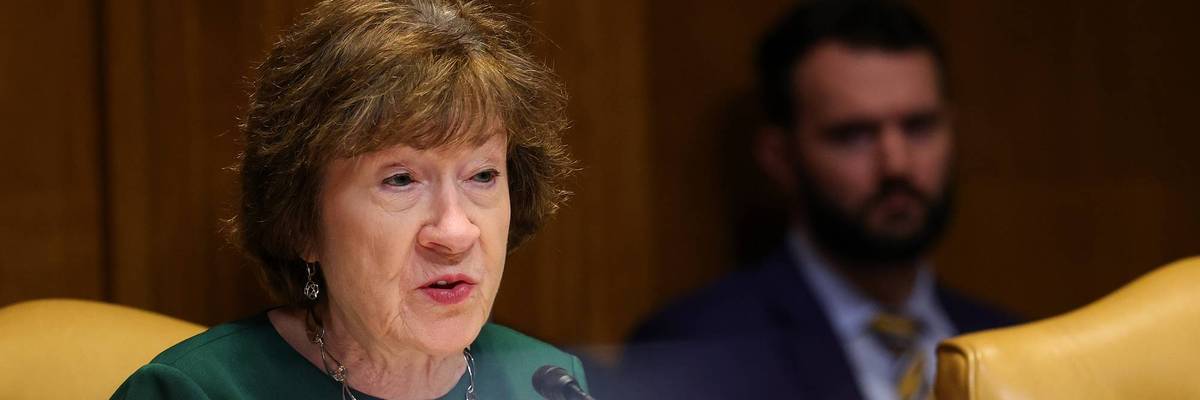
Sen. Susan Collins (R-Maine) speaks during a Senate hearing in the Dirksen Senate Office Building on April 22, 2026 in Washington, DC.
"Don't piss on our boots and tell us it's raining," said the Maine Democrat running to replace the state's Republican US senator.
As it struck down the last remaining provision of the Voting Rights Act that allowed voters of color to challenge racially discriminatory electoral maps, the right-wing majority on the US Supreme Court argued Wednesday that it was simply preventing racial discrimination.
“Allowing race to play any part in government decision-making represents a departure from the constitutional rule that applies in almost every other context,” Justice Samuel Alito wrote in the majority opinion, agreeing with the Trump administration and a group of voters who challenged an electoral map Louisiana lawmakers were forced to redraw in 2024, after the previous map was found to be racially gerrymandered and to discriminate against Black voters.
In Maine, Democratic US Senate candidate Graham Platner made clear that he—and many others—didn't buy it.
"Don't piss on our boots and tell us it's raining: Under their bullshit legalese, the far-right Supreme Court gutted the Voting Rights Act today," said Platner, a combat veteran and oyster farmer who is running a campaign focused on working families and taking on oligarchy.
Platner pointed the finger at the lawmaker he hopes to challenge following the Democratic primary, which is set for June 9—Sen. Susan Collins (R-Maine).
"Another disastrous decision brought to you by the court Susan Collins built," said Platner.
Collins cast the deciding vote in the Senate in 2018 during Justice Brett Kavanaugh's contentious confirmation process, solidifying his lifetime appointment. She also voted to advance Justice Amy Coney Barrett's nomination to the Senate floor just prior to the 2020 election, even as she said she did not believe a vote on the confirmation should take place right before Americans voted.
Platner said earlier this month that should Democrats retake Congress in the November elections, the party should "deal with" the Supreme Court by "exercising ethics oversight" over the court and potentially taking steps to impeach and remove "at least two" justices—likely a reference to Justices Clarence Thomas and Samuel Alito, who according to investigations by ProPublica have failed to disclose gifts from a GOP megadonor and a billionaire hedge fund owner who had business before the court, respectively.
The 6-3 ruling on Wednesday effectively voided what remained of Section 2 of the landmark Voting Right Act (VRA), and is likely to clear the way for new Republican districts to be created across the South ahead of the 2028 presidential election.
The case centered on the congressional map Republican lawmakers in Louisiana drew, which a federal judge found in 2022 did not fairly reflect the population of the state, in which one-third of residents are Black. Section 2 of the VRA states that minority voters must have the same opportunity as other voters to elect the candidates of their choice.
The non-Black voters who later challenged the map that was redrawn in response to the 2022 ruling claimed the new map was racially gerrymandered because it created a second majority-minority district. There are six congressional districts in the state in total.
Writing for the court's minority, Justice Elena Kagan said the consequences of the ruling "are likely to be far-reaching and grave."
“I dissent because the court betrays its duty to faithfully implement the great statute Congress wrote," said Kagan. "I dissent because the court’s decision will set back the foundational right Congress granted of racial equality in electoral opportunity. I dissent.”
Dear Common Dreams reader, It’s been nearly 30 years since I co-founded Common Dreams with my late wife, Lina Newhouser. We had the radical notion that journalism should serve the public good, not corporate profits. It was clear to us from the outset what it would take to build such a project. No paid advertisements. No corporate sponsors. No millionaire publisher telling us what to think or do. Many people said we wouldn't last a year, but we proved those doubters wrong. Together with a tremendous team of journalists and dedicated staff, we built an independent media outlet free from the constraints of profits and corporate control. Our mission has always been simple: To inform. To inspire. To ignite change for the common good. Building Common Dreams was not easy. Our survival was never guaranteed. When you take on the most powerful forces—Wall Street greed, fossil fuel industry destruction, Big Tech lobbyists, and uber-rich oligarchs who have spent billions upon billions rigging the economy and democracy in their favor—the only bulwark you have is supporters who believe in your work. But here’s the urgent message from me today. It's never been this bad out there. And it's never been this hard to keep us going. At the very moment Common Dreams is most needed, the threats we face are intensifying. We need your support now more than ever. We don't accept corporate advertising and never will. We don't have a paywall because we don't think people should be blocked from critical news based on their ability to pay. Everything we do is funded by the donations of readers like you. When everyone does the little they can afford, we are strong. But if that support retreats or dries up, so do we. Will you donate now to make sure Common Dreams not only survives but thrives? —Craig Brown, Co-founder |
As it struck down the last remaining provision of the Voting Rights Act that allowed voters of color to challenge racially discriminatory electoral maps, the right-wing majority on the US Supreme Court argued Wednesday that it was simply preventing racial discrimination.
“Allowing race to play any part in government decision-making represents a departure from the constitutional rule that applies in almost every other context,” Justice Samuel Alito wrote in the majority opinion, agreeing with the Trump administration and a group of voters who challenged an electoral map Louisiana lawmakers were forced to redraw in 2024, after the previous map was found to be racially gerrymandered and to discriminate against Black voters.
In Maine, Democratic US Senate candidate Graham Platner made clear that he—and many others—didn't buy it.
"Don't piss on our boots and tell us it's raining: Under their bullshit legalese, the far-right Supreme Court gutted the Voting Rights Act today," said Platner, a combat veteran and oyster farmer who is running a campaign focused on working families and taking on oligarchy.
Platner pointed the finger at the lawmaker he hopes to challenge following the Democratic primary, which is set for June 9—Sen. Susan Collins (R-Maine).
"Another disastrous decision brought to you by the court Susan Collins built," said Platner.
Collins cast the deciding vote in the Senate in 2018 during Justice Brett Kavanaugh's contentious confirmation process, solidifying his lifetime appointment. She also voted to advance Justice Amy Coney Barrett's nomination to the Senate floor just prior to the 2020 election, even as she said she did not believe a vote on the confirmation should take place right before Americans voted.
Platner said earlier this month that should Democrats retake Congress in the November elections, the party should "deal with" the Supreme Court by "exercising ethics oversight" over the court and potentially taking steps to impeach and remove "at least two" justices—likely a reference to Justices Clarence Thomas and Samuel Alito, who according to investigations by ProPublica have failed to disclose gifts from a GOP megadonor and a billionaire hedge fund owner who had business before the court, respectively.
The 6-3 ruling on Wednesday effectively voided what remained of Section 2 of the landmark Voting Right Act (VRA), and is likely to clear the way for new Republican districts to be created across the South ahead of the 2028 presidential election.
The case centered on the congressional map Republican lawmakers in Louisiana drew, which a federal judge found in 2022 did not fairly reflect the population of the state, in which one-third of residents are Black. Section 2 of the VRA states that minority voters must have the same opportunity as other voters to elect the candidates of their choice.
The non-Black voters who later challenged the map that was redrawn in response to the 2022 ruling claimed the new map was racially gerrymandered because it created a second majority-minority district. There are six congressional districts in the state in total.
Writing for the court's minority, Justice Elena Kagan said the consequences of the ruling "are likely to be far-reaching and grave."
“I dissent because the court betrays its duty to faithfully implement the great statute Congress wrote," said Kagan. "I dissent because the court’s decision will set back the foundational right Congress granted of racial equality in electoral opportunity. I dissent.”
As it struck down the last remaining provision of the Voting Rights Act that allowed voters of color to challenge racially discriminatory electoral maps, the right-wing majority on the US Supreme Court argued Wednesday that it was simply preventing racial discrimination.
“Allowing race to play any part in government decision-making represents a departure from the constitutional rule that applies in almost every other context,” Justice Samuel Alito wrote in the majority opinion, agreeing with the Trump administration and a group of voters who challenged an electoral map Louisiana lawmakers were forced to redraw in 2024, after the previous map was found to be racially gerrymandered and to discriminate against Black voters.
In Maine, Democratic US Senate candidate Graham Platner made clear that he—and many others—didn't buy it.
"Don't piss on our boots and tell us it's raining: Under their bullshit legalese, the far-right Supreme Court gutted the Voting Rights Act today," said Platner, a combat veteran and oyster farmer who is running a campaign focused on working families and taking on oligarchy.
Platner pointed the finger at the lawmaker he hopes to challenge following the Democratic primary, which is set for June 9—Sen. Susan Collins (R-Maine).
"Another disastrous decision brought to you by the court Susan Collins built," said Platner.
Collins cast the deciding vote in the Senate in 2018 during Justice Brett Kavanaugh's contentious confirmation process, solidifying his lifetime appointment. She also voted to advance Justice Amy Coney Barrett's nomination to the Senate floor just prior to the 2020 election, even as she said she did not believe a vote on the confirmation should take place right before Americans voted.
Platner said earlier this month that should Democrats retake Congress in the November elections, the party should "deal with" the Supreme Court by "exercising ethics oversight" over the court and potentially taking steps to impeach and remove "at least two" justices—likely a reference to Justices Clarence Thomas and Samuel Alito, who according to investigations by ProPublica have failed to disclose gifts from a GOP megadonor and a billionaire hedge fund owner who had business before the court, respectively.
The 6-3 ruling on Wednesday effectively voided what remained of Section 2 of the landmark Voting Right Act (VRA), and is likely to clear the way for new Republican districts to be created across the South ahead of the 2028 presidential election.
The case centered on the congressional map Republican lawmakers in Louisiana drew, which a federal judge found in 2022 did not fairly reflect the population of the state, in which one-third of residents are Black. Section 2 of the VRA states that minority voters must have the same opportunity as other voters to elect the candidates of their choice.
The non-Black voters who later challenged the map that was redrawn in response to the 2022 ruling claimed the new map was racially gerrymandered because it created a second majority-minority district. There are six congressional districts in the state in total.
Writing for the court's minority, Justice Elena Kagan said the consequences of the ruling "are likely to be far-reaching and grave."
“I dissent because the court betrays its duty to faithfully implement the great statute Congress wrote," said Kagan. "I dissent because the court’s decision will set back the foundational right Congress granted of racial equality in electoral opportunity. I dissent.”

