SUBSCRIBE TO OUR FREE NEWSLETTER
Daily news & progressive opinion—funded by the people, not the corporations—delivered straight to your inbox.
5
#000000
#FFFFFF
To donate by check, phone, or other method, see our More Ways to Give page.
Daily news & progressive opinion—funded by the people, not the corporations—delivered straight to your inbox.
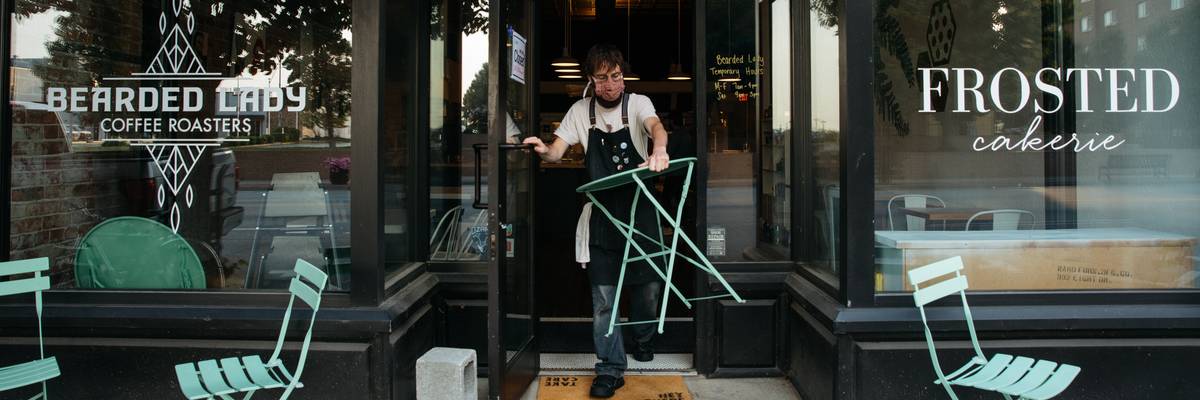
An employee of the Frosted Cakerie on Main St. sets up outdoor seating for the day in Joplin, Missouri on July 2, 2020.
“The minimum wage increase will recirculate back into the economy through spending at the main street shops that make up the fabric of our communities,” said one business owner in New York.
With 23 states and the District of Columbia slated to increase their minimum wages by the end of 2025, the national network Business for a Fair Minimum Wage reports that business owners in states around the country are cheering those increases, saying they will boost consumer spending and hiring, increase productivity, help retain employees, and in general strengthen the economy.
According to a statement Business for a Fair Minimum Wage issued on December 12, the following states will have either a planned or indexed minimum wage increase on January 1: Alaska, Arizona, California, Colorado, Connecticut, Delaware, Illinois, Maine, Michigan, Minnesota, Missouri, Montana, Nebraska, New Jersey, New York, Ohio, Rhode Island, South Dakota, Vermont, Virginia, and Washington.
Florida, Oregon, and the District of Columbia will see increases later in the year, and some states like Alaska will experience multiple wage floor increases during 2025, per the statement.
Voters in Alaska and Missouri approved ballot measures in November that greenlit increases to the minimum wage. Hundreds of business owners in those two states worked with Business for a Fair Minimum Wage to support the ballot initiatives, according to the statement.
" Workers are also customers and minimum wage increases boost consumer buying power. They go right back into the economy as increased spending at local businesses," said Holly Sklar, the CEO of Business for a Fair Minimum Wage.
She added: "State raises are vital for workers, businesses, and communities as the federal minimum wage remains stuck at just $7.25, falling further and further behind the cost of living." The federal minimum wage hasn't budged since 2009, when it was raised to $7.25.
One business owner, Erik Milan, whose music store Stick It In Your Ear is based in Springfield, Missouri, praised the state's increase. "Raising Missouri's minimum wage will be good for workers and businesses. When workers in our community are paid more, they can spend more at local businesses ... Thanks to better wages and paid sick time because of Proposition A, businesses will also benefit from lower employee turnover, increased productivity, better health and morale, and better customer service," he said, per the statement.
Because of Proposition A, Missouri will increase the state minimum wage to $13.75 an hour on January 1 for private and non-exempt employees, and then increase it again to $15 in 2026. Beginning in May of this coming year, employers are required to give employees one hour of paid sick time per 30 hours worked.
Over in Alaska, the owner of Waffles and Whatnot in Anchorage, Derrick Green, said that "Alaska's minimum wage increases will help Alaskans thrive ... The more that people can make a living in Alaska, the stronger our businesses and communities will be."
Same as Proposition A, Alaska's Ballot Measure One mandates that workers will be able to earn one hour of paid sick time for every 30 hours worked. Alaska's minimum wage was already set to increase on January 1, and then thanks to Ballot Measure One it will increase again on July 1 to $13 and then again to $14 in July 2026.
The statement from Business for a Fair Minimum Wage in total quotes 11 business owners touting the wage floor increases, including Jessica Galen, owner of Bloomy Cheese & Provisions in Dobbs Ferry, New York.
"The minimum wage increase will recirculate back into the economy through spending at the main street shops that make up the fabric of our communities. It's a virtuous cycle. When we take care of our employees, they take care of us," she said.
Dear Common Dreams reader, It’s been nearly 30 years since I co-founded Common Dreams with my late wife, Lina Newhouser. We had the radical notion that journalism should serve the public good, not corporate profits. It was clear to us from the outset what it would take to build such a project. No paid advertisements. No corporate sponsors. No millionaire publisher telling us what to think or do. Many people said we wouldn't last a year, but we proved those doubters wrong. Together with a tremendous team of journalists and dedicated staff, we built an independent media outlet free from the constraints of profits and corporate control. Our mission has always been simple: To inform. To inspire. To ignite change for the common good. Building Common Dreams was not easy. Our survival was never guaranteed. When you take on the most powerful forces—Wall Street greed, fossil fuel industry destruction, Big Tech lobbyists, and uber-rich oligarchs who have spent billions upon billions rigging the economy and democracy in their favor—the only bulwark you have is supporters who believe in your work. But here’s the urgent message from me today. It's never been this bad out there. And it's never been this hard to keep us going. At the very moment Common Dreams is most needed, the threats we face are intensifying. We need your support now more than ever. We don't accept corporate advertising and never will. We don't have a paywall because we don't think people should be blocked from critical news based on their ability to pay. Everything we do is funded by the donations of readers like you. When everyone does the little they can afford, we are strong. But if that support retreats or dries up, so do we. Will you donate now to make sure Common Dreams not only survives but thrives? —Craig Brown, Co-founder |
With 23 states and the District of Columbia slated to increase their minimum wages by the end of 2025, the national network Business for a Fair Minimum Wage reports that business owners in states around the country are cheering those increases, saying they will boost consumer spending and hiring, increase productivity, help retain employees, and in general strengthen the economy.
According to a statement Business for a Fair Minimum Wage issued on December 12, the following states will have either a planned or indexed minimum wage increase on January 1: Alaska, Arizona, California, Colorado, Connecticut, Delaware, Illinois, Maine, Michigan, Minnesota, Missouri, Montana, Nebraska, New Jersey, New York, Ohio, Rhode Island, South Dakota, Vermont, Virginia, and Washington.
Florida, Oregon, and the District of Columbia will see increases later in the year, and some states like Alaska will experience multiple wage floor increases during 2025, per the statement.
Voters in Alaska and Missouri approved ballot measures in November that greenlit increases to the minimum wage. Hundreds of business owners in those two states worked with Business for a Fair Minimum Wage to support the ballot initiatives, according to the statement.
" Workers are also customers and minimum wage increases boost consumer buying power. They go right back into the economy as increased spending at local businesses," said Holly Sklar, the CEO of Business for a Fair Minimum Wage.
She added: "State raises are vital for workers, businesses, and communities as the federal minimum wage remains stuck at just $7.25, falling further and further behind the cost of living." The federal minimum wage hasn't budged since 2009, when it was raised to $7.25.
One business owner, Erik Milan, whose music store Stick It In Your Ear is based in Springfield, Missouri, praised the state's increase. "Raising Missouri's minimum wage will be good for workers and businesses. When workers in our community are paid more, they can spend more at local businesses ... Thanks to better wages and paid sick time because of Proposition A, businesses will also benefit from lower employee turnover, increased productivity, better health and morale, and better customer service," he said, per the statement.
Because of Proposition A, Missouri will increase the state minimum wage to $13.75 an hour on January 1 for private and non-exempt employees, and then increase it again to $15 in 2026. Beginning in May of this coming year, employers are required to give employees one hour of paid sick time per 30 hours worked.
Over in Alaska, the owner of Waffles and Whatnot in Anchorage, Derrick Green, said that "Alaska's minimum wage increases will help Alaskans thrive ... The more that people can make a living in Alaska, the stronger our businesses and communities will be."
Same as Proposition A, Alaska's Ballot Measure One mandates that workers will be able to earn one hour of paid sick time for every 30 hours worked. Alaska's minimum wage was already set to increase on January 1, and then thanks to Ballot Measure One it will increase again on July 1 to $13 and then again to $14 in July 2026.
The statement from Business for a Fair Minimum Wage in total quotes 11 business owners touting the wage floor increases, including Jessica Galen, owner of Bloomy Cheese & Provisions in Dobbs Ferry, New York.
"The minimum wage increase will recirculate back into the economy through spending at the main street shops that make up the fabric of our communities. It's a virtuous cycle. When we take care of our employees, they take care of us," she said.
With 23 states and the District of Columbia slated to increase their minimum wages by the end of 2025, the national network Business for a Fair Minimum Wage reports that business owners in states around the country are cheering those increases, saying they will boost consumer spending and hiring, increase productivity, help retain employees, and in general strengthen the economy.
According to a statement Business for a Fair Minimum Wage issued on December 12, the following states will have either a planned or indexed minimum wage increase on January 1: Alaska, Arizona, California, Colorado, Connecticut, Delaware, Illinois, Maine, Michigan, Minnesota, Missouri, Montana, Nebraska, New Jersey, New York, Ohio, Rhode Island, South Dakota, Vermont, Virginia, and Washington.
Florida, Oregon, and the District of Columbia will see increases later in the year, and some states like Alaska will experience multiple wage floor increases during 2025, per the statement.
Voters in Alaska and Missouri approved ballot measures in November that greenlit increases to the minimum wage. Hundreds of business owners in those two states worked with Business for a Fair Minimum Wage to support the ballot initiatives, according to the statement.
" Workers are also customers and minimum wage increases boost consumer buying power. They go right back into the economy as increased spending at local businesses," said Holly Sklar, the CEO of Business for a Fair Minimum Wage.
She added: "State raises are vital for workers, businesses, and communities as the federal minimum wage remains stuck at just $7.25, falling further and further behind the cost of living." The federal minimum wage hasn't budged since 2009, when it was raised to $7.25.
One business owner, Erik Milan, whose music store Stick It In Your Ear is based in Springfield, Missouri, praised the state's increase. "Raising Missouri's minimum wage will be good for workers and businesses. When workers in our community are paid more, they can spend more at local businesses ... Thanks to better wages and paid sick time because of Proposition A, businesses will also benefit from lower employee turnover, increased productivity, better health and morale, and better customer service," he said, per the statement.
Because of Proposition A, Missouri will increase the state minimum wage to $13.75 an hour on January 1 for private and non-exempt employees, and then increase it again to $15 in 2026. Beginning in May of this coming year, employers are required to give employees one hour of paid sick time per 30 hours worked.
Over in Alaska, the owner of Waffles and Whatnot in Anchorage, Derrick Green, said that "Alaska's minimum wage increases will help Alaskans thrive ... The more that people can make a living in Alaska, the stronger our businesses and communities will be."
Same as Proposition A, Alaska's Ballot Measure One mandates that workers will be able to earn one hour of paid sick time for every 30 hours worked. Alaska's minimum wage was already set to increase on January 1, and then thanks to Ballot Measure One it will increase again on July 1 to $13 and then again to $14 in July 2026.
The statement from Business for a Fair Minimum Wage in total quotes 11 business owners touting the wage floor increases, including Jessica Galen, owner of Bloomy Cheese & Provisions in Dobbs Ferry, New York.
"The minimum wage increase will recirculate back into the economy through spending at the main street shops that make up the fabric of our communities. It's a virtuous cycle. When we take care of our employees, they take care of us," she said.