SUBSCRIBE TO OUR FREE NEWSLETTER
Daily news & progressive opinion—funded by the people, not the corporations—delivered straight to your inbox.
5
#000000
#FFFFFF
To donate by check, phone, or other method, see our More Ways to Give page.
Daily news & progressive opinion—funded by the people, not the corporations—delivered straight to your inbox.
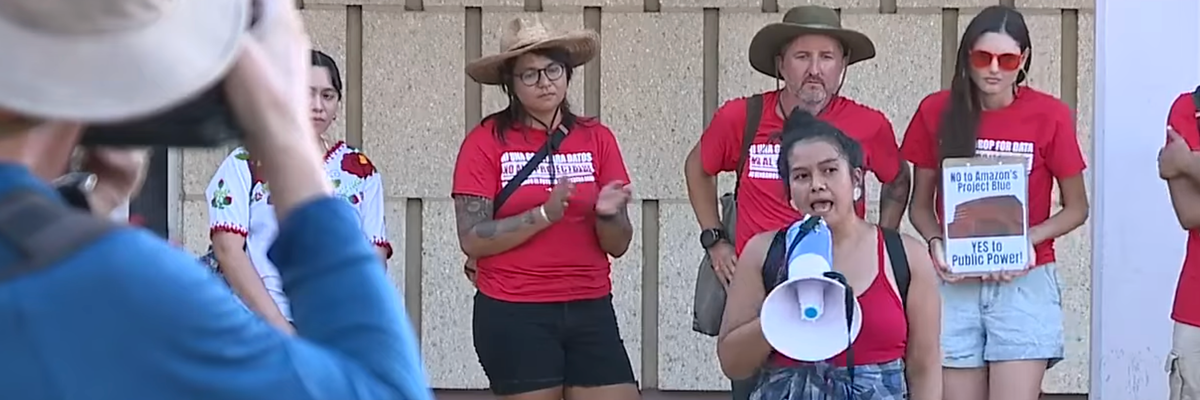
Local activists protest against a data center project at a Tucson City Council meeting on August 6, 2025
"Project Blue represents a lot of things to a lot of people," said one member of the Tucson City Council. "It's a distrust in government. It's a distrust in corporations. It's a very large distrust in tech companies."
A Wednesday evening city council meeting in Tucson, Arizona ended with boisterous cheers from attendees after lawmakers voted unanimously to kill a massive Amazon-linked data center project amid concerns over its impact on the city's water supply.
As reported by The Tucson Sentinel, the Project Blue data centers being spearheaded by development firm Beale Infrastructure went down in defeat during a lengthy meeting in which representatives from the company tried to assuage locals' concerns about the project's impact on their community and environment.
Although the company behind the proposed data centers had initially been a mystery, the Sentinel reported that documents mistakenly released by Pima County revealed that Amazon Web Services was the project's "final customer."
Opposition to the project grew over the summer after city officials released estimates showing the two planned data centers under Project Blue would use 2,000 acre-feet of water per year, which would be more than the annual use of four golf courses. Even though city officials emphasized that the project would be "net water positive" because its developers would invest in projects that would "offset their consumptive use, gallon-for-gallon," this wasn't enough to satisfy many Tucson residents.
During the Wednesday meeting, Councilmember Nikki Lee said she decided to oppose the construction of the data centers after listening to the constituents in her ward who were vehemently opposed.
"Project Blue represents a lot of things to a lot of people right now, more than just the data center and the project itself," she explained, according to The Tuscon Sentinel. "It's a distrust in government. It's a distrust in corporations. It's a very large distrust in tech companies, a distrust in technology and privacy in general, and a fear of artificial intelligence and how fast things are moving and how little control we have."
Councilmember Lane Santa Cruz also expressed a general distrust with corporate America in justifying her opposition to the project.
"What I've learned is simple, giant corporations prefer to operate in the shadows," explained Santa Cruz. "Cities across the country are being sold the same story, promises of jobs, innovation, and progress, but what's not being talked about is who really benefits and what it will cost us."
Local resident Vivek Bharathan, who campaigned against the initiative, told Arizona Luminaria that he was grateful that pressure from community organizations such as No Desert Data Center had pushed the council to scrap the project.
"I had hope but zero expectations," he told the publication. "This is a huge win."
Local resident Maria Renée, who had helped with No Desert Data Center's campaign, told Arizona Luminaria that she felt as though "a weight has totally lifted" after the project's demise, although she vowed to continue her advocacy for "policy that puts guard rails on large water users" in the community.
Video taken of the event by KVOA journalist Eric Fink showed that people attending the Wednesday city council meeting erupted in cheers after the council voted to scrap the project.
BREAKING: Tucson City Council votes 7-0, unanimously to kill Project Blue in the City of Tucson. Listen to the crowd. pic.twitter.com/OqnrMVacCM
— Eric Fink (@EricFinkTV) August 6, 2025
Arizona Luminaria also reported that Project Blue isn't entirely dead despite the council's vote, as Beale Infrastructure could still build out data centers in locations that are close to Tucson.
"Beale and Pima County entered into a purchase and sale agreement for 290 acres of unincorporated land in June," the publication explained. "The project developer was interested in having that land annexed into Tucson to access city water supplies, but could consider other locations to build outside Tucson city limits."
Dear Common Dreams reader, It’s been nearly 30 years since I co-founded Common Dreams with my late wife, Lina Newhouser. We had the radical notion that journalism should serve the public good, not corporate profits. It was clear to us from the outset what it would take to build such a project. No paid advertisements. No corporate sponsors. No millionaire publisher telling us what to think or do. Many people said we wouldn't last a year, but we proved those doubters wrong. Together with a tremendous team of journalists and dedicated staff, we built an independent media outlet free from the constraints of profits and corporate control. Our mission has always been simple: To inform. To inspire. To ignite change for the common good. Building Common Dreams was not easy. Our survival was never guaranteed. When you take on the most powerful forces—Wall Street greed, fossil fuel industry destruction, Big Tech lobbyists, and uber-rich oligarchs who have spent billions upon billions rigging the economy and democracy in their favor—the only bulwark you have is supporters who believe in your work. But here’s the urgent message from me today. It's never been this bad out there. And it's never been this hard to keep us going. At the very moment Common Dreams is most needed, the threats we face are intensifying. We need your support now more than ever. We don't accept corporate advertising and never will. We don't have a paywall because we don't think people should be blocked from critical news based on their ability to pay. Everything we do is funded by the donations of readers like you. When everyone does the little they can afford, we are strong. But if that support retreats or dries up, so do we. Will you donate now to make sure Common Dreams not only survives but thrives? —Craig Brown, Co-founder |
A Wednesday evening city council meeting in Tucson, Arizona ended with boisterous cheers from attendees after lawmakers voted unanimously to kill a massive Amazon-linked data center project amid concerns over its impact on the city's water supply.
As reported by The Tucson Sentinel, the Project Blue data centers being spearheaded by development firm Beale Infrastructure went down in defeat during a lengthy meeting in which representatives from the company tried to assuage locals' concerns about the project's impact on their community and environment.
Although the company behind the proposed data centers had initially been a mystery, the Sentinel reported that documents mistakenly released by Pima County revealed that Amazon Web Services was the project's "final customer."
Opposition to the project grew over the summer after city officials released estimates showing the two planned data centers under Project Blue would use 2,000 acre-feet of water per year, which would be more than the annual use of four golf courses. Even though city officials emphasized that the project would be "net water positive" because its developers would invest in projects that would "offset their consumptive use, gallon-for-gallon," this wasn't enough to satisfy many Tucson residents.
During the Wednesday meeting, Councilmember Nikki Lee said she decided to oppose the construction of the data centers after listening to the constituents in her ward who were vehemently opposed.
"Project Blue represents a lot of things to a lot of people right now, more than just the data center and the project itself," she explained, according to The Tuscon Sentinel. "It's a distrust in government. It's a distrust in corporations. It's a very large distrust in tech companies, a distrust in technology and privacy in general, and a fear of artificial intelligence and how fast things are moving and how little control we have."
Councilmember Lane Santa Cruz also expressed a general distrust with corporate America in justifying her opposition to the project.
"What I've learned is simple, giant corporations prefer to operate in the shadows," explained Santa Cruz. "Cities across the country are being sold the same story, promises of jobs, innovation, and progress, but what's not being talked about is who really benefits and what it will cost us."
Local resident Vivek Bharathan, who campaigned against the initiative, told Arizona Luminaria that he was grateful that pressure from community organizations such as No Desert Data Center had pushed the council to scrap the project.
"I had hope but zero expectations," he told the publication. "This is a huge win."
Local resident Maria Renée, who had helped with No Desert Data Center's campaign, told Arizona Luminaria that she felt as though "a weight has totally lifted" after the project's demise, although she vowed to continue her advocacy for "policy that puts guard rails on large water users" in the community.
Video taken of the event by KVOA journalist Eric Fink showed that people attending the Wednesday city council meeting erupted in cheers after the council voted to scrap the project.
BREAKING: Tucson City Council votes 7-0, unanimously to kill Project Blue in the City of Tucson. Listen to the crowd. pic.twitter.com/OqnrMVacCM
— Eric Fink (@EricFinkTV) August 6, 2025
Arizona Luminaria also reported that Project Blue isn't entirely dead despite the council's vote, as Beale Infrastructure could still build out data centers in locations that are close to Tucson.
"Beale and Pima County entered into a purchase and sale agreement for 290 acres of unincorporated land in June," the publication explained. "The project developer was interested in having that land annexed into Tucson to access city water supplies, but could consider other locations to build outside Tucson city limits."
A Wednesday evening city council meeting in Tucson, Arizona ended with boisterous cheers from attendees after lawmakers voted unanimously to kill a massive Amazon-linked data center project amid concerns over its impact on the city's water supply.
As reported by The Tucson Sentinel, the Project Blue data centers being spearheaded by development firm Beale Infrastructure went down in defeat during a lengthy meeting in which representatives from the company tried to assuage locals' concerns about the project's impact on their community and environment.
Although the company behind the proposed data centers had initially been a mystery, the Sentinel reported that documents mistakenly released by Pima County revealed that Amazon Web Services was the project's "final customer."
Opposition to the project grew over the summer after city officials released estimates showing the two planned data centers under Project Blue would use 2,000 acre-feet of water per year, which would be more than the annual use of four golf courses. Even though city officials emphasized that the project would be "net water positive" because its developers would invest in projects that would "offset their consumptive use, gallon-for-gallon," this wasn't enough to satisfy many Tucson residents.
During the Wednesday meeting, Councilmember Nikki Lee said she decided to oppose the construction of the data centers after listening to the constituents in her ward who were vehemently opposed.
"Project Blue represents a lot of things to a lot of people right now, more than just the data center and the project itself," she explained, according to The Tuscon Sentinel. "It's a distrust in government. It's a distrust in corporations. It's a very large distrust in tech companies, a distrust in technology and privacy in general, and a fear of artificial intelligence and how fast things are moving and how little control we have."
Councilmember Lane Santa Cruz also expressed a general distrust with corporate America in justifying her opposition to the project.
"What I've learned is simple, giant corporations prefer to operate in the shadows," explained Santa Cruz. "Cities across the country are being sold the same story, promises of jobs, innovation, and progress, but what's not being talked about is who really benefits and what it will cost us."
Local resident Vivek Bharathan, who campaigned against the initiative, told Arizona Luminaria that he was grateful that pressure from community organizations such as No Desert Data Center had pushed the council to scrap the project.
"I had hope but zero expectations," he told the publication. "This is a huge win."
Local resident Maria Renée, who had helped with No Desert Data Center's campaign, told Arizona Luminaria that she felt as though "a weight has totally lifted" after the project's demise, although she vowed to continue her advocacy for "policy that puts guard rails on large water users" in the community.
Video taken of the event by KVOA journalist Eric Fink showed that people attending the Wednesday city council meeting erupted in cheers after the council voted to scrap the project.
BREAKING: Tucson City Council votes 7-0, unanimously to kill Project Blue in the City of Tucson. Listen to the crowd. pic.twitter.com/OqnrMVacCM
— Eric Fink (@EricFinkTV) August 6, 2025
Arizona Luminaria also reported that Project Blue isn't entirely dead despite the council's vote, as Beale Infrastructure could still build out data centers in locations that are close to Tucson.
"Beale and Pima County entered into a purchase and sale agreement for 290 acres of unincorporated land in June," the publication explained. "The project developer was interested in having that land annexed into Tucson to access city water supplies, but could consider other locations to build outside Tucson city limits."