SUBSCRIBE TO OUR FREE NEWSLETTER
Daily news & progressive opinion—funded by the people, not the corporations—delivered straight to your inbox.
5
#000000
#FFFFFF
To donate by check, phone, or other method, see our More Ways to Give page.
Daily news & progressive opinion—funded by the people, not the corporations—delivered straight to your inbox.
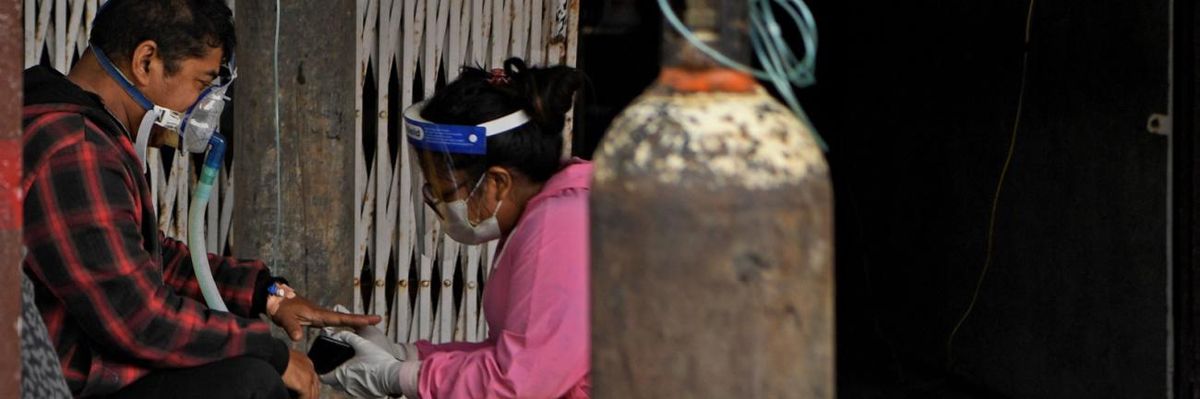
A Covid-19 patient wearing an oxygen mask sits outside an emergency ward at a hospital in Kathmandu on May 18, 2021. (Photo: Prakash Methema/AFP via Getty Images)
Persistent inequalities in healthcare have left many health systems in the Global South on the brink of collapse as Covid-19 case numbers climb and vaccinations lag, according to a new study of countries that are lacking oxygen supplies for patients.
The Bureau of Investigative Journalism analyzed data from the Every Breath Counts Coalition, the NGO Path, and the Clinton Health Access Initiative (CHAI) and found that at least 19 countries need more than 13 million liquid gallons of oxygen per day to cope with rising case numbers.
India, Nepal, Argentina, Colombia, Pakistan, South Africa, and Iran are among the countries most at risk, the report showed, with fewer than one in 10 people having been vaccinated and the need for oxygen supplies rising more than 20% since March.
"We could see the total collapse of health systems, especially in countries with very fragile systems," said Robert Matiru, chair of the World Health Organization's Covid-19 Oxygen Emergency Task Force.
"Medical oxygen has been around for over a century yet countries are struggling to prevent Covid patients from suffocating," said Dr. Paul Sonenthal, a critical care physician and instructor at Harvard Medical School. "It's a tragic example of the violence of health inequity and demands action."
The task force was assembled in February as WHO announced that $90 million was needed immediately to secure oxygen supplies in up to 20 low- and middle-income countries.
"Medical oxygen has been around for over a century yet countries are struggling to prevent Covid patients from suffocating. It's a tragic example of the violence of health inequity and demands action."
--Dr. Paul Sonenthal, Harvard Medical School
At the time, Brazil's Covid-19 crisis was being called "a warning to the whole world" as it faced an especially contagious variant of the coronavirus and hospitals in the northern state of Amazonas ran out of oxygen, forcing healthcare workers to allow some patients to suffocate while they saved others.
"The situation last year, and again in January this year in Brazil and Peru, should have been the wake up call," said Leith Greenslade, coordinator of the Every Breath Counts Coalition. "But the world did not wake up."
"We should have known India would happen after seeing what happened in Latin America," she added, referring to India's current Covid-19 outbreak, putting the country at the epicenter of the pandemic with more than 300,000 deaths. "And now looking at Asia, we should know this will happen in some of the big cities in Africa."
India is currently reporting an average of 4,000 deaths per day, while several countries in South America including Uruguay, Argentina, and Chile are reporting the highest new rates of infection in the world.
According to the Bureau of Investigative Journalism, emergency funding for oxygen is not reaching countries in need quickly enough, leading some governments to order liquid oxygen producers to divert their supply to fulfill medical needs instead of sending it to industrial clients.
"We have to ask a very critical question: Why such an essential resource as oxygen is locked up in mining, steel, oil, and gas when the poor public hospital system can't provide enough to keep babies, adults and the elderly alive," Greenslade said. "If oxygen capacity is there for mining companies to extract, the capacity must be there for the health system to save lives."
In Nepal, the Bureau reported, healthcare workers lack not only liquid oxygen but also canisters in which to store and transport it to patients.
"They can't access fast financing from the global players that can translate into product in-country quickly," Greenslade said. "Now, if we had an emergency financing, we could immediately negotiate directly with cylinder makers to buy those cylinders, and transport them into Nepal within days."
Oxygen supplies were low in several of the countries in need prior to the pandemic, and Greenslade called on health ministries and global policymakers to ensure the Global South is better prepared if another respiratory public health crisis emerges.
"Countries must do what they need to do to prepare for the next one," she told the Bureau. "Scientists are saying this is not the first, and it may not be the worst."
Dear Common Dreams reader, It’s been nearly 30 years since I co-founded Common Dreams with my late wife, Lina Newhouser. We had the radical notion that journalism should serve the public good, not corporate profits. It was clear to us from the outset what it would take to build such a project. No paid advertisements. No corporate sponsors. No millionaire publisher telling us what to think or do. Many people said we wouldn't last a year, but we proved those doubters wrong. Together with a tremendous team of journalists and dedicated staff, we built an independent media outlet free from the constraints of profits and corporate control. Our mission has always been simple: To inform. To inspire. To ignite change for the common good. Building Common Dreams was not easy. Our survival was never guaranteed. When you take on the most powerful forces—Wall Street greed, fossil fuel industry destruction, Big Tech lobbyists, and uber-rich oligarchs who have spent billions upon billions rigging the economy and democracy in their favor—the only bulwark you have is supporters who believe in your work. But here’s the urgent message from me today. It's never been this bad out there. And it's never been this hard to keep us going. At the very moment Common Dreams is most needed, the threats we face are intensifying. We need your support now more than ever. We don't accept corporate advertising and never will. We don't have a paywall because we don't think people should be blocked from critical news based on their ability to pay. Everything we do is funded by the donations of readers like you. When everyone does the little they can afford, we are strong. But if that support retreats or dries up, so do we. Will you donate now to make sure Common Dreams not only survives but thrives? —Craig Brown, Co-founder |
Persistent inequalities in healthcare have left many health systems in the Global South on the brink of collapse as Covid-19 case numbers climb and vaccinations lag, according to a new study of countries that are lacking oxygen supplies for patients.
The Bureau of Investigative Journalism analyzed data from the Every Breath Counts Coalition, the NGO Path, and the Clinton Health Access Initiative (CHAI) and found that at least 19 countries need more than 13 million liquid gallons of oxygen per day to cope with rising case numbers.
India, Nepal, Argentina, Colombia, Pakistan, South Africa, and Iran are among the countries most at risk, the report showed, with fewer than one in 10 people having been vaccinated and the need for oxygen supplies rising more than 20% since March.
"We could see the total collapse of health systems, especially in countries with very fragile systems," said Robert Matiru, chair of the World Health Organization's Covid-19 Oxygen Emergency Task Force.
"Medical oxygen has been around for over a century yet countries are struggling to prevent Covid patients from suffocating," said Dr. Paul Sonenthal, a critical care physician and instructor at Harvard Medical School. "It's a tragic example of the violence of health inequity and demands action."
The task force was assembled in February as WHO announced that $90 million was needed immediately to secure oxygen supplies in up to 20 low- and middle-income countries.
"Medical oxygen has been around for over a century yet countries are struggling to prevent Covid patients from suffocating. It's a tragic example of the violence of health inequity and demands action."
--Dr. Paul Sonenthal, Harvard Medical School
At the time, Brazil's Covid-19 crisis was being called "a warning to the whole world" as it faced an especially contagious variant of the coronavirus and hospitals in the northern state of Amazonas ran out of oxygen, forcing healthcare workers to allow some patients to suffocate while they saved others.
"The situation last year, and again in January this year in Brazil and Peru, should have been the wake up call," said Leith Greenslade, coordinator of the Every Breath Counts Coalition. "But the world did not wake up."
"We should have known India would happen after seeing what happened in Latin America," she added, referring to India's current Covid-19 outbreak, putting the country at the epicenter of the pandemic with more than 300,000 deaths. "And now looking at Asia, we should know this will happen in some of the big cities in Africa."
India is currently reporting an average of 4,000 deaths per day, while several countries in South America including Uruguay, Argentina, and Chile are reporting the highest new rates of infection in the world.
According to the Bureau of Investigative Journalism, emergency funding for oxygen is not reaching countries in need quickly enough, leading some governments to order liquid oxygen producers to divert their supply to fulfill medical needs instead of sending it to industrial clients.
"We have to ask a very critical question: Why such an essential resource as oxygen is locked up in mining, steel, oil, and gas when the poor public hospital system can't provide enough to keep babies, adults and the elderly alive," Greenslade said. "If oxygen capacity is there for mining companies to extract, the capacity must be there for the health system to save lives."
In Nepal, the Bureau reported, healthcare workers lack not only liquid oxygen but also canisters in which to store and transport it to patients.
"They can't access fast financing from the global players that can translate into product in-country quickly," Greenslade said. "Now, if we had an emergency financing, we could immediately negotiate directly with cylinder makers to buy those cylinders, and transport them into Nepal within days."
Oxygen supplies were low in several of the countries in need prior to the pandemic, and Greenslade called on health ministries and global policymakers to ensure the Global South is better prepared if another respiratory public health crisis emerges.
"Countries must do what they need to do to prepare for the next one," she told the Bureau. "Scientists are saying this is not the first, and it may not be the worst."
Persistent inequalities in healthcare have left many health systems in the Global South on the brink of collapse as Covid-19 case numbers climb and vaccinations lag, according to a new study of countries that are lacking oxygen supplies for patients.
The Bureau of Investigative Journalism analyzed data from the Every Breath Counts Coalition, the NGO Path, and the Clinton Health Access Initiative (CHAI) and found that at least 19 countries need more than 13 million liquid gallons of oxygen per day to cope with rising case numbers.
India, Nepal, Argentina, Colombia, Pakistan, South Africa, and Iran are among the countries most at risk, the report showed, with fewer than one in 10 people having been vaccinated and the need for oxygen supplies rising more than 20% since March.
"We could see the total collapse of health systems, especially in countries with very fragile systems," said Robert Matiru, chair of the World Health Organization's Covid-19 Oxygen Emergency Task Force.
"Medical oxygen has been around for over a century yet countries are struggling to prevent Covid patients from suffocating," said Dr. Paul Sonenthal, a critical care physician and instructor at Harvard Medical School. "It's a tragic example of the violence of health inequity and demands action."
The task force was assembled in February as WHO announced that $90 million was needed immediately to secure oxygen supplies in up to 20 low- and middle-income countries.
"Medical oxygen has been around for over a century yet countries are struggling to prevent Covid patients from suffocating. It's a tragic example of the violence of health inequity and demands action."
--Dr. Paul Sonenthal, Harvard Medical School
At the time, Brazil's Covid-19 crisis was being called "a warning to the whole world" as it faced an especially contagious variant of the coronavirus and hospitals in the northern state of Amazonas ran out of oxygen, forcing healthcare workers to allow some patients to suffocate while they saved others.
"The situation last year, and again in January this year in Brazil and Peru, should have been the wake up call," said Leith Greenslade, coordinator of the Every Breath Counts Coalition. "But the world did not wake up."
"We should have known India would happen after seeing what happened in Latin America," she added, referring to India's current Covid-19 outbreak, putting the country at the epicenter of the pandemic with more than 300,000 deaths. "And now looking at Asia, we should know this will happen in some of the big cities in Africa."
India is currently reporting an average of 4,000 deaths per day, while several countries in South America including Uruguay, Argentina, and Chile are reporting the highest new rates of infection in the world.
According to the Bureau of Investigative Journalism, emergency funding for oxygen is not reaching countries in need quickly enough, leading some governments to order liquid oxygen producers to divert their supply to fulfill medical needs instead of sending it to industrial clients.
"We have to ask a very critical question: Why such an essential resource as oxygen is locked up in mining, steel, oil, and gas when the poor public hospital system can't provide enough to keep babies, adults and the elderly alive," Greenslade said. "If oxygen capacity is there for mining companies to extract, the capacity must be there for the health system to save lives."
In Nepal, the Bureau reported, healthcare workers lack not only liquid oxygen but also canisters in which to store and transport it to patients.
"They can't access fast financing from the global players that can translate into product in-country quickly," Greenslade said. "Now, if we had an emergency financing, we could immediately negotiate directly with cylinder makers to buy those cylinders, and transport them into Nepal within days."
Oxygen supplies were low in several of the countries in need prior to the pandemic, and Greenslade called on health ministries and global policymakers to ensure the Global South is better prepared if another respiratory public health crisis emerges.
"Countries must do what they need to do to prepare for the next one," she told the Bureau. "Scientists are saying this is not the first, and it may not be the worst."