SUBSCRIBE TO OUR FREE NEWSLETTER
Daily news & progressive opinion—funded by the people, not the corporations—delivered straight to your inbox.
5
#000000
#FFFFFF
To donate by check, phone, or other method, see our More Ways to Give page.
Daily news & progressive opinion—funded by the people, not the corporations—delivered straight to your inbox.
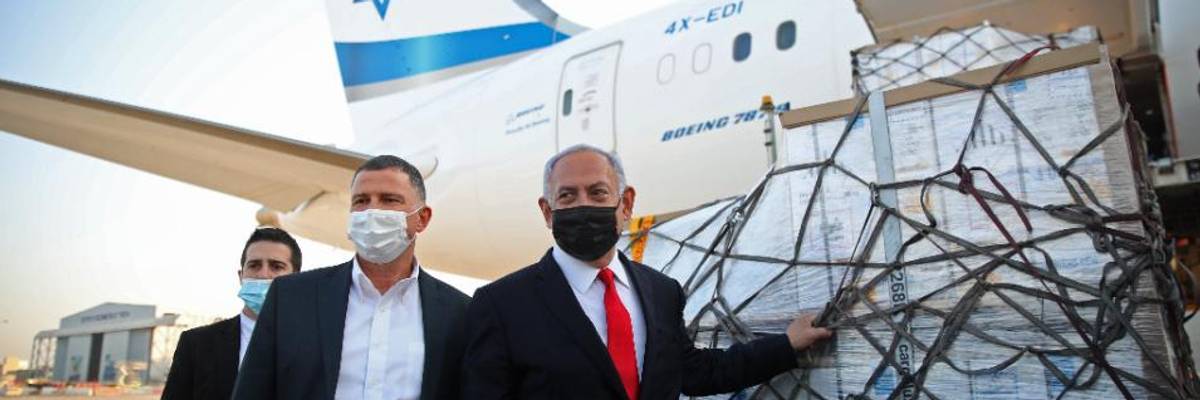
Israel's Prime Minister Benjamin Netanyahu and Health Minister Yuli Edelstein attend a ceremony for the arrival of a plane carrying a shipment of the Pfizer-BioNTech coronavirus vaccine at Ben Gurion airport near Tel Aviv on January 10, 2021. (Photo: Motti Millrod/Pool/AFP via Getty Images)
The Israeli government on Tuesday began delivering coronavirus vaccine doses to nations thousands of miles away--Honduras, Guatemala, and the Czech Republic--as Palestinians living under occupation are left largely uninoculated thanks in part to the Netanyahu administration's widely condemned delay in allowing vials into the West Bank and Gaza.
"You are over 60 times more likely to have a vaccination in Israel than in Palestine... It is inexplicable and unbelievable. Worse than that--it is unjust and cruel."
--Matthias Kennes, Doctors Without Borders
Israeli journalist Gili Cohen reported Tuesday morning that the three nations set to receive thousands of doses from Israel's supply of Pfizer and Moderna vaccines have either moved or agreed to move their embassies to Jerusalem--an indication that the shipments are politically motivated.
"Deeply, deeply messed up," tweeted Yousef Munayyer, a political analyst and Palestinian rights activist. "Israel to start giving vaccines to countries without much access to them in exchange for their diplomatic support of their apartheid policies. Honduras, 7,500 miles away, will get some but Palestinians living under Israeli control still neglected."
While Israeli Prime Minister Benjamin Netanyahu's office said Tuesday that it is giving some of its surplus coronavirus vaccine supply to the Palestinians--who have also received thousands of doses of Russia's Sputnik vaccine--the vast majority of people living in the occupied territories remain without access to the life-saving shot.
"Vaccines being used as political chips internationally while the Palestinian rollout has yet to really begin is both bad health policy and a disgrace," said journalist Neri Zilber.
According to the nation's health ministry, Israel has vaccinated 70% of its population over the age of 16. Meanwhile, as Al Jazeera reported Monday, the West Bank and Gaza have received roughly 32,000 vaccine doses--enough to inoculate just a tiny fraction of the 5.2 million Palestinians who live there. Late last week, the Israeli government finally agreed to help vaccinate 100,000 Palestinians who regularly cross into Israel for work.
"Vaccines being used as political chips internationally while the Palestinian rollout has yet to really begin is both bad health policy and a disgrace."
--Neri Zilber
"We welcome this," Palestinian Health Minister Mai al-Kaila said Saturday. "We need to vaccinate our people, so we can end the pandemic everywhere."
Matthias Kennes, a registered nurse and medical referent for the Doctors Without Borders (MSF) Covid-19 response in the West Bank city of Hebron, wrote in a blog post Monday that "the internationally acclaimed Covid-19 vaccination success of Israel has a dark side: the consequences of which are being felt cruelly in the West Bank Palestinian territory where I work."
"You are over 60 times more likely to have a vaccination in Israel than in Palestine," wrote Kennes. "If asked why vulnerable people cannot be vaccinated in Palestine, I do not know how to answer. It is inexplicable and unbelievable. Worse than that--it is unjust and cruel."
"Israel is an occupying power, and has millions of vaccines. Palestine is the occupied territory, and has barely a few thousand vaccines," Kennes continued. "As a medic, I don't really care who sorts this out. As a medic, I do care deeply that the most vulnerable are prioritized. I am left with this shameful thought echoing in my mind--60 times more likely to be vaccinated in Israel than in Palestine, with the most vulnerable in Palestine still left unprotected."
Dear Common Dreams reader, It’s been nearly 30 years since I co-founded Common Dreams with my late wife, Lina Newhouser. We had the radical notion that journalism should serve the public good, not corporate profits. It was clear to us from the outset what it would take to build such a project. No paid advertisements. No corporate sponsors. No millionaire publisher telling us what to think or do. Many people said we wouldn't last a year, but we proved those doubters wrong. Together with a tremendous team of journalists and dedicated staff, we built an independent media outlet free from the constraints of profits and corporate control. Our mission has always been simple: To inform. To inspire. To ignite change for the common good. Building Common Dreams was not easy. Our survival was never guaranteed. When you take on the most powerful forces—Wall Street greed, fossil fuel industry destruction, Big Tech lobbyists, and uber-rich oligarchs who have spent billions upon billions rigging the economy and democracy in their favor—the only bulwark you have is supporters who believe in your work. But here’s the urgent message from me today. It's never been this bad out there. And it's never been this hard to keep us going. At the very moment Common Dreams is most needed, the threats we face are intensifying. We need your support now more than ever. We don't accept corporate advertising and never will. We don't have a paywall because we don't think people should be blocked from critical news based on their ability to pay. Everything we do is funded by the donations of readers like you. When everyone does the little they can afford, we are strong. But if that support retreats or dries up, so do we. Will you donate now to make sure Common Dreams not only survives but thrives? —Craig Brown, Co-founder |
The Israeli government on Tuesday began delivering coronavirus vaccine doses to nations thousands of miles away--Honduras, Guatemala, and the Czech Republic--as Palestinians living under occupation are left largely uninoculated thanks in part to the Netanyahu administration's widely condemned delay in allowing vials into the West Bank and Gaza.
"You are over 60 times more likely to have a vaccination in Israel than in Palestine... It is inexplicable and unbelievable. Worse than that--it is unjust and cruel."
--Matthias Kennes, Doctors Without Borders
Israeli journalist Gili Cohen reported Tuesday morning that the three nations set to receive thousands of doses from Israel's supply of Pfizer and Moderna vaccines have either moved or agreed to move their embassies to Jerusalem--an indication that the shipments are politically motivated.
"Deeply, deeply messed up," tweeted Yousef Munayyer, a political analyst and Palestinian rights activist. "Israel to start giving vaccines to countries without much access to them in exchange for their diplomatic support of their apartheid policies. Honduras, 7,500 miles away, will get some but Palestinians living under Israeli control still neglected."
While Israeli Prime Minister Benjamin Netanyahu's office said Tuesday that it is giving some of its surplus coronavirus vaccine supply to the Palestinians--who have also received thousands of doses of Russia's Sputnik vaccine--the vast majority of people living in the occupied territories remain without access to the life-saving shot.
"Vaccines being used as political chips internationally while the Palestinian rollout has yet to really begin is both bad health policy and a disgrace," said journalist Neri Zilber.
According to the nation's health ministry, Israel has vaccinated 70% of its population over the age of 16. Meanwhile, as Al Jazeera reported Monday, the West Bank and Gaza have received roughly 32,000 vaccine doses--enough to inoculate just a tiny fraction of the 5.2 million Palestinians who live there. Late last week, the Israeli government finally agreed to help vaccinate 100,000 Palestinians who regularly cross into Israel for work.
"Vaccines being used as political chips internationally while the Palestinian rollout has yet to really begin is both bad health policy and a disgrace."
--Neri Zilber
"We welcome this," Palestinian Health Minister Mai al-Kaila said Saturday. "We need to vaccinate our people, so we can end the pandemic everywhere."
Matthias Kennes, a registered nurse and medical referent for the Doctors Without Borders (MSF) Covid-19 response in the West Bank city of Hebron, wrote in a blog post Monday that "the internationally acclaimed Covid-19 vaccination success of Israel has a dark side: the consequences of which are being felt cruelly in the West Bank Palestinian territory where I work."
"You are over 60 times more likely to have a vaccination in Israel than in Palestine," wrote Kennes. "If asked why vulnerable people cannot be vaccinated in Palestine, I do not know how to answer. It is inexplicable and unbelievable. Worse than that--it is unjust and cruel."
"Israel is an occupying power, and has millions of vaccines. Palestine is the occupied territory, and has barely a few thousand vaccines," Kennes continued. "As a medic, I don't really care who sorts this out. As a medic, I do care deeply that the most vulnerable are prioritized. I am left with this shameful thought echoing in my mind--60 times more likely to be vaccinated in Israel than in Palestine, with the most vulnerable in Palestine still left unprotected."
The Israeli government on Tuesday began delivering coronavirus vaccine doses to nations thousands of miles away--Honduras, Guatemala, and the Czech Republic--as Palestinians living under occupation are left largely uninoculated thanks in part to the Netanyahu administration's widely condemned delay in allowing vials into the West Bank and Gaza.
"You are over 60 times more likely to have a vaccination in Israel than in Palestine... It is inexplicable and unbelievable. Worse than that--it is unjust and cruel."
--Matthias Kennes, Doctors Without Borders
Israeli journalist Gili Cohen reported Tuesday morning that the three nations set to receive thousands of doses from Israel's supply of Pfizer and Moderna vaccines have either moved or agreed to move their embassies to Jerusalem--an indication that the shipments are politically motivated.
"Deeply, deeply messed up," tweeted Yousef Munayyer, a political analyst and Palestinian rights activist. "Israel to start giving vaccines to countries without much access to them in exchange for their diplomatic support of their apartheid policies. Honduras, 7,500 miles away, will get some but Palestinians living under Israeli control still neglected."
While Israeli Prime Minister Benjamin Netanyahu's office said Tuesday that it is giving some of its surplus coronavirus vaccine supply to the Palestinians--who have also received thousands of doses of Russia's Sputnik vaccine--the vast majority of people living in the occupied territories remain without access to the life-saving shot.
"Vaccines being used as political chips internationally while the Palestinian rollout has yet to really begin is both bad health policy and a disgrace," said journalist Neri Zilber.
According to the nation's health ministry, Israel has vaccinated 70% of its population over the age of 16. Meanwhile, as Al Jazeera reported Monday, the West Bank and Gaza have received roughly 32,000 vaccine doses--enough to inoculate just a tiny fraction of the 5.2 million Palestinians who live there. Late last week, the Israeli government finally agreed to help vaccinate 100,000 Palestinians who regularly cross into Israel for work.
"Vaccines being used as political chips internationally while the Palestinian rollout has yet to really begin is both bad health policy and a disgrace."
--Neri Zilber
"We welcome this," Palestinian Health Minister Mai al-Kaila said Saturday. "We need to vaccinate our people, so we can end the pandemic everywhere."
Matthias Kennes, a registered nurse and medical referent for the Doctors Without Borders (MSF) Covid-19 response in the West Bank city of Hebron, wrote in a blog post Monday that "the internationally acclaimed Covid-19 vaccination success of Israel has a dark side: the consequences of which are being felt cruelly in the West Bank Palestinian territory where I work."
"You are over 60 times more likely to have a vaccination in Israel than in Palestine," wrote Kennes. "If asked why vulnerable people cannot be vaccinated in Palestine, I do not know how to answer. It is inexplicable and unbelievable. Worse than that--it is unjust and cruel."
"Israel is an occupying power, and has millions of vaccines. Palestine is the occupied territory, and has barely a few thousand vaccines," Kennes continued. "As a medic, I don't really care who sorts this out. As a medic, I do care deeply that the most vulnerable are prioritized. I am left with this shameful thought echoing in my mind--60 times more likely to be vaccinated in Israel than in Palestine, with the most vulnerable in Palestine still left unprotected."