
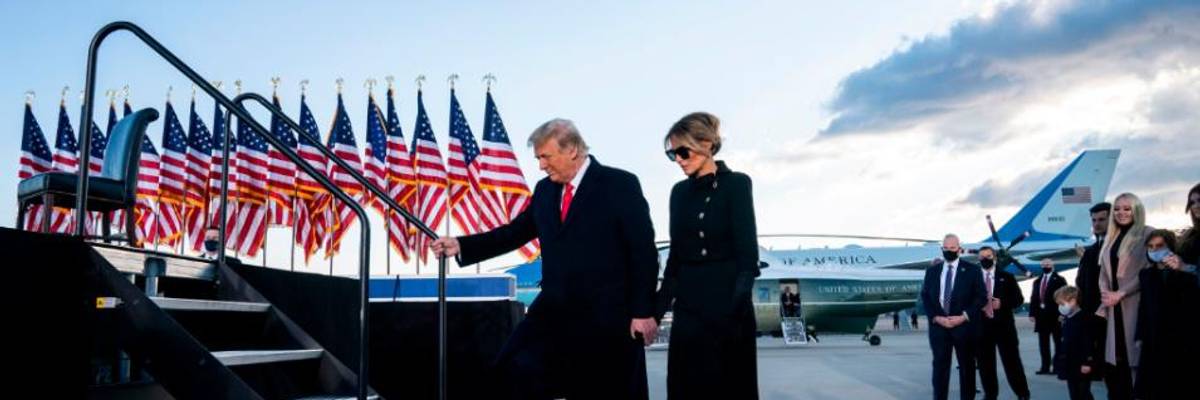
Former President Donald Trump and former First Lady Melania Trump take the stage prior to delivering remarks at Joint Base Andrews in Maryland on January 20, 2021. (Photo: Alex Edelman/AFP via Getty Images)
Schumer: GOP Embracing 'Fringe Legal Theory' With Claim That Trump Trial Is Unconstitutional
"Given that the Constitution permits the Senate to impose the penalty of permanent disqualification only on former officeholders, it defies logic to suggest that the Senate is prohibited from trying and convicting former officeholders."
Senate Majority Leader Chuck Schumer on Monday announced a resolution outlining the plan for former President Donald Trump's second impeachment trial, just one day after Democrats received an unexpected assist from a conservative attorney--highly respected in GOP legal circles--who skewered the right-wing argument that it's unconstitutional for the Senate to try and convict a former officeholder.
Speaking from the Senate floor on Monday soon after reaching an agreement with Senate Minority Leader Mitch McConnell (R-Ky.) on the trial's details, Schumer (D-N.Y.) said Republican lawmakers' objections to trying Trump are based on a "fringe legal theory," which they are attempting to hide behind.
Schumer cited a Sunday Wall Street Journal op-ed by Charles Cooper, whom the top Democrat described as "no liberal," and said it "driv[es] a stake into the central argument" being advanced by Trump's legal team and his allies.
After delaying Trump's second impeachment trial, 45 Republican senators voted late last month to invalidate the trial, as Common Dreams reported at the time, with Sen. Rand Paul (R-Ky.) arguing that "impeachment is for removal from office, and the accused here has already left office."
Though Paul's attempt to challenge the legitimacy of the trial on constitutional grounds ultimately failed, it was significant in that it officially revealed that all but five Republican senators are opposed to the trial, delivering a preemptive blow to the prospects for conviction, which requires the support of two-thirds of the chamber, including 17 GOP lawmakers.
Cooper, whom the New York Times called "a stalwart of the conservative legal establishment," defended the constitutionality of prosecuting Trump even though he's no longer in office and argued that "the senators who supported Mr. Paul's motion should reconsider their view and judge the former president's misconduct on the merits."
In the op-ed, Cooper, an attorney for former National Security Adviser John Bolton, had this to say:
Forty-five Republican senators voted in favor of Sen. Rand Paul's motion challenging the Senate's jurisdiction to try Trump. But scholarship on this question has matured substantially since that vote, and it has exposed the serious weakness of Mr. Paul's analysis.
The strongest argument against the Senate's authority to try a former officer relies on Article II, Section 4 of the Constitution, which provides: "The president, vice president, and all civil officers of the United States, shall be removed from office on impeachment for, and conviction of, treason, bribery, or other high crimes and misdemeanors." The trial's opponents argue that because this provision requires removal, and because only incumbent officers can be removed, it follows that only incumbent officers can be impeached and tried.
But the provision cuts against their interpretation. It simply establishes what is known in criminal law as a "mandatory minimum" punishment: If an incumbent officeholder is convicted by a two-thirds vote of the Senate, he is removed from office as a matter of law.
If removal were the only punishment that could be imposed, the argument against trying former officers would be compelling. But it isn't. Article I, Section 3 authorizes the Senate to impose an optional punishment on conviction: "disqualification to hold and enjoy any office of honor, trust, or profit under the United States."
That punishment can be imposed only on former officers. That is because Article II, Section 4 is self-executing: A convicted officeholder is automatically removed at the moment of conviction. The formal Senate procedures for impeachment trials acknowledge this constitutional reality, noting that a two-thirds vote to convict "operates automatically and instantaneously to separate the person impeached from the office." The Senate may then, at its discretion, take a separate vote to impose, by simple majority, "the additional consequences provided by the Constitution in the case of an impeached and convicted civil officer, viz: permanent disqualification from elected or appointed office."
Thus a vote by the Senate to disqualify can be taken only after the officer has been removed and is by definition a former officer. Given that the Constitution permits the Senate to impose the penalty of permanent disqualification only on former officeholders, it defies logic to suggest that the Senate is prohibited from trying and convicting former officeholders.
According to The Hill, "the Senate will debate and vote on Tuesday on whether or not the trial is constitutional," meaning that Cooper's arguments are likely to be invoked as soon as the trial begins.
Opening arguments will start on Wednesday. Under the bipartisan framework, House impeachment managers and Trump's defense team will have 16 hours over two days each to make their case to the Senate. The trial could conclude within roughly one week if no witnesses are called, though "the deal leaves the door open to calling witnesses," The Hill noted.
As Common Dreams has reported, polls continue to show that a clear majority of the American public supports convicting Trump and barring him from ever holding office again following the former president's incitement of a deadly insurrection at the U.S. Capitol on January 6 as Congress was certifying President Joe Biden's electoral victory.
We are at a crossroads
This country and this world are at a monumental crossroads. In a few short weeks, US voters will have an opportunity to beat back the forces of fascism and confront the billionaires who are rigging the economy, our media system, and our democracy, making it increasingly impossible for ordinary people to get by. We’re not just talking about the election. We’re talking about what must be done once these fascist elements are vanquished from power. We need a bolder set of solutions than what either major party has so far been willing to offer and a working-class movement ready to fight like hell for it. Trump didn't emerge from nowhere. The conditions that fueled MAGA authoritarianism were created by decades of radical neoliberal economic policies and a corrupt political system dominated by corporate interests. They slashed taxes on the super-rich, promising that the benefits would trickle down. They said giveaways to the corporate titans would make life more affordable for the rest of us. It was all bullshit. And when a bitter, betrayed populace searches for someone to blame, right-wing demagogues have little trouble finding scapegoats. People know when they're being lied to, but you won't hear any of this from the corporate media. Only independent journalism—powered and funded by people who believe in building a better world—can deliver truly trustworthy daily news. Our Fall Campaign is underway, and we need your help. To power our newsroom through the rest of the year, we need to raise $125,000 by midnight on October 31. So if you share our vision, please contribute whatever you can to sustain our work. |
Senate Majority Leader Chuck Schumer on Monday announced a resolution outlining the plan for former President Donald Trump's second impeachment trial, just one day after Democrats received an unexpected assist from a conservative attorney--highly respected in GOP legal circles--who skewered the right-wing argument that it's unconstitutional for the Senate to try and convict a former officeholder.
Speaking from the Senate floor on Monday soon after reaching an agreement with Senate Minority Leader Mitch McConnell (R-Ky.) on the trial's details, Schumer (D-N.Y.) said Republican lawmakers' objections to trying Trump are based on a "fringe legal theory," which they are attempting to hide behind.
Schumer cited a Sunday Wall Street Journal op-ed by Charles Cooper, whom the top Democrat described as "no liberal," and said it "driv[es] a stake into the central argument" being advanced by Trump's legal team and his allies.
After delaying Trump's second impeachment trial, 45 Republican senators voted late last month to invalidate the trial, as Common Dreams reported at the time, with Sen. Rand Paul (R-Ky.) arguing that "impeachment is for removal from office, and the accused here has already left office."
Though Paul's attempt to challenge the legitimacy of the trial on constitutional grounds ultimately failed, it was significant in that it officially revealed that all but five Republican senators are opposed to the trial, delivering a preemptive blow to the prospects for conviction, which requires the support of two-thirds of the chamber, including 17 GOP lawmakers.
Cooper, whom the New York Times called "a stalwart of the conservative legal establishment," defended the constitutionality of prosecuting Trump even though he's no longer in office and argued that "the senators who supported Mr. Paul's motion should reconsider their view and judge the former president's misconduct on the merits."
In the op-ed, Cooper, an attorney for former National Security Adviser John Bolton, had this to say:
Forty-five Republican senators voted in favor of Sen. Rand Paul's motion challenging the Senate's jurisdiction to try Trump. But scholarship on this question has matured substantially since that vote, and it has exposed the serious weakness of Mr. Paul's analysis.
The strongest argument against the Senate's authority to try a former officer relies on Article II, Section 4 of the Constitution, which provides: "The president, vice president, and all civil officers of the United States, shall be removed from office on impeachment for, and conviction of, treason, bribery, or other high crimes and misdemeanors." The trial's opponents argue that because this provision requires removal, and because only incumbent officers can be removed, it follows that only incumbent officers can be impeached and tried.
But the provision cuts against their interpretation. It simply establishes what is known in criminal law as a "mandatory minimum" punishment: If an incumbent officeholder is convicted by a two-thirds vote of the Senate, he is removed from office as a matter of law.
If removal were the only punishment that could be imposed, the argument against trying former officers would be compelling. But it isn't. Article I, Section 3 authorizes the Senate to impose an optional punishment on conviction: "disqualification to hold and enjoy any office of honor, trust, or profit under the United States."
That punishment can be imposed only on former officers. That is because Article II, Section 4 is self-executing: A convicted officeholder is automatically removed at the moment of conviction. The formal Senate procedures for impeachment trials acknowledge this constitutional reality, noting that a two-thirds vote to convict "operates automatically and instantaneously to separate the person impeached from the office." The Senate may then, at its discretion, take a separate vote to impose, by simple majority, "the additional consequences provided by the Constitution in the case of an impeached and convicted civil officer, viz: permanent disqualification from elected or appointed office."
Thus a vote by the Senate to disqualify can be taken only after the officer has been removed and is by definition a former officer. Given that the Constitution permits the Senate to impose the penalty of permanent disqualification only on former officeholders, it defies logic to suggest that the Senate is prohibited from trying and convicting former officeholders.
According to The Hill, "the Senate will debate and vote on Tuesday on whether or not the trial is constitutional," meaning that Cooper's arguments are likely to be invoked as soon as the trial begins.
Opening arguments will start on Wednesday. Under the bipartisan framework, House impeachment managers and Trump's defense team will have 16 hours over two days each to make their case to the Senate. The trial could conclude within roughly one week if no witnesses are called, though "the deal leaves the door open to calling witnesses," The Hill noted.
As Common Dreams has reported, polls continue to show that a clear majority of the American public supports convicting Trump and barring him from ever holding office again following the former president's incitement of a deadly insurrection at the U.S. Capitol on January 6 as Congress was certifying President Joe Biden's electoral victory.