SUBSCRIBE TO OUR FREE NEWSLETTER
Daily news & progressive opinion—funded by the people, not the corporations—delivered straight to your inbox.
5
#000000
#FFFFFF
To donate by check, phone, or other method, see our More Ways to Give page.
Daily news & progressive opinion—funded by the people, not the corporations—delivered straight to your inbox.
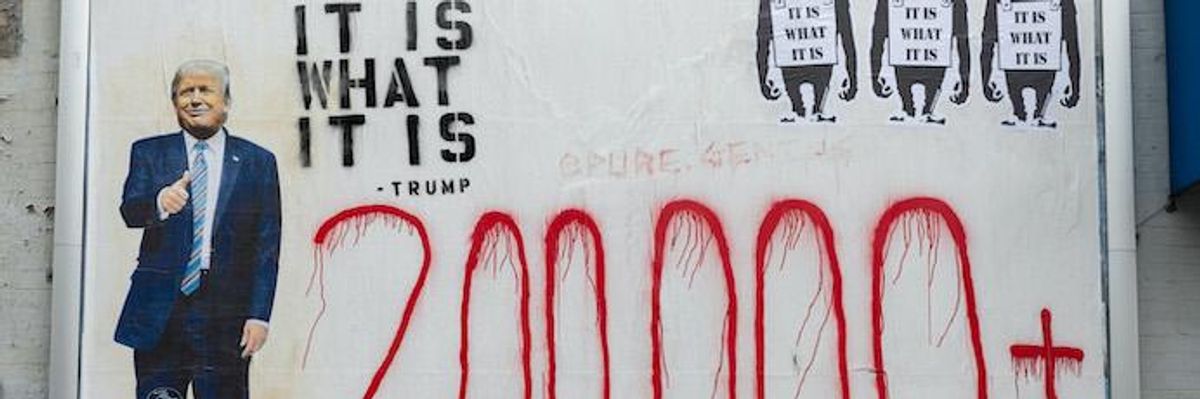
Street art that reads, "200,000+ Covid-19 deaths" near an "It is what t is" quote by President Donald Trump is displayed on a wall in Park Slope as the city continues Phase 4 of re-opening following restrictions imposed to slow the spread of coronavirus on September 29, 2020 in New York City. (Photo: Alexi Rosenfeld/Getty Images)
With Election Day a mere 11 days out--and after repeated claims by President Donald Trump the nation is "rounding the corner" on the virus--the number of coronavirus cases the United States has now set a new record high.
According to NBC News's tally, 77,640 new Covid-19 cases were reported on Thursday, breaking the previous record high 75,723 set in July.
NBC's tracker now puts the nation's death toll from the coronavirus at 224,185 and the number of confirmed cases of the disease at 8,449,855.
The Covid Tracking Project, in its latest assessment, put the death toll from Thursday at 1,038, the highest single day toll since late September.
Trump, however, continues to downplay the severity of the disease and the mounting number of cases and death toll and reject science-backed measures to stop its spread. He has doubled down on his distrastrous repsonse, saying Wednesday there is "not much" he would do differently.
Thursday evening, during the final presidential debate, Trump again defied evidence and falsely claimed again of the coronavirus, "We are rounding the corner. It's going away."
The president's comments during the debate came just a day after Jay Butler, deputy director for infectious diseases at the Centers for Disease Control and Prevention, lamented, "Unfortunately, we're seeing a distressing trend here in the United States, with Covid-19 cases increasing in nearly 75% of the country."
That trend is poised to continue. CNN reported this week:
As cold weather is likely to drive more gatherings indoors, the case level appears too high to avoid dangerous levels of infections and hospitalizations in the coming weeks, experts have said.
"(With) the fact that we're only going to see more transmission occur with indoor air, people inside, this is going to be a rough fall," Michael Osterholm, the director of the Center for Infectious Disease Research and Policy at the University of Minnesota, told CNN on Tuesday.
That's especially worrying given that hospitals are already overwhelmed with Covid-19 patients, a situation forcing some states like Wisconsin to open a field hospital--a step officials in Utah are standing ready to take as well.
"More than 41,000 people are currently hospitalized with the coronavirus in the United States, a 40 percent rise in the past month," the New York Times reported Friday, adding that "the sharply rising numbers now are deeply worrisome, in part, because they are testing the limits of smaller hospital systems." According to the Times,
Patients are now spread more broadly across the country, with troubling hot spots from North Dakota to Kentucky. More people than ever are falling critically ill in rural areas, particularly in the Midwest and the Mountain West, where they must rely on hospitals that may have only a handful of beds. And experts worry that the growing numbers in need of hospital care will only get worse if cases continue to mount.
Dr. Ezekiel J. Emanuel, a professor of health policy and medical ethics at the University of Pennsylvania and co-author of a newly released study comparing Covid-19 death figures in the U.S. to those of 18 other countries, put the American response in blunt terms.
"It's shocking. It's horrible," he told NPR.
"The United States really has done remarkably badly compared to other countries," Emanuel told NPR. "I mean, remarkably badly."
This country and this world are at a monumental crossroads. US voters have an opportunity to beat back the forces of fascism and confront the billionaires who are rigging the economy, our media system, and our democracy, making it increasingly impossible for ordinary people to get by. We’re not just talking about the election. We’re talking about what must be done once these fascist elements are vanquished from power. We need a bolder set of solutions than what either major party has so far been willing to offer and a working-class movement ready to fight like hell for it. Trump didn't emerge from nowhere. The conditions that fueled MAGA authoritarianism were created by decades of radical neoliberal economic policies and a corrupt political system dominated by corporate interests. They slashed taxes on the super-rich, promising that the benefits would trickle down. They said giveaways to the corporate titans would make life more affordable for the rest of us. It was all bullshit. And when a bitter, betrayed populace searches for someone to blame, right-wing demagogues have little trouble finding scapegoats. People know when they're being lied to, but you won't hear any of this from the corporate media. Only independent journalism—powered and funded by people who believe in building a better world—can deliver truly trustworthy daily news. If you share our vision, please contribute whatever you can to sustain our work. |
With Election Day a mere 11 days out--and after repeated claims by President Donald Trump the nation is "rounding the corner" on the virus--the number of coronavirus cases the United States has now set a new record high.
According to NBC News's tally, 77,640 new Covid-19 cases were reported on Thursday, breaking the previous record high 75,723 set in July.
NBC's tracker now puts the nation's death toll from the coronavirus at 224,185 and the number of confirmed cases of the disease at 8,449,855.
The Covid Tracking Project, in its latest assessment, put the death toll from Thursday at 1,038, the highest single day toll since late September.
Trump, however, continues to downplay the severity of the disease and the mounting number of cases and death toll and reject science-backed measures to stop its spread. He has doubled down on his distrastrous repsonse, saying Wednesday there is "not much" he would do differently.
Thursday evening, during the final presidential debate, Trump again defied evidence and falsely claimed again of the coronavirus, "We are rounding the corner. It's going away."
The president's comments during the debate came just a day after Jay Butler, deputy director for infectious diseases at the Centers for Disease Control and Prevention, lamented, "Unfortunately, we're seeing a distressing trend here in the United States, with Covid-19 cases increasing in nearly 75% of the country."
That trend is poised to continue. CNN reported this week:
As cold weather is likely to drive more gatherings indoors, the case level appears too high to avoid dangerous levels of infections and hospitalizations in the coming weeks, experts have said.
"(With) the fact that we're only going to see more transmission occur with indoor air, people inside, this is going to be a rough fall," Michael Osterholm, the director of the Center for Infectious Disease Research and Policy at the University of Minnesota, told CNN on Tuesday.
That's especially worrying given that hospitals are already overwhelmed with Covid-19 patients, a situation forcing some states like Wisconsin to open a field hospital--a step officials in Utah are standing ready to take as well.
"More than 41,000 people are currently hospitalized with the coronavirus in the United States, a 40 percent rise in the past month," the New York Times reported Friday, adding that "the sharply rising numbers now are deeply worrisome, in part, because they are testing the limits of smaller hospital systems." According to the Times,
Patients are now spread more broadly across the country, with troubling hot spots from North Dakota to Kentucky. More people than ever are falling critically ill in rural areas, particularly in the Midwest and the Mountain West, where they must rely on hospitals that may have only a handful of beds. And experts worry that the growing numbers in need of hospital care will only get worse if cases continue to mount.
Dr. Ezekiel J. Emanuel, a professor of health policy and medical ethics at the University of Pennsylvania and co-author of a newly released study comparing Covid-19 death figures in the U.S. to those of 18 other countries, put the American response in blunt terms.
"It's shocking. It's horrible," he told NPR.
"The United States really has done remarkably badly compared to other countries," Emanuel told NPR. "I mean, remarkably badly."