

SUBSCRIBE TO OUR FREE NEWSLETTER
Daily news & progressive opinion—funded by the people, not the corporations—delivered straight to your inbox.
5
#000000
#FFFFFF
To donate by check, phone, or other method, see our More Ways to Give page.
Daily news & progressive opinion—funded by the people, not the corporations—delivered straight to your inbox.
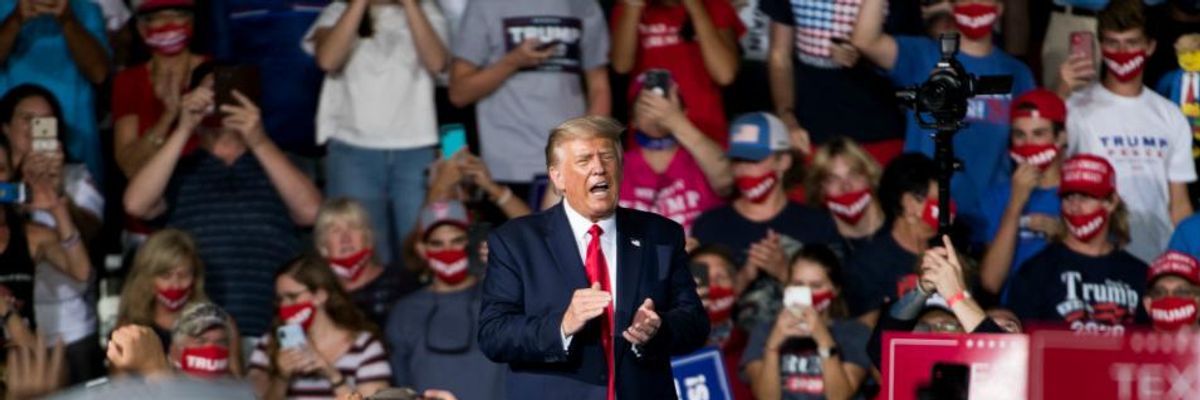
President Donald Trump greets a crowd during a campaign rally at Smith Reynolds Airport on September 8, 2020 in Winston Salem, North Carolina. The president also made a campaign stop in South Florida on Tuesday. (Photo: Sean Rayford/Getty Images)
After refusing to say whether he has tested negative for Covid-19 since his diagnosis late last week, President Donald Trump told Sean Hannity of Fox News Thursday night that he is hoping to hold a pair of in-person rallies this coming weekend in the key battleground states of Florida and Pennsylvania despite the potential risk of spreading a virus that has now killed more than 212,000 Americans on his watch.
"I'll tell you, I took this Regeneron, it's phenomenal," Trump said, blowing past Hannity's question about whether he has recently tested negative for Covid-19. "Eli Lilly has something very comparable, it's phenomenal. It's a whole new day."
When asked later in the interview if he's had a coronavirus test since his diagnosis, Trump said, "Well, what we're doing is probably the test will be tomorrow, the actual test, because there's no reason to test all the time. But they found very little infection or virus, if any. I don't know that they found any--I didn't go into it greatly with the doctors."
Watch:
Amid ongoing questions about the president's condition following his release from Walter Reed National Military Medical Center on Monday, White House doctors and administration officials have repeatedly declined to say when Trump's last negative coronavirus test was, prompting concerns that the president is still contagious and poses a risk to others.
"I don't want to go backwards," White House physician Dr. Sean Conley said Monday when asked about the president's last negative test result. White House Deputy Press Secretary Brian Morgenstern told reporters that he doesn't know when the president last tested negative for the coronavirus and is not interested in finding out.
"We're not asking to go back through a bunch of records and look backwards," Morgenstern said, parroting Conley's line.
In a brief memo on Thursday, Conley--who has come under fire for evading reporters' questions and omitting crucial information during his briefings on the president's condition--wrote that "based on the trajectory of advanced diagnostics the team has been conducting," he believes Trump will be able to safely "return to public engagements" as early as Saturday.
But public health experts immediately voiced skepticism in response to Conley's proposed timeline. Dr. Leana Wen, an emergency physician and visiting professor of health policy and management at the George Washington University's Milken School of Public Health, said she was "stunned" by Conley's claim that the president is nearly ready to return to public activities.
Saturday is "day 10, according to White House's own time course," Wen noted. "Patients with severe Covid-19 can be infectious for 20 days."
Dr. Krutika Kuppalli, an infectious-disease physician based in South Carolina, told the New York Times Thursday that while "everyone is going to have a different point of view," he would "err on the safe side, and keep [Trump] isolated for 20 days."
The Centers for Disease Control and Prevention recommends that "for most persons with Covid-19 illness, isolation and precautions can generally be discontinued 10 days after symptom onset and resolution of fever for at least 24 hours, without the use of fever-reducing medications, and with improvement of other symptoms." Based on the White House's public statements, it's unclear when Trump began showing coronavirus symptoms.
"This is bigger than him," Kuppalli said, alluding to the public health risks associated with the president resuming public events.
Dear Common Dreams reader, It’s been nearly 30 years since I co-founded Common Dreams with my late wife, Lina Newhouser. We had the radical notion that journalism should serve the public good, not corporate profits. It was clear to us from the outset what it would take to build such a project. No paid advertisements. No corporate sponsors. No millionaire publisher telling us what to think or do. Many people said we wouldn't last a year, but we proved those doubters wrong. Together with a tremendous team of journalists and dedicated staff, we built an independent media outlet free from the constraints of profits and corporate control. Our mission has always been simple: To inform. To inspire. To ignite change for the common good. Building Common Dreams was not easy. Our survival was never guaranteed. When you take on the most powerful forces—Wall Street greed, fossil fuel industry destruction, Big Tech lobbyists, and uber-rich oligarchs who have spent billions upon billions rigging the economy and democracy in their favor—the only bulwark you have is supporters who believe in your work. But here’s the urgent message from me today. It's never been this bad out there. And it's never been this hard to keep us going. At the very moment Common Dreams is most needed, the threats we face are intensifying. We need your support now more than ever. We don't accept corporate advertising and never will. We don't have a paywall because we don't think people should be blocked from critical news based on their ability to pay. Everything we do is funded by the donations of readers like you. When everyone does the little they can afford, we are strong. But if that support retreats or dries up, so do we. Will you donate now to make sure Common Dreams not only survives but thrives? —Craig Brown, Co-founder |
After refusing to say whether he has tested negative for Covid-19 since his diagnosis late last week, President Donald Trump told Sean Hannity of Fox News Thursday night that he is hoping to hold a pair of in-person rallies this coming weekend in the key battleground states of Florida and Pennsylvania despite the potential risk of spreading a virus that has now killed more than 212,000 Americans on his watch.
"I'll tell you, I took this Regeneron, it's phenomenal," Trump said, blowing past Hannity's question about whether he has recently tested negative for Covid-19. "Eli Lilly has something very comparable, it's phenomenal. It's a whole new day."
When asked later in the interview if he's had a coronavirus test since his diagnosis, Trump said, "Well, what we're doing is probably the test will be tomorrow, the actual test, because there's no reason to test all the time. But they found very little infection or virus, if any. I don't know that they found any--I didn't go into it greatly with the doctors."
Watch:
Amid ongoing questions about the president's condition following his release from Walter Reed National Military Medical Center on Monday, White House doctors and administration officials have repeatedly declined to say when Trump's last negative coronavirus test was, prompting concerns that the president is still contagious and poses a risk to others.
"I don't want to go backwards," White House physician Dr. Sean Conley said Monday when asked about the president's last negative test result. White House Deputy Press Secretary Brian Morgenstern told reporters that he doesn't know when the president last tested negative for the coronavirus and is not interested in finding out.
"We're not asking to go back through a bunch of records and look backwards," Morgenstern said, parroting Conley's line.
In a brief memo on Thursday, Conley--who has come under fire for evading reporters' questions and omitting crucial information during his briefings on the president's condition--wrote that "based on the trajectory of advanced diagnostics the team has been conducting," he believes Trump will be able to safely "return to public engagements" as early as Saturday.
But public health experts immediately voiced skepticism in response to Conley's proposed timeline. Dr. Leana Wen, an emergency physician and visiting professor of health policy and management at the George Washington University's Milken School of Public Health, said she was "stunned" by Conley's claim that the president is nearly ready to return to public activities.
Saturday is "day 10, according to White House's own time course," Wen noted. "Patients with severe Covid-19 can be infectious for 20 days."
Dr. Krutika Kuppalli, an infectious-disease physician based in South Carolina, told the New York Times Thursday that while "everyone is going to have a different point of view," he would "err on the safe side, and keep [Trump] isolated for 20 days."
The Centers for Disease Control and Prevention recommends that "for most persons with Covid-19 illness, isolation and precautions can generally be discontinued 10 days after symptom onset and resolution of fever for at least 24 hours, without the use of fever-reducing medications, and with improvement of other symptoms." Based on the White House's public statements, it's unclear when Trump began showing coronavirus symptoms.
"This is bigger than him," Kuppalli said, alluding to the public health risks associated with the president resuming public events.
After refusing to say whether he has tested negative for Covid-19 since his diagnosis late last week, President Donald Trump told Sean Hannity of Fox News Thursday night that he is hoping to hold a pair of in-person rallies this coming weekend in the key battleground states of Florida and Pennsylvania despite the potential risk of spreading a virus that has now killed more than 212,000 Americans on his watch.
"I'll tell you, I took this Regeneron, it's phenomenal," Trump said, blowing past Hannity's question about whether he has recently tested negative for Covid-19. "Eli Lilly has something very comparable, it's phenomenal. It's a whole new day."
When asked later in the interview if he's had a coronavirus test since his diagnosis, Trump said, "Well, what we're doing is probably the test will be tomorrow, the actual test, because there's no reason to test all the time. But they found very little infection or virus, if any. I don't know that they found any--I didn't go into it greatly with the doctors."
Watch:
Amid ongoing questions about the president's condition following his release from Walter Reed National Military Medical Center on Monday, White House doctors and administration officials have repeatedly declined to say when Trump's last negative coronavirus test was, prompting concerns that the president is still contagious and poses a risk to others.
"I don't want to go backwards," White House physician Dr. Sean Conley said Monday when asked about the president's last negative test result. White House Deputy Press Secretary Brian Morgenstern told reporters that he doesn't know when the president last tested negative for the coronavirus and is not interested in finding out.
"We're not asking to go back through a bunch of records and look backwards," Morgenstern said, parroting Conley's line.
In a brief memo on Thursday, Conley--who has come under fire for evading reporters' questions and omitting crucial information during his briefings on the president's condition--wrote that "based on the trajectory of advanced diagnostics the team has been conducting," he believes Trump will be able to safely "return to public engagements" as early as Saturday.
But public health experts immediately voiced skepticism in response to Conley's proposed timeline. Dr. Leana Wen, an emergency physician and visiting professor of health policy and management at the George Washington University's Milken School of Public Health, said she was "stunned" by Conley's claim that the president is nearly ready to return to public activities.
Saturday is "day 10, according to White House's own time course," Wen noted. "Patients with severe Covid-19 can be infectious for 20 days."
Dr. Krutika Kuppalli, an infectious-disease physician based in South Carolina, told the New York Times Thursday that while "everyone is going to have a different point of view," he would "err on the safe side, and keep [Trump] isolated for 20 days."
The Centers for Disease Control and Prevention recommends that "for most persons with Covid-19 illness, isolation and precautions can generally be discontinued 10 days after symptom onset and resolution of fever for at least 24 hours, without the use of fever-reducing medications, and with improvement of other symptoms." Based on the White House's public statements, it's unclear when Trump began showing coronavirus symptoms.
"This is bigger than him," Kuppalli said, alluding to the public health risks associated with the president resuming public events.

