SUBSCRIBE TO OUR FREE NEWSLETTER
Daily news & progressive opinion—funded by the people, not the corporations—delivered straight to your inbox.
5
#000000
#FFFFFF
To donate by check, phone, or other method, see our More Ways to Give page.
Daily news & progressive opinion—funded by the people, not the corporations—delivered straight to your inbox.
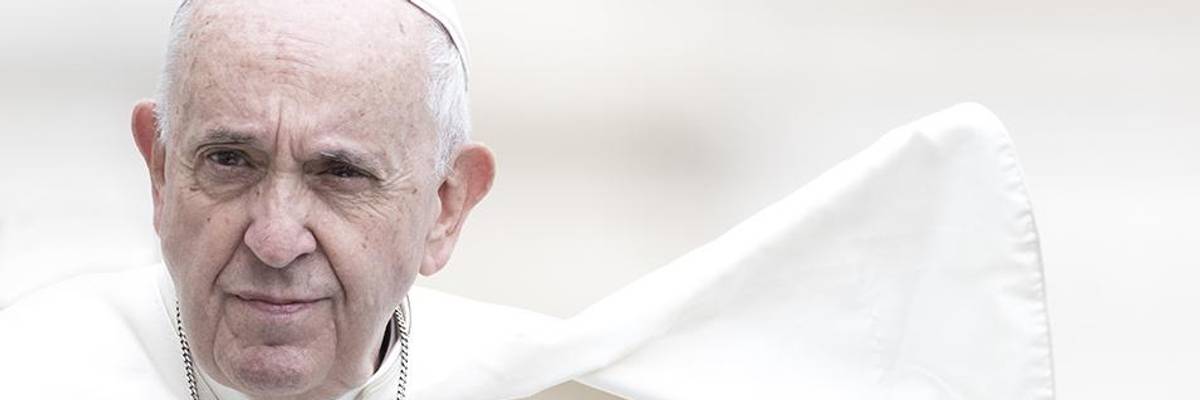
Pope Francis leads his general weekly audience in St. Peter's Square on October 30, 2019 in Vatican City, Vatican. (Photo: Alessandra Benedetti - Corbis/Corbis)
Speaking on the Covid-19 pandemic and a potential vaccine, Pope Francis on Wednesday said the world's wealthiest should not be prioritized over the poor.
"And what a scandal it would be if all the economic assistance we are observing--most of it with public money--were to focus on rescuing those industries that do not contribute to the inclusion of the excluded, the promotion of the least, the common good or the care of creation."
--Pope Francis
"It would be sad if, for the vaccine for Covid-19, priority were to be given to the richest!" the Pope said during his weekly general audience. "It would be sad if this vaccine were to become the property of this nation or another, rather than universal and for all."
"And what a scandal it would be if all the economic assistance we are observing--most of it with public money--were to focus on rescuing those industries that do not contribute to the inclusion of the excluded, the promotion of the least, the common good, or the care of creation," he continued.
The Pope's remarks came as the world's reported positive cases of the virus passed the 22 million mark, with the Americas accounting for 64% of global deaths from Covid-19.
Acknowledging that the pandemic has "exposed the plight of the poor and the great inequality that reigns in the world," the religious leader said global citizens must work to rectify those injustices as the world recovers.
"On the one hand, it is essential to find a cure for this small but terrible virus which has brought the whole world to its knees," he said. "On the other, we must also cure a larger virus, that of social injustice, inequality of opportunity, marginalization, and the lack of protection for the weakest."
Drug manufacturers developing Covid-19 vaccines have come under scrutiny for projected costs of their potential products and political debates continue about whether a vaccine should be made available to the public free of charge.
Australian Prime Minister Scott Morrison announced Tuesday that he had made a deal with drugmaker AstraZeneca to supply a potential Covid-19 vaccine to the entire country's population, though details are scant.
But Pope Francis warned that the global response to the virus should not fall along ideological lines.
"This is not a political option; nor is it an ideological option, a party option... no," he said. "The preferential option for the poor is at the center of the Gospel."
On life after Covid-19, Pope Francis declared that a new "normality" must include transforming systemic injustices, not simply maintain the status quo.
"We are all worried about the social consequences of the pandemic," he said. "Many people want to return to normality and resume economic activities. Certainly, but this 'normality' should not include social injustices and the degradation of the environment."
"The pandemic is a crisis, and we do not emerge from a crisis the same as before," the Pope continued. "Either we come out of it better, or we come out of it worse. We must come out of it better, to counter social injustice and environmental damage. Today we have an opportunity to build something different."
Dear Common Dreams reader, It’s been nearly 30 years since I co-founded Common Dreams with my late wife, Lina Newhouser. We had the radical notion that journalism should serve the public good, not corporate profits. It was clear to us from the outset what it would take to build such a project. No paid advertisements. No corporate sponsors. No millionaire publisher telling us what to think or do. Many people said we wouldn't last a year, but we proved those doubters wrong. Together with a tremendous team of journalists and dedicated staff, we built an independent media outlet free from the constraints of profits and corporate control. Our mission has always been simple: To inform. To inspire. To ignite change for the common good. Building Common Dreams was not easy. Our survival was never guaranteed. When you take on the most powerful forces—Wall Street greed, fossil fuel industry destruction, Big Tech lobbyists, and uber-rich oligarchs who have spent billions upon billions rigging the economy and democracy in their favor—the only bulwark you have is supporters who believe in your work. But here’s the urgent message from me today. It's never been this bad out there. And it's never been this hard to keep us going. At the very moment Common Dreams is most needed, the threats we face are intensifying. We need your support now more than ever. We don't accept corporate advertising and never will. We don't have a paywall because we don't think people should be blocked from critical news based on their ability to pay. Everything we do is funded by the donations of readers like you. When everyone does the little they can afford, we are strong. But if that support retreats or dries up, so do we. Will you donate now to make sure Common Dreams not only survives but thrives? —Craig Brown, Co-founder |
Speaking on the Covid-19 pandemic and a potential vaccine, Pope Francis on Wednesday said the world's wealthiest should not be prioritized over the poor.
"And what a scandal it would be if all the economic assistance we are observing--most of it with public money--were to focus on rescuing those industries that do not contribute to the inclusion of the excluded, the promotion of the least, the common good or the care of creation."
--Pope Francis
"It would be sad if, for the vaccine for Covid-19, priority were to be given to the richest!" the Pope said during his weekly general audience. "It would be sad if this vaccine were to become the property of this nation or another, rather than universal and for all."
"And what a scandal it would be if all the economic assistance we are observing--most of it with public money--were to focus on rescuing those industries that do not contribute to the inclusion of the excluded, the promotion of the least, the common good, or the care of creation," he continued.
The Pope's remarks came as the world's reported positive cases of the virus passed the 22 million mark, with the Americas accounting for 64% of global deaths from Covid-19.
Acknowledging that the pandemic has "exposed the plight of the poor and the great inequality that reigns in the world," the religious leader said global citizens must work to rectify those injustices as the world recovers.
"On the one hand, it is essential to find a cure for this small but terrible virus which has brought the whole world to its knees," he said. "On the other, we must also cure a larger virus, that of social injustice, inequality of opportunity, marginalization, and the lack of protection for the weakest."
Drug manufacturers developing Covid-19 vaccines have come under scrutiny for projected costs of their potential products and political debates continue about whether a vaccine should be made available to the public free of charge.
Australian Prime Minister Scott Morrison announced Tuesday that he had made a deal with drugmaker AstraZeneca to supply a potential Covid-19 vaccine to the entire country's population, though details are scant.
But Pope Francis warned that the global response to the virus should not fall along ideological lines.
"This is not a political option; nor is it an ideological option, a party option... no," he said. "The preferential option for the poor is at the center of the Gospel."
On life after Covid-19, Pope Francis declared that a new "normality" must include transforming systemic injustices, not simply maintain the status quo.
"We are all worried about the social consequences of the pandemic," he said. "Many people want to return to normality and resume economic activities. Certainly, but this 'normality' should not include social injustices and the degradation of the environment."
"The pandemic is a crisis, and we do not emerge from a crisis the same as before," the Pope continued. "Either we come out of it better, or we come out of it worse. We must come out of it better, to counter social injustice and environmental damage. Today we have an opportunity to build something different."
Speaking on the Covid-19 pandemic and a potential vaccine, Pope Francis on Wednesday said the world's wealthiest should not be prioritized over the poor.
"And what a scandal it would be if all the economic assistance we are observing--most of it with public money--were to focus on rescuing those industries that do not contribute to the inclusion of the excluded, the promotion of the least, the common good or the care of creation."
--Pope Francis
"It would be sad if, for the vaccine for Covid-19, priority were to be given to the richest!" the Pope said during his weekly general audience. "It would be sad if this vaccine were to become the property of this nation or another, rather than universal and for all."
"And what a scandal it would be if all the economic assistance we are observing--most of it with public money--were to focus on rescuing those industries that do not contribute to the inclusion of the excluded, the promotion of the least, the common good, or the care of creation," he continued.
The Pope's remarks came as the world's reported positive cases of the virus passed the 22 million mark, with the Americas accounting for 64% of global deaths from Covid-19.
Acknowledging that the pandemic has "exposed the plight of the poor and the great inequality that reigns in the world," the religious leader said global citizens must work to rectify those injustices as the world recovers.
"On the one hand, it is essential to find a cure for this small but terrible virus which has brought the whole world to its knees," he said. "On the other, we must also cure a larger virus, that of social injustice, inequality of opportunity, marginalization, and the lack of protection for the weakest."
Drug manufacturers developing Covid-19 vaccines have come under scrutiny for projected costs of their potential products and political debates continue about whether a vaccine should be made available to the public free of charge.
Australian Prime Minister Scott Morrison announced Tuesday that he had made a deal with drugmaker AstraZeneca to supply a potential Covid-19 vaccine to the entire country's population, though details are scant.
But Pope Francis warned that the global response to the virus should not fall along ideological lines.
"This is not a political option; nor is it an ideological option, a party option... no," he said. "The preferential option for the poor is at the center of the Gospel."
On life after Covid-19, Pope Francis declared that a new "normality" must include transforming systemic injustices, not simply maintain the status quo.
"We are all worried about the social consequences of the pandemic," he said. "Many people want to return to normality and resume economic activities. Certainly, but this 'normality' should not include social injustices and the degradation of the environment."
"The pandemic is a crisis, and we do not emerge from a crisis the same as before," the Pope continued. "Either we come out of it better, or we come out of it worse. We must come out of it better, to counter social injustice and environmental damage. Today we have an opportunity to build something different."