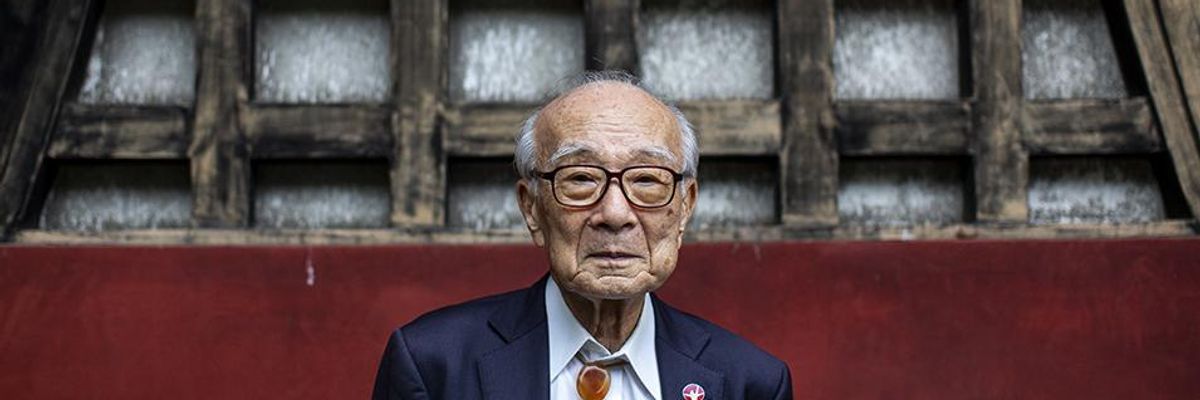
As Japan marks 75 years since the devastating attacks on Hiroshima and Nagasaki, the last generation of nuclear bomb survivors are working to ensure their message lives on after them. Terumi Tanaka, 88, was 13 when the bomb hit his hometown of Nagasaki. (Photo: Behrouz/Mehri/AFP via Getty Images)
After 75 Years, Last Survivors of Hiroshima and Nagasaki Atomic Bombings Says Nuclear Abolition Still 'Starting Point for Peace'
"Hell is probably like what we went through. It must never be allowed to happen again."
Jiro Hamasumi's mother was pregnant with him when the United States dropped a nuclear bomb on the Japanese city of Hiroshima on Aug. 6, 1945, killing tens of thousands instantly.
Today, at 74, Hamasumi is one of the remaining survivors of the attack pleading with world leaders to abolish nuclear arms.
"Hibakusha want the United States to apologize to us," Hamasumi told Agence France-Press this week. "But the proof of the apology is nuclear abolition, we're not after vengeance."
AFP estimates there are about 136,700 living survivors of the attacks on Hiroshima and Nagasaki, which ended the second World War in 1945.
For decades anti-nuclear activists have pointed to the destruction, devastation, and deadly consequences of the attacks as reason to rid the world of nuclear weapons. World leaders have continued to develop the technology, however, in spite of those pleas.
"A nuclear weapons ban is the starting point for peace."
--Lee Jong-keun, 92, Hiroshima survivor
"We must work harder to get our voices heard, not just mine but those of many other survivors," Lee Jong-keun, a 92-year-old hibakusha, who after decades of hiding his past as a Hiroshima survivor has, since 2012, joined others in telling his story and appealing for abolition of nuclear arms, said in an interview with the Associated Press this week. "A nuclear weapons ban is the starting point for peace."
In 2019, Pope Francis, speaking at Hiroshima Peace Park, a memorial to the events located in Japan, called nuclear weapons "a crime not only against the dignity of human beings but against any possible future for our common home."
"How," the pope asked, "can we speak of peace even as we build terrifying new weapons of war?"
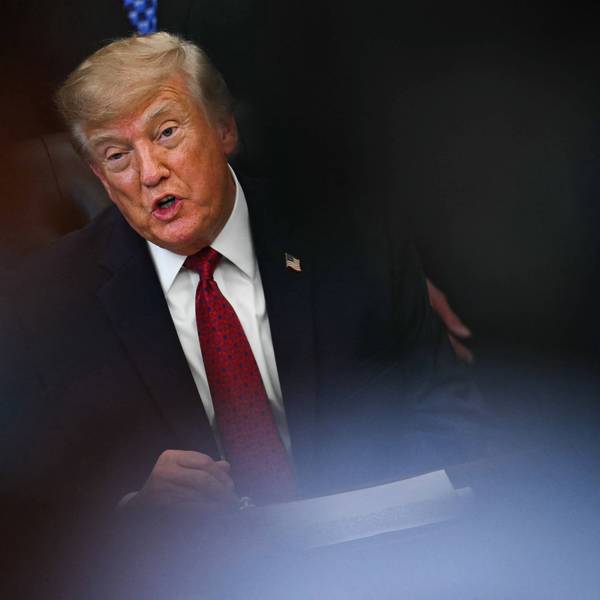
President Donald Trump has instead forged ahead with plans for nuclear testing, even as Democratic lawmakers push for legislation that would prevent the Trump administration from restarting nuclear weapons testing.
But remaining survivors, whose numbers dwindle as they age, and activists continue their fight for a world free of nuclear weapons.
"I haven't been to Hell," Hiroshima survivor Teruko Ueno told BBC. "So I don't know what it's like, but Hell is probably like what we went through. It must never be allowed to happen again."
We are at a crossroads
This country and this world are at a monumental crossroads. In a few short weeks, US voters will have an opportunity to beat back the forces of fascism and confront the billionaires who are rigging the economy, our media system, and our democracy, making it increasingly impossible for ordinary people to get by. We’re not just talking about the election. We’re talking about what must be done once these fascist elements are vanquished from power. We need a bolder set of solutions than what either major party has so far been willing to offer and a working-class movement ready to fight like hell for it. Trump didn't emerge from nowhere. The conditions that fueled MAGA authoritarianism were created by decades of radical neoliberal economic policies and a corrupt political system dominated by corporate interests. They slashed taxes on the super-rich, promising that the benefits would trickle down. They said giveaways to the corporate titans would make life more affordable for the rest of us. It was all bullshit. And when a bitter, betrayed populace searches for someone to blame, right-wing demagogues have little trouble finding scapegoats. People know when they're being lied to, but you won't hear any of this from the corporate media. Only independent journalism—powered and funded by people who believe in building a better world—can deliver truly trustworthy daily news. Our Fall Campaign is underway, and we need your help. To power our newsroom through the rest of the year, we need to raise $125,000 by midnight on October 31. So if you share our vision, please contribute whatever you can to sustain our work. |
Jiro Hamasumi's mother was pregnant with him when the United States dropped a nuclear bomb on the Japanese city of Hiroshima on Aug. 6, 1945, killing tens of thousands instantly.
Today, at 74, Hamasumi is one of the remaining survivors of the attack pleading with world leaders to abolish nuclear arms.
"Hibakusha want the United States to apologize to us," Hamasumi told Agence France-Press this week. "But the proof of the apology is nuclear abolition, we're not after vengeance."
AFP estimates there are about 136,700 living survivors of the attacks on Hiroshima and Nagasaki, which ended the second World War in 1945.
For decades anti-nuclear activists have pointed to the destruction, devastation, and deadly consequences of the attacks as reason to rid the world of nuclear weapons. World leaders have continued to develop the technology, however, in spite of those pleas.
"A nuclear weapons ban is the starting point for peace."
--Lee Jong-keun, 92, Hiroshima survivor
"We must work harder to get our voices heard, not just mine but those of many other survivors," Lee Jong-keun, a 92-year-old hibakusha, who after decades of hiding his past as a Hiroshima survivor has, since 2012, joined others in telling his story and appealing for abolition of nuclear arms, said in an interview with the Associated Press this week. "A nuclear weapons ban is the starting point for peace."
In 2019, Pope Francis, speaking at Hiroshima Peace Park, a memorial to the events located in Japan, called nuclear weapons "a crime not only against the dignity of human beings but against any possible future for our common home."
"How," the pope asked, "can we speak of peace even as we build terrifying new weapons of war?"
President Donald Trump has instead forged ahead with plans for nuclear testing, even as Democratic lawmakers push for legislation that would prevent the Trump administration from restarting nuclear weapons testing.
But remaining survivors, whose numbers dwindle as they age, and activists continue their fight for a world free of nuclear weapons.
"I haven't been to Hell," Hiroshima survivor Teruko Ueno told BBC. "So I don't know what it's like, but Hell is probably like what we went through. It must never be allowed to happen again."