SUBSCRIBE TO OUR FREE NEWSLETTER
Daily news & progressive opinion—funded by the people, not the corporations—delivered straight to your inbox.
5
#000000
#FFFFFF
To donate by check, phone, or other method, see our More Ways to Give page.
Daily news & progressive opinion—funded by the people, not the corporations—delivered straight to your inbox.
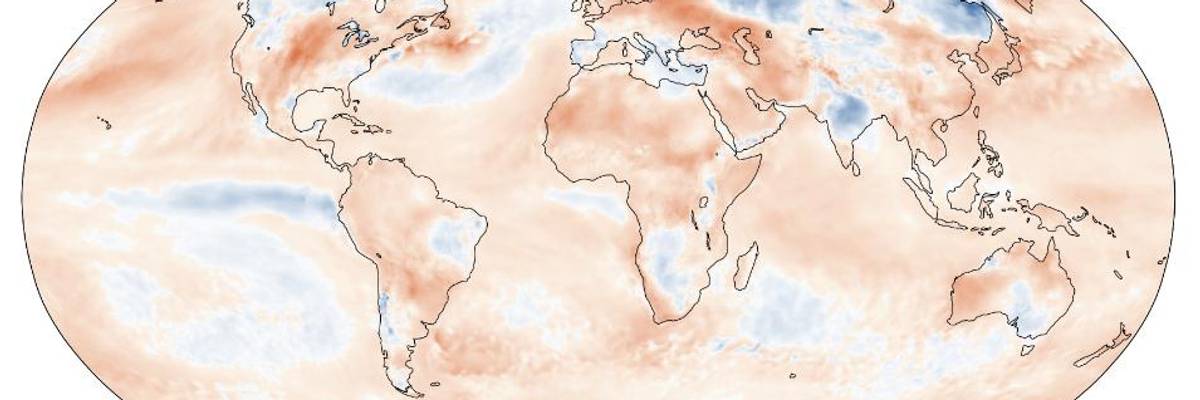
Surface air temperature anomaly for June 2020 relative to the June average for the period 1981-2010. (Image: C3S/ECMWF)
The unprecedented heat and fires that ravaged Siberia last month came at the tail end of a 12-month period that European researchers revealed Tuesday effectively tied with the hottest year on record based on global surface temperatures, bolstering calls from activists for international bodies and governments across the globe to take immediate action to tackle the climate crisis.
As Carbon Brief noted on Twitter, the 12-month period ending in June aligned with a record from August 2015 to September 2016. The findings come from the Copernicus Climate Change Service (C3S), which is implemented by the European Center for Medium-Range Weather Forecasts (ECMWF) on behalf of the European Commission.
Swedish 17-year-old climate activist Greta Thunberg, founder of the global youth-led Fridays for Future movement, responded to Carbon Brief's tweets about the new C3S report with a series of questions reiterating her challenge to reporters, governments, and other "adults" to take the planetary emergency seriously:
The European researchers found that during June 2020 alone, global temperatures were 0.53degC warmer than the average for June 1981-2010. Last month was also less than 0.01degC cooler than the warmest June on record in 2019 and 0.1degC warmer than the third warmest June in 2016.
In a press statement Tuesday, C3S explained that in terms of data from June 2020,
the most striking regional feature was exceptional warmth over Arctic Siberia, where average temperatures reached as high as 10degC above normal for June. The temperature averaged over all land in Arctic Siberia combined was more than five degrees above normal, and more than a degree higher than in 2018 and 2019, the two previous warmest Junes.
"Finding what caused these record temperatures is not a straightforward endeavor as there are many contributing factors interacting with each other," said C3S director Carlo Buontempo. "Siberia and the Arctic Circle in general have large fluctuations from year to year and have experienced other relatively warm Junes before."
"What is worrisome is that the Arctic is warming faster than the rest of the world," he continued. "Western Siberia experiencing warmer-than-average temperatures so long during the winter and spring is unusual, and the exceptionally high temperatures in Arctic Siberia that have occurred now in June 2020 are equally a cause for concern."
As Common Dreams reported June 27, experts linked the temperatures and fires in Siberia last month to the climate crisis. "Had the climate not changed due to man-made greenhouse gases, the heat we've seen in parts of Siberia would have been a 100,000-year event," said Weather Channel meteorologist Carl Parker.
Copernicus Atmosphere Monitoring Service (CAMS) senior scientist and ECMWF wildfire expert Mark Parrington said Tuesday that "what is remarkable with these fires in Siberia is the striking similarity with what we saw over the same period of last year in terms of both the area affected and the scale of the fires."
"Last year was already by far an unusual, and record, summer for fires in the Arctic Circle in our Global Fire Assimilation System dataset, which goes back to 2003," said Parrington. "This year has evolved in a very similar way and if it continues to progress like last year, we could see intense activity for the next few weeks."
"Higher temperatures and drier surface conditions are providing ideal conditions for these fires to burn and to persist for so long over such a large area," he added. "We have seen very similar patterns in the fire activity and soil moisture anomalies across the region in our fire monitoring activities over the last few years."
During the July 2019-June 2020 period, global temperatures were "well above the 1981-2010 average over a large part of Siberia and the Arctic Ocean to the north, to the north of Alaska, and over parts of West Antarctica" as well as "above average over virtually all of Europe," according to C3S.
"Globally, the 12-month period from July 2019 to June 2020 was 0.65degC warmer than the 1981-2010 average," the new C3S report says. "The value for this period is very close to that of the 12-month periods ending in May 2020 and September 2016, the two warmest such periods in this record."
Dear Common Dreams reader, It’s been nearly 30 years since I co-founded Common Dreams with my late wife, Lina Newhouser. We had the radical notion that journalism should serve the public good, not corporate profits. It was clear to us from the outset what it would take to build such a project. No paid advertisements. No corporate sponsors. No millionaire publisher telling us what to think or do. Many people said we wouldn't last a year, but we proved those doubters wrong. Together with a tremendous team of journalists and dedicated staff, we built an independent media outlet free from the constraints of profits and corporate control. Our mission has always been simple: To inform. To inspire. To ignite change for the common good. Building Common Dreams was not easy. Our survival was never guaranteed. When you take on the most powerful forces—Wall Street greed, fossil fuel industry destruction, Big Tech lobbyists, and uber-rich oligarchs who have spent billions upon billions rigging the economy and democracy in their favor—the only bulwark you have is supporters who believe in your work. But here’s the urgent message from me today. It's never been this bad out there. And it's never been this hard to keep us going. At the very moment Common Dreams is most needed, the threats we face are intensifying. We need your support now more than ever. We don't accept corporate advertising and never will. We don't have a paywall because we don't think people should be blocked from critical news based on their ability to pay. Everything we do is funded by the donations of readers like you. When everyone does the little they can afford, we are strong. But if that support retreats or dries up, so do we. Will you donate now to make sure Common Dreams not only survives but thrives? —Craig Brown, Co-founder |
The unprecedented heat and fires that ravaged Siberia last month came at the tail end of a 12-month period that European researchers revealed Tuesday effectively tied with the hottest year on record based on global surface temperatures, bolstering calls from activists for international bodies and governments across the globe to take immediate action to tackle the climate crisis.
As Carbon Brief noted on Twitter, the 12-month period ending in June aligned with a record from August 2015 to September 2016. The findings come from the Copernicus Climate Change Service (C3S), which is implemented by the European Center for Medium-Range Weather Forecasts (ECMWF) on behalf of the European Commission.
Swedish 17-year-old climate activist Greta Thunberg, founder of the global youth-led Fridays for Future movement, responded to Carbon Brief's tweets about the new C3S report with a series of questions reiterating her challenge to reporters, governments, and other "adults" to take the planetary emergency seriously:
The European researchers found that during June 2020 alone, global temperatures were 0.53degC warmer than the average for June 1981-2010. Last month was also less than 0.01degC cooler than the warmest June on record in 2019 and 0.1degC warmer than the third warmest June in 2016.
In a press statement Tuesday, C3S explained that in terms of data from June 2020,
the most striking regional feature was exceptional warmth over Arctic Siberia, where average temperatures reached as high as 10degC above normal for June. The temperature averaged over all land in Arctic Siberia combined was more than five degrees above normal, and more than a degree higher than in 2018 and 2019, the two previous warmest Junes.
"Finding what caused these record temperatures is not a straightforward endeavor as there are many contributing factors interacting with each other," said C3S director Carlo Buontempo. "Siberia and the Arctic Circle in general have large fluctuations from year to year and have experienced other relatively warm Junes before."
"What is worrisome is that the Arctic is warming faster than the rest of the world," he continued. "Western Siberia experiencing warmer-than-average temperatures so long during the winter and spring is unusual, and the exceptionally high temperatures in Arctic Siberia that have occurred now in June 2020 are equally a cause for concern."
As Common Dreams reported June 27, experts linked the temperatures and fires in Siberia last month to the climate crisis. "Had the climate not changed due to man-made greenhouse gases, the heat we've seen in parts of Siberia would have been a 100,000-year event," said Weather Channel meteorologist Carl Parker.
Copernicus Atmosphere Monitoring Service (CAMS) senior scientist and ECMWF wildfire expert Mark Parrington said Tuesday that "what is remarkable with these fires in Siberia is the striking similarity with what we saw over the same period of last year in terms of both the area affected and the scale of the fires."
"Last year was already by far an unusual, and record, summer for fires in the Arctic Circle in our Global Fire Assimilation System dataset, which goes back to 2003," said Parrington. "This year has evolved in a very similar way and if it continues to progress like last year, we could see intense activity for the next few weeks."
"Higher temperatures and drier surface conditions are providing ideal conditions for these fires to burn and to persist for so long over such a large area," he added. "We have seen very similar patterns in the fire activity and soil moisture anomalies across the region in our fire monitoring activities over the last few years."
During the July 2019-June 2020 period, global temperatures were "well above the 1981-2010 average over a large part of Siberia and the Arctic Ocean to the north, to the north of Alaska, and over parts of West Antarctica" as well as "above average over virtually all of Europe," according to C3S.
"Globally, the 12-month period from July 2019 to June 2020 was 0.65degC warmer than the 1981-2010 average," the new C3S report says. "The value for this period is very close to that of the 12-month periods ending in May 2020 and September 2016, the two warmest such periods in this record."
The unprecedented heat and fires that ravaged Siberia last month came at the tail end of a 12-month period that European researchers revealed Tuesday effectively tied with the hottest year on record based on global surface temperatures, bolstering calls from activists for international bodies and governments across the globe to take immediate action to tackle the climate crisis.
As Carbon Brief noted on Twitter, the 12-month period ending in June aligned with a record from August 2015 to September 2016. The findings come from the Copernicus Climate Change Service (C3S), which is implemented by the European Center for Medium-Range Weather Forecasts (ECMWF) on behalf of the European Commission.
Swedish 17-year-old climate activist Greta Thunberg, founder of the global youth-led Fridays for Future movement, responded to Carbon Brief's tweets about the new C3S report with a series of questions reiterating her challenge to reporters, governments, and other "adults" to take the planetary emergency seriously:
The European researchers found that during June 2020 alone, global temperatures were 0.53degC warmer than the average for June 1981-2010. Last month was also less than 0.01degC cooler than the warmest June on record in 2019 and 0.1degC warmer than the third warmest June in 2016.
In a press statement Tuesday, C3S explained that in terms of data from June 2020,
the most striking regional feature was exceptional warmth over Arctic Siberia, where average temperatures reached as high as 10degC above normal for June. The temperature averaged over all land in Arctic Siberia combined was more than five degrees above normal, and more than a degree higher than in 2018 and 2019, the two previous warmest Junes.
"Finding what caused these record temperatures is not a straightforward endeavor as there are many contributing factors interacting with each other," said C3S director Carlo Buontempo. "Siberia and the Arctic Circle in general have large fluctuations from year to year and have experienced other relatively warm Junes before."
"What is worrisome is that the Arctic is warming faster than the rest of the world," he continued. "Western Siberia experiencing warmer-than-average temperatures so long during the winter and spring is unusual, and the exceptionally high temperatures in Arctic Siberia that have occurred now in June 2020 are equally a cause for concern."
As Common Dreams reported June 27, experts linked the temperatures and fires in Siberia last month to the climate crisis. "Had the climate not changed due to man-made greenhouse gases, the heat we've seen in parts of Siberia would have been a 100,000-year event," said Weather Channel meteorologist Carl Parker.
Copernicus Atmosphere Monitoring Service (CAMS) senior scientist and ECMWF wildfire expert Mark Parrington said Tuesday that "what is remarkable with these fires in Siberia is the striking similarity with what we saw over the same period of last year in terms of both the area affected and the scale of the fires."
"Last year was already by far an unusual, and record, summer for fires in the Arctic Circle in our Global Fire Assimilation System dataset, which goes back to 2003," said Parrington. "This year has evolved in a very similar way and if it continues to progress like last year, we could see intense activity for the next few weeks."
"Higher temperatures and drier surface conditions are providing ideal conditions for these fires to burn and to persist for so long over such a large area," he added. "We have seen very similar patterns in the fire activity and soil moisture anomalies across the region in our fire monitoring activities over the last few years."
During the July 2019-June 2020 period, global temperatures were "well above the 1981-2010 average over a large part of Siberia and the Arctic Ocean to the north, to the north of Alaska, and over parts of West Antarctica" as well as "above average over virtually all of Europe," according to C3S.
"Globally, the 12-month period from July 2019 to June 2020 was 0.65degC warmer than the 1981-2010 average," the new C3S report says. "The value for this period is very close to that of the 12-month periods ending in May 2020 and September 2016, the two warmest such periods in this record."