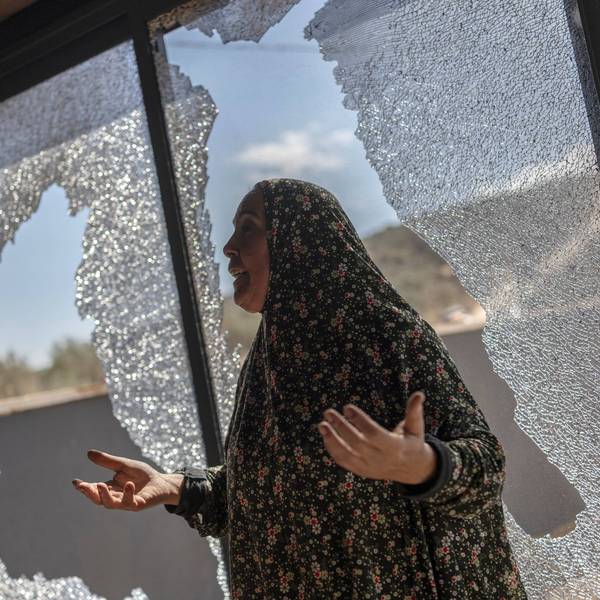
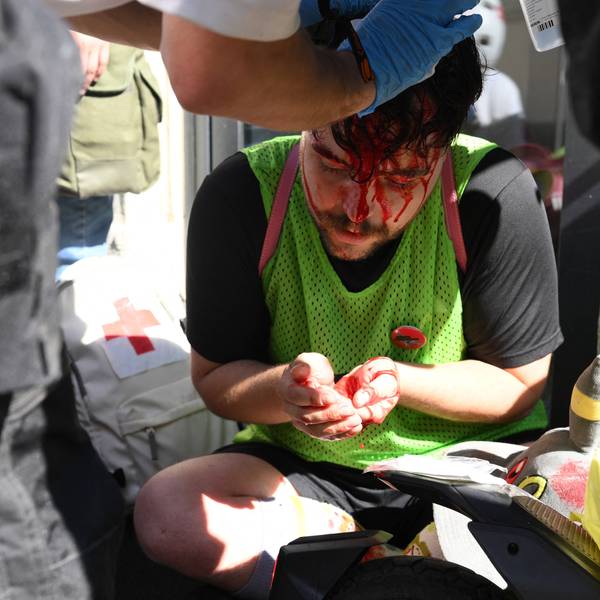

"Officers responsible for excessive force and unlawful killings must always be held accountable," said Brian Castner, senior crisis adviser on arms and military operations at Amnesty International. (Image: Amnesty International)
New Amnesty Map Documents 'Shocking Extent' of US Police Violence Against Black Lives Matter Protesters
Denying people's constitutional rights "with physical violence, tear gas, and pepper spray is a hallmark of repression," said one Amnesty researcher.
An extensive new report released Tuesday morning by human rights group Amnesty International finds that between May 26 and June 5, local, state, and federal law enforcement officials in 40 U.S. states and Washington, D.C. committed more than 125 separate acts of violence against demonstrators who gathered in the streets en masse to protest the police killing of George Floyd.
Law enforcement officials "consistently violated human rights out on the streets instead of fulfilling their obligations to respect and facilitate the right of people to peacefully protest," said Amnesty, which published an interactive map containing video evidence of police officers beating, teargassing, and firing rubber bullets at protesters.
"The analysis is clear: when activists and supporters of the Black Lives Matter movement took to the streets in cities and towns across the country to peacefully demand an end to systemic racism and police violence, they were overwhelmingly met with a militarized response and more police violence," Brian Castner, senior crisis adviser on arms and military operations at Amnesty International, said in a statement.
In the process of compiling its detailed report, Amnesty examined more than 500 videos and photos posted to social media in recent weeks as demonstrations against police brutality and racial injustice spread across the U.S. and around the world following Floyd's killing on May 25.
"This digital content was then verified, geolocated, and analyzed by investigators with expertise in weapons, police tactics, and international and U.S. laws governing the use of force," Amnesty said. "In some cases, researchers were also able to interview victims and confirm police conduct with local police departments."
The resulting report documents what the group describes as a "dizzying array of violations by law enforcement across the country."
Amnesty's analysis includes vivid and appalling firsthand accounts of police brutality by demonstrators who were present when law enforcement indiscriminately fired tear gas and projectiles into crowds. Lizzie Horne, a Rabbinical student, offered the following anecdote:
Out of the blue, they started breezing pepper spray into the crowd. There was one officer on the median who was spraying as well. Then they started with tear gas. Someone who was right in the front--who had a tear gas canister hit his head--started running back. And we were trying to help him, flushing his eyes and then he just fainted and started having a seizure. He came to pretty quickly. As we were finally lifting him up and started getting him out of the way, they started launching more tear gas; that's when people started to get really scared. They started gassing in a kettle formation--we were against a big fence that people had to jump over, up a steep hill. The fence was maybe six feet tall. People started putting their hands up--but the cops wouldn't let up. It was can after can after can. We were encapsulated in gas. We were drooling and coughing uncontrollably.
Then the cops came from the other side of the fence and started gassing from that direction. After that, the police started coming up the hill and... they were hitting and tackling people. They were dragging people down the hill and forcing them down on their knees, lining them up kneeling on the median on the highway with their hands in zip ties, and pulling down their masks and spraying and gassing them again.
Ernest Coverson, End Gun Violence Campaign manager for Amnesty International USA, said in a statement that the new research "shows that the police will stop at nothing to squash protesters."
"Giving law enforcement weapons of war creates an endless cycle of violence that disproportionately affects Black people," said Coverson. "No one had to lose their eyesight, get sick, or forever fear the police because they wanted to say that Black lives matter. It's time to end these human rights violations once and for all."
Amnesty suggested a number of specific reforms that it said would help stem widespread human rights abuses by law enforcement:
- Stop extrajudicial executions of Black people by police and bring accountability for their deaths through independent, impartial investigations that lead to reparations for the victims and survivors;
- Pass federal legislation, like the PEACE Act, to restrict police use of force to only what is strictly necessary and proportionate in order to limit the use of deadly force;
- Pass federal legislation to demilitarize the police by eliminating the 1033 program;
- Ban the use of chokeholds and other maneuvers that cut off blood and oxygen to the brain, including neck holds, chokeholds, and similar excessive force. Such use force should be considered a federal civil rights violation;
- Prohibit the use of no knock warrants, particularly for drug searches;
- Change the intent standard requirement from "willfulness" to "recklessness," permitting prosecutors to successfully hold law enforcement accountable for depriving people of their civil rights and civil liberties;
- End the qualified immunity doctrine, which prevents police from being legally held accountable when they break the law; and
- Ensure the right to peaceful protest against police violence, without the threat of protesters, journalists, or bystanders being targeted by further police violence.
"Real, systemic, and lasting police reform is needed at all levels to ensure that people across the country feel safe to walk the streets and express their opinions freely and peacefully without facing a real threat of harm from the very officers that are supposed to protect them," said Brian Griffey, USA researcher and adviser at Amnesty.
"This is a Constitutional right that is mirrored in international human rights law; to deny this right with physical violence, tear gas, and pepper spray is a hallmark of repression," Griffey added.
We are at a crossroads
This country and this world are at a monumental crossroads. In a few short weeks, US voters will have an opportunity to beat back the forces of fascism and confront the billionaires who are rigging the economy, our media system, and our democracy, making it increasingly impossible for ordinary people to get by. We’re not just talking about the election. We’re talking about what must be done once these fascist elements are vanquished from power. We need a bolder set of solutions than what either major party has so far been willing to offer and a working-class movement ready to fight like hell for it. Trump didn't emerge from nowhere. The conditions that fueled MAGA authoritarianism were created by decades of radical neoliberal economic policies and a corrupt political system dominated by corporate interests. They slashed taxes on the super-rich, promising that the benefits would trickle down. They said giveaways to the corporate titans would make life more affordable for the rest of us. It was all bullshit. And when a bitter, betrayed populace searches for someone to blame, right-wing demagogues have little trouble finding scapegoats. People know when they're being lied to, but you won't hear any of this from the corporate media. Only independent journalism—powered and funded by people who believe in building a better world—can deliver truly trustworthy daily news. Our Fall Campaign is underway, and we need your help. To power our newsroom through the rest of the year, we need to raise $125,000 by midnight on October 31. So if you share our vision, please contribute whatever you can to sustain our work. |
An extensive new report released Tuesday morning by human rights group Amnesty International finds that between May 26 and June 5, local, state, and federal law enforcement officials in 40 U.S. states and Washington, D.C. committed more than 125 separate acts of violence against demonstrators who gathered in the streets en masse to protest the police killing of George Floyd.
Law enforcement officials "consistently violated human rights out on the streets instead of fulfilling their obligations to respect and facilitate the right of people to peacefully protest," said Amnesty, which published an interactive map containing video evidence of police officers beating, teargassing, and firing rubber bullets at protesters.
"The analysis is clear: when activists and supporters of the Black Lives Matter movement took to the streets in cities and towns across the country to peacefully demand an end to systemic racism and police violence, they were overwhelmingly met with a militarized response and more police violence," Brian Castner, senior crisis adviser on arms and military operations at Amnesty International, said in a statement.
In the process of compiling its detailed report, Amnesty examined more than 500 videos and photos posted to social media in recent weeks as demonstrations against police brutality and racial injustice spread across the U.S. and around the world following Floyd's killing on May 25.
"This digital content was then verified, geolocated, and analyzed by investigators with expertise in weapons, police tactics, and international and U.S. laws governing the use of force," Amnesty said. "In some cases, researchers were also able to interview victims and confirm police conduct with local police departments."
The resulting report documents what the group describes as a "dizzying array of violations by law enforcement across the country."
Amnesty's analysis includes vivid and appalling firsthand accounts of police brutality by demonstrators who were present when law enforcement indiscriminately fired tear gas and projectiles into crowds. Lizzie Horne, a Rabbinical student, offered the following anecdote:
Out of the blue, they started breezing pepper spray into the crowd. There was one officer on the median who was spraying as well. Then they started with tear gas. Someone who was right in the front--who had a tear gas canister hit his head--started running back. And we were trying to help him, flushing his eyes and then he just fainted and started having a seizure. He came to pretty quickly. As we were finally lifting him up and started getting him out of the way, they started launching more tear gas; that's when people started to get really scared. They started gassing in a kettle formation--we were against a big fence that people had to jump over, up a steep hill. The fence was maybe six feet tall. People started putting their hands up--but the cops wouldn't let up. It was can after can after can. We were encapsulated in gas. We were drooling and coughing uncontrollably.
Then the cops came from the other side of the fence and started gassing from that direction. After that, the police started coming up the hill and... they were hitting and tackling people. They were dragging people down the hill and forcing them down on their knees, lining them up kneeling on the median on the highway with their hands in zip ties, and pulling down their masks and spraying and gassing them again.
Ernest Coverson, End Gun Violence Campaign manager for Amnesty International USA, said in a statement that the new research "shows that the police will stop at nothing to squash protesters."
"Giving law enforcement weapons of war creates an endless cycle of violence that disproportionately affects Black people," said Coverson. "No one had to lose their eyesight, get sick, or forever fear the police because they wanted to say that Black lives matter. It's time to end these human rights violations once and for all."
Amnesty suggested a number of specific reforms that it said would help stem widespread human rights abuses by law enforcement:
- Stop extrajudicial executions of Black people by police and bring accountability for their deaths through independent, impartial investigations that lead to reparations for the victims and survivors;
- Pass federal legislation, like the PEACE Act, to restrict police use of force to only what is strictly necessary and proportionate in order to limit the use of deadly force;
- Pass federal legislation to demilitarize the police by eliminating the 1033 program;
- Ban the use of chokeholds and other maneuvers that cut off blood and oxygen to the brain, including neck holds, chokeholds, and similar excessive force. Such use force should be considered a federal civil rights violation;
- Prohibit the use of no knock warrants, particularly for drug searches;
- Change the intent standard requirement from "willfulness" to "recklessness," permitting prosecutors to successfully hold law enforcement accountable for depriving people of their civil rights and civil liberties;
- End the qualified immunity doctrine, which prevents police from being legally held accountable when they break the law; and
- Ensure the right to peaceful protest against police violence, without the threat of protesters, journalists, or bystanders being targeted by further police violence.
"Real, systemic, and lasting police reform is needed at all levels to ensure that people across the country feel safe to walk the streets and express their opinions freely and peacefully without facing a real threat of harm from the very officers that are supposed to protect them," said Brian Griffey, USA researcher and adviser at Amnesty.
"This is a Constitutional right that is mirrored in international human rights law; to deny this right with physical violence, tear gas, and pepper spray is a hallmark of repression," Griffey added.