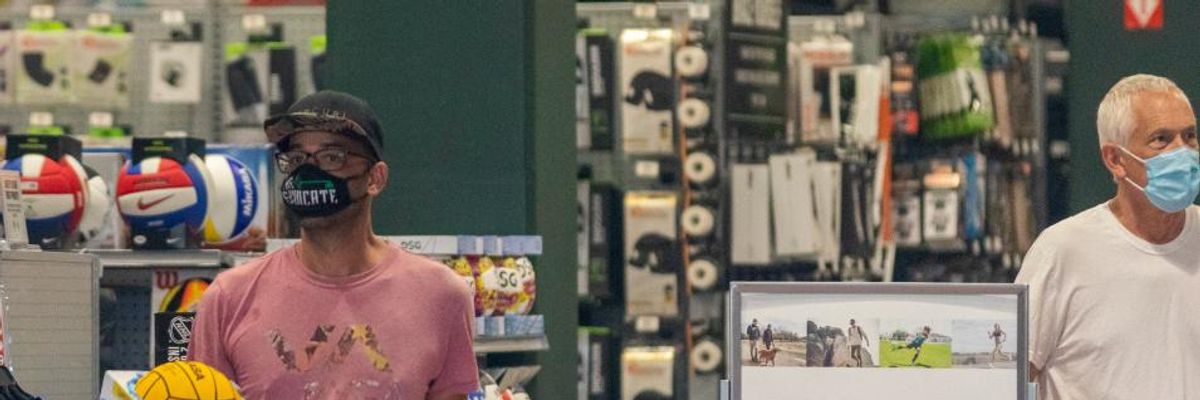
Customers shop in a Dick's Sporting Goods store as Los Angeles County retail businesses reopen while the Covid-19 pandemic continues on May 27, 2020 in Glendale, California. (Photo: David McNew/Getty Images)
Amid Easing Restrictions, Study Estimates Shutdowns Prevented 60 Million Covid-19 Cases in US Alone
"I don't think any human endeavor has ever saved so many lives in such a short period of time," said the study's lead author.
Though the number of confirmed Covid-19 cases in the United States is nearing two million and the death toll has topped 110,500, an analysis published Monday in the journal Nature shows that stay-at-home orders and other measures implemented in response to the ongoing coronavirus pandemic prevented about 60 million infections nationwide.
"It's as if the roof was about to fall in, but we caught it before it crushed everyone."
--Solomon Hsiang, UC Berkeley
"The last several months have been extraordinarily difficult, but through our individual sacrifices, people everywhere have each contributed to one of humanity's greatest collective achievements," lead author Solomon Hsiang said in a statement Monday. "I don't think any human endeavor has ever saved so many lives in such a short period of time."
Since mid-March, millions of people in the U.S. have lost their jobs--and for many, that has also meant losing their health insurance in the midst of a pandemic. Americans' struggles to access healthcare, remain in their homes, and keep food on the table has put pressure on congressional leaders and the Trump administration to dramatically expand efforts that provide direct relief to peple who need it.
The findings come as communities across the country are easing restrictions--despite worries that reopening too early could lead to a surge in new infections. The analysis also comes amid a wave of nationwide protests against police brutality and systemic racism for which hundreds (pdf) of public health experts have expressed support while also warning of the inherent risks and the necessity of taking precautions.
The University of California, Berkeley said in a statement that the study is the "first peer-reviewed analysis of local, regional, and national policies" enacted to contain the virus. Researchers examined containment efforts in the U.S., South Korea, Italy, Iran, France, and China--where the virus first emerged late last year--and found that across all six nations, 1,717 travel restrictions, business and school closures, and other policies prevented roughly 530 million Covid-19 infections.
The study period ended April 6. Continuing containment policies since then has likely prevented many millions more cases, according to Hsiang, director of UC Berkeley's Global Policy Laboratory and a professor at the Goldman School of Public Policy. He said that "April and May would have been even more devastating if we had done nothing, with a toll we probably can't imagine."
"It's as if the roof was about to fall in, but we caught it before it crushed everyone," Hsiang added. "It was difficult and exhausting, and we are still holding it up. But by coming together, we did something as a society that nobody could have done alone and which has never been done before."
The UC Berkeley statement explained that "the study did not estimate how many lives might have been saved by the policies because, with so many infections, fatality rates would be much higher than anything observed to date."
Infectious disease expert Dr. Dena Grayson added a similar note after responding to the new study on Twitter Monday with an estimate of the number of deaths prevented based on the current fatality rate:
As the Washington Post reported Monday:
A separate study from epidemiologists at Imperial College London estimated the shutdowns saved about 3.1 million lives in 11 European countries, including 500,000 in the United Kingdom, and dropped infection rates by an average of 82%, sufficient to drive the contagion well below epidemic levels.
...But the overwhelming majority of people remain susceptible to the virus. Only about 3% to 4% of people in the countries being studied have been infected to date, said Samir Bhatt, senior author of the Imperial College London study.
"This is just the beginning of the epidemic: we're very far from herd immunity," Bhatt told the Post in an email Monday. "The risk of a second wave happening if all interventions and precautions are abandoned is very real."
We are at a crossroads
This country and this world are at a monumental crossroads. In a few short weeks, US voters will have an opportunity to beat back the forces of fascism and confront the billionaires who are rigging the economy, our media system, and our democracy, making it increasingly impossible for ordinary people to get by. We’re not just talking about the election. We’re talking about what must be done once these fascist elements are vanquished from power. We need a bolder set of solutions than what either major party has so far been willing to offer and a working-class movement ready to fight like hell for it. Trump didn't emerge from nowhere. The conditions that fueled MAGA authoritarianism were created by decades of radical neoliberal economic policies and a corrupt political system dominated by corporate interests. They slashed taxes on the super-rich, promising that the benefits would trickle down. They said giveaways to the corporate titans would make life more affordable for the rest of us. It was all bullshit. And when a bitter, betrayed populace searches for someone to blame, right-wing demagogues have little trouble finding scapegoats. People know when they're being lied to, but you won't hear any of this from the corporate media. Only independent journalism—powered and funded by people who believe in building a better world—can deliver truly trustworthy daily news. Our Fall Campaign is underway, and we need your help. To power our newsroom through the rest of the year, we need to raise $125,000 by midnight on October 31. So if you share our vision, please contribute whatever you can to sustain our work. |
Though the number of confirmed Covid-19 cases in the United States is nearing two million and the death toll has topped 110,500, an analysis published Monday in the journal Nature shows that stay-at-home orders and other measures implemented in response to the ongoing coronavirus pandemic prevented about 60 million infections nationwide.
"It's as if the roof was about to fall in, but we caught it before it crushed everyone."
--Solomon Hsiang, UC Berkeley
"The last several months have been extraordinarily difficult, but through our individual sacrifices, people everywhere have each contributed to one of humanity's greatest collective achievements," lead author Solomon Hsiang said in a statement Monday. "I don't think any human endeavor has ever saved so many lives in such a short period of time."
Since mid-March, millions of people in the U.S. have lost their jobs--and for many, that has also meant losing their health insurance in the midst of a pandemic. Americans' struggles to access healthcare, remain in their homes, and keep food on the table has put pressure on congressional leaders and the Trump administration to dramatically expand efforts that provide direct relief to peple who need it.
The findings come as communities across the country are easing restrictions--despite worries that reopening too early could lead to a surge in new infections. The analysis also comes amid a wave of nationwide protests against police brutality and systemic racism for which hundreds (pdf) of public health experts have expressed support while also warning of the inherent risks and the necessity of taking precautions.
The University of California, Berkeley said in a statement that the study is the "first peer-reviewed analysis of local, regional, and national policies" enacted to contain the virus. Researchers examined containment efforts in the U.S., South Korea, Italy, Iran, France, and China--where the virus first emerged late last year--and found that across all six nations, 1,717 travel restrictions, business and school closures, and other policies prevented roughly 530 million Covid-19 infections.
The study period ended April 6. Continuing containment policies since then has likely prevented many millions more cases, according to Hsiang, director of UC Berkeley's Global Policy Laboratory and a professor at the Goldman School of Public Policy. He said that "April and May would have been even more devastating if we had done nothing, with a toll we probably can't imagine."
"It's as if the roof was about to fall in, but we caught it before it crushed everyone," Hsiang added. "It was difficult and exhausting, and we are still holding it up. But by coming together, we did something as a society that nobody could have done alone and which has never been done before."
The UC Berkeley statement explained that "the study did not estimate how many lives might have been saved by the policies because, with so many infections, fatality rates would be much higher than anything observed to date."
Infectious disease expert Dr. Dena Grayson added a similar note after responding to the new study on Twitter Monday with an estimate of the number of deaths prevented based on the current fatality rate:
As the Washington Post reported Monday:
A separate study from epidemiologists at Imperial College London estimated the shutdowns saved about 3.1 million lives in 11 European countries, including 500,000 in the United Kingdom, and dropped infection rates by an average of 82%, sufficient to drive the contagion well below epidemic levels.
...But the overwhelming majority of people remain susceptible to the virus. Only about 3% to 4% of people in the countries being studied have been infected to date, said Samir Bhatt, senior author of the Imperial College London study.
"This is just the beginning of the epidemic: we're very far from herd immunity," Bhatt told the Post in an email Monday. "The risk of a second wave happening if all interventions and precautions are abandoned is very real."