
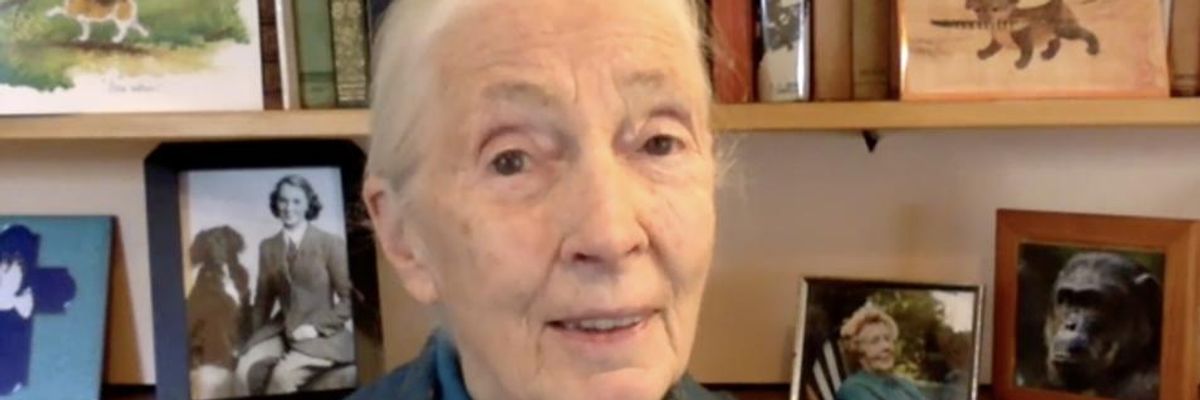
Primatologist and conservationist Jane Goodall particpated in a Tuesday webinar about pandemics, wildlife, and intensive animal farming. (Photo: Compassion in World Farming)
Jane Goodall Warns Humanity Will Be 'Finished' After Covid-19 Without Ending 'Absolute Disrespect for Animals and the Environment'
"Our disrespect for wild animals and our disrespect for farmed animals has created this situation where disease can spill over to infect human beings."
In a webinar Tuesday about pandemics, wildlife, and intensive animal farming, world renowned primatologist and conservationist Jane Goodall warned of dire consequences if humanity fails to rapidly reform the global food system and stop destroying natural habitats.
"One of the lessons learnt from this crisis is that we must change our ways."
--Jane Goodall, primatologist
"If we do not do things differently, we are finished," said Goodall, a United Nations messenger of peace, during the Compassion in World Farming event. "We can't go on very much longer like this."
The 86-year-old founder of the Jane Goodall Institute, famous for her research on wild chimpanzees at Gombe National Park in Tanzania, delivered the online speech as the international community continued to battle the coronavirus pandemic, which has killed over 382,000 and infected more than 6.4 million people worldwide.
As the Guardian reported: "She blamed the emergence of Covid-19 on the over-exploitation of the natural world, which has seen forests cut down, species made extinct, and natural habitats destroyed... Intensive farming was also creating a reservoir of animal diseases that would spill over and hurt human society, said Goodall."
"We have brought this on ourselves because of our absolute disrespect for animals and the environment," Goodall said of the ongoing pandemic. "Our disrespect for wild animals and our disrespect for farmed animals has created this situation where disease can spill over to infect human beings."
"We have come to a turning point in our relationship with the natural world," she added. "One of the lessons learnt from this crisis is that we must change our ways. Scientists warn that to avoid future crises, we must drastically change our diets and move to plant-rich foods--for the sake of the animals, planet, and the health of our children."
In addition to urging the world to urgently shift away from factory farming and the destruction of wildlife, Goodall acknowledged the need to end poverty, war, and violence worldwide to protect nature. Her speech was celebrated by animal rights and climate campaigners who tweeted the Guardian's reporting about the webinar:
The event also featured remarks from Compassion in World Farming Global CEO Philip Lymbery, who introduced Goodall, and seven Members of the European Parliament (MEPs). It came as governments and international bodies are faced with mounting calls from activists, healthcare providers, progressive policymakers, and other experts to pursue a #PeoplesBailout, Just Recovery, Healthy Recovery, Green Recovery, Green Stimulus, and Global Green New Deal.
The webinar also came amid the emergence of new research bolstering Goodall's warnings about the impacts of intensive animal agriculture and humanity's destruction of nature.
As Common Dreams reported, a study published Monday concluded that the current mass extinction crisis is "human caused and accelerating," and "may be the most serious environmental threat to the persistence of civilization, because it is irreversible."
The study's authors warned that continued environmental destruction could result in more threats to human health. "The vaccine for Covid-19 was natural habitat," lead author Gerardo Ceballos Gonzalez told the New York Times. "The pandemic is a great example of how badly we've treated nature."
Research published Wednesday by the London-based investor initiative Farm Animal Investment Risk and Return (FAIRR) found that 73% of world's 60 largest meat, fish, and dairy companies are at "high risk" for fostering future zoonotic pandemics.
The group's new report features a "Pandemic Ranking" that combines six risks from the 2019 Coller FAIRR Protein Producer Index: deforestation and biodiversity loss, antibiotics, waste and pollution, working conditions, food safety, and animal welfare.
"Factory farming is both vulnerable to pandemics, and guilty of creating them," Jeremy Coller, founder of FAIRR and CIO of Coller Capital, said in a statement announcing the report. "It's a self-sabotaging cycle that destroys value and risks lives."
"To avoid causing the next pandemic, the meat industry must tackle lax safety standards for food and workers alike, closely confined animals, and overused antibiotics," he said. "This will disrupt a supply chain already cracking from fundamental land, water, and emissions constraints."
We are at a crossroads
This country and this world are at a monumental crossroads. US voters have an opportunity to beat back the forces of fascism and confront the billionaires who are rigging the economy, our media system, and our democracy, making it increasingly impossible for ordinary people to get by. We’re not just talking about the election. We’re talking about what must be done once these fascist elements are vanquished from power. We need a bolder set of solutions than what either major party has so far been willing to offer and a working-class movement ready to fight like hell for it. Trump didn't emerge from nowhere. The conditions that fueled MAGA authoritarianism were created by decades of radical neoliberal economic policies and a corrupt political system dominated by corporate interests. They slashed taxes on the super-rich, promising that the benefits would trickle down. They said giveaways to the corporate titans would make life more affordable for the rest of us. It was all bullshit. And when a bitter, betrayed populace searches for someone to blame, right-wing demagogues have little trouble finding scapegoats. People know when they're being lied to, but you won't hear any of this from the corporate media. Only independent journalism—powered and funded by people who believe in building a better world—can deliver truly trustworthy daily news. Our Fall Campaign is underway, and we need your help. To power our newsroom through the rest of the year, we need to raise $125,000 by midnight on October 31. So if you share our vision, please contribute whatever you can to sustain our work. |
In a webinar Tuesday about pandemics, wildlife, and intensive animal farming, world renowned primatologist and conservationist Jane Goodall warned of dire consequences if humanity fails to rapidly reform the global food system and stop destroying natural habitats.
"One of the lessons learnt from this crisis is that we must change our ways."
--Jane Goodall, primatologist
"If we do not do things differently, we are finished," said Goodall, a United Nations messenger of peace, during the Compassion in World Farming event. "We can't go on very much longer like this."
The 86-year-old founder of the Jane Goodall Institute, famous for her research on wild chimpanzees at Gombe National Park in Tanzania, delivered the online speech as the international community continued to battle the coronavirus pandemic, which has killed over 382,000 and infected more than 6.4 million people worldwide.
As the Guardian reported: "She blamed the emergence of Covid-19 on the over-exploitation of the natural world, which has seen forests cut down, species made extinct, and natural habitats destroyed... Intensive farming was also creating a reservoir of animal diseases that would spill over and hurt human society, said Goodall."
"We have brought this on ourselves because of our absolute disrespect for animals and the environment," Goodall said of the ongoing pandemic. "Our disrespect for wild animals and our disrespect for farmed animals has created this situation where disease can spill over to infect human beings."
"We have come to a turning point in our relationship with the natural world," she added. "One of the lessons learnt from this crisis is that we must change our ways. Scientists warn that to avoid future crises, we must drastically change our diets and move to plant-rich foods--for the sake of the animals, planet, and the health of our children."
In addition to urging the world to urgently shift away from factory farming and the destruction of wildlife, Goodall acknowledged the need to end poverty, war, and violence worldwide to protect nature. Her speech was celebrated by animal rights and climate campaigners who tweeted the Guardian's reporting about the webinar:
The event also featured remarks from Compassion in World Farming Global CEO Philip Lymbery, who introduced Goodall, and seven Members of the European Parliament (MEPs). It came as governments and international bodies are faced with mounting calls from activists, healthcare providers, progressive policymakers, and other experts to pursue a #PeoplesBailout, Just Recovery, Healthy Recovery, Green Recovery, Green Stimulus, and Global Green New Deal.
The webinar also came amid the emergence of new research bolstering Goodall's warnings about the impacts of intensive animal agriculture and humanity's destruction of nature.
As Common Dreams reported, a study published Monday concluded that the current mass extinction crisis is "human caused and accelerating," and "may be the most serious environmental threat to the persistence of civilization, because it is irreversible."
The study's authors warned that continued environmental destruction could result in more threats to human health. "The vaccine for Covid-19 was natural habitat," lead author Gerardo Ceballos Gonzalez told the New York Times. "The pandemic is a great example of how badly we've treated nature."
Research published Wednesday by the London-based investor initiative Farm Animal Investment Risk and Return (FAIRR) found that 73% of world's 60 largest meat, fish, and dairy companies are at "high risk" for fostering future zoonotic pandemics.
The group's new report features a "Pandemic Ranking" that combines six risks from the 2019 Coller FAIRR Protein Producer Index: deforestation and biodiversity loss, antibiotics, waste and pollution, working conditions, food safety, and animal welfare.
"Factory farming is both vulnerable to pandemics, and guilty of creating them," Jeremy Coller, founder of FAIRR and CIO of Coller Capital, said in a statement announcing the report. "It's a self-sabotaging cycle that destroys value and risks lives."
"To avoid causing the next pandemic, the meat industry must tackle lax safety standards for food and workers alike, closely confined animals, and overused antibiotics," he said. "This will disrupt a supply chain already cracking from fundamental land, water, and emissions constraints."