

SUBSCRIBE TO OUR FREE NEWSLETTER
Daily news & progressive opinion—funded by the people, not the corporations—delivered straight to your inbox.
5
#000000
#FFFFFF
To donate by check, phone, or other method, see our More Ways to Give page.
Daily news & progressive opinion—funded by the people, not the corporations—delivered straight to your inbox.
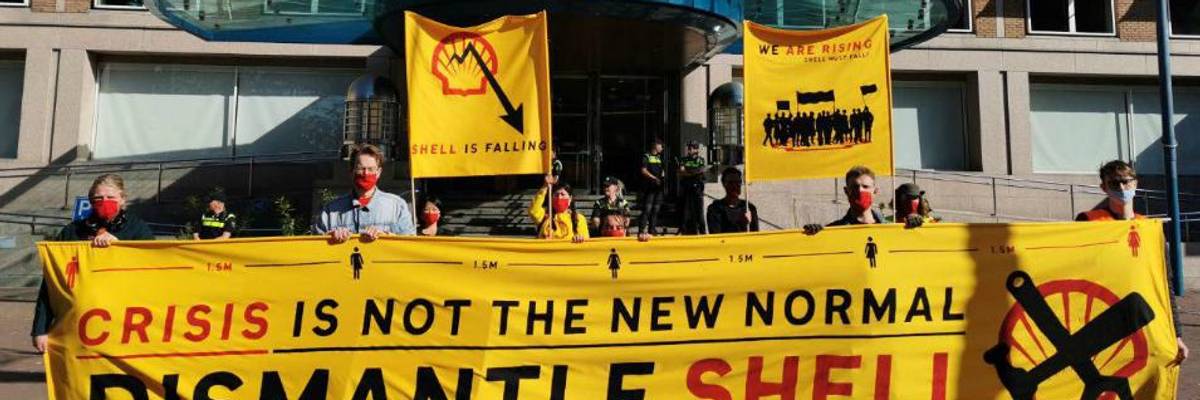
About 30 protesters gathered outside Royal Dutch Shell's headquarters in The Hague Tuesday to declare that the oil giant "must fall." (Photo: Shell Must Fall/Twitter)
Donning face masks and abiding by social distancing guidelines because of the coronavirus pandemic, climate activists gathered at Royal Dutch Shell's headquarters in The Hague Tuesday during the oil giant's annual shareholders meeting to declare that "Shell must fall."
"It's time to end all investment in the fossil fuel industry."
-- Greenpeace
Although hundreds of activists had signed up to join the protest, Dutch authorities capped the number at 30 due to Covid-19 concerns, Reuters reported. "Dozens more protesters... demonstrated outside the nearby national parliament building and city hall."
The demonstrations in the Netherlands--among several targeting Shell that were held across Europe Tuesday--were attended by members of the advocacy groups Greenpeace, Extinction Rebellion, and Code Rood.
"Shell and its investors must now take responsibility," Greenpeace biologist Helena Spiritus told Reuters. "Shell has earned billions from oil exploitation, now these dirty investments must come to an end."
A website set up by Code Rood explains that Shell's Annual General Meeting (AGM) "is where the company fulfills its legal duties: approving the Annual Report and discussing the plans for the following year. It is where they openly decide to carry on their destructive business-as-usual."
The site also details activists' key demands:
The Shell Must Fall coalition, which also includes the Gastivists and Climate Liberation Bloc, initially planned massive civil disobedience to block access to the company's AGM but ultimately urged climate activists to organize local protests rather than traveling to The Hague and take safety precautions because of the ongoing pandemic. The coalition also encouraged using the internet to circulate their demands.
"At shareholders meetings like this, money is the only priority--even if it is at the expense of integrity, people's lives, and the climate," a Code Rood spokesperson named Nina said in a statement ahead of the protests.
"Shell won't change as long as it is a profit-driven shareholder company," Nina added. "Climate change, ecocide, and human rights abuses will continue. The escalating climate crisis is making Shell's fall inevitable. Shell CEO Ben van Beurden doesn't accept that because his hourly salary is EUR2,000. That's why Shell's dismantling is up to us!"
Activists and reporters shared updates about the protests on social media with the hashtag #ShellMustFall:
The actions online and across Europe continued even after the demonstration at The Hague ended:
In a Monday blog post for Oil Change International, Andy Rowell highlighted the protests planned to coincide with Shell's primarily virtual AGM and addressed how the company has been affected by the Covid-19 crisis:
When Shell reported its first quarter results last month, the company cut its dividend for the first time since the Second World War, which was reported as a "devastating blow for investors." Savers were said to be "shocked."
Announcing the results, Ben van Buerden, Shell's chief executive, warned the company is facing a "crisis of uncertainty" following the collapse of global oil prices due to Covid-19. And you can see why Ben van Buerden and Shell's savers are worried.
The company, once the bastion of guaranteed gold-plated returns for investors, is in trouble. Its share price is now down by more than 50% in 2020. The old certainty has gone. As one commentator noted recently, "This oil crash is not like the others." A post-Covid-19 Shell will be different from a pre-Covid-19 Shell.
In addition to the pandemic and protesters, Shell is also under pressure from shareholders. Reuters reported that "during the shareholders meeting, some large investors were expected to press the company for more concrete action to reduce its environmental footprint and meet the Paris climate goals."
Shell has pledged to cut by 65% its overall carbon intensity--or the level of carbon emitted per each unit of energy used--but "intensity targets mean that absolute emissions can rise with increasing production," Reuters noted.
"You don't have to dig hard to find examples of Shell climate hypocrisy," Rowell wrote Monday, echoing the protest organizers. "While Shell talks about being at the forefront of climate action, it continues to offer false solutions and business as usual. Shell doesn't change."
Rowell referenced recent reporting that "fossil fuel lobbyists representing U.K. oil interests are pressuring Norway to ignore proposals that would restrict offshore drilling in Arctic seas teeming with vulnerable and diverse sea life" and the announcement that Shell is involved with the Northern Lights carbon capture and storage (CCS) project. CCS, he explained, is "one of those so-called solutions to climate change... which remains unproven at scale."
Bill McKibben, who co-founded the group 350.org, pointed out Tuesday that the company also has a long track record of helping to foster public doubt about climate science, citing a report from last week on how "Shell and other Dutch multinationals donated over a million guilders--close to half a million Euros--to prominent Dutch climate science denier Frits Bottcher during the 1990s."
Internal documents and reporting over the past few years have also revealed that Shell--like ExxonMobil--was warned by the company's own scientists decades ago about the threat that fossil fuel emissions pose to the planet but opted to keep extracting and polluting anyway.
Dear Common Dreams reader, It’s been nearly 30 years since I co-founded Common Dreams with my late wife, Lina Newhouser. We had the radical notion that journalism should serve the public good, not corporate profits. It was clear to us from the outset what it would take to build such a project. No paid advertisements. No corporate sponsors. No millionaire publisher telling us what to think or do. Many people said we wouldn't last a year, but we proved those doubters wrong. Together with a tremendous team of journalists and dedicated staff, we built an independent media outlet free from the constraints of profits and corporate control. Our mission has always been simple: To inform. To inspire. To ignite change for the common good. Building Common Dreams was not easy. Our survival was never guaranteed. When you take on the most powerful forces—Wall Street greed, fossil fuel industry destruction, Big Tech lobbyists, and uber-rich oligarchs who have spent billions upon billions rigging the economy and democracy in their favor—the only bulwark you have is supporters who believe in your work. But here’s the urgent message from me today. It's never been this bad out there. And it's never been this hard to keep us going. At the very moment Common Dreams is most needed, the threats we face are intensifying. We need your support now more than ever. We don't accept corporate advertising and never will. We don't have a paywall because we don't think people should be blocked from critical news based on their ability to pay. Everything we do is funded by the donations of readers like you. When everyone does the little they can afford, we are strong. But if that support retreats or dries up, so do we. Will you donate now to make sure Common Dreams not only survives but thrives? —Craig Brown, Co-founder |
Donning face masks and abiding by social distancing guidelines because of the coronavirus pandemic, climate activists gathered at Royal Dutch Shell's headquarters in The Hague Tuesday during the oil giant's annual shareholders meeting to declare that "Shell must fall."
"It's time to end all investment in the fossil fuel industry."
-- Greenpeace
Although hundreds of activists had signed up to join the protest, Dutch authorities capped the number at 30 due to Covid-19 concerns, Reuters reported. "Dozens more protesters... demonstrated outside the nearby national parliament building and city hall."
The demonstrations in the Netherlands--among several targeting Shell that were held across Europe Tuesday--were attended by members of the advocacy groups Greenpeace, Extinction Rebellion, and Code Rood.
"Shell and its investors must now take responsibility," Greenpeace biologist Helena Spiritus told Reuters. "Shell has earned billions from oil exploitation, now these dirty investments must come to an end."
A website set up by Code Rood explains that Shell's Annual General Meeting (AGM) "is where the company fulfills its legal duties: approving the Annual Report and discussing the plans for the following year. It is where they openly decide to carry on their destructive business-as-usual."
The site also details activists' key demands:
The Shell Must Fall coalition, which also includes the Gastivists and Climate Liberation Bloc, initially planned massive civil disobedience to block access to the company's AGM but ultimately urged climate activists to organize local protests rather than traveling to The Hague and take safety precautions because of the ongoing pandemic. The coalition also encouraged using the internet to circulate their demands.
"At shareholders meetings like this, money is the only priority--even if it is at the expense of integrity, people's lives, and the climate," a Code Rood spokesperson named Nina said in a statement ahead of the protests.
"Shell won't change as long as it is a profit-driven shareholder company," Nina added. "Climate change, ecocide, and human rights abuses will continue. The escalating climate crisis is making Shell's fall inevitable. Shell CEO Ben van Beurden doesn't accept that because his hourly salary is EUR2,000. That's why Shell's dismantling is up to us!"
Activists and reporters shared updates about the protests on social media with the hashtag #ShellMustFall:
The actions online and across Europe continued even after the demonstration at The Hague ended:
In a Monday blog post for Oil Change International, Andy Rowell highlighted the protests planned to coincide with Shell's primarily virtual AGM and addressed how the company has been affected by the Covid-19 crisis:
When Shell reported its first quarter results last month, the company cut its dividend for the first time since the Second World War, which was reported as a "devastating blow for investors." Savers were said to be "shocked."
Announcing the results, Ben van Buerden, Shell's chief executive, warned the company is facing a "crisis of uncertainty" following the collapse of global oil prices due to Covid-19. And you can see why Ben van Buerden and Shell's savers are worried.
The company, once the bastion of guaranteed gold-plated returns for investors, is in trouble. Its share price is now down by more than 50% in 2020. The old certainty has gone. As one commentator noted recently, "This oil crash is not like the others." A post-Covid-19 Shell will be different from a pre-Covid-19 Shell.
In addition to the pandemic and protesters, Shell is also under pressure from shareholders. Reuters reported that "during the shareholders meeting, some large investors were expected to press the company for more concrete action to reduce its environmental footprint and meet the Paris climate goals."
Shell has pledged to cut by 65% its overall carbon intensity--or the level of carbon emitted per each unit of energy used--but "intensity targets mean that absolute emissions can rise with increasing production," Reuters noted.
"You don't have to dig hard to find examples of Shell climate hypocrisy," Rowell wrote Monday, echoing the protest organizers. "While Shell talks about being at the forefront of climate action, it continues to offer false solutions and business as usual. Shell doesn't change."
Rowell referenced recent reporting that "fossil fuel lobbyists representing U.K. oil interests are pressuring Norway to ignore proposals that would restrict offshore drilling in Arctic seas teeming with vulnerable and diverse sea life" and the announcement that Shell is involved with the Northern Lights carbon capture and storage (CCS) project. CCS, he explained, is "one of those so-called solutions to climate change... which remains unproven at scale."
Bill McKibben, who co-founded the group 350.org, pointed out Tuesday that the company also has a long track record of helping to foster public doubt about climate science, citing a report from last week on how "Shell and other Dutch multinationals donated over a million guilders--close to half a million Euros--to prominent Dutch climate science denier Frits Bottcher during the 1990s."
Internal documents and reporting over the past few years have also revealed that Shell--like ExxonMobil--was warned by the company's own scientists decades ago about the threat that fossil fuel emissions pose to the planet but opted to keep extracting and polluting anyway.
Donning face masks and abiding by social distancing guidelines because of the coronavirus pandemic, climate activists gathered at Royal Dutch Shell's headquarters in The Hague Tuesday during the oil giant's annual shareholders meeting to declare that "Shell must fall."
"It's time to end all investment in the fossil fuel industry."
-- Greenpeace
Although hundreds of activists had signed up to join the protest, Dutch authorities capped the number at 30 due to Covid-19 concerns, Reuters reported. "Dozens more protesters... demonstrated outside the nearby national parliament building and city hall."
The demonstrations in the Netherlands--among several targeting Shell that were held across Europe Tuesday--were attended by members of the advocacy groups Greenpeace, Extinction Rebellion, and Code Rood.
"Shell and its investors must now take responsibility," Greenpeace biologist Helena Spiritus told Reuters. "Shell has earned billions from oil exploitation, now these dirty investments must come to an end."
A website set up by Code Rood explains that Shell's Annual General Meeting (AGM) "is where the company fulfills its legal duties: approving the Annual Report and discussing the plans for the following year. It is where they openly decide to carry on their destructive business-as-usual."
The site also details activists' key demands:
The Shell Must Fall coalition, which also includes the Gastivists and Climate Liberation Bloc, initially planned massive civil disobedience to block access to the company's AGM but ultimately urged climate activists to organize local protests rather than traveling to The Hague and take safety precautions because of the ongoing pandemic. The coalition also encouraged using the internet to circulate their demands.
"At shareholders meetings like this, money is the only priority--even if it is at the expense of integrity, people's lives, and the climate," a Code Rood spokesperson named Nina said in a statement ahead of the protests.
"Shell won't change as long as it is a profit-driven shareholder company," Nina added. "Climate change, ecocide, and human rights abuses will continue. The escalating climate crisis is making Shell's fall inevitable. Shell CEO Ben van Beurden doesn't accept that because his hourly salary is EUR2,000. That's why Shell's dismantling is up to us!"
Activists and reporters shared updates about the protests on social media with the hashtag #ShellMustFall:
The actions online and across Europe continued even after the demonstration at The Hague ended:
In a Monday blog post for Oil Change International, Andy Rowell highlighted the protests planned to coincide with Shell's primarily virtual AGM and addressed how the company has been affected by the Covid-19 crisis:
When Shell reported its first quarter results last month, the company cut its dividend for the first time since the Second World War, which was reported as a "devastating blow for investors." Savers were said to be "shocked."
Announcing the results, Ben van Buerden, Shell's chief executive, warned the company is facing a "crisis of uncertainty" following the collapse of global oil prices due to Covid-19. And you can see why Ben van Buerden and Shell's savers are worried.
The company, once the bastion of guaranteed gold-plated returns for investors, is in trouble. Its share price is now down by more than 50% in 2020. The old certainty has gone. As one commentator noted recently, "This oil crash is not like the others." A post-Covid-19 Shell will be different from a pre-Covid-19 Shell.
In addition to the pandemic and protesters, Shell is also under pressure from shareholders. Reuters reported that "during the shareholders meeting, some large investors were expected to press the company for more concrete action to reduce its environmental footprint and meet the Paris climate goals."
Shell has pledged to cut by 65% its overall carbon intensity--or the level of carbon emitted per each unit of energy used--but "intensity targets mean that absolute emissions can rise with increasing production," Reuters noted.
"You don't have to dig hard to find examples of Shell climate hypocrisy," Rowell wrote Monday, echoing the protest organizers. "While Shell talks about being at the forefront of climate action, it continues to offer false solutions and business as usual. Shell doesn't change."
Rowell referenced recent reporting that "fossil fuel lobbyists representing U.K. oil interests are pressuring Norway to ignore proposals that would restrict offshore drilling in Arctic seas teeming with vulnerable and diverse sea life" and the announcement that Shell is involved with the Northern Lights carbon capture and storage (CCS) project. CCS, he explained, is "one of those so-called solutions to climate change... which remains unproven at scale."
Bill McKibben, who co-founded the group 350.org, pointed out Tuesday that the company also has a long track record of helping to foster public doubt about climate science, citing a report from last week on how "Shell and other Dutch multinationals donated over a million guilders--close to half a million Euros--to prominent Dutch climate science denier Frits Bottcher during the 1990s."
Internal documents and reporting over the past few years have also revealed that Shell--like ExxonMobil--was warned by the company's own scientists decades ago about the threat that fossil fuel emissions pose to the planet but opted to keep extracting and polluting anyway.

