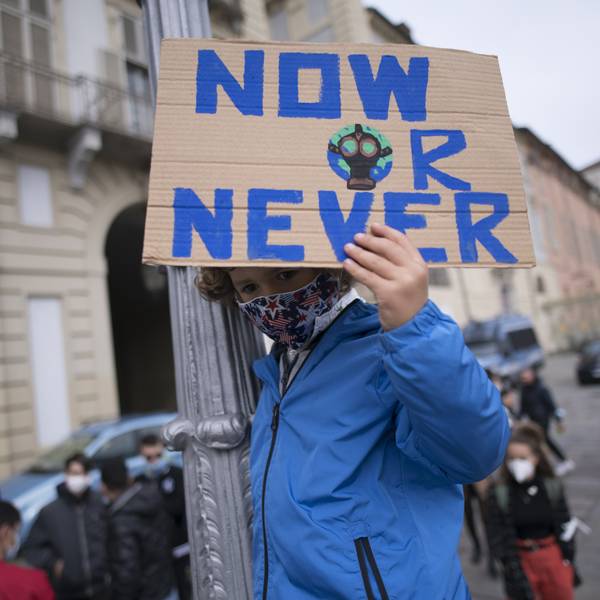

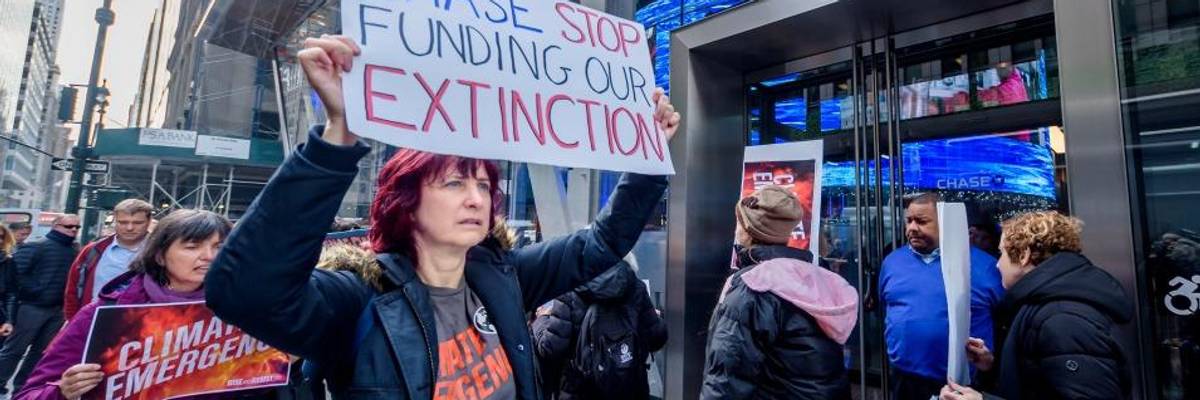
Protesters picket outside a Chase Bank branch in November 2019. An Extinction Rebellion campaigner released a leaked document from the bank Thursday in which JP Morgan Chase economists warned the company's investment in fossil fuels is contributing to the climate crisis. (Photo: Erik McGregor/LightRocket via Getty Images)
JP Morgan Economists Warn of 'Catastrophic Outcomes' of Human-Caused Climate Crisis
"Don't want to hear Greta Thunberg or Extinction Rebellion? Try J.P. Morgan instead."
Climate campaigners on Friday expressed hope that policymakers who are stalling on taking decisive climate action would reconsider their stance in light of new warnings from an unlikely source: two economists at J.P. Morgan Chase.
Extinction Rebellion spokesperson Rupert Read revealed Thursday that he had obtained a report, entitled "Risky Business: Climate and the Macroeconomy," by J.P. Morgan economists David Mackie and Jessica Murray. The report issued warnings to bank clients similar to those promoted by climate action groups--describing extreme weather events and global conditions that could result from the continued extraction of fossil fuels.
In doing so, the economists implicated the bank's own investment activities in the potentially catastrophic effects of the climate crisis.
J.P. Morgan is the world's largest financial backer of fossil fuel companies, helping to fund fracking, pipeline projects, and Arctic oil and gas exploration. The company has contributed $75 billion to such projects since the Paris climate agreement was forged in 2015. The agreement called on governments to reduce fossil fuel emissions to help limit global heating to 1.5deg Celsius above pre-industrial temperatures.
If activities like the ones funded by J.P. Morgan continue to release fossil fuels into the atmosphere, Murray and Mackie wrote, "We cannot rule out catastrophic outcomes where human life as we know it is threatened."
Failing to move away from global systems that scientists agree are causing the planet to warm "would likely push the Earth to a place that we haven't seen for many millions of years," they added.
On Twitter, Read pointed out the incongruity of such "radical truth-telling" coming from J.P. Morgan.
Others highlighted the report as one that might catch the attention of others in the financial services industry and people who believe bold climate action is a cause embraced by a minority of extremists.
"Hardly a bank you could call communist now, is it?" tweeted journalist Dom Phillips.
Citing reports by the International Monetary Fund (IMF) and the Intergovernmental Panel on Climate Change (IPCC), the authors note that with the status quo kept in place, the planet is expected to reach a temperature 3.5deg above pre-industrial levels.
In addition to major impacts on the world economy, the authors wrote, the climate crisis will affect human health, water supplies, and migration.
The report comes just weeks after CNBC host Jim Cramer announced fossil fuel investments are "in the death knell phase" and that "the world's turned on" the industry as it did on tobacco as understanding grew about the risks of smoking.
"It is clear that the Earth is on an unsustainable trajectory," reads the report. "Something will have to change at some point if the human race is going to survive."
The authors advocated for a global carbon tax but said, "This is not going to happen anytime soon" and called the continued investment in climate-warming fossil fuels a global problem with "no global solution...in sight."
Bill McKibben, co-founder of 350.org, suggested that as one solution, the economists "might want to talk with the Chase bankers who are guaranteeing [climate catastrophe] will happen by lending oil companies endless cash."
Activist Becky Brunton said the report offers the latest evidence that those with the power to stop supporting fossil fuel projects are fully aware of the damage their investments are doing to the planet.
"They know. They ALL know," tweeted Brunton. "But the now (profits) outweighs the future (earth)."
We are at a crossroads
This country and this world are at a monumental crossroads. In a few short weeks, US voters will have an opportunity to beat back the forces of fascism and confront the billionaires who are rigging the economy, our media system, and our democracy, making it increasingly impossible for ordinary people to get by. We’re not just talking about the election. We’re talking about what must be done once these fascist elements are vanquished from power. We need a bolder set of solutions than what either major party has so far been willing to offer and a working-class movement ready to fight like hell for it. Trump didn't emerge from nowhere. The conditions that fueled MAGA authoritarianism were created by decades of radical neoliberal economic policies and a corrupt political system dominated by corporate interests. They slashed taxes on the super-rich, promising that the benefits would trickle down. They said giveaways to the corporate titans would make life more affordable for the rest of us. It was all bullshit. And when a bitter, betrayed populace searches for someone to blame, right-wing demagogues have little trouble finding scapegoats. People know when they're being lied to, but you won't hear any of this from the corporate media. Only independent journalism—powered and funded by people who believe in building a better world—can deliver truly trustworthy daily news. Our Fall Campaign is underway, and we need your help. To power our newsroom through the rest of the year, we need to raise $125,000 by midnight on October 31. So if you share our vision, please contribute whatever you can to sustain our work. |
Climate campaigners on Friday expressed hope that policymakers who are stalling on taking decisive climate action would reconsider their stance in light of new warnings from an unlikely source: two economists at J.P. Morgan Chase.
Extinction Rebellion spokesperson Rupert Read revealed Thursday that he had obtained a report, entitled "Risky Business: Climate and the Macroeconomy," by J.P. Morgan economists David Mackie and Jessica Murray. The report issued warnings to bank clients similar to those promoted by climate action groups--describing extreme weather events and global conditions that could result from the continued extraction of fossil fuels.
In doing so, the economists implicated the bank's own investment activities in the potentially catastrophic effects of the climate crisis.
J.P. Morgan is the world's largest financial backer of fossil fuel companies, helping to fund fracking, pipeline projects, and Arctic oil and gas exploration. The company has contributed $75 billion to such projects since the Paris climate agreement was forged in 2015. The agreement called on governments to reduce fossil fuel emissions to help limit global heating to 1.5deg Celsius above pre-industrial temperatures.
If activities like the ones funded by J.P. Morgan continue to release fossil fuels into the atmosphere, Murray and Mackie wrote, "We cannot rule out catastrophic outcomes where human life as we know it is threatened."
Failing to move away from global systems that scientists agree are causing the planet to warm "would likely push the Earth to a place that we haven't seen for many millions of years," they added.
On Twitter, Read pointed out the incongruity of such "radical truth-telling" coming from J.P. Morgan.
Others highlighted the report as one that might catch the attention of others in the financial services industry and people who believe bold climate action is a cause embraced by a minority of extremists.
"Hardly a bank you could call communist now, is it?" tweeted journalist Dom Phillips.
Citing reports by the International Monetary Fund (IMF) and the Intergovernmental Panel on Climate Change (IPCC), the authors note that with the status quo kept in place, the planet is expected to reach a temperature 3.5deg above pre-industrial levels.
In addition to major impacts on the world economy, the authors wrote, the climate crisis will affect human health, water supplies, and migration.
The report comes just weeks after CNBC host Jim Cramer announced fossil fuel investments are "in the death knell phase" and that "the world's turned on" the industry as it did on tobacco as understanding grew about the risks of smoking.
"It is clear that the Earth is on an unsustainable trajectory," reads the report. "Something will have to change at some point if the human race is going to survive."
The authors advocated for a global carbon tax but said, "This is not going to happen anytime soon" and called the continued investment in climate-warming fossil fuels a global problem with "no global solution...in sight."
Bill McKibben, co-founder of 350.org, suggested that as one solution, the economists "might want to talk with the Chase bankers who are guaranteeing [climate catastrophe] will happen by lending oil companies endless cash."
Activist Becky Brunton said the report offers the latest evidence that those with the power to stop supporting fossil fuel projects are fully aware of the damage their investments are doing to the planet.
"They know. They ALL know," tweeted Brunton. "But the now (profits) outweighs the future (earth)."