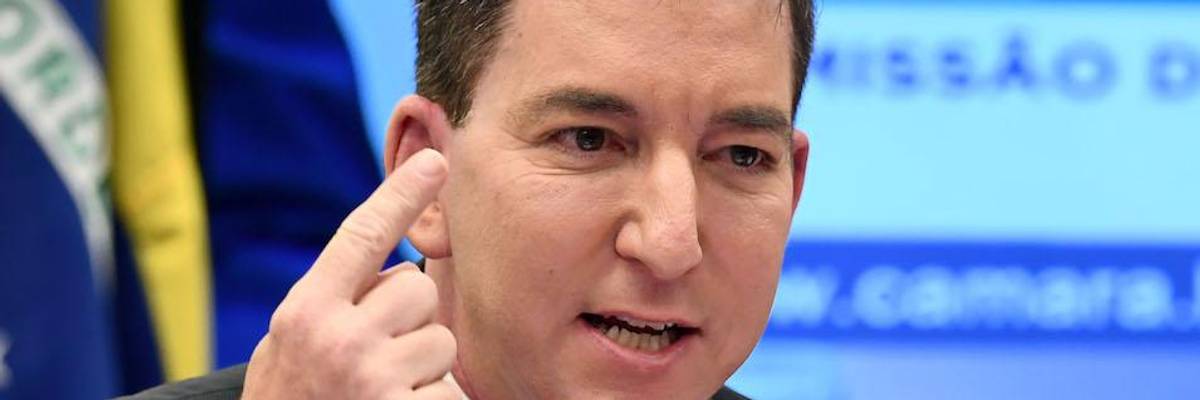
Glenn Greenwald, founder and editor of The Intercept, gestures during a hearing at the Lower House's Human Rights Commission in Brasilia, Brazil, on June 25, 2019. (Photo: Evaristo Sa/AFP/Getty Images)
'A Brutal Violation of Press Freedom': Glenn Greenwald Targeted With Investigation by Brazilian Government After Reporting on Corruption
"Criminally investigating journalist Glenn Greenwald for reporting on corruption within the Bolsonaro government is a shocking violation of his rights as a reporter."
The Brazilian government is targeting one of its biggest critics, journalist Glenn Greenwald, in a move that has been decried by observers as an intimidation tactic designed to stifle opposition to right-wing President Jair Bolsonaro.
The government's finance ministry's money laundering unit was asked by federal police to investigate Greenwald's finances, O Antagonista reported Tuesday. The right-wing Brazilian news site said that the investigation would focus on whether Greenwald paid for access to leaked records he used in reporting on the Bolsonaro government's "Operation Car Wash" sting.
"If there is an investigation for doing journalism it is illegal and it is an attempt at intimidation," University of Sao Paulo law professor Pierpaolo Bottini told The Guardian.
Attacks on Greenwald and his family, including husband David Miranda, a member of Brazil's Congress, were criticized by U.N. and Organization of American States (OAS) Edison Lanza and David Kaye. In a joint press release, Lanza and Kaye called on Brazil "to conduct an exhaustive, effective, and impartial investigation on the threats against the journalist and his family."
"The Special Rapporteurs remind the Brazilian State that it has an obligation to prevent, protect, investigate, and punish violence against journalists, particularly those who have been subjected to harassment and threats or other acts of violence," the rapporteurs' statement said.
Greenwald, co-founder of independent news organization The Intercept, published in the online magazine's Brazilian edition a number of investigations that use leaked documents to prove that the prosecution of former President Lula da Silva for corruption was steered by now Justice Minister Sergio Moro. The reporting has impacted Brazil's politics and thrown the Bolsonaro presidency into crisis.
Given the impact of the reporting, said Jose Guimaraes, a congressman who is a member of da Silva's Workers' Party, the investigation appears to be "a brutal violation of press freedom."
That point was echoed by Trevor Timm of the Freedom of the Press Foundation. In a statement, Timm said that an investigation into Greenwald would be "not only an outrageous attack on press freedom, but a gross abuse of power."
"Criminally investigating journalist Glenn Greenwald for reporting on corruption within the Bolsonaro government is a shocking violation of his rights as a reporter," Timm said. "Worse, the same person who is the primary subject of The Intercept's reporting--Minister of Justice Sergio Moro--would also have ultimate authority over any Federal Police investigation."
The fallout from Greenwald's reporting is having a major affect on Brazilian politics. On Tuesday, Moro appeared in front of the Brazilian Congress to answer questions on "Operation Car Wash" in a hearing that devolved at one point into near-violence.
Greenwald, who spoke to the lower house of Brazil's Congress about his reporting in June, was invited this week to testify in front of the Brazilian Senate. A date for that testimony has yet to be set.
We are at a crossroads
This country and this world are at a monumental crossroads. In a few short weeks, US voters will have an opportunity to beat back the forces of fascism and confront the billionaires who are rigging the economy, our media system, and our democracy, making it increasingly impossible for ordinary people to get by. We’re not just talking about the election. We’re talking about what must be done once these fascist elements are vanquished from power. We need a bolder set of solutions than what either major party has so far been willing to offer and a working-class movement ready to fight like hell for it. Trump didn't emerge from nowhere. The conditions that fueled MAGA authoritarianism were created by decades of radical neoliberal economic policies and a corrupt political system dominated by corporate interests. They slashed taxes on the super-rich, promising that the benefits would trickle down. They said giveaways to the corporate titans would make life more affordable for the rest of us. It was all bullshit. And when a bitter, betrayed populace searches for someone to blame, right-wing demagogues have little trouble finding scapegoats. People know when they're being lied to, but you won't hear any of this from the corporate media. Only independent journalism—powered and funded by people who believe in building a better world—can deliver truly trustworthy daily news. Our Fall Campaign is underway, and we need your help. To power our newsroom through the rest of the year, we need to raise $125,000 by midnight on October 31. So if you share our vision, please contribute whatever you can to sustain our work. |
The Brazilian government is targeting one of its biggest critics, journalist Glenn Greenwald, in a move that has been decried by observers as an intimidation tactic designed to stifle opposition to right-wing President Jair Bolsonaro.
The government's finance ministry's money laundering unit was asked by federal police to investigate Greenwald's finances, O Antagonista reported Tuesday. The right-wing Brazilian news site said that the investigation would focus on whether Greenwald paid for access to leaked records he used in reporting on the Bolsonaro government's "Operation Car Wash" sting.
"If there is an investigation for doing journalism it is illegal and it is an attempt at intimidation," University of Sao Paulo law professor Pierpaolo Bottini told The Guardian.
Attacks on Greenwald and his family, including husband David Miranda, a member of Brazil's Congress, were criticized by U.N. and Organization of American States (OAS) Edison Lanza and David Kaye. In a joint press release, Lanza and Kaye called on Brazil "to conduct an exhaustive, effective, and impartial investigation on the threats against the journalist and his family."
"The Special Rapporteurs remind the Brazilian State that it has an obligation to prevent, protect, investigate, and punish violence against journalists, particularly those who have been subjected to harassment and threats or other acts of violence," the rapporteurs' statement said.
Greenwald, co-founder of independent news organization The Intercept, published in the online magazine's Brazilian edition a number of investigations that use leaked documents to prove that the prosecution of former President Lula da Silva for corruption was steered by now Justice Minister Sergio Moro. The reporting has impacted Brazil's politics and thrown the Bolsonaro presidency into crisis.
Given the impact of the reporting, said Jose Guimaraes, a congressman who is a member of da Silva's Workers' Party, the investigation appears to be "a brutal violation of press freedom."
That point was echoed by Trevor Timm of the Freedom of the Press Foundation. In a statement, Timm said that an investigation into Greenwald would be "not only an outrageous attack on press freedom, but a gross abuse of power."
"Criminally investigating journalist Glenn Greenwald for reporting on corruption within the Bolsonaro government is a shocking violation of his rights as a reporter," Timm said. "Worse, the same person who is the primary subject of The Intercept's reporting--Minister of Justice Sergio Moro--would also have ultimate authority over any Federal Police investigation."
The fallout from Greenwald's reporting is having a major affect on Brazilian politics. On Tuesday, Moro appeared in front of the Brazilian Congress to answer questions on "Operation Car Wash" in a hearing that devolved at one point into near-violence.
Greenwald, who spoke to the lower house of Brazil's Congress about his reporting in June, was invited this week to testify in front of the Brazilian Senate. A date for that testimony has yet to be set.