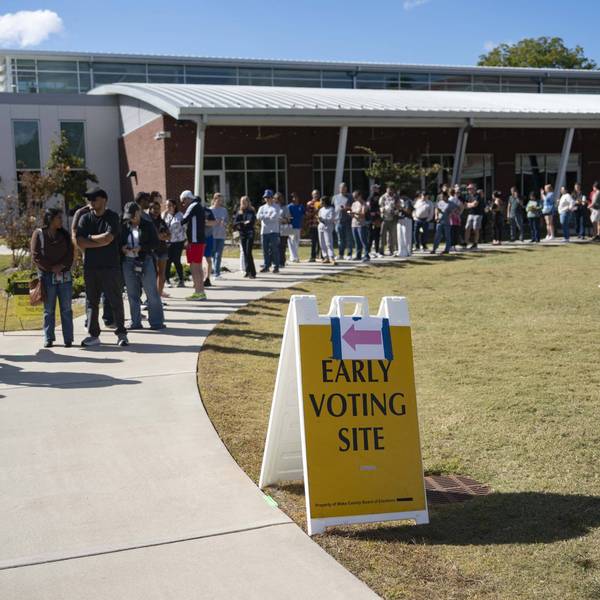
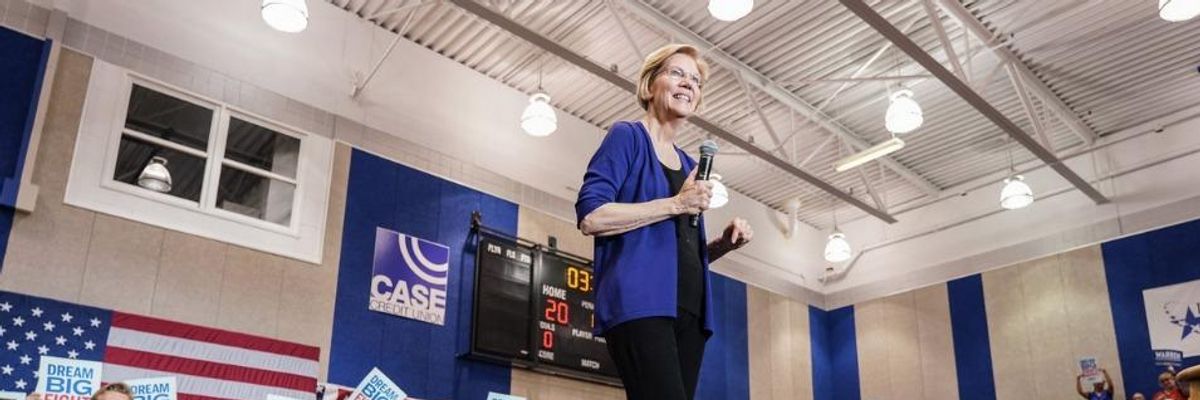
Sen. Elizabeth Warren announced a plan on Tuesday to "strengthen our democracy" by expanding voting access and boosting election security. (Photo: @ewarren/Twitter)
Warren Wins Praise for Plan to End 'Rigged Game' Plaguing US Elections by Expanding Voting Rights and Improving Security
"Our democracy shouldn't be about keeping people out—it should strive to bring everyone to the polls."
Sen. Elizabeth Warren unveiled on Tuesday her plan to reform the United States' electoral system--a vision that one observer wrote would "totally transform" U.S. elections by making them far more accessible and equitable for all Americans.
In an email to supporters and a post at Medium, Warren announced her latest policy proposal "to strengthen our democracy." The plan includes provisions to outlaw gerrymandering, pass a constitutional amendment guaranteeing the right to vote, update and standardize states' voting systems, and make it easier for Americans to vote by declaring Election Day a federal holiday and expanding access through other reforms.
The reforms would force the government to stop treating voting "like it's one of the least important things we do," the Massachusetts Democrat wrote.
"Democracy hangs on the idea that whoever gets the most votes wins," she added. "Politicians are supposed to compete over how many voters they can persuade, not how many they can disqualify or demoralize. And we have a solemn obligation to secure our elections from those who would try to undermine them. That's why the Constitution gives Congress the tools to regulate the administration of federal elections. It's time to pick up those tools and use them."
The plan builds on proposals within H.R. 1, the House Democrats' sweeping pro-democracy and anti-corruption legislation, Think Progress reporter Ian Millhiser noted.
"What sets Warren's plan apart is the sophisticated mechanisms she uses to insulate voting reforms from state officials hostile to voting rights," he wrote.
Under her plan, Warren would ensure enforcement of the new measures through federal authority as well as incentives for states. Under the proposal, the federal government would pay the entirety of state election costs if states comply with federal security standards and work to make voting easier.
States that violate provisions for federal elections under Warren's plan and continue to suppress voting rights would face a newly created federal agency, the Secure Democracy Administration, which would be empowered to seek a court order to ensure everyone in the state has access to the polls.
Other observers on social media also applauded the proposal:
Calling the myriad methods states use to keep track of registered voters "laughably" outdated and vulnerable to attacks, Warren decried a national electoral system in which the majority of voter databases are more than a decade old, several states require no post-election audits, and paperless machines make it impossible for election officials to verify results.
"Our elections should be as secure as Fort Knox. But instead, they're less secure than your Amazon account," wrote Warren.
Under a Warren administration, automatic and same-day voter registration would be mandated throughout the nation. Election Day would be made a federal holiday to expand access for people who have trouble getting to the polls due to work, and early voting and voting by mail would be available to every voter to make casting ballots as easy as possible for anyone who may still be unable to make it to their polling station.
States would also be barred from purging voters from their rolls unless a voter has died, moved to a new state, or explicitly asked to be removed.
"Our democracy shouldn't be about keeping people out--it should strive to bring everyone to the polls," Warren said. "Enough is enough. It is time to make high-quality voting in the greatest democracy in the world easy, convenient, and professional."
To stop political parties and groups from amassing power by redrawing districts, Warren would require states to use independent redistricting commissions.
"Both parties should compete on a level playing field; not in a rigged game designed to suppress the will of the people," Warren wrote.
As with some of her other policy proposals aimed at serving the public, Warren plans to pay for the electoral system overhaul with revenue from her Ultra-Millionaires Tax. The senator estimated that her plan would require a $20 billion investment over 10 years.
"Our democracy is too important for it to be under-resourced and insecure," wrote Warren. "We need to do everything we can to make sure our elections are convenient, professional, and secure--and we should be willing to pay for it."
We are at a crossroads
This country and this world are at a monumental crossroads. US voters have an opportunity to beat back the forces of fascism and confront the billionaires who are rigging the economy, our media system, and our democracy, making it increasingly impossible for ordinary people to get by. We’re not just talking about the election. We’re talking about what must be done once these fascist elements are vanquished from power. We need a bolder set of solutions than what either major party has so far been willing to offer and a working-class movement ready to fight like hell for it. Trump didn't emerge from nowhere. The conditions that fueled MAGA authoritarianism were created by decades of radical neoliberal economic policies and a corrupt political system dominated by corporate interests. They slashed taxes on the super-rich, promising that the benefits would trickle down. They said giveaways to the corporate titans would make life more affordable for the rest of us. It was all bullshit. And when a bitter, betrayed populace searches for someone to blame, right-wing demagogues have little trouble finding scapegoats. People know when they're being lied to, but you won't hear any of this from the corporate media. Only independent journalism—powered and funded by people who believe in building a better world—can deliver truly trustworthy daily news. Our Fall Campaign is underway, and we need your help. To power our newsroom through the rest of the year, we need to raise $125,000 by midnight on October 31. So if you share our vision, please contribute whatever you can to sustain our work. |
Sen. Elizabeth Warren unveiled on Tuesday her plan to reform the United States' electoral system--a vision that one observer wrote would "totally transform" U.S. elections by making them far more accessible and equitable for all Americans.
In an email to supporters and a post at Medium, Warren announced her latest policy proposal "to strengthen our democracy." The plan includes provisions to outlaw gerrymandering, pass a constitutional amendment guaranteeing the right to vote, update and standardize states' voting systems, and make it easier for Americans to vote by declaring Election Day a federal holiday and expanding access through other reforms.
The reforms would force the government to stop treating voting "like it's one of the least important things we do," the Massachusetts Democrat wrote.
"Democracy hangs on the idea that whoever gets the most votes wins," she added. "Politicians are supposed to compete over how many voters they can persuade, not how many they can disqualify or demoralize. And we have a solemn obligation to secure our elections from those who would try to undermine them. That's why the Constitution gives Congress the tools to regulate the administration of federal elections. It's time to pick up those tools and use them."
The plan builds on proposals within H.R. 1, the House Democrats' sweeping pro-democracy and anti-corruption legislation, Think Progress reporter Ian Millhiser noted.
"What sets Warren's plan apart is the sophisticated mechanisms she uses to insulate voting reforms from state officials hostile to voting rights," he wrote.
Under her plan, Warren would ensure enforcement of the new measures through federal authority as well as incentives for states. Under the proposal, the federal government would pay the entirety of state election costs if states comply with federal security standards and work to make voting easier.
States that violate provisions for federal elections under Warren's plan and continue to suppress voting rights would face a newly created federal agency, the Secure Democracy Administration, which would be empowered to seek a court order to ensure everyone in the state has access to the polls.
Other observers on social media also applauded the proposal:
Calling the myriad methods states use to keep track of registered voters "laughably" outdated and vulnerable to attacks, Warren decried a national electoral system in which the majority of voter databases are more than a decade old, several states require no post-election audits, and paperless machines make it impossible for election officials to verify results.
"Our elections should be as secure as Fort Knox. But instead, they're less secure than your Amazon account," wrote Warren.
Under a Warren administration, automatic and same-day voter registration would be mandated throughout the nation. Election Day would be made a federal holiday to expand access for people who have trouble getting to the polls due to work, and early voting and voting by mail would be available to every voter to make casting ballots as easy as possible for anyone who may still be unable to make it to their polling station.
States would also be barred from purging voters from their rolls unless a voter has died, moved to a new state, or explicitly asked to be removed.
"Our democracy shouldn't be about keeping people out--it should strive to bring everyone to the polls," Warren said. "Enough is enough. It is time to make high-quality voting in the greatest democracy in the world easy, convenient, and professional."
To stop political parties and groups from amassing power by redrawing districts, Warren would require states to use independent redistricting commissions.
"Both parties should compete on a level playing field; not in a rigged game designed to suppress the will of the people," Warren wrote.
As with some of her other policy proposals aimed at serving the public, Warren plans to pay for the electoral system overhaul with revenue from her Ultra-Millionaires Tax. The senator estimated that her plan would require a $20 billion investment over 10 years.
"Our democracy is too important for it to be under-resourced and insecure," wrote Warren. "We need to do everything we can to make sure our elections are convenient, professional, and secure--and we should be willing to pay for it."