SUBSCRIBE TO OUR FREE NEWSLETTER
Daily news & progressive opinion—funded by the people, not the corporations—delivered straight to your inbox.
5
#000000
#FFFFFF
To donate by check, phone, or other method, see our More Ways to Give page.
Daily news & progressive opinion—funded by the people, not the corporations—delivered straight to your inbox.
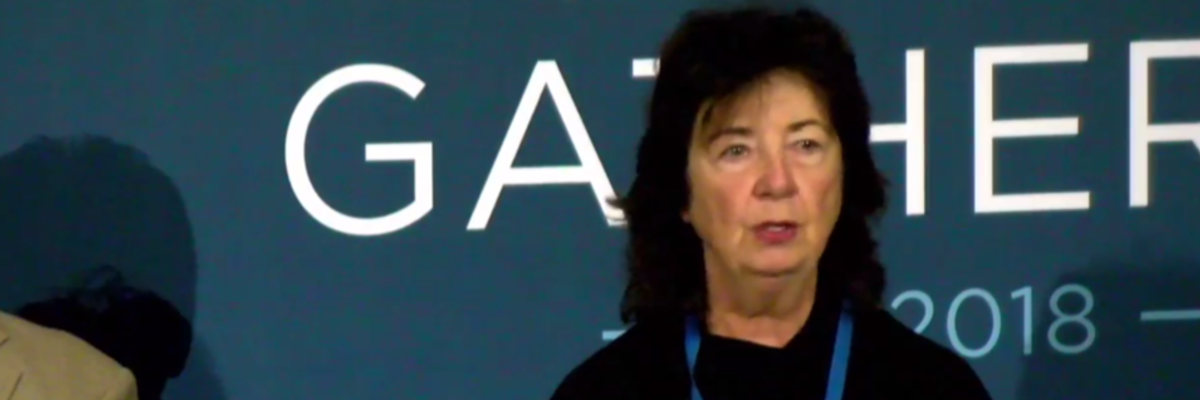
Labor leader RoseAnn DeMoro, former executive director of National Nurses United, during a panel discussion titled, "The Labor Movement: Essential to Democracy" at The Sanders Institute Gathering on Saturday. (Photo: Screengrab/The Sanders Institute Gathering)
BURLINGTON, VT. -- With the American labor movement under relentless assault by the right-wing Supreme Court, the Republican Party at both the state and federal level, and President Donald Trump's plutocratic administration, prominent union leaders convened during the final day of The Sanders Institute Gathering on Saturday to confront the existential threat facing the working class and emphasize the urgency of organizing at the grassroots level to fight back and build political power.
" Unions and the working class need to be political as hell. Last time I checked, the Koch brothers are political as hell, Wall Street is political is hell."
--Mark Dimondstein, American Postal Workers Union
"The working class is hurting, and they're done with business as usual," Mark Dimondstein, president of the American Postal Workers Union, declared during a panel discussion titled, "The Labor Movement: Essential to Democracy."
Moderated by RoseAnn DeMoro--former executive director of National Nurses United (NNU)--the panel of progressive union leaders attributed Trump's presidential victory to the Democratic Party's decades-long corporate turn and abandonment of the working class, which left a gaping void that the billionaire real estate mogul exploited in his rise to power.
The result, Dimondstein argued, was "a lesser of two evils duopoly"--two dominant political parties that side with the interests of business over those of the working class.
"Political parties have failed, absolutely failed, the working class," Dimondstein said.
To begin rebuilding the labor movement in the face of the ceaseless assault from right-wing politicians and their billionaire benefactors, Good Jobs Nation executive director Joseph Geevarghese argued that the tepid centrism and incremental solutions offered by the Democratic establishment will not cut it.
"We don't need more centrism. We don't need more half-baked economic ideas," Geevarghese said during the panel discussion, which also included Peter Knowlton, general president of United Electrical, Radio, and Machine Workers of America.
"We need more full-throated economic populism," Geevarghese continued. "We need to make sure that we grow the American labor movement."
As the panelists readily acknowledged, the present state of organized labor is grim, particularly after the Supreme Court's Janus ruling, which dealt a major blow to public-sector unions. According to the most recent government data, just over 10 percent of American workers are union members--an all-time low.
"The labor movement isn't just people who are in unions, it's all of us."
-- RoseAnn DeMoro
But there are plenty of bright spots, such as radicalized teachers unions striking to combat budget cuts and demanding fair pay nationwide, nurses leading the grassroots fight for Medicare for All, and workers throughout the country organizing for a $15 minimum wage.
"Working people are the most powerful force on Earth," said DeMoro, who retired this year as executive director of NNU, the largest nurses union in the United States. "The labor movement isn't just people who are in unions, it's all of us."
In order to defeat the corporate forces hellbent on completely eliminating workers' right to organize and bargain collectively for better wages and conditions, Dimondstein of the Postal Workers Union argued the working class must become as organized and political as the business elites it is combating.
"Unions and the working class need to be political as hell," Dimondstein concluded. "Last time I checked, the Koch brothers are political as hell, Wall Street is political is hell... We have to be political."
Watch the full panel discussion, which closed with a rousing group performance of Solidarity Forever, the union anthem by Ralph Chaplin, the iconic labor activist:
Dear Common Dreams reader, It’s been nearly 30 years since I co-founded Common Dreams with my late wife, Lina Newhouser. We had the radical notion that journalism should serve the public good, not corporate profits. It was clear to us from the outset what it would take to build such a project. No paid advertisements. No corporate sponsors. No millionaire publisher telling us what to think or do. Many people said we wouldn't last a year, but we proved those doubters wrong. Together with a tremendous team of journalists and dedicated staff, we built an independent media outlet free from the constraints of profits and corporate control. Our mission has always been simple: To inform. To inspire. To ignite change for the common good. Building Common Dreams was not easy. Our survival was never guaranteed. When you take on the most powerful forces—Wall Street greed, fossil fuel industry destruction, Big Tech lobbyists, and uber-rich oligarchs who have spent billions upon billions rigging the economy and democracy in their favor—the only bulwark you have is supporters who believe in your work. But here’s the urgent message from me today. It's never been this bad out there. And it's never been this hard to keep us going. At the very moment Common Dreams is most needed, the threats we face are intensifying. We need your support now more than ever. We don't accept corporate advertising and never will. We don't have a paywall because we don't think people should be blocked from critical news based on their ability to pay. Everything we do is funded by the donations of readers like you. When everyone does the little they can afford, we are strong. But if that support retreats or dries up, so do we. Will you donate now to make sure Common Dreams not only survives but thrives? —Craig Brown, Co-founder |
BURLINGTON, VT. -- With the American labor movement under relentless assault by the right-wing Supreme Court, the Republican Party at both the state and federal level, and President Donald Trump's plutocratic administration, prominent union leaders convened during the final day of The Sanders Institute Gathering on Saturday to confront the existential threat facing the working class and emphasize the urgency of organizing at the grassroots level to fight back and build political power.
" Unions and the working class need to be political as hell. Last time I checked, the Koch brothers are political as hell, Wall Street is political is hell."
--Mark Dimondstein, American Postal Workers Union
"The working class is hurting, and they're done with business as usual," Mark Dimondstein, president of the American Postal Workers Union, declared during a panel discussion titled, "The Labor Movement: Essential to Democracy."
Moderated by RoseAnn DeMoro--former executive director of National Nurses United (NNU)--the panel of progressive union leaders attributed Trump's presidential victory to the Democratic Party's decades-long corporate turn and abandonment of the working class, which left a gaping void that the billionaire real estate mogul exploited in his rise to power.
The result, Dimondstein argued, was "a lesser of two evils duopoly"--two dominant political parties that side with the interests of business over those of the working class.
"Political parties have failed, absolutely failed, the working class," Dimondstein said.
To begin rebuilding the labor movement in the face of the ceaseless assault from right-wing politicians and their billionaire benefactors, Good Jobs Nation executive director Joseph Geevarghese argued that the tepid centrism and incremental solutions offered by the Democratic establishment will not cut it.
"We don't need more centrism. We don't need more half-baked economic ideas," Geevarghese said during the panel discussion, which also included Peter Knowlton, general president of United Electrical, Radio, and Machine Workers of America.
"We need more full-throated economic populism," Geevarghese continued. "We need to make sure that we grow the American labor movement."
As the panelists readily acknowledged, the present state of organized labor is grim, particularly after the Supreme Court's Janus ruling, which dealt a major blow to public-sector unions. According to the most recent government data, just over 10 percent of American workers are union members--an all-time low.
"The labor movement isn't just people who are in unions, it's all of us."
-- RoseAnn DeMoro
But there are plenty of bright spots, such as radicalized teachers unions striking to combat budget cuts and demanding fair pay nationwide, nurses leading the grassroots fight for Medicare for All, and workers throughout the country organizing for a $15 minimum wage.
"Working people are the most powerful force on Earth," said DeMoro, who retired this year as executive director of NNU, the largest nurses union in the United States. "The labor movement isn't just people who are in unions, it's all of us."
In order to defeat the corporate forces hellbent on completely eliminating workers' right to organize and bargain collectively for better wages and conditions, Dimondstein of the Postal Workers Union argued the working class must become as organized and political as the business elites it is combating.
"Unions and the working class need to be political as hell," Dimondstein concluded. "Last time I checked, the Koch brothers are political as hell, Wall Street is political is hell... We have to be political."
Watch the full panel discussion, which closed with a rousing group performance of Solidarity Forever, the union anthem by Ralph Chaplin, the iconic labor activist:
BURLINGTON, VT. -- With the American labor movement under relentless assault by the right-wing Supreme Court, the Republican Party at both the state and federal level, and President Donald Trump's plutocratic administration, prominent union leaders convened during the final day of The Sanders Institute Gathering on Saturday to confront the existential threat facing the working class and emphasize the urgency of organizing at the grassroots level to fight back and build political power.
" Unions and the working class need to be political as hell. Last time I checked, the Koch brothers are political as hell, Wall Street is political is hell."
--Mark Dimondstein, American Postal Workers Union
"The working class is hurting, and they're done with business as usual," Mark Dimondstein, president of the American Postal Workers Union, declared during a panel discussion titled, "The Labor Movement: Essential to Democracy."
Moderated by RoseAnn DeMoro--former executive director of National Nurses United (NNU)--the panel of progressive union leaders attributed Trump's presidential victory to the Democratic Party's decades-long corporate turn and abandonment of the working class, which left a gaping void that the billionaire real estate mogul exploited in his rise to power.
The result, Dimondstein argued, was "a lesser of two evils duopoly"--two dominant political parties that side with the interests of business over those of the working class.
"Political parties have failed, absolutely failed, the working class," Dimondstein said.
To begin rebuilding the labor movement in the face of the ceaseless assault from right-wing politicians and their billionaire benefactors, Good Jobs Nation executive director Joseph Geevarghese argued that the tepid centrism and incremental solutions offered by the Democratic establishment will not cut it.
"We don't need more centrism. We don't need more half-baked economic ideas," Geevarghese said during the panel discussion, which also included Peter Knowlton, general president of United Electrical, Radio, and Machine Workers of America.
"We need more full-throated economic populism," Geevarghese continued. "We need to make sure that we grow the American labor movement."
As the panelists readily acknowledged, the present state of organized labor is grim, particularly after the Supreme Court's Janus ruling, which dealt a major blow to public-sector unions. According to the most recent government data, just over 10 percent of American workers are union members--an all-time low.
"The labor movement isn't just people who are in unions, it's all of us."
-- RoseAnn DeMoro
But there are plenty of bright spots, such as radicalized teachers unions striking to combat budget cuts and demanding fair pay nationwide, nurses leading the grassroots fight for Medicare for All, and workers throughout the country organizing for a $15 minimum wage.
"Working people are the most powerful force on Earth," said DeMoro, who retired this year as executive director of NNU, the largest nurses union in the United States. "The labor movement isn't just people who are in unions, it's all of us."
In order to defeat the corporate forces hellbent on completely eliminating workers' right to organize and bargain collectively for better wages and conditions, Dimondstein of the Postal Workers Union argued the working class must become as organized and political as the business elites it is combating.
"Unions and the working class need to be political as hell," Dimondstein concluded. "Last time I checked, the Koch brothers are political as hell, Wall Street is political is hell... We have to be political."
Watch the full panel discussion, which closed with a rousing group performance of Solidarity Forever, the union anthem by Ralph Chaplin, the iconic labor activist: