

SUBSCRIBE TO OUR FREE NEWSLETTER
Daily news & progressive opinion—funded by the people, not the corporations—delivered straight to your inbox.
5
#000000
#FFFFFF
To donate by check, phone, or other method, see our More Ways to Give page.
Nearly 30,000 oil and gas wells in California sit within 3,200 feet of sensitive land, exposing the health and safety of nearly 3 million innocent Californians. These wells are disproportionately placed in communities of color, and their emissions can cause birth defects, respiratory illnesses, and even cancer. In 2021, an independent scientific advisory panel advised California officials that a 3,200-foot setback between oil wells and sensitive receptors is the minimum distance to protect public health.
In California, we have shattered the illusion that profit should outweigh the health and safety of our people. Our collective voice has risen above that of the oil industry, proclaiming that our lives are not negotiable commodities.
In the face of these stark realities, California Senate Bill (SB)1137 emerged as a beacon of hope—a legislative effort to establish a health and safety buffer zone between oil operations and communities. This bill aimed to safeguard public health and the environment by imposing sensible setbacks, ensuring that our neighborhoods are no longer sacrificed for corporate gain. However, the road to implementing this crucial legislation was blocked when the drillers put a referendum on the ballot to overturn the law and undo the will of the people.
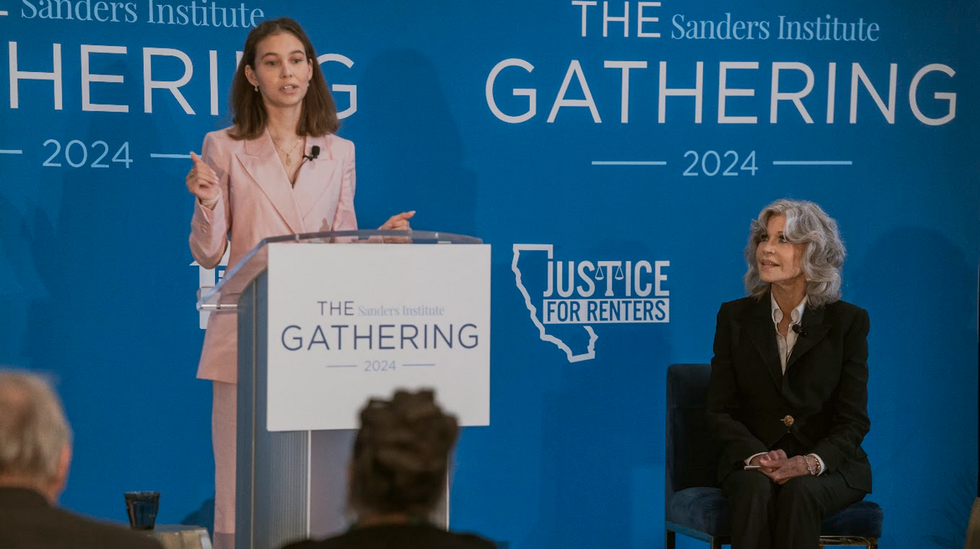 Climate activists Nalleli Cobo and Jane Fonda speaking at the Sanders Institute Gathering that took place in Los Angeles earlier this year as they discussed their fight against fossil fuel giants in California. (Photo: © Bryan Giardinelli / The Sanders Institute)
The oil industry, driven by profits and indifferent to the suffering of kids and communities, launched a relentless campaign against SB 1137. Pouring a staggering $61 million into efforts to overturn the law, they sought to drown out our voices with misleading campaigns and political maneuvers. Their deep pockets funded a barrage of advertisements, lobbyists, and deceptive rhetoric aimed at undermining the very protections that our communities won and desperately need.
But we refused to be silenced. Armed with determination and unwavering resolve, we mobilized grassroots movements, rallied community support, and engaged lawmakers to stand firm against industry pressure. Our collective advocacy turned the tide, demonstrating that people power can triumph over corporate interests. Despite the formidable opposition, SB 1137 stood strong, embodying our unwavering commitment to justice and public health.
My childhood was stolen by the impacts of the fossil industry, and they cast a shadow over my future. I fight every day to ensure that my story will end with me.
My personal journey into activism was fueled by firsthand experience—the profound impact of living 30 feet away from an active oil and gas well that poisoned my health and threatened my future. This intimate connection to the issue ignited a fire within me, propelling me into advocacy at a young age. The diagnosis of stage 2 reproductive cancer at 19 was a devastating consequence of this environmental injustice—a reminder of the stakes in our fight. My childhood was stolen by the impacts of the fossil industry, and they cast a shadow over my future. I fight every day to ensure that my story will end with me.
Last month's victory, and Big Oil’s unconditional surrender, is not just about legislative success; it is a testament to the resilience of communities and the power of grassroots activism. It symbolizes hope for a future where our children can grow up without fear of toxic exposure and where justice prevails over corporate greed. Together, we have proven that when we unite in pursuit of a common cause, we can achieve transformative change.
As we celebrate this milestone, let us remember that our work is far from over. Big Oil has already announced plans to sue over the law, hoping to overturn our victory in the courts. We must stand together and continue defending the 3,200-foot setback law to ensure that all Californians are protected from toxic oil drilling in their neighborhoods.
Let this victory propel us forward, energized and emboldened, to continue pushing for environmental justice and equity. Let us hold steadfast in our commitment to protect our communities, our health, and our planet from the harms of industrial pollution. Let’s continue to bring the fight to Big Oil and keep them on the run.
Together, we are forging a path toward a world where every voice is heard, every life is valued, and every community thrives free from the threat of environmental harm. This victory is not the end of our journey but a pivotal step forward in the ongoing fight for a better, healthier future for all.
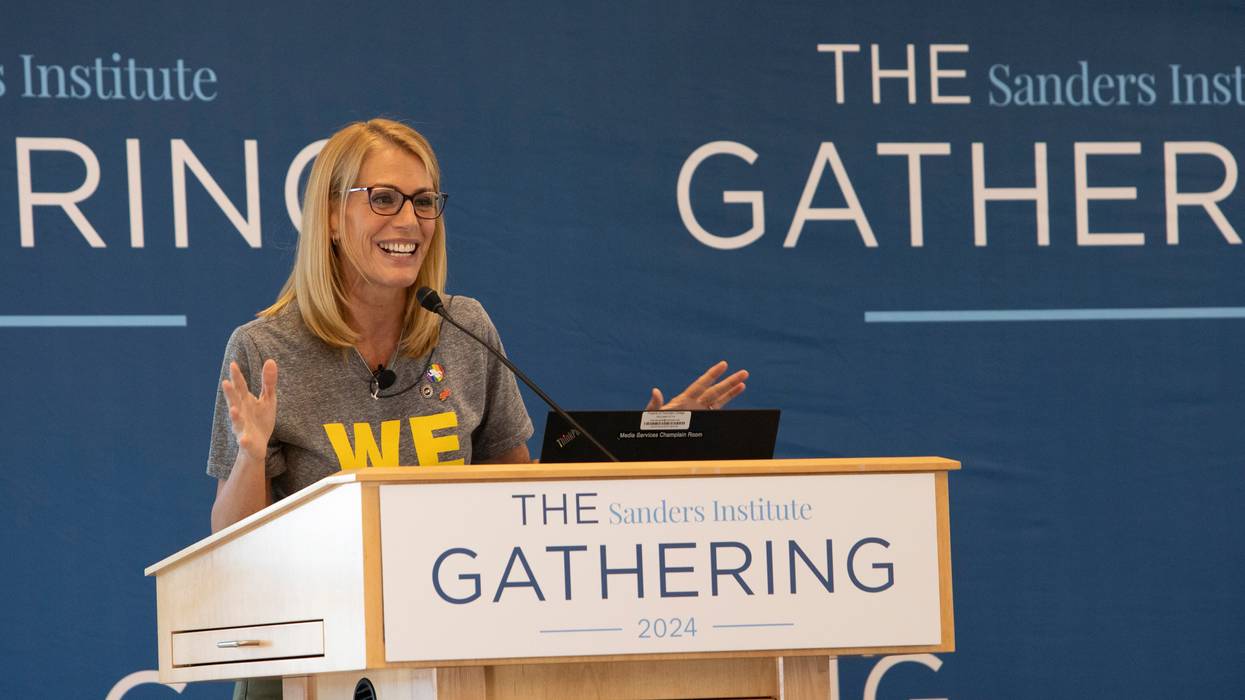
President of the Association of Flight Attendants-CWA (AFA), Nelson argues that what constitutes those specific "issues that really matter" has not changed very much since Franklin Delano Roosevelt promoted his Economic Bill of Rights nearly 80 years ago: a living wage and dignity at work, decent and affordable housing, universal healthcare, quality education for all, retirement security, and a life with recreation and leisure not just toil and labor.
"Stop doing bullshit applause lines and do real work on workers' rights." —AFA president Sara Nelson
While the Republican Party remains the chief political obstacle to achieving those goals, says Nelson—currently at the bargaining table representing her members in contract negotiations with several major airline carriers—the Democrats also have a long way to go. Meanwhile, the corporate interests that pump massive amounts of money into both major parties can only be challenged by a more cohesive and strategically-minded working class.
"Democrats in general," she says, "need to get back to talking about that Economic Bill of Rights fundamentally across the board. And that is what is going to attract people to the party—not just talking about it, but fighting for it and having actual demands."
In a series of discussions during and after The Sanders Institute Gathering that took place in Burlington, Vermont on the first weekend of June, Nelson explained how being "pro-labor," regardless of party affiliation, "has to be more than just not killing labor every single day."
"It has to be more than that," she told Common Dreams during a lengthy interview, "and it has to be more than politicians going to a rally and saying the same tired applause lines that they've been saying for 80 years—things like: 'We like labor because you gave us the 8-hour work day.'"
"I promise you, politician," she continued, "that the vast majority of people in the audience listening to you no longer have an eight-hour day. It is the same with the line about how it was labor who delivered the weekend. I promise you, the vast majority of people in the audience do not have their weekends off anymore. 'Oh, labor that gave us sick leave and vacations!' Same thing again. Stop doing bullshit applause lines and do real work on workers' rights."
In Vermont, Nelson explained to attendees at the Sanders Institute event that "the labor movement"—especially in a nation that is 90 percent non-unionized—"is the entire working class, not just people who currently have a union card."
Saru Jayaraman, a professor at the University of California, Berkeley and president of the advocacy group One Fair Wage, which she co-founded, explained to those at the Gathering how the approximately 13 million restaurant and food service workers her group represents are on the front lines of a largely non-unionized worker movement focused like a laser on improving the material conditions of individual, families, and the wider working class.
During her earlier organizing with the Restaurant Opportunity Center (ROC) in the decade after Sept. 11, 2001, Jayaraman said that workers wherever she went—"from California to the Deep South, to the Midwest, and to the Northeast"—would all say the same thing: "It's my wages, it's my wages, it's my wages."
With a new book titled "One Fair Wage: Ending Subminimum Pay in America," and state-level ballot fights for wage increases this election season in Arizona, Michigan, Ohio, Massachusetts, and elsewhere, Jayaraman says the organizing of workers making less than $15 in real wages is vital within the nation's "absolute largest" private employer sector, the restaurant and food service industry.
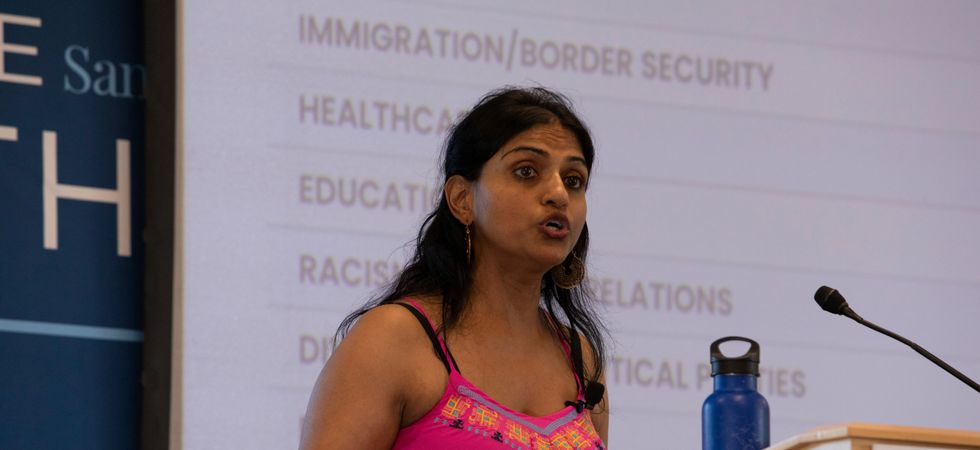 Saru Jayaraman, co-founder and president of One Fair Wage, speaking during the Gathering in Burlington, Vermont on Saturday, June 1, 2024. (Photo: Will Allen / via The Sanders Institute)
After a show of hands from audience members in Burlington who had at one point worked in a restaurant, Jayaraman reminded them how "one in two Americans has worked in the industry at some point in their lives."
"It is the largest private sector employer of women. It is the largest private sector of young people," she said. "It's the largest private sector employer of immigrants, formerly incarcerated individuals, people of color—pretty much everybody—but it is the absolute lowest-paying employer in the United States of America."
With the lobbying power of the National Restaurant Association, founded in 1919—"we call it the other NRA," Jayaraman noted—owners and investors in the food industry have generated massive profits for themselves by paying poverty wages and forcing tipped wages on their employees "for generations."
What this "other NRA" has been able to achieve over the course of its existence, she said, is ensuring that millions of restaurant workers across the country are forbidden from earning more per hour than the $2.13 that such tipped workers currently receive.
In her book, Jayaraman writes, "Subminimum wages are subhuman. They are reflection of the value America has placed on the humanity of the people" who work in those sectors.
Those receiving this paltry hourly wage, still the law in 43 U.S. states, she said in Burlington, is "not some niche group. It's where all of us worked, our kids work. It's the largest employer in America, and it gets to pay $2 an hour because we've let it."
And the current outrage among restaurant workers isn't restricted to that. In context of the Covid-19 pandemic that shook the nation and the world in 2020, Jayaraman spoke with fury about the thousands of food industry workers who "died—no, the 12,000 workers who were murdered—because they were forced to go back to work before it was safe, into an industry that the CDC named as the most dangerous place for adults to be during the pandemic."
"They died because they were poor," she roared. "For those that survived, 60% told us that tips went way down and the women, more than half of women told us harassment went way up. They said, I'm regularly asked, 'Take off your mask so I can see how cute you are before I decide how much I want to tip you.'" Reports like that from workers, she said, are endless and continue to this day.
"The only way it's going to work is that we are going to have this huge base, the ability to mobilize them, but it's got to be a thousand flowers blooming." —Saru Jayaraman, One Fair Wage
It's for these reasons and more that tipped workers are fighting for the Raise the Wage Act, a bill which passed the U.S House in 2021 but failed in the U.S. Senate despite support from Sen. Bernie Sanders (I-Vt.) and other Democrats. After House Democrats lost their House majority in 2022, Sanders reintroduced the bill in the Senate last year, but it has no hope of passing until Republican opposition is vanquished.
Again, Jayaraman pointed to the restaurant industry lobby as the key villain in the workers fight.
"They're the major opposition in every state," she said. "They're the major opposition at the federal level. And there can be no change at the federal level until we defeat the 'other NRA' and we are on our way."
What she sees in her work among non-unionized restaurant workers fighting to destroy sub-minimum wages is that it's workers that must lead.
"We are not trying to mobilize these hundreds of thousands of people in the same way," Jayaraman told Common Dreams. "The only way it's going to work is that we are going to have this huge base, the ability to mobilize them, but it's got to be a thousand flowers blooming. That is how this moment of worker power has happened."
It was workers on their own, she explained, who "started walking out of their restaurants and putting up signs saying: 'We all left. The pay is too low.' Nobody gave them a sign and trained them how to do that. There was a moment of power where they all collectively felt 'I'm worth more' and walked out."
"There's no humanity in capitalism, it's only about extracting as much profit as possible from the entire machinery, which includes human beings." —Sara Nelson
Like Jayaraman, Nelson spoke about the lessons she learned after seeing corporate bosses willing to sacrifice the safety, and even the lives, of workers at the altar of profit.
Speaking passionately about her career in the airline industry—including close colleagues killed on the hijacked planes used in the 9/11 attacks—Nelson describes the AFA as a union that centers the needs of its members but also one that recognizes its role in the broader fight for economic equality and the common good.
In the years after 2001, she saw firsthand how the industry exploited the horrific tragedy of 9/11 to undermine worker power while protecting owners and investors through a bankruptcy process.
"For me, that was real people, those were my friends and it was my friends who died too," she explained to Common Dreams. It was painful, she said, "coming to grips with the fact that there's no sympathy, there's no humanity in capitalism, it's only about extracting as much profit as possible from the entire machinery, which includes human beings."
While the union fought to protect their pensions during that time, executives were clamoring for unlimited compensation packages, Nelson recounted. It was during those battles, she said, "that I got a firsthand experience in the four D's of union busting: divide, delay, distract, and demoralize. And I saw workers go through all of those very divisive tactics."
"So the first question is, why aren't we winning? And the answer is we don't have a working-class base." —Les Leopold, Labor Institute
Joining Jayaraman and Nelson on the Sanders Institute panel focused on workers was Les Leopold, executive director of the Labor Institute and author of the new book, "Wall Street's War on Workers: How Mass Layoffs and Greed Are Destroying the Working Class and What to Do About It."
What Nelson, Jayaraman, and Leopold all argued in separate interviews with Common Dreams during and after the Gathering is that organized workers need to be at the center of fighting for their own economic well-being. A more unified and coordinated working class is also the key missing ingredient if the broader progressive agenda—from voting rights and democracy protection to the climate fight and economic battles over healthcare and housing—is ever to be won.
"There are all these organizations and we're fighting all these good fights on all these issues," Leopold said on the edge of the three-day event, referring to green groups, healthcare advocates, and organizers on a range of social justice issues gathered in Burlington. "So the first question is, why aren't we winning? And the answer is we don't have a working-class base."
Without workers in the fight in a deep and organized way, Leopold argued, progressives can't win—"or can't win substantially"—and that means new structures are needed to galvanize workers. In his book, Leopold identifies years of mass layoffs, driven in large part by stock buybacks and leveraged buyouts by private equity and other powerful investors, as evidence of the battering workers have taken from their corporate bosses and neoliberal capitalism.
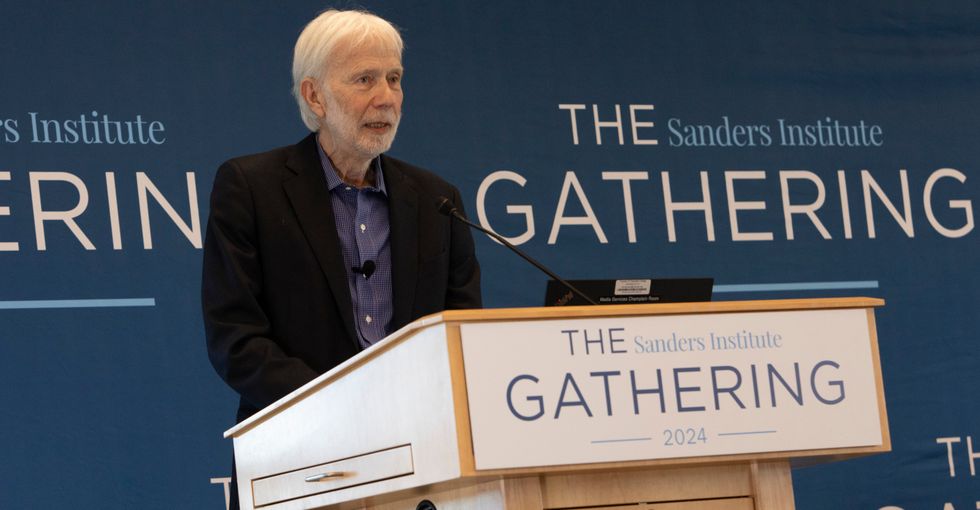 The Labor Institute's executive director Les Leopold addresses the audience in Burlington, as he called for a ban on compulsory mass layoffs for companies with federal government contracts. (Photo: Will Allen / via The Sanders Institute)
"As Wall Street has routinized the financial strip-mining of productive enterprises," Leopold writes in the book, "more than 30 million of us have experienced mass layoffs [over recent decades]. And even more have felt the pain and suffering as our family members lost jobs."
Despite that, he says, the occurrence of mass layoffs has "become so commonplace, so normalized, so routinized, that for-profit and nonprofit executives alike do not hesitate to slash jobs whenever they feel it necessary." But with a working class fractured and pummeled from the decades-long corporate crusade against unionization, Leopold told Common Dreams in Burlington that he believes a fight against mass layoffs could be a way to help turn the tide.
"Why are working class people apathetic about politics?" asked Leopold. "Because politics is completely dominated by corporations and they're totally alienated from that. We've got to fight the class war around politics. We have got to get working-class control over politics."
"The working class is going to save the working class. It's never going to be a party."
Nelson echoed that, saying the policies passed in Congress "are not going to be the policies we need until we extract money from our politics."
Getting corporate money out of politics can't be won in Congress "because we don't have the politicians in office that can vote it out because money is still controlling it," Nelson said. "So the only way to get at it, the only way to change our politics is to have workers in a massive way organize their unions and take the money from capital so that they don't have it to spend in our politics."
In Leopold's mind, a worker-centered politics and a "class war" framework is something "we can sell anywhere." It can work with organized workers already with labor unions like Nelson's AFA, the United Auto Workers (UAW), and other major trade unions. It can also be the linchpin for workers who are not yet organized within unions, like Jayaraman's approach with One Fair Wage.
It can work for "Trump people" that have looked to the far-right because they saw Democrats year after year not fighting for their interests, he said, and it can work for "not Trump people," who are simply looking for allies to stand with them in the demand for better wages, job security, healthcare, housing costs, and more.
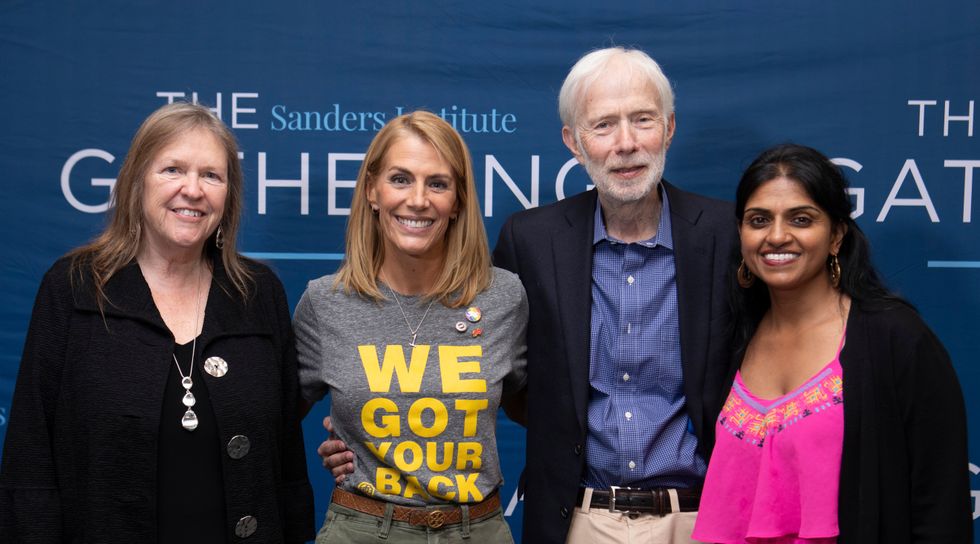 (From left) Sanders Institute co-founder Jane O'Meara Sanders, AFA president Sara Nelson, the Labor Institute's Les Leopold, and Saru Jayaraman of One Fair Wage pose for a picture together at the Gathering in Burlington, Vt. on Saturday, June 1, 2024. (Photo: Will Allen / via The Sanders Institute)
Offering a concrete example for workers to rally around, Leopold proposed in Vermont—something he has written about extensively in recent months, including for Common Dreams—is the idea of putting a target on mass layoffs and stock buybacks by large employers to help galvanize working-class power.
What he's calling for is a provision that would prohibit any company that receives a government contract from carrying out a compulsory mass layoff—defined as the termination of 50 jobs or more at one time.
"Think about how easy it is to add one sentence to a federal contract, which says: 'If you take this contract, no compulsory layoffs, no stock buybacks," Leopold told Common Dreams. Having calculated the amount of money flowing through such contracts for large corporations at about $700 billion, he admits it's not clear exactly how many jobs that could save—but it would be a significant number.
"Well, $700 billion worth of no layoffs is a lot of no layoffs," he said, but even more important is this: "It would be a fight." And if the Democratic Party was willing to put such a proposal into its 2024 platform it would be a signal that the party was willing to go to bat for working people in ways it has not done in a very long time.
"If they fight for that plank, people will hear them," said Leopold. "It would show there's a fight going on in Democratic Party on behalf of the working class. Then labor can rally. Then progressive organizations can rally. But there has to be a fight."
"You're going to conduct a mass layoff or spend billions on stock buybacks while there's layoffs, then you don't get the federal contract. The federal government has a lot of power with the purse strings that they need to use."
Last week, Leopold wrote an op-ed calling for President Joe Biden to intervene on behalf John Deere workers facing mass layoffs by the owners of the iconic tractor company. "Come on Joe, go to bat for these workers," Leopold wrote. "Put the heat on John Deere and show the working class that you’re tougher than Trump when it comes to saving American jobs."
And Nelson agrees that the onus is on the Democrats to be much bolder than they have been.
"The Democratic Party has to put working peoples central to its platform and put in its platform things like Les Leopold's idea on mass layoffs," she told Common Dreams.
"It's a very simple idea," Nelson continued, but it's exactly on the right track. "You're going to conduct a mass layoff or spend billions on stock buybacks while there are layoffs, then you don't get the federal contract. The federal government has a lot of power with the purse strings that they need to use."
Despite the hopes for big labor's abilities to get something dramatic accomplished in the coming months and years, both in their own contract fights and building up their own unions, Leopold said they also need to use their size and resources to help build "an organization for unorganized workers."
Leopold happens to think the mass layoffs could be a vehicle for that, though he admits it's not been tested and would need a much larger buy-in as a strategy before it could be proven effective. Jayaraman noted in her discussion with Common Dreams that low wages is a more likely issue for the broader working class to organize around.
"If we're waiting for the law to change, we're just going to keep waiting until we're completely extinct."
Nelson recognized the value of a number of approaches, and said unions and the unorganized workforce must go much further than they've gone since Reagan busted the PATCO strike in 1981.
"We have to organize like never before," she said, noting how large established unions like the UAW have been putting resources and energy into helping non-unionized works in the south, including Tennessee and Alabama, win recognition. "That's important," Nelson explained, "but it's also not enough if we're really going to do the kind of organizing that can truly put a check on capital and change the political environment."
When it comes to the Pro Act, or Protecting the Right to Organize Act, which would enhance workers rights and that Democrats tried but failed to pass during the first half of Biden's term, Nelson said it is very much "a chicken and egg situation." The legislation, she said, "is not going to come before we organize more workers" in order to tilt the political scales that would make passage possible.
"So if we're waiting for the law to change," she warned, "we're just going to keep waiting until we're completely extinct."
Referencing an effort by United Auto Worker's president Shawn Fain to align as many contract fights as possible around May 1, 2028 in an effort to further create broader worker solidarity and increase pressure across various trade and service union sectors and industries, Nelson expressed hope for Leopold's mass layoff idea and what Fain has proposed.
Both show, she said, "the working class that there is a way to be strategic" and can wake people up to "the power we have in standing together," whether it be on wages, firings, union card campaigns, or contract fights.
And it may not take as long as May of 2028, Nelson added. "The moment may come to us before then, but talking about and really defining the problems—which we're doing over and over again—is key, showing that these are not isolated issues," she said. "The issue with housing, the issue with gun violence, the issue with healthcare, the issue with education and debt—these are not isolated issues. The issue is pure and simple corporate greed, and that's what we have to organize against."
"The issue with housing, the issue with gun violence, the issue with healthcare, the issue with education and debt—these are not isolated issues. The issue is pure and simple corporate greed, and that's what we have to organize against."
"Solidarity is our power," Nelson explained during her interview with Common Dreams. "And so the strike is not itself the most powerful weapon here. It is the consciousness of worker power and the threat of the strike that is going to make change in our economy and in people's lives."
In a podcast interview with Sen. Bernie Sanders earlier this week, Fain of the UAW spoke along similar lines.
"We have to harness that power" of working-class power led by organized labor, Fain said to Sanders.
"Union or not, we have to bring workers together all over, not just in America, but all over the globe," Fain continued. "We want to see working-class people all over this globe come together. The only way we're going to beat the corporate global fight is by standing together globally and fighting for better standards for everyone and standard wages for everyone. So we lift everyone up everywhere. And to a lot of people, that seems like a pipe dream. I don't believe it is."
It was during the panel discussion in Burlington that Nelson looked out at the audience where Sen. Sanders—"our organizer-in-chief," she called him—was seated and thanked him for the leadership he showed in both 2016 and 2020 while seeking the Democratic nomination for president.
"We want to see working-class people all over this globe come together." —UAW president Shawn Fain
"One of the reasons that unions are one of the most popular ideas in this country is because Bernie Sanders went around this country telling people that the trade union movement is the only way for us to lift up the standards for the working class," Nelson said. "It is the only way to get back to the issues that we were talking about a hundred years ago and pushing forward on them. It is the only way to build the power that we need to change our politics. It is the only way to give working people agency to feel the democracy is something that they own, not what the capital class does."
While speaking of Trump—who "lives the very antithesis of what it means to be union"—and his Republican Party with outright contempt as enemies of working people everywhere, Nelson was clear that nobody should think the Democratic Party is riding courageously to the rescue of the tens of millions of workers who toil and sweat to provide themselves and their families a decent life.
"The working class is going to save the working class," she said. "It's never going to be a party. We are going to bring politics to us if we do our jobs right. It doesn't happen the other way around."
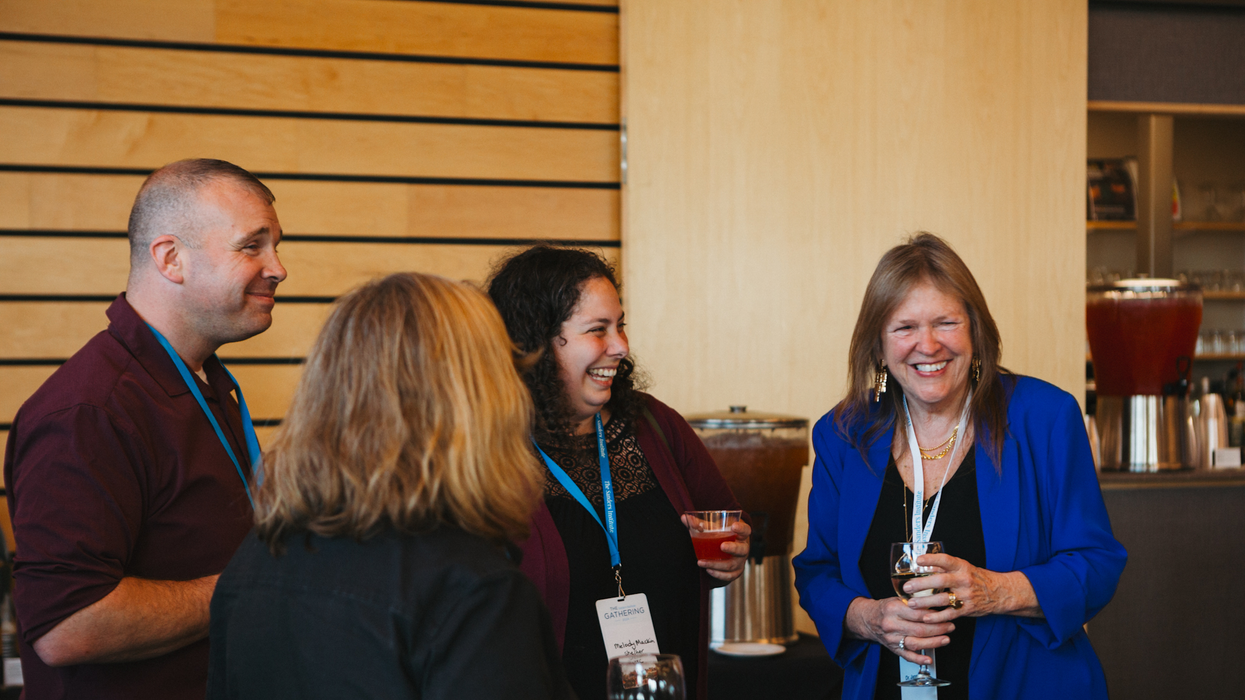
"We are all working so hard in our own areas," O'Meara Sanders told Common Dreams after the event wrapped up on June 2. "It allowed people to get out of the silos that too often separate the policymakers. So to have elected officials and advocates in so many different areas, having them be able to come together and discuss different things... it bodes well for the future."
Over three days filled with more than 15 livestreamed panel discussions, film screenings, and other events, participants in the Gathering learned about how advocates in California are working to implement social housing, taking inspiration from countries like Austria and Spain; the labor rights movement's "25x2" strategy of pushing living wage legislation and ballot measures in dozens of states; and a number of reasons to be optimistic about fighting the climate crisis—even as scientists warn the continued burning of fossil fuels will push global temperatures past 1.5°C of heating in at least one of the next five years.
Climate
Despite experts' bleak projections, McKibben and Sierra Club executive director Ben Jealous welcomed guests on the first night of the conference by offering evidence that electric vehicles and solar panels are rapidly becoming more powerful and more accessible to more U.S. households, providing hope that the world's largest historic emitter of carbon dioxide is making strides to cut down on planet-heating pollution from transportation and electricity.
"Right now, the sea surface temperature in the Atlantic is two to three degrees higher than we've ever seen it before," said McKibben. "And at the exact same moment that the planet is physically starting to disintegrate precisely the way the scientists 30 years ago told us it would—as if scripted by Hollywood—you'll also see finally the sudden spike in... the only antidote we have at scale to deal with this: the application of renewable energy around the world."
"Last summer, just as scientists were telling us that it was the hottest week in the last 125,000 years, that same week was the week that the engineers told us that for the first time, human beings were now installing more than a gigawatt's worth of solar panels every single day on this planet," he added. "That's a nuclear power plant's worth of solar panels. So we are right at the moment when one or the other of these trends is going to cancel out... the other one. Our job, I think, is to make sure that we figure out how to dramatically accelerate that second trend so that we have some hope of catching up with the physics of climate change before it does in everything that we care about on this planet. So for me, that's the context of the moment that we're in."
That theme—giving guests at the Gathering an unvarnished accounting of the very real crises that face communities while providing a glimpse into campaigners' ongoing efforts and positive results of their tireless advocacy work, with the crucial help of progressive lawmakers like Sen. Sanders—continued throughout the weekend.
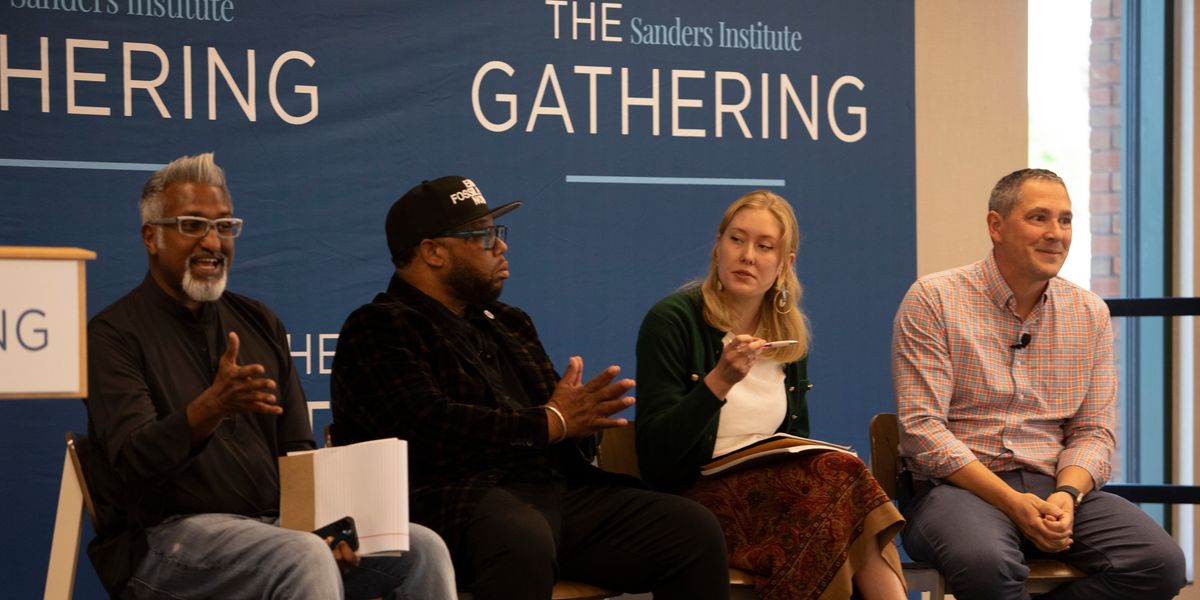 Joseph Geevarghese of Our Revolution, The Hip Hop Caucus' Rev. Lennox Yearwood, Jamie Minden of Zero Hour, and Friends of the Earth U.S. president Erich Pica. (Photo: Will Allen / via The Sanders Institute)
On the climate front, advocates shared their hopes to seize on the opportunity of Republican plans to extend Trump-era tax cuts if they regain power in the November elections.
Participants on a Saturday panel at the Gathering—including Joseph Geevarghese of Our Revolution, the Hip Hop Caucus' Rev. Lennox Yearwood, Jamie Minden of Zero Hour, and Friends of the Earth U.S. president Erich Pica—argued that ending federal handouts to Big Oil is part of the broader effort to ultimately "kill the fossil fuel industry" that's cooking the planet while blocking the worker-led demand for a green energy transition.
Too often when covering advocacy work, the corporate media focuses on "the controversy," O'Meara Sanders told Common Dreams. "What's the controversy as opposed to what's the plan?"
The Gathering set out to offer an antidote to that dynamic and many participants—including Dr. Deborah Richter, board president of Vermont Health Care for All—said the effort was a success.
"Sometimes when you're trying to get some sort of major social change, it can get really, really strenuous and make you sad," Richter told Common Dreams. "I felt incredibly rejuvenated after this weekend."
"You tend to get single-focused when you're working on one issue," she added. "And I actually really appreciated the updates, the good and the bad on climate change... I came away thinking, I have to learn more about climate change. I'm going to learn more about this. I'm going to learn more about that."
Richter spoke to attendees about her group's efforts to bring government-funded healthcare to Vermont, noting that she has spent years advocating to expand Medicare to the entire population while also witnessing her own patients' struggles with the for-profit system as a primary care doctor and addiction medicine specialist.
Joining Richter for the panel discussion was Dr. Jehan "Gigi" El-Bayoumi, a Georgetown University School of Medicine professor who founded the Rodham Institute, which works to achieve health equity in communities across Washington, D.C.
"Many people think that what determines how long you live and how healthy you are is access to healthcare," El-Bayoumi told Common Dreams. While crucial, "that only accounts for 20%." The remaining 80% is other "social determinants of health," such as whether people live in a neighborhood with access to affordable, nutritious food and clean air or a fenceline community next to a chemical plant or oil refinery, raising their chance of developing respiratory problems or other health issues.
"Health is the air that we breathe. Health is what we eat and where we live," El-Bayoumi said, noting that the same factors are also "the social determinants of education and the social determinants of employment."
"If you don't have those things in place," the physician continued, "then how are you going to have better health?"
In Burlington, El-Bayoumi spoke about efforts to ensure people of color in Washington, D.C. had access to Covid-19 vaccines when they were first introduced. Working with the Black Coalition Against Covid, she partnered with medical schools at historically Black universities, Black fraternities and sororities, the hip-hop community, and others to hold a mass vaccination event in Ward 8.
"Community needs to be at the table," she told the audience. "The people that are closest to the problem know the solutions."
El-Bayoumi stressed to Common Dreams the importance of not only engaging with impacted community members but also following the lead of success stories around the world. While progressives often cite European examples, she pointed to models such as the International Union Against Tuberculosis and Lung Disease's Project Axshya, which set up nearly 100 tuberculosis treatment and information kiosks in 40 cities across India.
She also cited models from Egypt, Namibia, and Zimbabwe, where the Friendship Bench project trained elder volunteers without any formal medical credentials to discreetly counsel patients on wooden benches on the grounds of clinics, aiming to address "kufungisisa," the local word closest to depression.
When it comes to providing healthcare, "we're all spokes on a wheel," El-Bayoumi said. "The nurses and the physicians and the custodians... we're all spokes. We could not function without each other."
"But then similarly, health, environment, food, political, education—all spokes on a wheel," she added. "There is not one thing that's more important."
Housing
The latest Gathering built on the institute's April conference on housing justice—an event that brought together leaders in Los Angeles, including the city's Mayor Karen Bass, California Assemblyman Alex Lee (D-25), and U.S. Reps. Pramila Jayapal (D-Wash.) and Ro Khanna (D-Calif.).
Lee also attended the Burlington conference, where he spoke on a panel with Michael Monte of Vermont's Champlain Housing Trust and AIDS Healthcare Foundation president Michael Weinstein, who argued that "housing is not high enough on the progressive agenda."
"Our job as progressives is to do everything we can every day to make people's lives materially better, and this is an area that we have to focus on," Weinstein said, echoing his remarks during the 2018 Gathering, the very first such event hosted by the institute.
In terms of actually getting people into affordable homes, "we could do a lot to make it less bureaucratic," he said—touching on a topic that dominated a second housing crisis panel.
For that discussion, O'Meara Sanders was joined by Brian McCabe, deputy assistant secretary for policy development at the U.S. Department of Housing and Urban Development, and Nika Soon-Shiong of the Fund for Guaranteed Income (F4GI), which provides "cash transfers that support those who have been locked out of welfare programs and economic systems."
F4GI is also working on a pilot program to provide a "cash on-ramp" to help people who are participating in the federal Housing Choice Voucher Program, commonly called Section 8, while they search for rental units, Soon-Shiong explained.
She stressed the importance of including community members in the development and implementation of the programs designed to help them, and pushed back against common messages about financial and logical hurdles.
"Part of addressing the root cause of the housing crisis is actually removing that false frame," she said, "and demonstrating that it's possible to collaborate, to move quickly, and to design things that are new and actually relatively inexpensive."
Workers' Rights
During one of the labor panels, Jayaraman of One Fair Wage spoke about the nationwide fight for better pay and working conditions—and how the movement's wins had provoked threats to her and her family.
El-Bayoumi said that before Jayaraman's remarks, she knew a bit about restaurant workers' fight for higher pay due to experiences living and working in Washington, D.C.—where residents passed ballot measures to raise the minimum wage for tipped employees in 2018 and 2022.
"What did I not know? Always scale," the physician continued. She was struck by the specifics that the labor leader shared, as well as her perseverance while being attacked for being successful.
"She was so inspiring and invigorating… She was raw. She was real. I'm just a great admirer now, and I learned a lot from her," El-Bayoumi said. "Her energy was amazing... It was the information, but also her commitment."
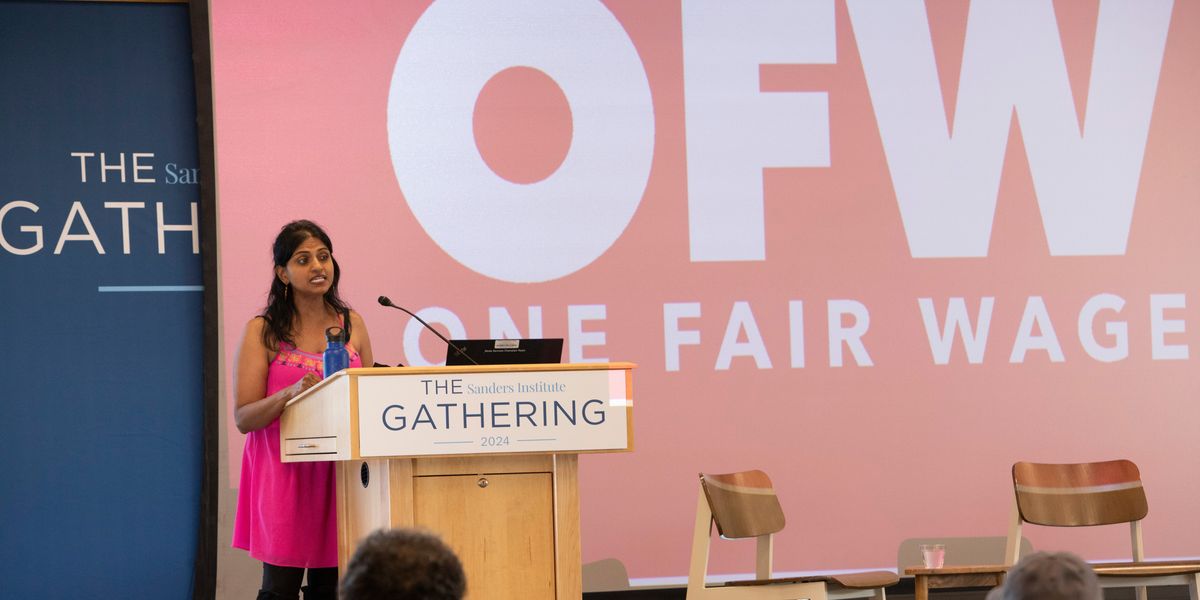 One Fair Wage co-founder and president Saru Jayaraman during a speech at The Gathering. (Photo: Will Allen / via The Sanders Institute)
During her speech at the Gathering, Jayaraman said the fight being fought by the millions of low-wage workers her group represents, many of whom work two or even three jobs just to stay afloat, are crucial if the progressive movement more broadly wants to win the battles on climate, healthcare justice, and housing.
"It's not a competition with all of our issues," Jayaraman said, "because if these folks could work one job instead of two or three, they would have the capacity to work on healthcare and climate change and everything else. I asked them, 'What would you work on if you could only work one job?' They've said climate. They've said public education. They've said, 'I would do so much, but I have time to survive right now. I just have to get from job to job.'"
So if the question is what's the problem and what's the opportunity, Jayaraman said, "The opportunity is this November—we have 3.5 million workers get a raise and then turn around and work on all of the issues everybody else cares about in this room."
Media & Technology
At a panel on progressive news media, The Nation national affairs correspondent John Nichols spotlighted another labor struggle that has national and global implications, as U.S. newsrooms lose thousands of working journalists to layoffs and budget cuts—frequently stemming from private equity firms purchasing newspapers and then looking to raise revenues at the expense of the reporters whose work the outlets rely on to operate.
"Since 2005, we have lost 45,000 working journalists in this country," said Nichols. "So we have a collapse of journalism. We have no filling of the void, and the institutions themselves are collapsing. Since 2005, roughly 20 years, we have lost a third of all print and online publications that existed at that time."
Nichols, who edited Sanders' book, It's OK to Be Angry About Capitalism, and spoke on the senator's podcast in April about the current crisis in media, was joined by The Lever founder David Sirota and Common Dreams managing editor Jon Queally.
"We are in a period where our media in this country is in such crisis and such collapse and such dysfunction that it is no longer sufficient to sustain democracy itself," Nichols told the audience.
As traditional newsrooms across the country struggle to survive in an industry increasingly dominated by private equity firms and hedge funds, Sirota spoke about starting an online investigative news outlet with the aim of breaking news stories that might otherwise go uncovered by large publications—or that might be reported on briefly, with the stories of the people affected forgotten within a few days.
After a Norfolk Southern train carrying toxic chemicals derailed in the town of East Palestine, Ohio, Sirota said, The Lever "broke open a story that looked back at what were the decisions on specific policies that were made to create an environment for a disaster like that to happen, and which politicians took money at the time while they were making those decisions."
The Lever reported on how Norfolk Southern lobbied lawmakers to repeal a rule requiring widespread use of electronic braking systems, which were meant to help avoid accidents, and how the Trump administration rescinded the rule in 2017 after the rail industry donated more than $6 million to GOP candidates.
"Ultimately, our reporting ended up playing a big role in getting the Senate and the House to introduce major rail safety legislation that had specific provisions in it that dealt with exactly what we were reporting on," said Sirota. "The New York Times asked us to do a full page op-ed about our reporting... That's how elevated it became."
"The reason to do that is not for our own glory," he added. "It's ultimately to shape what actually happens moving forward. So our goal is to hold accountable those who are making these decisions with the hope that if they are held accountable, they will be deterred from making such bad decisions in the future."
In addition to the media, the Gathering featured panels on civil discourse and technology. During the latter discussion, which addressed topics including artificial intelligence and data collection, journalist Sue Halpern pointed out that in Congress, "there's a tension between... wanting to protect us—theoretically—and commerce."
She suggested that corporate pressure is blocking bipartisan efforts to pass federal privacy legislation, explaining that "the lobbyists for the Big Tech companies are constantly saying to lawmakers... if you regulate this, if you pull back on this, you will harm the American economy and you will limit innovation. And I have to say that most congresspeople are terrified of being accused of limiting innovation."
"Congress can't get it together to make national legislation. And so we see kind of a piecemeal thing going on, at least with privacy," Halpern said, highlighting laws passed by California, Illinois, and recently, Vermont, that serve as models for other states, in the absence of federal action.
Screenings
Along with panel discussions, the Sanders Institute incorporated film screenings and music into the Gathering to offer attendees another avenue into some of the issues discussed.
Kelton, an economist at Stony Brook University, presented a film spotlighting efforts by her and several colleagues to prompt a "paradigm shift" in Americans' understanding of the national deficit by introducing the public to Modern Monetary Theory (MMT).
Directed by Maren Poitras, Finding the Money follows Kelton and economists including Randall Wray as they explain their vision for how the national debt could be viewed not as a burden that American taxpayers must pay back through cuts to government programs, but "as simply a historical record of the number of dollars created by the U.S. federal government currently being held in pockets, as assets, by the rest of us."
Kelton questioned how the Republican Party can, year after year, name reducing the federal deficit as one of their top priorities when the tax cuts introduced by the GOP under the George W. Bush and Trump administrations have been the primary drivers of the increasing debt ratio in recent years.
"They don't care about the fiscal or budgetary impacts. They want to pass their agenda. So we get sweeping tax cuts," Kelton said. "[The Congressional Budget Office] says the tax cuts will add $1.9 trillion to the deficit. Republicans shrug and say, who cares? On the other side of the government deficit lies a financial windfall for somebody else. Every deficit is good for someone. The question is for whom and for what."
In the film, Kelton argues that as the issuer of U.S. currency, the federal government does not need to "find the money" to spend on public programs, but instead needs only to ensure that real resources like workers and construction supplies are available when it comes to spending. The government can avoid a surge in inflation through policy decisions, the economists in the film argue, but greater deficits in a large country like the U.S. are far more sustainable than Americans have been led to believe.
Along with the Bush and Trump tax cuts, Kelton used the relief packages passed by Congress when the coronavirus pandemic began in 2020. A total of $5 trillion in relief was passed through several laws, raising people's unemployment benefits and helping small businesses to stay afloat.
"We cut child poverty by roughly 40%, and you can talk on and on about the benefits, because every deficit is good for someone," Kelton said. "The question is for whom and where does the windfall on the other side of the government deficit go? In March of 2021, it went to the bottom... That's who it helped. The Republicans did $1.9 trillion with their tax cuts. Where did it go? Eighty-three percent of the benefits went to people in top 1% of the income distribution."
Now, said Kelton, the deficit should be seen as a way for the government to pass more far-reaching legislation to fight the climate emergency.
The weekend also featured screenings of trailers for filmmaker Josh Fox's The Welcome Table—which is about the climate emergency causing displacement and is set to be released on HBO—and The Edge of Nature, an evolving documentary project that connects the crises of Covid, climate, and healthcare.
Fox, known for the award-winning anti-fracking film Gasland, brought his banjo—signed by Sen. Sanders—to Burlington to preview a musical performance that accompanies The Edge of Nature, which he is bringing to New York City with a 12-person ensemble from June 14-30.
"I thought that his telling of his own experience with Covid and the healing power of nature is just so true," El-Bayoumi said of the performance. "I have patients who are just struggling with life, with mental health issues. I will tell them, go outside, take off your shoes, feel the ground under your feet, because nature is healing."
The Edge of Nature "actually gave me hope... which I think is one of the things that was brought up over and over again at the Sanders Institute Gathering," she added. "How do you present that, the issues and solutions, if you will. And I thought that he did that very well."
There was also a screening of a video produced by the Power to the Patients campaign, which has worked to educate the public about healthcare transparency requirements through murals painted in cities across the United States. While the auditorium was waiting for that video to start amid technical difficulties, the audience broke out in song, singing "Solidarity Forever."
"It was so beautiful. And that was an amazing moment to me," Fox told Common Dreams. "And it said to me, go ahead and sing your song in your presentation, because this is a room where you can sing."
"My takeaway was, we have our differences, and we definitely have our identities, and we have our priorities, and we have... teachable moments where we have to instruct each other as to how we're messing up," he said. "But also, we really need to focus on solidarity."
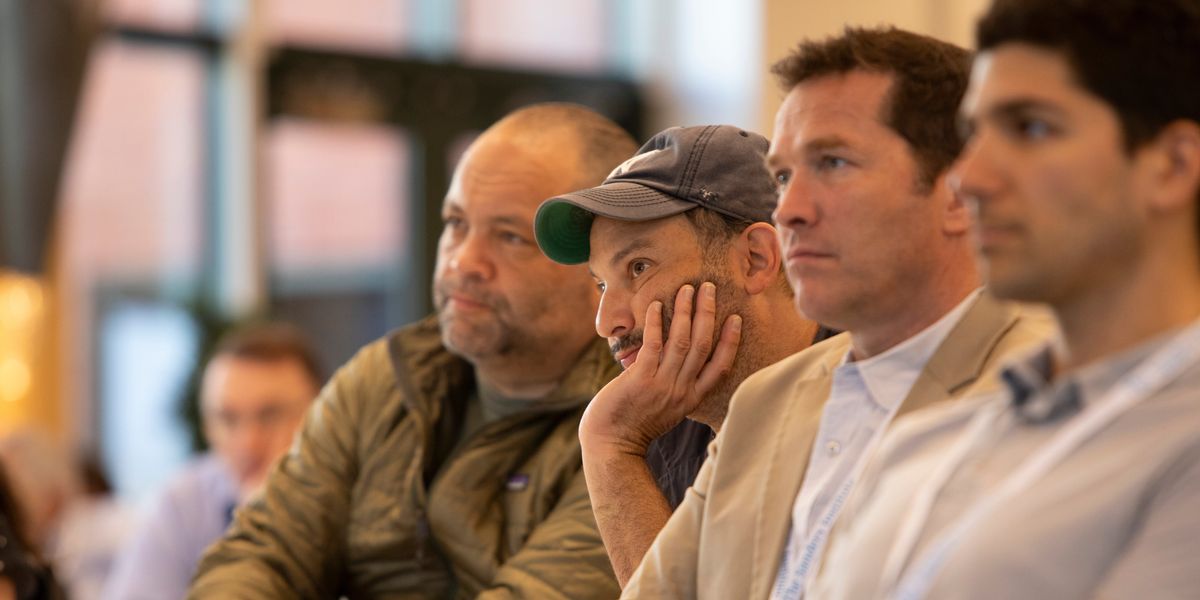 Sierra Club executive director Ben Jealous, filmmaker Josh Fox, and The Sanders Institute's Dave Driscoll listen to a presentation during the Gathering in Burlington, Vermont on Saturday, June 1, 2024. (Photo: Will Allen / via The Sanders Institute)
Fox noted that when he used to introduce Sen. Sanders during his 2016 presidential campaign, the filmmaker would say, "All the movements are in this room."
As he prepared for the NYC performances, Fox said that in the current "moment of division… the more we can come together in physical space—and that's what we're offering here with this show, a chance to be in an audience, a chance to be together, a chance to be in reality with each other—the better we can break those boundaries down."
"My takeaway from the Gathering is, I wish this was happening all the time and at the White House," he added, "but if it's not, we can recreate this in our small ways throughout this [election] cycle."
What's Next
O'Meara Sanders said the Sanders Institute intends to have one large Gathering each year and will continue to hold smaller events focused on specific issues, as it did in April with housing.
International Gatherings are one possibility, said O'Meara Sanders, expressing hope that some of the policymakers and advocates who shared their aspirations and plans for the United States in Burlington could convene with lawmakers in other countries who have been successful at implementing social housing, far-reaching climate action, and government-funded healthcare.
The institute aims to bring "members of Parliament together with members of Congress, to bring together diplomats from different countries," said O'Meara Sanders, "to talk about specific issues. Who's doing it best? How can we learn from them?"
"We're going to be bringing people together from all the different countries to explore what they're doing best and how we can do it better together," she added. "And then what's the political will necessary to accomplish these things?"

Beginning June 14, Fox is set to couple the resulting film with a live musical performance, featuring a 12-person ensemble, for three weeks at La MaMa Experimental Theatre Club in New York City. He started the month at The Sanders Institute Gathering in Burlington, Vermont, previewing a part of the performance solo, with his banjo—signed by U.S. Sen. Bernie Sanders (I-Vt.).
The banjo and songs of Pete Seeger—whose influence Fox can trace back to the folk legend visiting his elementary school—are just part of the film's soundtrack. There are also blue jays and coyotes. The rustle of the forest, filled with bears and beavers. The clicks of typewriter keys. Occasional gunshots in the distance. Radio reports about the intertwined public health and economic crises.
"A lot of the film is about these big lessons that we got during that time and that we have decided don't count anymore. We reduced emissions for the very first time in history enough to meet the goals of [the Paris agreement]," Fox said in an interview with Common Dreams.
Scientists have used the term anthropause "to refer specifically to a considerable global slowing of modern human activities," as over a dozen experts wrote in June 2020 in Nature Ecology & Evolution.
Fox said: "That was a moment that we all remember. We healed as a planet. The skies got clearer. The water got better. Bird song increased in complexity."
The detail about bird songs stayed with Dr. Jehan "Gigi" El-Bayoumi, a professor at Georgetown University School of Medicine who was in the Burlington audience, which included academics, advocates, and policymakers fighting for a better world, focused on issues including climate, inequality, healthcare, and housing.
After the conference, El-Bayoumi was walking outdoors with her mother and spotted a bird. She shared what she learned from Fox's performance—which she described as "sheer brilliance," adding that "if there's anything that's going to save humanity, it's the arts."
 Filmmaker Josh Fox performs at The Sanders Institute Gathering in Burlington, Vermont in spring 2024. (Photo: © Will Allen 2024 / via the Sanders Institute)
Another member of the audience was Wendell Potter, a former insurance executive now at the Center for Health and Democracy. Watching the performance, he told Common Dreams, "I just was enthralled."
Fox also spoke with Potter about suffering from long Covid and struggling to get the care he needed, especially with intermittent health insurance coverage. The filmmaker recalled that "Wendell came in and was just absolutely astounded I have no health insurance right now."
Potter, who advocates for major healthcare reforms including Medicare for All, said that "what he shared with me is terrifying, but is something that so many people are facing day in and day out."
While alarmed by Fox's experiences battling for medical care, Potter "was inspired" by his performance and said, "I think he can play a big role in waking people up."
Fox said that performing at the Gathering and speaking with people there, including Potter and El-Bayoumi, woke him up—and inspired him to make some additions to the forthcoming performances.
"Every time I do a performance, I learn," he explained. "And I realized that some of the things that are implicit in the film... meaning I want people and audiences to feel and figure out on their own—at times, I think when we're doing a performance of it, it needs to be explicit."
"Getting to the Sanders Institute was this huge wake-up call. I was like, oh my God, I just made a movie about health."
"I made it from the fossil fuel, climate change angle," Fox said of The Edge of Nature. "Getting to the Sanders Institute was this huge wake-up call. I was like, oh my God, I just made a movie about health."
Since the conference, he has been working on some new lines for the performance. In terms of healthcare lessons from the pandemic, he hopes to highlight that "the vaccines came and made the whole thing a helluva lot less fatal and a lot less scary (for those of us who are educated and believe in science that is). And the vaccines were free for every American!"
"Of course, because we don't have Medicare for All in this country, we still have to pay for cancer, and asthma, and heartbreak of psoriasis, and lupus, and Lyme, and diabetes, and glaucoma, and painful corns, and scabies, and rabies, flu, AIDS, and ME/CFS, every other ailment under the sun from Alzheimer's to ADHD," he now wants to say. "Medical debt once again being America's leading cause of bankruptcy, insolvency, and despair."
He also plans to point out that "hurricane season never used to be a thing in PA. It is now. But this deluge is only the beginning. Our climate system is tipping into uncharted territory. Industrial fossil fuel-based civilization's emissions are trapping us in the planet's fever dream."
"So unless you have a ticket to Jeff Bezos' floating Floridian totalitarian salad spinner in the sky, then you are gonna be stuck down here, in their greenhouse gas chamber. And the billionaire colonizers will keep dreaming of Mars," he will warn. "While down here what's worse than genocide will occur. Omnicide. The murder of all."
Fox plans to have climate experts and advocates in New York City this month for post-performance discussions.
Like Gasland, he also plans to take The Edge of Nature—which has already won the Best Environmental Film Award at the 2023 Byron Bay International Film Festival in Australia—and its musical performance on tour, so audiences beyond NYC can experience it.
"We're going to try to have this piece make an impact," Fox told Common Dreams. "This is obviously an election year. This film was entirely made in Pennsylvania, so we're hoping to take it throughout PA, maybe New Hampshire, Vermont, New York."
"Sometimes that's in a huge arts center," he said. "And sometimes that's somebody's Unitarian church set up and we have 50 people, or it's somebody's backyard or somebody's barn—set up the screen outside on a hillside... Those are some of the most fun. So we don't make a distinction between what is a legit theater and what is somebody's barn... it's all just people."
Reflecting on the
Gasland years, Fox noted that "the reason why we succeeded so many places with the anti-fracking campaign... is because we were talking about public health. Fracking was the scary chemicals across your fenceline that was going to harm your children."
With future performances, Fox said, "what I would love to see—and it's such a no-brainer—is the Medicare for All and climate change/Green New Deal movements coming into the same space."
"And by the way, the Green New Deal is a kind of Medicare for All. Getting rid of the fossil fuel industry is a kind of Medicare for All, because you're simply eliminating all of those illnesses that it causes," he said. "It is a great moment to potentially campaign for both... to break out of our silos."
"We get very siloed in the activist world," he added. "I get siloed in climate and fracking and environmental space. Others are siloed in Medicare for All. So this film is a chance for us to try to work across those two lines."

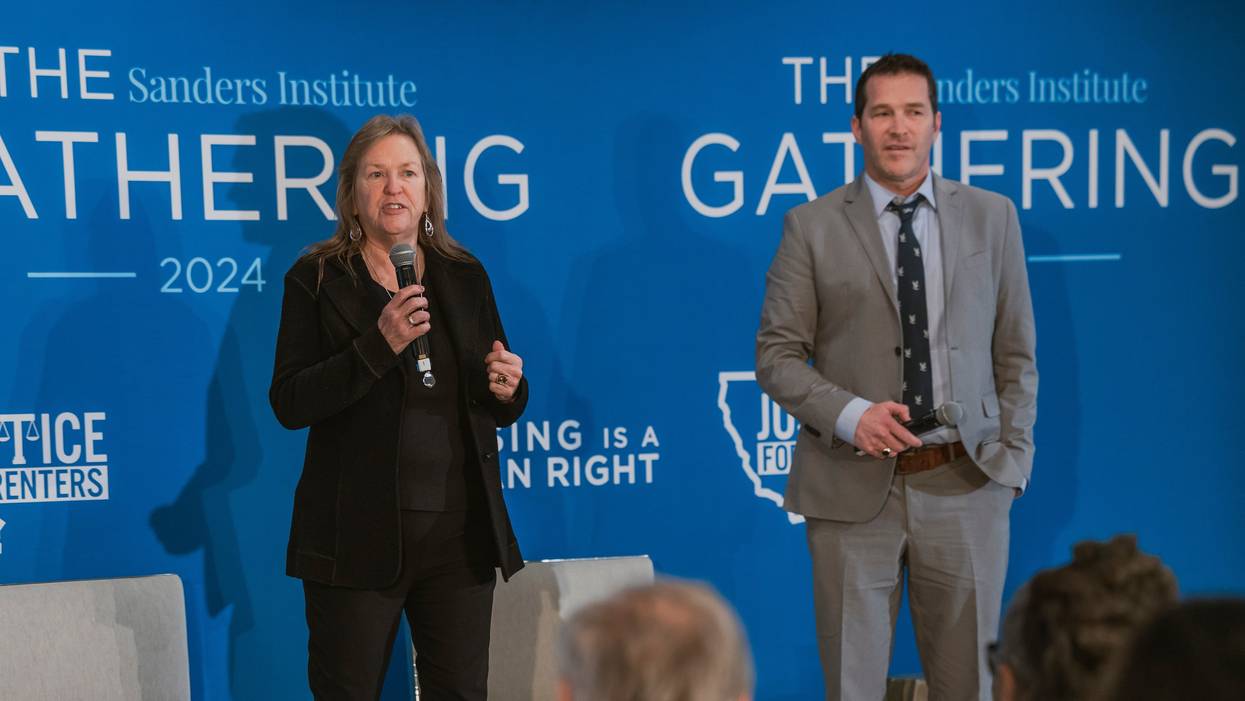
While the policy discussion around housing has a reputation for being dynamic and complex—especially as an issue that straddles municipal, state, and federal governance—the human story at the center of what it means to have a home or be housed is simple and universal, a thread woven into over a dozen panels, presentations, and keynote speeches by progressive lawmakers, top experts, frontline advocates, academics, and community organizers.
In a conversation with Common Dreams, Sanders and Driscoll explained that everyone who attended the event—kept intentionally small and low-profile—was told that the focus would be on "concrete remedies" and "replicable policies" with the ultimate purpose of informing a national audience about not only how severe the housing crisis has become, but also the concrete ways to address it.
"We believe democracy requires an informed electorate and civil discourse and bold ideas. That's part of our mission," Sanders said. "And the purpose was to come at the housing crisis from many aspects—not all of the aspects, but many of them—with the goal of actionable solutions."
"None of us are very interested in making small incremental change, which might mean building some more affordable housing or supporting this or that initiative. That's not what this is about." —Dr. Jane O'Meara Sanders, The Sanders Institute
But why housing? Why now? According to Sanders, the issue is potent politically because it's an issue that is not just about the poor and unhoused, but also central to the working class.
"Everybody knows somebody that has a problem getting affordable housing or just affording their life and having to make different choices," she told Common Dreams. "It's middle-income people, it's everybody having a problem with the housing crisis, and elected officials are getting pressure. Those lawmakers and politicians are hearing it more and more. And we said, okay, now's the time to bring people together around this."
Driscoll targeted private equity, Wall Street investors, and real estate developers that have used their outsized economic and political power to further skew the nation's housing market in search of ever-larger profits, squeezing out low- or middle-income individuals and families in the process.
"It's just another way in which the gap is growing between the rich and the poor and increasing inequality," said Driscoll. "And that needs to stop."
It is powerful interests most of all, says Michael Weinstein, president of the AIDS Healthcare Foundation (AHF), who must be named, shamed, and overcome if any of the progressive solutions championed at the gathering—including rent control, social housing models, community land trusts, more climate-resilient communities, and proven efforts to curb homelessness—are to have any hope of being implemented at the necessary scale.
Weinstein—a driving force behind the event, a supporter of the Sanders Institute, and a major player in California's healthcare and housing political landscape—agrees fully with Sanders and Driscoll that the moment, both in California and nationally, is ripe for an invigorating politics focused on housing.
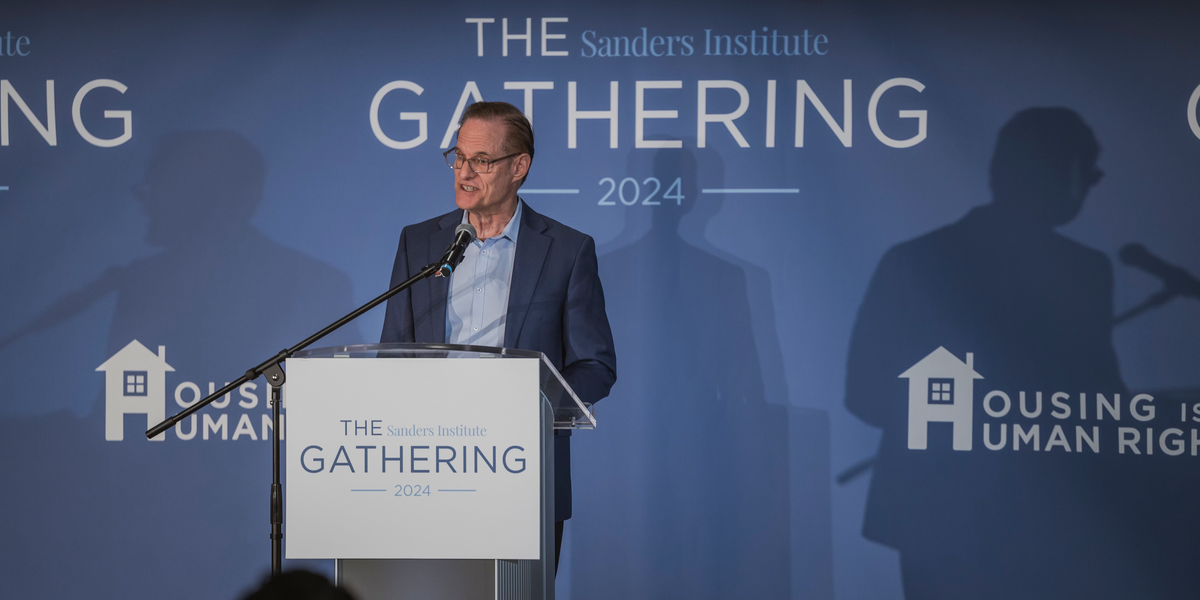
Michael Weinstein, president of the AIDS Healthcare Foundation, presenting at the Sanders Institute event in Los Angeles on Thursday, April 4, 2024. (Photo: © Bryan Giardinelli / The Sanders Institute)
During opening remarks focused on "perpetually affordable housing" and a 2024 ballot initiative in California that would end the state's existing ban on local rent control ordinances, Weinstein said that he has argued for years that "the housing issue was not high enough on the progressive agenda."
"This is a battle for the poor and working-class people in California," Weinstein said of the Justice for Renters campaign, an effort funded by AHF, local unions, and others to see the Justice for Renters Act become law via a ballot measure this year.
"There are 17 million renters in California—that's 45% of the population," he explained. "There are tens of millions more renters across the country. Our primary job as progressives is to improve the lives of people and housing is their greatest need."
If enacted, the law would remove the existing ban on rent control laws in California, encourage expanded rent control at the local level, and curb the power of "predatory landlords" who charge "unfair and unaffordable" rent.
While everyone at the gathering agreed more housing stock is a key part of the solution, Weinstein was among those who emphasized that the biggest obstacle is unaffordability of homes and rental units—a problem attributable to the greed of landlords and the investor class within an economy designed to siphon the wealth of workers into the coffers of the already rich.
"We can't address the housing crisis by chopping the weed off at the top. We have to pull it out by the roots," Weinstein explained. "And high rents are the root cause of the housing affordability crisis. It's that transfer of wealth that's causing the problem. And if we do nothing about rising rents, then nothing else we do in terms of producing housing or other changes will make a difference. If we continue to treat housing as a commodity, we'll never be able to house everyone. It's very similar to healthcare. If we leave it up to the marketplace, we're lost."
With the homeless population in Los Angeles estimated to be over 70,000—in a city of approximately 3.9 million—Weinstein said that L.A. is "not just the homeless capital of this country" but the "homeless capital of the world." This, he lamented, is "truly shameful," but also the reason why California has a vital role to play in showing people that the crisis can be confronted.
As a veteran healthcare advocate and the head of a nonprofit organization focused on AIDS, Weinstein rejected the accusation he sometimes receives from political opponents that he is somehow "out of his lane" by pushing so loudly and aggressively for rent control reforms. One reason that assessment is wrong, Weinstein explained, is that housing is the largest predeterminant of health, which is also why so many at the gathering rallied around the demand that housing be treated like the human right it is.
"But the main reason I'm involved in housing," Weinstein told the audience at the gathering, "is that I feel the same outrage about the housing situation and homelessness today as I did in the 1980s about AIDS, where the benign neglect saw tens of thousands of people die needlessly."
In his remarks, Weinstein stressed the crisis is a result of the most powerful in society refusing to meet the needs of its most vulnerable. But he said the galvanizing potential of housing—and the political potency and opportunities of social uplift embedded in the solutions presented at the conference—must be recognized.
"This is a cry for unity," he said. "Unity behind rent control and unity behind opposing corporate real estate and unity behind housing justice. There's no better time than now."
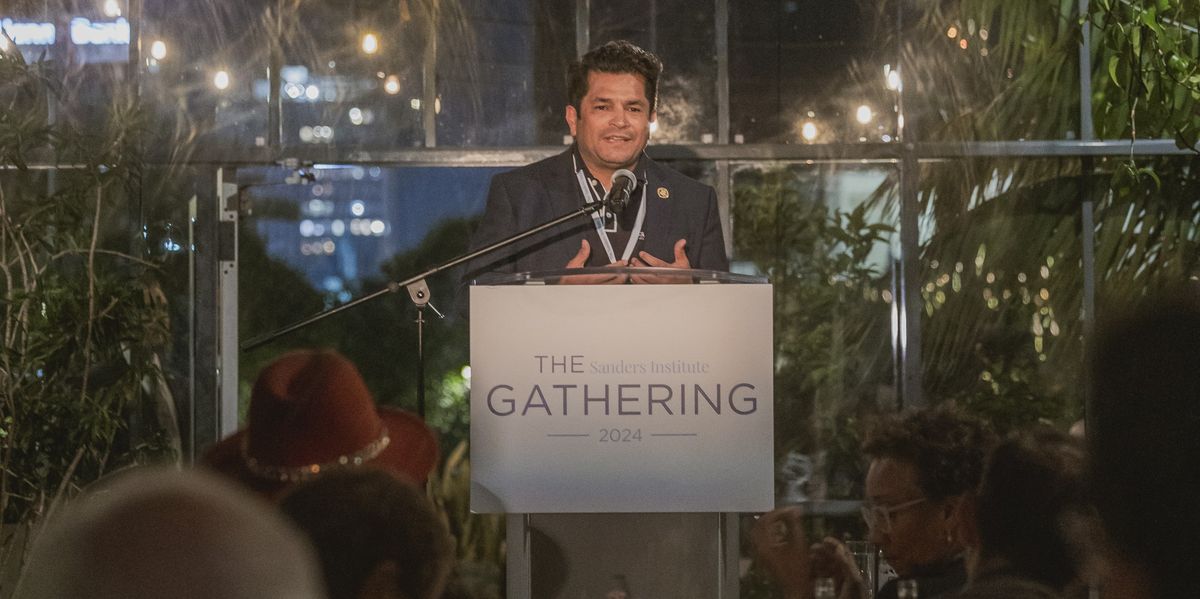
Rep. Jimmy Gomez (D-Calif.) said during the event that Democrats are ready to put housing back at the top of the party's national agenda. (Photo: © Bryan Giardinelli / The Sanders Institute)
The sense of urgency felt by attendees of the event was unmistakable.
Speaking at the opening night dinner for the conference, Rep. Jimmy Gomez (D-Calif.), who represents parts of Los Angeles County, said the creation of the Renters Caucus in Congress last year is a sign that lawmakers are beginning to take housing more seriously at the federal level.
The goal of the new caucus, Gomez said, "is to make sure that the renters agenda is at the top of the Democratic Party agenda." This was a focus of all the members of Congress who attended the gathering in some capacity, including Reps. Pramila Jayapal (D-Wash.) and Ro Khanna (D-Calif.) as well as Sen. Bernie Sanders (I-Vt.), also notable as Jane's husband. Driscoll is their son.
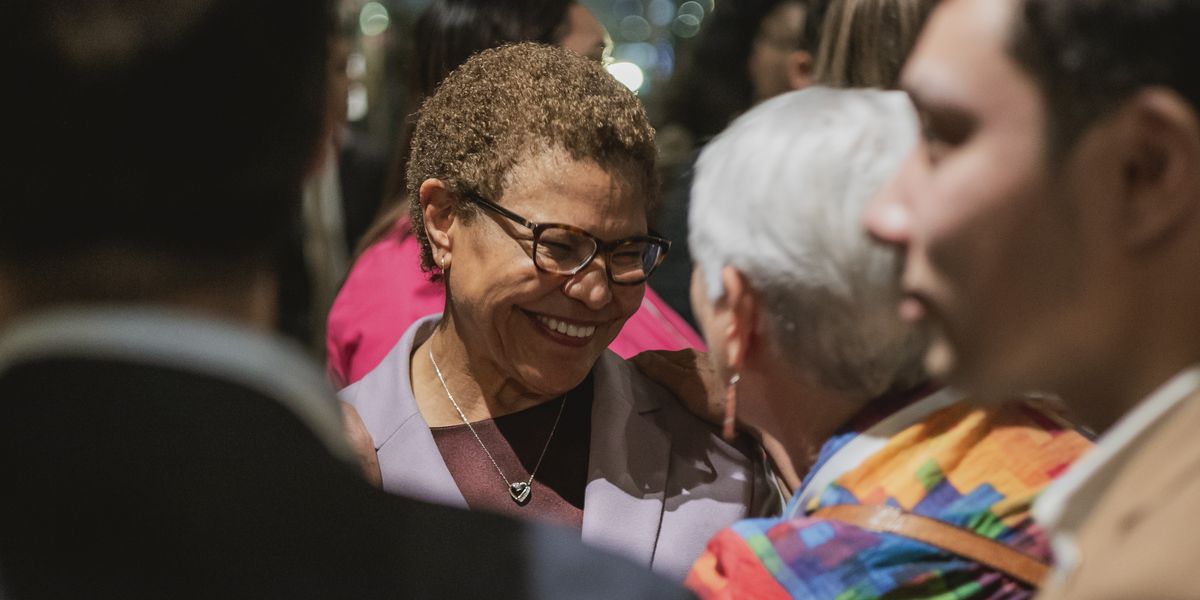
Los Angeles Mayor Karen Bass speaking with attendees at the event focused on the housing crisis, where she delivered an opening speech on the issue that focused on both the local battles for housing and, as a former member of Congress, the need for federal action. (Photo: © Bryan Giardinelli / The Sanders Institute)
Democratic Los Angeles Mayor Karen Bass, who left Congress to provide more local leadership, said she did so because she saw that the rightward political shift at the local government level was set to take the city backward on a numerous fronts, including on the issues of affordable housing, education, and homelessness.
Calling housing "one of the most important issues of our lifetime right now," Bass praised the Sanders Institute's focus on the crisis and for bringing the event to California. "I know that you are going to be the brains behind what we need, which is a national movement," said Bass. "That's the only thing that is going to bring about the type of fundamental change that we need."
"What we need... is a national movement." —Los Angeles Mayor Karen Bass
Speaking after Jayapal—who had told the audience the battle for better housing policy in the United States should be viewed much like the battle for universal healthcare—Bass acknowledged there are things on the housing agenda that will require action by leaders at every level of government.
"But nothing takes the place of the grassroots day-to-day organizing that is needed," she said, "so that we can win what Pramila said: Housing should be a human right in the richest country in the history of the world, just like healthcare should be a human right."
According to Sen. Sanders, who delivered the keynote address and was an active participant throughout, the purpose of the gathering was to get beyond talk in order to get down to the real work of making change.
"Our task is to organize and to educate," Sanders said. "It's easy to come up with rhetoric—which I have done once or twice in my life—but when you're the mayor of a city, you're going to need some concrete plans. How do you do it? You're going to have to bring a lot of smart people together to figure out the best way forward."
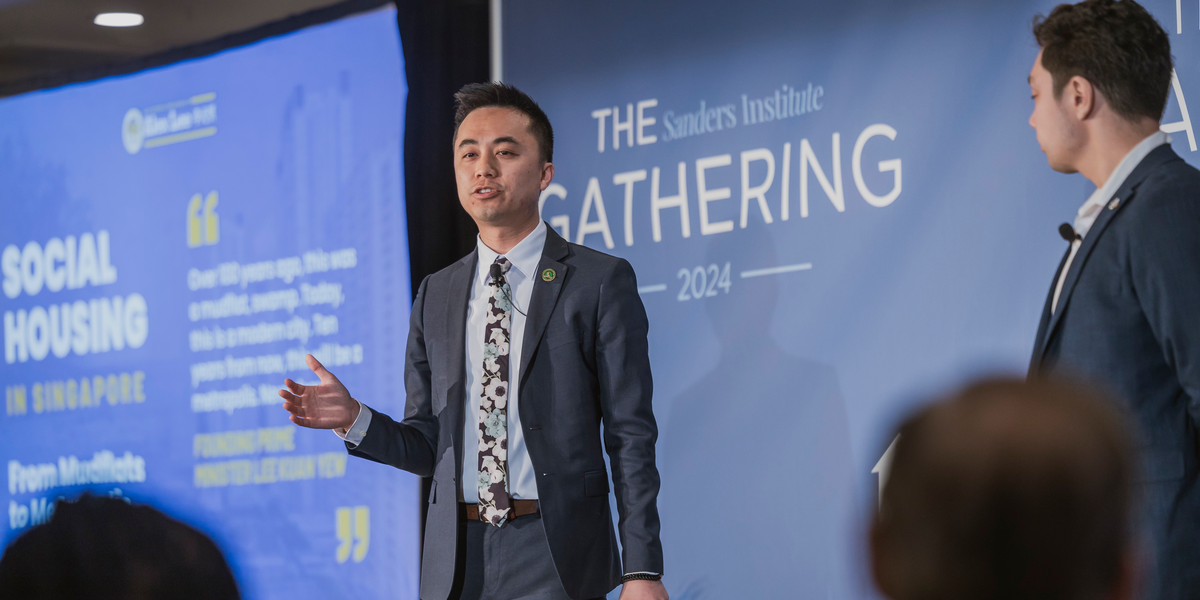
California Assemblyman Alex Lee (D-25), center, and South San Francisco Mayor James Coleman, right, present on social housing models during the event in Los Angeles on Thursday, April 4, 2024. (Photo: © Bryan Giardinelli / The Sanders Institute)
A constant theme at the event was that not only does the housing crisis demand progressive solutions, but the implementation of those solutions are themselves opportunities to revive democracy, increase social cohesion, and expand the public imagination.
In their joint presentation on social housing, California Assemblymember Alex Lee (D-25) and South San Francisco Mayor James Coleman, also a Democrat, detailed a vision for "social housing" which aims to demolish preconceived notions that tend to dominate understandings of "public housing" throughout the United States.
When it comes to defining the term "social housing," Lee explained that he likes to "keep it simple." Social housing, he said, "is beautiful, sustainable, and publicly led developed housing that is available to everyone and for everyone."
The idea of universality, he emphasized, is critical in the U.S. context where public housing is typically subsidized housing only for low-income individuals or families. Social housing models across the world provide housing across economic classes, which creates more buy-in from communities and residents.
"There's a very deliberate reason of why we stick to the term social housing," Lee said, "even though it is three letters away from a scary thing that Americans fear." But it is the term used around the world, he explained—both in highly capitalistic economies like Singapore's as well as in the various social democracies of Europe and beyond.
Because it's housing for everyone—the poor, the middle class, and even the upper-middle class—Lee and Coleman explained that "universality" and the lack of means-testing are core components of a model they believe can transform people's understanding of what's possible in this country.
"With social housing," argued Coleman, "you'll see broad spots of the public be able to look at it and say: 'That is quality housing. I want to live there. I want my children to live there and I know I'm going to be paying lower rents than market rate.' And when people start seeing that, then they're going to want to continue to invest in social housing and we won't see the decades of disinvestment that we have seen here in the United States for our public housing program."
In an interview with Common Dreams, Lee offered a parallel example.
"In America," he said, "there is no constitutional guarantee of education, yet every parent will wake up tomorrow not having a single doubt in their mind that their child will go to school." Lee acknowledged not all children go to the same kinds of school, but said that people never doubt that education will be there for their families.
"But there is not the similar sense of options in housing—people don't have that." But they should, he said, and there are models out there—not just abroad but also examples in the U.S.—that show how it could work.
Citing housing construction in the post-war years, Lee said the country has shown it's capable of amazing things when it comes to housing.
"We could end the housing crisis in four years, at true scale," said Lee. "That's why it's really important to prove that this can work at the state level, especially in a state as populous as California. If we prove the concept here, we can show nationally how it can be done."
 Actor and activist Jane Fonda and community organizer Nalleli Cobo speak to the audience at The Gathering. (Photo: © Bryan Giardinelli / The Sanders Institute)
During another session, actor and activist Jane Fonda presented alongside local activist Nalleli Cobo, a cancer survivor who has been fighting the oil industry that operates drilling wells in her urban neighborhood since she was a child.
Cobo, co-founder of the South Central Youth Leadership Coalition and a 2022 Goldman Environmental Prize winner for the activism that she initiated while still a teenager living in South Los Angeles, told the audience that the hard-fought victories she and her allies were able to win against the fossil fuel industry "were made possible because of a frontline community that was historically viewed as silenced, invisible, and disposable finally said: 'Enough is enough. We deserve to open our windows and our home and we deserve to breathe clean air.'"
"This is the largest crisis humanity has ever faced. We're running out of time and we have to fight back." —Jane Fonda
Living her whole life in a home neighboring a fossil fuel operation beset Cobo with health challenges throughout her childhood and ultimately led to a cancer diagnosis. Now three years in remission, she said affordable and healthy housing is something that every single member of society is entitled to.
"They may not be drilling in your community right now, but they can be unless we stand up and fight back," she said.
With nearly 3 million Californians living within a mile or less from oil and gas drilling wells, Fonda championed the courage and determination of Cobo to end this toxic practice, including with a ballot fight in California this year to ban such operations permanently.
"What Nalleli didn't tell you," Fonda told the audience when she took the podium, "is that at age 10 and 11, she and her mother had to be put into a witness protection program because of her organizing in the community to shut the oil well down; that at 19 she had to have a total hysterectomy; that her dream was to be a dancer and now that is no longer possible for her."
People must understand, Fonda said, that "the climate crisis is actually a massive health crisis" for people living in communities made toxic by fossil fuels all over the country and around the world. A cancer survivor in her own life, Fonda said she was told by someone when she threatened to tattoo the phrase "climate emergency" on her bald head if the chemotherapy took her hair that "the cancer community doesn't like to be looped in with other causes."
"Causes?!" she recalled exclaiming in response. "Honey, the climate crisis is not a cause. This is the largest crisis humanity has ever faced. We're running out of time and we have to fight back."
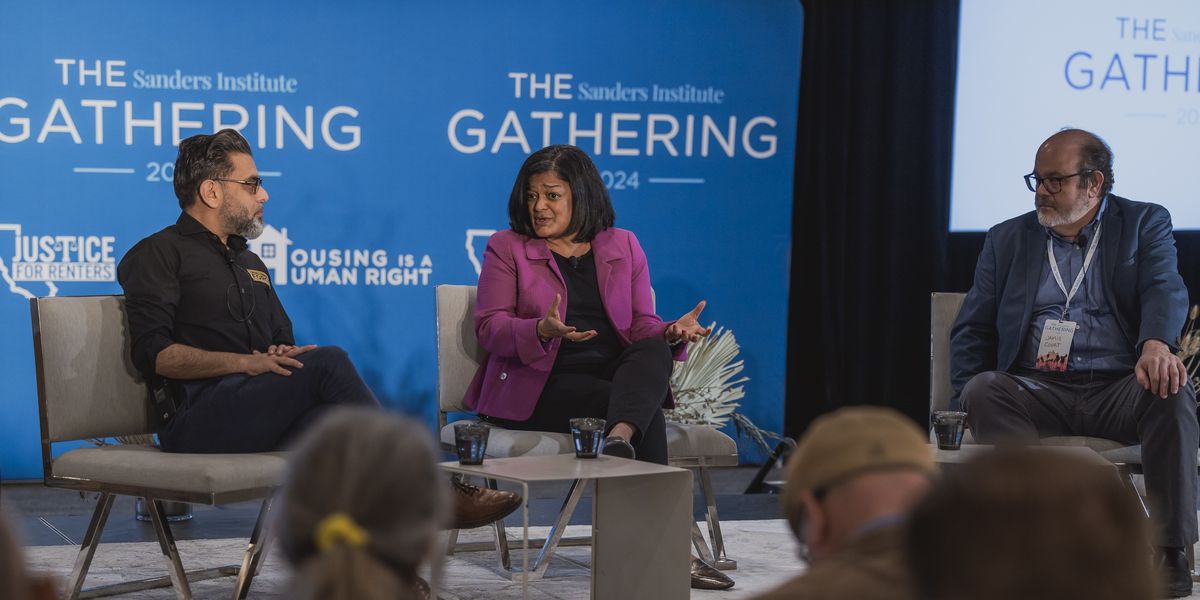
(From left): Author and labor organizer Saket Soni, Rep. Pramila Jayapal (D-Wash.), and Consumer Watchdog's Jamie Court. (Photo: © Bryan Giardinelli / The Sanders Institute)
Also on the climate front—which highlighted the intersectional style of the Sanders Institute's gathering—Congresswoman Jayapal joined with author and labor organizer Saket Soni as well as Jamie Court of the California-based Consumer Watchdog, an advocacy group, to discuss the linked issues of community resilience amid extreme weather disasters and soaring insurance costs that have arrived hand-in-hand with rising global temperatures.
While Soni in his work has been at the forefront of building up climate resilience in communities for decades—both by helping to mitigate the impact of extreme weather and also working on disaster relief and rebuilding—Jayapal explained that she has a bill in the U.S. House—called the Climate Resilience Workforce Act—that would formalize processes and establish funding to make such work a more integral part of federal, state, and local planning.
Among others, one component of the legislation would be to make sure that people in communities "disproportionately affected by climate change are actually at the table" when federal funds are dispersed.
According to the panel, the increasing impacts of climate change are a key driver of housing costs but nothing will get better without a justice lens through which to see the crisis of housing in an increasingly hotter world that is resulting in more floods, larger fires, and too little accountability for the corporate interests profiting from those extremes.
"In the context of our climate crisis," Soni explained during the panel discussion, "there is an opening for justice that Jayapal's bill is trying to take and that we're all trying to take. There is an opening where resilience is a framework that can accelerate housing justice, justice for the incarcerated, and justice for immigrants. And that's what we should all be trying to do, is look at how resilience is a real majoritarian framework—maybe one of the last ones left in our country—and inside of that there is so much consensus that we can push justice forward in many, many ways."
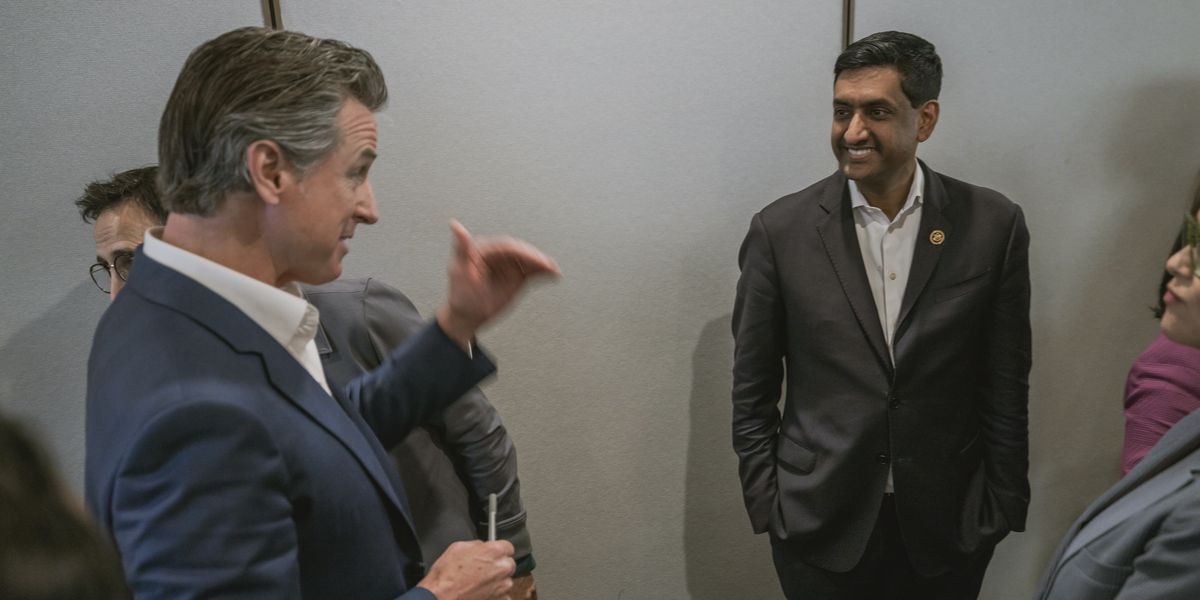
California's Democratic Gov. Gavin Newsom talks with Rep. Ro Khanna (D-Calif.) during the event in Los Angeles on Thursday, April 4, 2024. (Photo: © Bryan Giardinelli / The Sanders Institute)
On the state level, California's Democratic Gov. Gavin Newsom arrived at the event to champion the recently approved measure known as Proposition 1, which will, among other things, provide state revenue from a nearly $6.4 billion bond to build and service more treatment beds for those experiencing severe mental health and addiction disorders as a way to curb homelessness across California.
During a panel discussion with Sacramento Mayor Darrell Steinberg and California Secretary of Health & Human Services Dr. Mark Ghaly, both Democrats, Newsom said that Prop. 1 would allow for a "strike force" that could better confront the overlapping issues of housing, homelessness, mental health, and substance addiction disorders.
Acknowledging the potential for hyperbole, Newsom said he believes what's contained in the new law "are the most significant" and far-reaching "behavioral health reforms happening anywhere in the United States of America."
While the debate over Proposition 1 was heated in the state, including among progressives who landed on various sides of the initiative, a subsequent panel focused on the implementation mostly landed on the side of cautious optimism for what it could be and what kind of model it might represent.
"There is a lot of potential for Prop 1," said Dr. Margot Kushel, professor of medicine at University of California San Francisco and director of the UCSF Benioff Homelessness and Housing Initiative.
"No matter where you stood on it before it passed," Kushel added, "there is a lot of potential now that it's here and we need to exercise that in the right way, which is that we need to be sure that it is used to enable these living-in-the-community, choice-driven, client-driven, but very supportive programs for people who are suffering terribly."
The evidence for what it will take to solve the mental health crisis as it pertains to homelessness, said Kushel, is overwhelming. "You don't need me to do more studies on it," she said, "we actually just need to bring to bear that funding [supplied by Prop 1] to solve some of these really sticky funding issues so that we can create the workforce, sustain the workforce, and create the programming" that will really serve the unhoused population "with dignity" in the communities they live in.
Several researchers presented on the severe impacts that homelessness and housing insecurity have on students and young people, including those in the foster care system. Other presenters described how community land trusts and other innovative housing collaborations, including faith-based initiatives, are providing models that could be replicated nationwide. Separately, a panel focused on the struggle of homeless veterans told the harrowing tale of former U.S. soldiers denied access to housing and care in Los Angeles who remain in a protracted legal fight with the U.S. Department of Veterans Affairs over land set aside for exactly that purpose.
"We don't suffer from scarcity in this country, we suffer from greed. We have enough money to house people and to create situations where people aren't going to fear for what tomorrow's going to look like." —Rep. Pramila Jayapal
In her reflections as a presenter and participant of the gathering, Congresswoman Jayapal explained to Common Dreams that the event was significant because "it lifted up an issue that" has been central for progressives but too often ignored and neglected by those in the media and within both major political parties.
"We don't suffer from scarcity in this country. We suffer from greed," Jayapal said. "We have enough money to house people, and to create situations where people aren't going to fear for what tomorrow's going to look like."
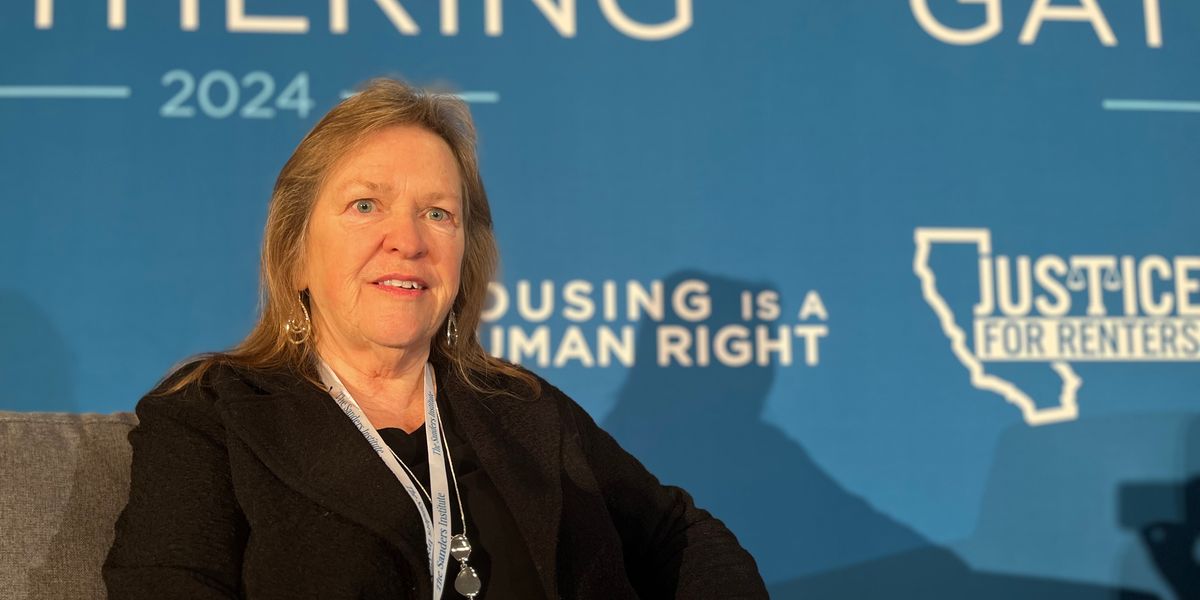
Sanders Institute co-founder Dr. Jane O'Meara Sanders in Los Angeles on Friday, April 5. "We're talking about transformational change," she said about the event. (Photo: J. Queally / Common Dreams)
The germination of the gathering, Jane Sanders explained to Common Dreams in the wake of the three days, was like "peeling back the onion" as one area of focus led to another, and a discussion with one invited expert resulted in the introduction to another.
As she realized the issue of housing was such a "hornet's nest" of intersecting issues, overlapping viewpoints, and innovative thinking, Sanders said it became increasingly clear that was exactly the reason to go forward with the event.
"We're talking about transformational change," she said of the work that she, Driscoll, and their colleagues are doing at the Sanders Institute. "None of us are very interested in making small incremental change, which might mean building some more affordable housing or supporting this or that initiative. That's not what this is about."
The Sanders Institute was initially in founded in 2018 with the goal of extending the energy, ideas, and political movement sparked during Bernie's presidential run in 2016. When the senator decided to run again in 2020, Jane and Dave decided to pause operations and then went into full hiatus when the coronavirus pandemic hit. In this context, holding an intimate housing conference in Los Angeles was conceived as a reawakening for the organization and a chance to let people know the time has now arrived to continue their original mission.
Reflecting on his experience after the gathering had concluded, Driscoll said it had been great to see so many people—whether in government or through an organization or at the grassroots level—having the chance to connect, learn from one another, and hopefully collaborate in the future.
"Sometimes this can be a lonely fight, whether or not you're fighting for housing or you're fighting for healthcare, sometimes you feel like you're not getting anywhere," he said. "But when you bring all these people together like we did over the last couple days, I felt at times a real energy in the room. People felt good about a really tough fight. So I think it inspired and fired people up, and also gave people hope for the future."
While they don't have it pinned down yet—that was the admission of the gathering—the point going forward is to clarify what the progressive agenda on housing should be and help push out to others how that fits into the broader movement for bold and lasting change.
When it comes to the opponents of such transformational proposals—national rent control, expansion of social housing, ending homelessness, or forging the Green New Deal for public housing—Driscoll said it's important that people understand powerful financial interests will fight such ideas with everything they have.
"We need to start calling people out like we did with tobacco money or with oil money," Driscoll said. "We need to start calling people out and saying, you're taking money from big real estate and developers that are causing this harm and stopping this progress." As is true in so many other areas of policy and politics, he said, following the money will be key in the battles to come.
"I don't like to call out individuals," Sanders said, "but we need to call out the system."
"It's a systematic problem that we don't say 'housing is a human right.' That's not shared in a capitalist society," she continued. "Not everybody would agree with that statement. We agree with that statement, but it's not one of those accepted truisms in this country. So what's our goal? That it become one."

Sen. Bernie Sanders (I-Vt.), Rep. Pramila Jayapal (D-Wash.), and Rep. Ro Khanna (D-Calif.) made their case for a bold affordable housing push during a gathering last week in Los Angeles, California, the epicenter of the crisis. The trio of lawmakers and other participants touted a wide range of potential policy solutions during the three-day event, from national rent control to social housing to a Green New Deal for public housing.
"Housing has not been at the level it should be on the progressive agenda," Sanders said during a panel discussion with Jayapal and Khanna at the Los Angeles gathering, which was organized by the Sanders Institute—a think tank co-founded by the Vermont senator's wife, Jane O'Meara Sanders, and their son, executive director Dave Driscoll.
"This is the richest country on Earth. We're not a poor country," the senator continued. "Can we build affordable housing that we need? Can we protect? And the answer is of course we can. But it will require a massive grassroots effort to transform our political system to do that."
The other two panelists agreed, stressing that housing intersects with every aspect of life and should be a human right, not a commodity.
"How do you apply for a job if you don't have an address? How do you get your health insurance if you don't have a stable place? How do you deal with kids if you're houseless?" asked Jayapal, the chair of the Congressional Progressive Caucus (CPC). "I think the good news is housing is at the top of our agenda now."
"Pramila is right," said Khanna, "that housing has become front and center."
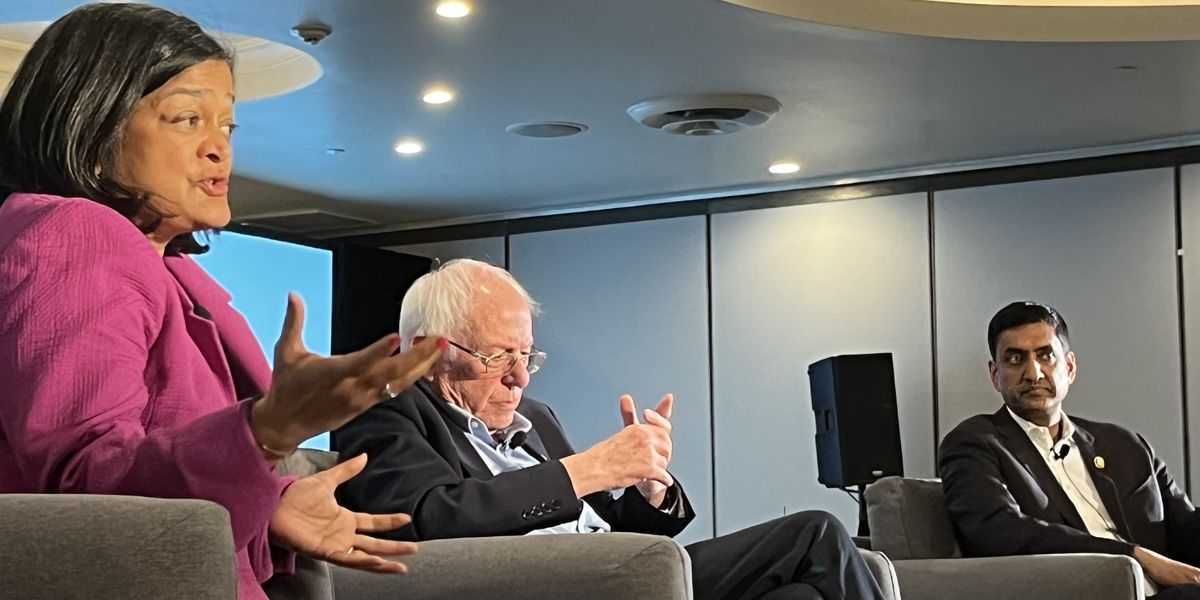 Rep. Pramila Jayapal, Sen. Bernie Sanders, and Rep. Ro Khanna discuss housing at the Los Angeles gathering. (Photo: J. Queally/Common Dreams)
In November 2021, in the midst of a deadly pandemic that left tens of millions of Americans at imminent risk of eviction, the U.S. House passed legislation that would have made the single largest investment in affordable housing in the nation's history—over $170 billion.
That legislation, known as the Build Back Better Act, died in the U.S. Senate, felled by the unanimous opposition of the chamber's Republicans and two right-wing Democrats—Sens. Joe Manchin of West Virginia and Kyrsten Sinema of Arizona, who has since left the party to become an Independent.
The ire for Manchin and Sinema was palpable at the gathering; "two sellout Democrats" was how Sanders described the pair.
But the framework offered by the ill-fated Build Back Better package—which included tens of billions of dollars in funds for rental assistance and much-needed public housing renovations—remains a guidepost for progressives, who pushed housing to the forefront of negotiations over the bill.
"We laid the groundwork for this investment. We made the arguments for why this has to be a top priority," Jayapal said in a speech at the event. "The rent is too damn high. And that is true everywhere across the country."
The daunting situation facing tenants, prospective homeowners, and unhoused people appears even more stark when contrasted with the exploding fortunes of private equity behemoths and billionaire investors fueling—and benefiting from—soaring housing costs.
In recent years, private equity firms notorious for gutting companies and making off with a quick profit have been on a buying spree in the American housing sector, snatching up apartment buildings and single-family rental homes—sometimes with no intention of even housing tenants.
The reach of corporate landlords extends from student apartments to senior housing, from older buildings to newer luxury high-rises. One recent analysis estimates institutional investors could control as much as 40% of all single-family homes in the U.S. by decade's end.
Growing corporate ownership of the nation's housing stock has been disastrous for tenants already squeezed by other elevated living costs. The experiences of tenants across the U.S. and empirical research have shown that private-equity landlords are more likely to jack up rent (sometimes with the help of profit-maximizing algorithms), skimp on basic maintenance, and aggressively pursue evictions.
A 2022 report authored by city officials in Berkeley, California expressed alarm at the "nationwide trend where large institutional investors have since the beginning of the pandemic purchased an enormous number of homes; over 75% of these offers are in all cash, and many without any inspections, pricing prospective homeowners out of the real estate market."
That trend has drawn scrutiny from local and national lawmakers, including attendees of the Sanders Institute gathering in Los Angeles.
Khanna, the lead sponsor of the Stop Wall Street Landlords Act, told Common Dreams on the sidelines of the gathering that preventing large institutional investors from seizing an ever-growing share of the U.S. housing market is an important part of tackling the broader affordability crisis—but isn't sufficient on its own.
"I would say that the defining theme of this conference is that there needs to be some regulation on rent, and then in addition, there needs to be an increase of housing supply and a prevention of Wall Street from buying up single-family homes."
Sanders echoed that message in a separate interview with Common Dreams.
"We really need a revolution in housing and how we deal with housing," said Sanders, calling for a comprehensive approach that "deals with tenants' rights, deals with taking on the corporate interests, deals with building massive amounts of affordable housing, deals with public housing."
"It's got to be placed way up in the agenda," Sanders added.
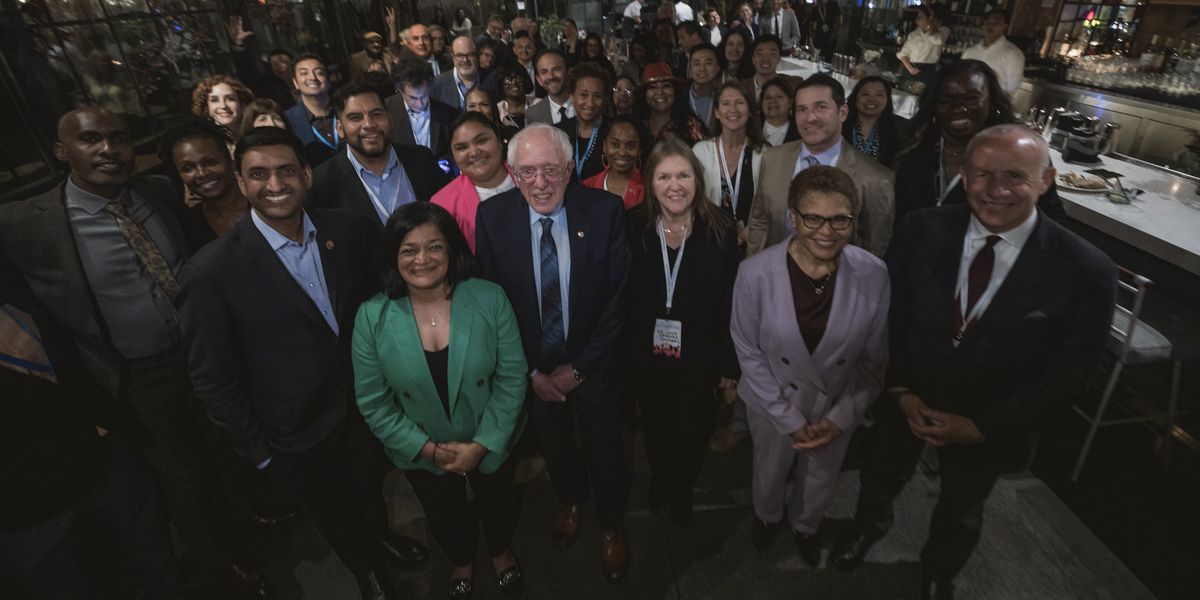 Opening night attendees at The Sanders Institute's conference focused on the national housing crisis. (In front, from left): Prof. Tyrone Howard, Rep. Ro Khanna (D-Calif), Rep. Pramila Jayapal (D-Wash.), Sen. Bernie Sanders (I-Vt.), Dr. Jane O'Meara Sanders, The Sanders Institute's Dave Driscoll, Los Angeles Mayor Karen Bass, and Sacramento Mayor Darrell Steinberg. (Photo: © Bryan Giardinelli/The Sanders Institute)
There's not a single state in the U.S. that has an adequate supply of affordable rental housing for the lowest-income renters, according to the National Low Income Housing Coalition, which estimates that the nation's shortage of affordable housing has grown to roughly 7.3 million units.
A recent Harvard study found that more than 12 million Americans are paying more than 50% of their income on housing.
The dearth of affordable housing nationwide has fueled state and local efforts to boost supply and rein in out-of-control rent. An initiative on the November ballot in California—which has the largest unhoused population in the country—aims to repeal a real estate industry-backed state law that limits the power of local governments to implement rent control measures.
Such rent control preemption laws exist in at least 30 states, underscoring the need for federal action.
"We really need the federal government's help here," Margot Kushel, a professor of medicine at the University of California, San Francisco who led the largest study of U.S. homelessness in decades, said at the gathering.
The study, which examined homelessness in California, concluded that "for most of the participants, the cost of housing had simply become unsustainable."
In the face of sky-high housing costs across the country, lawmakers and advocates convened by the Sanders Institute made the case for pursuing rent control measures at the national level. Polling indicates that would be popular: A
survey conducted by Data for Progress and YouGov found that 56% of U.S. voters would support "a policy to cap rent increases to 5% a year."
Speaking on the event's opening night, Khanna rejected the neoliberal economic orthodoxy that says rent control—like other price controls—would limit supply, worsening the nation's shortage of affordable housing.
Khanna pointed to studies out of New Jersey and elsewhere showing that local rent control measures did not, in fact, negatively affect housing supply.
"It reminds me of the arguments they used to give about the minimum wage," said Khanna, pointing to the debunked notion that minimum wage hikes harm employment. "We need to argue very clearly that rent regulation—making sure that rent doesn't go too high, making sure that it doesn't exceed inflation—is about creating balance for renters in the market and not being exploited by landlords in a time of scarcity. At the same time, we should build more housing. These two aren't mutually exclusive."
Experts agree. Last year, as Common Dreams reported at the time, a group of economists including Mark Paul of Rutgers University, James K. Galbraith of the University of Texas at Austin, and Isabella Weber of the University of Massachusetts Amherst signed a letter urging the Biden administration to mandate rent caps and other tenant protections as conditions for federally backed mortgages, which support nearly half of the country's rental units.
The economists' push was part of a broader tenant-led rent control campaign backed by
climate researchers, local elected officials, and others.
In an op-ed for The American Prospect last year, Paul argued that "to truly transform the housing sector, the United States will need to embrace complementary policies to increase the number of affordable and market-rate housing units, encourage more construction and density through changes to zoning laws, and build millions of units of social housing—high-quality public housing for people across the income spectrum."
"It's a tall order," he wrote. "But embracing rent control is a commonsense place to start."
Khanna, who served as national co-chair of Sanders' 2020 presidential campaign, told Common Dreams that he wants President Joe Biden to embrace rent control as a plank of his 2024 bid, as the Vermont senator did four years ago.
"I think the president should endorse caps on rent," Khanna said. "I think that would be one of the ways to win back a lot of younger voters, a lot of progressive voters who feel that they're having a hard time making ends meet and they're saddled with student debt. They're burdened with high rent. They often have high credit card payments because of the interest rates and they're struggling in an economy that isn't working for them."
Last week, the Biden administration announced that it would limit rent increases at properties funded by the federal Low-Income Housing Tax Credit—a limited move that affordable housing campaigners welcomed as a step in the right direction.
“The rent is still too damn high, but this cap will provide stability to more than a million tenants," Tara Raghuveer, the director of the National Tenant Union Federation, said in response.
"The idea that we have millions of families in America paying 50% or more of their income on housing is unconscionable." —Sen. Bernie Sanders
In recent years, progressives in Congress have introduced numerous bills aimed at curbing runaway housing costs, boosting supply, bolstering tenants' rights, and ensuring the nation's housing stock is climate-resilient.
The Green New Deal for Public Housing Act, spearheaded by Sanders and Rep. Alexandria Ocasio-Cortez (D-N.Y.), would repeal the Faircloth Amendment—which artificially limits the construction of new public housing—and invest over $230 billion into making the country's public housing stock energy-efficient and zero-carbon.
Other legislation includes Rep. Cori Bush's (D-Mo.) Unhoused Bill of Rights, Jayapal's Housing Is a Human Right Act, Rep. Delia Ramirez's (D-Ill.) Tenants' Right to Organize Act, and Rep. Maxwell Frost's (D-Fla.) End Junk Fees for Renters Act.
Some of those bills make up part of the first-of-its-kind Renters Agenda unveiled last month by the congressional Renters Caucus, which was founded last year by Rep. Jimmy Gomez (D-Calif.), a Los Angeles representative who also spoke at the Sanders Institute gathering.
"Our goal is to make sure that the Renters Agenda is at the top of the Democratic Party agenda," Gomez said. "We have to tackle this problem if we want a healthy economy and we want our families to thrive."
But such legislation stands no chance of passing without major shifts in the composition of Congress and a president committed to ambitious solutions to the housing crisis.
During his State of the Union address last month, Biden pointed to steps his administration has taken to combat algorithmic price-fixing in the housing market and urged Congress to take action to provide relief for renters and boost the nation's lagging supply of affordable housing.
In an interview with Common Dreams, Jayapal emphasized that there's a lot more the president can do through executive action—some of which is laid out in the CPC's executive action agenda. She also argued that Biden should put housing costs at the forefront of his campaign against presumptive GOP nominee Donald Trump, who repeatedly sought steep cuts to federal housing programs during his first four years in office.
"We don't suffer from scarcity in this country, we suffer from greed," Jayapal said. "We have enough money to house people, and to create situations where people aren't going to fear for what tomorrow's going to look like, and are able to raise a family and think about more opportunity for themselves in the future. So I think housing is at the center of that."
Sanders said Jayapal is "exactly right."
"The idea that we have millions of families in America paying 50% or more of their income on housing is unconscionable," the Vermont senator told Common Dreams. "And the idea that you're having these private equity firms, Blackstone, et cetera, gobbling more and more of these houses up is unacceptable."
That, Sanders said, "we've got to deal with."
