SUBSCRIBE TO OUR FREE NEWSLETTER
Daily news & progressive opinion—funded by the people, not the corporations—delivered straight to your inbox.
5
#000000
#FFFFFF
To donate by check, phone, or other method, see our More Ways to Give page.
Daily news & progressive opinion—funded by the people, not the corporations—delivered straight to your inbox.
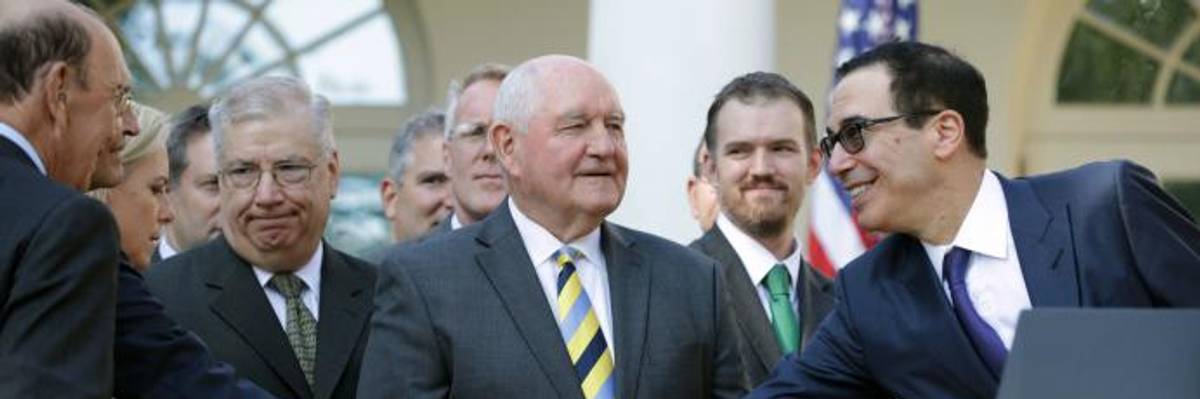
Commerce Secretary Wilbur Ross, Homeland Security Secretary Kirstjen Nielsen, Agriculture Secretary Sonny Perdue, and Treasury Secretary Steven Mnuchin congratulate one another before a news conference with President Donald Trump to discuss a revised U.S. trade agreement with Mexico and Canada at the White House on Oct. 1, 2018. (Photo: Chip Somodevilla/Getty Images)
Environmentalists on Monday slammed President Donald Trump's replacement for the North American Free Trade Agreement (NAFTA), with Food & Water Watch executive director Wenonah Hauter warning that it "would enshrine and globalize Trump's deregulatory zealotry into a trade pact that would outlast the administration and imperil future efforts to protect consumers, workers, and the environment."
Presented as the United States-Mexico-Canada Agreement (USMCA), many have noted that Trump's trade deal, as Bloomberg put it, "looks more like a rebranding than a revolution," despite Trump's vows when he was a presidential candidate that he would negotiate a new deal that's dramatically better for American workers. As experts and campaigners comb through the details of the agreement, environmental activists are homing in on provisions they warn would endanger people and the planet.
Calling on Congress to reject the deal, Hauter outlined in a statement how USMCA:
"Based on our initial read, Trump's trade deal poses a considerably greater threat to commonsense regulatory protections," Hauter concluded. "A closer look at the text will undoubtedly reveal a host of pro-polluter, pro-fossil fuel industry, pro-Wall Street deregulation that has been a hallmark of Trump's domestic agenda."
While the agreement, unsurprising, does not mention "climate change" or anthropogenic global warming--including in its chapter on environment--as The Huffington Post pointed out, the deal limits the long-criticized investor-state dispute settlement (ISDS) process that corporate powers have used to override local environmental protection regulations.
However, there is a major exception that infuriated activists on Monday. As HuffPost outlined:
Under the rules, firms that have, or may at some point obtain, government contracts to drill or build infrastructure like pipelines and refineries in Mexico--such as ExxonMobil Corp.--can challenge new environmental safeguards Mexican President-elect Andres Manuel Lopez Obrador has vowed to erect.
"It's like saying, 'From here on, we're going to protect the henhouse by keeping all animals away, except for foxes, they're cool,'" Ben Beachy, director of the Sierra Club's living economy program, said in a phone interview.
That's not the only giveaway for the oil and gas industry. The updated deal, which requires congressional approval, preserves a provision that requires the U.S. government to automatically approve all gas exports to Mexico, despite another rule mandating regulators consider the public interest.
While American Petroleum Institute chief executive Mike Sommers on Monday celebrated the provision and encouraged lawmakers to sign off on USMCA, environmentalists such as Doug Norlen, director of economic policy at Friends of the Earth, called USMCA "a corporate giveaway intended to sharply limit the powers of government to protect people and the planet," and "an attack on our ability to hold Big Oil and Gas accountable for the damage they cause to our communities."
Labor advocates such as AFL-CIO trade policy specialist Celeste Drake, meanwhile, called on representatives from all three nations "to go back to the table and finish a deal that creates good, high-wage jobs, protects our environment, and safeguards our democracy." Although Drake said Monday that "there are too many details that still need to be worked out before working people make a final judgment on a deal," she highlighted a few alarming elements.
Broadly, Drake noted, USMCA "moves backward from the original NAFTA in many areas important to working families, including with respect to 'good regulatory practices' (code for using this trade agreement to attack important consumer, health, safety and environmental protections), financial services (providing new tools for Wall Street to attack efforts to rein in its continuing abuses), affordable medicines (extending monopolies for brand-name pharmaceuticals at the expense of affordability), and privacy of personal data."
Dear Common Dreams reader, It’s been nearly 30 years since I co-founded Common Dreams with my late wife, Lina Newhouser. We had the radical notion that journalism should serve the public good, not corporate profits. It was clear to us from the outset what it would take to build such a project. No paid advertisements. No corporate sponsors. No millionaire publisher telling us what to think or do. Many people said we wouldn't last a year, but we proved those doubters wrong. Together with a tremendous team of journalists and dedicated staff, we built an independent media outlet free from the constraints of profits and corporate control. Our mission has always been simple: To inform. To inspire. To ignite change for the common good. Building Common Dreams was not easy. Our survival was never guaranteed. When you take on the most powerful forces—Wall Street greed, fossil fuel industry destruction, Big Tech lobbyists, and uber-rich oligarchs who have spent billions upon billions rigging the economy and democracy in their favor—the only bulwark you have is supporters who believe in your work. But here’s the urgent message from me today. It's never been this bad out there. And it's never been this hard to keep us going. At the very moment Common Dreams is most needed, the threats we face are intensifying. We need your support now more than ever. We don't accept corporate advertising and never will. We don't have a paywall because we don't think people should be blocked from critical news based on their ability to pay. Everything we do is funded by the donations of readers like you. When everyone does the little they can afford, we are strong. But if that support retreats or dries up, so do we. Will you donate now to make sure Common Dreams not only survives but thrives? —Craig Brown, Co-founder |
Environmentalists on Monday slammed President Donald Trump's replacement for the North American Free Trade Agreement (NAFTA), with Food & Water Watch executive director Wenonah Hauter warning that it "would enshrine and globalize Trump's deregulatory zealotry into a trade pact that would outlast the administration and imperil future efforts to protect consumers, workers, and the environment."
Presented as the United States-Mexico-Canada Agreement (USMCA), many have noted that Trump's trade deal, as Bloomberg put it, "looks more like a rebranding than a revolution," despite Trump's vows when he was a presidential candidate that he would negotiate a new deal that's dramatically better for American workers. As experts and campaigners comb through the details of the agreement, environmental activists are homing in on provisions they warn would endanger people and the planet.
Calling on Congress to reject the deal, Hauter outlined in a statement how USMCA:
"Based on our initial read, Trump's trade deal poses a considerably greater threat to commonsense regulatory protections," Hauter concluded. "A closer look at the text will undoubtedly reveal a host of pro-polluter, pro-fossil fuel industry, pro-Wall Street deregulation that has been a hallmark of Trump's domestic agenda."
While the agreement, unsurprising, does not mention "climate change" or anthropogenic global warming--including in its chapter on environment--as The Huffington Post pointed out, the deal limits the long-criticized investor-state dispute settlement (ISDS) process that corporate powers have used to override local environmental protection regulations.
However, there is a major exception that infuriated activists on Monday. As HuffPost outlined:
Under the rules, firms that have, or may at some point obtain, government contracts to drill or build infrastructure like pipelines and refineries in Mexico--such as ExxonMobil Corp.--can challenge new environmental safeguards Mexican President-elect Andres Manuel Lopez Obrador has vowed to erect.
"It's like saying, 'From here on, we're going to protect the henhouse by keeping all animals away, except for foxes, they're cool,'" Ben Beachy, director of the Sierra Club's living economy program, said in a phone interview.
That's not the only giveaway for the oil and gas industry. The updated deal, which requires congressional approval, preserves a provision that requires the U.S. government to automatically approve all gas exports to Mexico, despite another rule mandating regulators consider the public interest.
While American Petroleum Institute chief executive Mike Sommers on Monday celebrated the provision and encouraged lawmakers to sign off on USMCA, environmentalists such as Doug Norlen, director of economic policy at Friends of the Earth, called USMCA "a corporate giveaway intended to sharply limit the powers of government to protect people and the planet," and "an attack on our ability to hold Big Oil and Gas accountable for the damage they cause to our communities."
Labor advocates such as AFL-CIO trade policy specialist Celeste Drake, meanwhile, called on representatives from all three nations "to go back to the table and finish a deal that creates good, high-wage jobs, protects our environment, and safeguards our democracy." Although Drake said Monday that "there are too many details that still need to be worked out before working people make a final judgment on a deal," she highlighted a few alarming elements.
Broadly, Drake noted, USMCA "moves backward from the original NAFTA in many areas important to working families, including with respect to 'good regulatory practices' (code for using this trade agreement to attack important consumer, health, safety and environmental protections), financial services (providing new tools for Wall Street to attack efforts to rein in its continuing abuses), affordable medicines (extending monopolies for brand-name pharmaceuticals at the expense of affordability), and privacy of personal data."
Environmentalists on Monday slammed President Donald Trump's replacement for the North American Free Trade Agreement (NAFTA), with Food & Water Watch executive director Wenonah Hauter warning that it "would enshrine and globalize Trump's deregulatory zealotry into a trade pact that would outlast the administration and imperil future efforts to protect consumers, workers, and the environment."
Presented as the United States-Mexico-Canada Agreement (USMCA), many have noted that Trump's trade deal, as Bloomberg put it, "looks more like a rebranding than a revolution," despite Trump's vows when he was a presidential candidate that he would negotiate a new deal that's dramatically better for American workers. As experts and campaigners comb through the details of the agreement, environmental activists are homing in on provisions they warn would endanger people and the planet.
Calling on Congress to reject the deal, Hauter outlined in a statement how USMCA:
"Based on our initial read, Trump's trade deal poses a considerably greater threat to commonsense regulatory protections," Hauter concluded. "A closer look at the text will undoubtedly reveal a host of pro-polluter, pro-fossil fuel industry, pro-Wall Street deregulation that has been a hallmark of Trump's domestic agenda."
While the agreement, unsurprising, does not mention "climate change" or anthropogenic global warming--including in its chapter on environment--as The Huffington Post pointed out, the deal limits the long-criticized investor-state dispute settlement (ISDS) process that corporate powers have used to override local environmental protection regulations.
However, there is a major exception that infuriated activists on Monday. As HuffPost outlined:
Under the rules, firms that have, or may at some point obtain, government contracts to drill or build infrastructure like pipelines and refineries in Mexico--such as ExxonMobil Corp.--can challenge new environmental safeguards Mexican President-elect Andres Manuel Lopez Obrador has vowed to erect.
"It's like saying, 'From here on, we're going to protect the henhouse by keeping all animals away, except for foxes, they're cool,'" Ben Beachy, director of the Sierra Club's living economy program, said in a phone interview.
That's not the only giveaway for the oil and gas industry. The updated deal, which requires congressional approval, preserves a provision that requires the U.S. government to automatically approve all gas exports to Mexico, despite another rule mandating regulators consider the public interest.
While American Petroleum Institute chief executive Mike Sommers on Monday celebrated the provision and encouraged lawmakers to sign off on USMCA, environmentalists such as Doug Norlen, director of economic policy at Friends of the Earth, called USMCA "a corporate giveaway intended to sharply limit the powers of government to protect people and the planet," and "an attack on our ability to hold Big Oil and Gas accountable for the damage they cause to our communities."
Labor advocates such as AFL-CIO trade policy specialist Celeste Drake, meanwhile, called on representatives from all three nations "to go back to the table and finish a deal that creates good, high-wage jobs, protects our environment, and safeguards our democracy." Although Drake said Monday that "there are too many details that still need to be worked out before working people make a final judgment on a deal," she highlighted a few alarming elements.
Broadly, Drake noted, USMCA "moves backward from the original NAFTA in many areas important to working families, including with respect to 'good regulatory practices' (code for using this trade agreement to attack important consumer, health, safety and environmental protections), financial services (providing new tools for Wall Street to attack efforts to rein in its continuing abuses), affordable medicines (extending monopolies for brand-name pharmaceuticals at the expense of affordability), and privacy of personal data."