SUBSCRIBE TO OUR FREE NEWSLETTER
Daily news & progressive opinion—funded by the people, not the corporations—delivered straight to your inbox.
5
#000000
#FFFFFF
To donate by check, phone, or other method, see our More Ways to Give page.
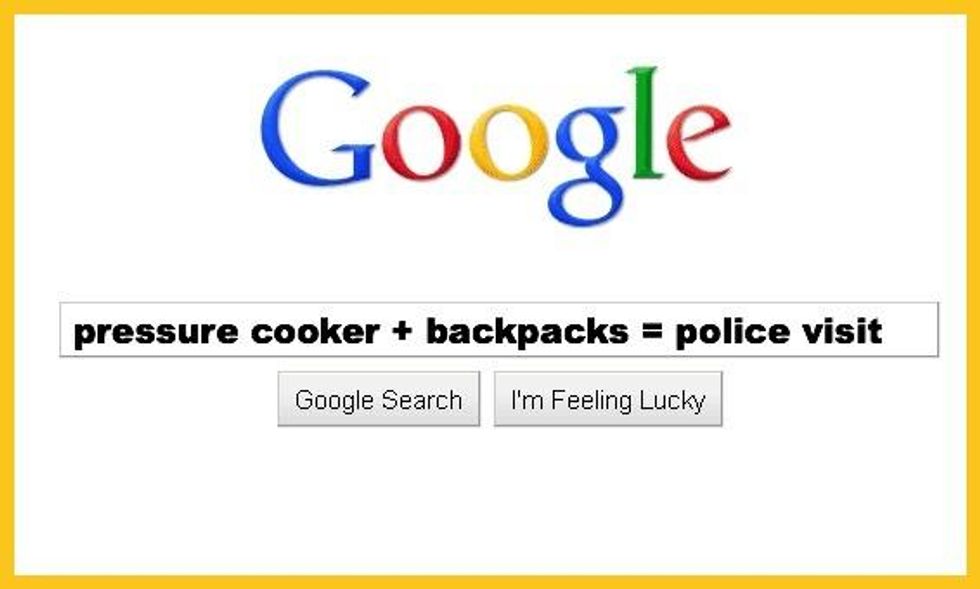
Police in Suffolk County, NY, released the following statement on Thursday evening:
Suffolk County Criminal Intelligence Detectives received a tip from a Bay Shore based computer company regarding suspicious computer searches conducted by a recently released employee. The former employee's computer searches took place on this employee's workplace computer. On that computer, the employee searched the terms "pressure cooker bombs" and "backpacks".
After interviewing the company representatives, Suffolk County Police Detectives visited the subject's home to ask about the suspicious internet searches. The incident was investigated by Suffolk County Police Department's Criminal Intelligence Detectives and was determined to be non-criminal in nature.
Michele Catalano also made a further statement on her website:
We found out through the Suffolk Police Department that the searches involved also things my husband looked up at his old job. We were not made aware of this at the time of questioning and were led to believe it was solely from searches from within our house.
I did not lie or make it up. I wrote the piece with the information that was given. What was withheld from us obviously could not be a part of a story I wrote based on what happened yesterday.
The piece I wrote was the story as we knew it with the information we were told. None of it was fabricated. If you know me, you know I would never do that.
If it was misleading, just know that my intention was the truth. And that was what I knew as the truth until about ten minutes ago. That there were other circumstances involved was something we all were unaware of.
Earlier:
The question is this: Who was monitoring the online Google searches of a Long Island, New York family in order to trigger a visit by six law enforcement officers asking if the family "had any bombs" in their homes?
Michelle Catalano and her family were shaken and made anxious on Wednesday after being visited by "six gentleman in casual clothes"--who turned out to be local police operating under the authority of, or least in connection with, federal agencies--and getting "peppered" with questions resulting from a series of coincidently entered search terms made on their home computer in recent weeks.
Catalano, who writes professionally, explained the whole story in her own words on her blog. In way of background, she explained:
Most of it was innocent enough. I had researched pressure cookers. My husband was looking for a backpack. And maybe in another time those two things together would have seemed innocuous, but we are in "these times" now. And in these times, when things like the Boston bombing happen, you spend a lot of time on the internet reading about it and, if you are my exceedingly curious news junkie of a twenty-year-old son, you click a lot of links when you read the myriad of stories. You might just read a CNN piece about how bomb making instructions are readily available on the internet and you will in all probability, if you are that kid, click the link provided.
Which might not raise any red flags. Because who wasn't reading those stories? Who wasn't clicking those links? But my son's reading habits combined with my search for a pressure cooker and my husband's search for a backpack set off an alarm of sorts at the joint terrorism task force headquarters.
That's how I imagine it played out, anyhow. Lots of bells and whistles and a crowd of task force workers huddled around a computer screen looking at our Google history.
The curious incident, of course, piqued immediate media interest, especially in the aftermath of recent revelations made possible by Edward Snowden about the manner in which the NSA accesses online databases of internet sites, including Google, Facebook, and others.
"Do you have any bombs, they asked. Do you own a pressure cooker? My husband said no, but we have a rice cooker. Can you make a bomb with that? My husband said no, my wife uses it to make quinoa. What the hell is quinoa, they asked."
As the police officers casually searched the home--looking on bookshelves, peaking in the kitchen--they asked the husband numerous questions. As Catalano recounts it:
Where is he from? Where are his parents from? They asked about me, where was I, where do I work, where do my parents live. Do you have any bombs, they asked. Do you own a pressure cooker? My husband said no, but we have a rice cooker. Can you make a bomb with that? My husband said no, my wife uses it to make quinoa. What the hell is quinoa, they asked.
Following up on Catalano's story, the Guardian's Adam Gabbatt talked to a spokesman for the FBI Thursday who said its investigators were not involved directly, but that "she was visited by Nassau County police department ... They were working in conjunction with Suffolk County police department."
Exploring the possible connection between what happened to the Catalanos and recently exposed surveillance programs, The Atlantic's Philip Bump writes:
Ever since details of the NSA's surveillance infrastructure were leaked by Edward Snowden, the agency has been insistent on the boundaries of the information it collects. It is not, by law, allowed to spy on Americans -- although there are exceptions of which it takes advantage. Its PRISM program, under which it collects internet content, does not include information from Americans unless those Americans are connected to terror suspects by no more than two other people. It collects metadata on phone calls made by Americans, but reportedly stopped collecting metadata on Americans' internet use in 2011. So how, then, would the government know what Catalano and her husband were searching for?
It's possible that one of the two of them is tangentially linked to a foreign terror suspect, allowing the government to review their internet activity. After all, that "no more than two other people" ends up covering millions of people. Or perhaps the NSA, as part of its routine collection of as much internet traffic as it can, automatically flags things like Google searches for "pressure cooker" and "backpack" and passes on anything it finds to the FBI.
Or maybe it was something else. On Wednesday, The Guardian reported on XKeyscore, a program eerily similar to Facebook search that could clearly allow an analyst to run a search that picked out people who'd done searches for those items from the same location. How those searches got into the government's database is a question worth asking; how the information got back out seems apparent.
Whatever the trail of surveillance and assessment that led law enforcement to the Catalano house, the result is the same and is reflected best by Michelle Catalano herself.
"Mostly I felt a great sense of anxiety," she said of the incident. "This is where we are at. Where you have no expectation of privacy. Where trying to learn how to cook some lentils could possibly land you on a watch list. Where you have to watch every little thing you do because someone else is watching every little thing you do."
And concluded, "All I know is if I'm going to buy a pressure cooker in the near future, I'm not doing it online."
_____________________________________________________
Police in Suffolk County, NY, released the following statement on Thursday evening:
Suffolk County Criminal Intelligence Detectives received a tip from a Bay Shore based computer company regarding suspicious computer searches conducted by a recently released employee. The former employee's computer searches took place on this employee's workplace computer. On that computer, the employee searched the terms "pressure cooker bombs" and "backpacks".
After interviewing the company representatives, Suffolk County Police Detectives visited the subject's home to ask about the suspicious internet searches. The incident was investigated by Suffolk County Police Department's Criminal Intelligence Detectives and was determined to be non-criminal in nature.
Michele Catalano also made a further statement on her website:
We found out through the Suffolk Police Department that the searches involved also things my husband looked up at his old job. We were not made aware of this at the time of questioning and were led to believe it was solely from searches from within our house.
I did not lie or make it up. I wrote the piece with the information that was given. What was withheld from us obviously could not be a part of a story I wrote based on what happened yesterday.
The piece I wrote was the story as we knew it with the information we were told. None of it was fabricated. If you know me, you know I would never do that.
If it was misleading, just know that my intention was the truth. And that was what I knew as the truth until about ten minutes ago. That there were other circumstances involved was something we all were unaware of.
Earlier:
The question is this: Who was monitoring the online Google searches of a Long Island, New York family in order to trigger a visit by six law enforcement officers asking if the family "had any bombs" in their homes?
Michelle Catalano and her family were shaken and made anxious on Wednesday after being visited by "six gentleman in casual clothes"--who turned out to be local police operating under the authority of, or least in connection with, federal agencies--and getting "peppered" with questions resulting from a series of coincidently entered search terms made on their home computer in recent weeks.
Catalano, who writes professionally, explained the whole story in her own words on her blog. In way of background, she explained:
Most of it was innocent enough. I had researched pressure cookers. My husband was looking for a backpack. And maybe in another time those two things together would have seemed innocuous, but we are in "these times" now. And in these times, when things like the Boston bombing happen, you spend a lot of time on the internet reading about it and, if you are my exceedingly curious news junkie of a twenty-year-old son, you click a lot of links when you read the myriad of stories. You might just read a CNN piece about how bomb making instructions are readily available on the internet and you will in all probability, if you are that kid, click the link provided.
Which might not raise any red flags. Because who wasn't reading those stories? Who wasn't clicking those links? But my son's reading habits combined with my search for a pressure cooker and my husband's search for a backpack set off an alarm of sorts at the joint terrorism task force headquarters.
That's how I imagine it played out, anyhow. Lots of bells and whistles and a crowd of task force workers huddled around a computer screen looking at our Google history.
The curious incident, of course, piqued immediate media interest, especially in the aftermath of recent revelations made possible by Edward Snowden about the manner in which the NSA accesses online databases of internet sites, including Google, Facebook, and others.
"Do you have any bombs, they asked. Do you own a pressure cooker? My husband said no, but we have a rice cooker. Can you make a bomb with that? My husband said no, my wife uses it to make quinoa. What the hell is quinoa, they asked."
As the police officers casually searched the home--looking on bookshelves, peaking in the kitchen--they asked the husband numerous questions. As Catalano recounts it:
Where is he from? Where are his parents from? They asked about me, where was I, where do I work, where do my parents live. Do you have any bombs, they asked. Do you own a pressure cooker? My husband said no, but we have a rice cooker. Can you make a bomb with that? My husband said no, my wife uses it to make quinoa. What the hell is quinoa, they asked.
Following up on Catalano's story, the Guardian's Adam Gabbatt talked to a spokesman for the FBI Thursday who said its investigators were not involved directly, but that "she was visited by Nassau County police department ... They were working in conjunction with Suffolk County police department."
Exploring the possible connection between what happened to the Catalanos and recently exposed surveillance programs, The Atlantic's Philip Bump writes:
Ever since details of the NSA's surveillance infrastructure were leaked by Edward Snowden, the agency has been insistent on the boundaries of the information it collects. It is not, by law, allowed to spy on Americans -- although there are exceptions of which it takes advantage. Its PRISM program, under which it collects internet content, does not include information from Americans unless those Americans are connected to terror suspects by no more than two other people. It collects metadata on phone calls made by Americans, but reportedly stopped collecting metadata on Americans' internet use in 2011. So how, then, would the government know what Catalano and her husband were searching for?
It's possible that one of the two of them is tangentially linked to a foreign terror suspect, allowing the government to review their internet activity. After all, that "no more than two other people" ends up covering millions of people. Or perhaps the NSA, as part of its routine collection of as much internet traffic as it can, automatically flags things like Google searches for "pressure cooker" and "backpack" and passes on anything it finds to the FBI.
Or maybe it was something else. On Wednesday, The Guardian reported on XKeyscore, a program eerily similar to Facebook search that could clearly allow an analyst to run a search that picked out people who'd done searches for those items from the same location. How those searches got into the government's database is a question worth asking; how the information got back out seems apparent.
Whatever the trail of surveillance and assessment that led law enforcement to the Catalano house, the result is the same and is reflected best by Michelle Catalano herself.
"Mostly I felt a great sense of anxiety," she said of the incident. "This is where we are at. Where you have no expectation of privacy. Where trying to learn how to cook some lentils could possibly land you on a watch list. Where you have to watch every little thing you do because someone else is watching every little thing you do."
And concluded, "All I know is if I'm going to buy a pressure cooker in the near future, I'm not doing it online."
_____________________________________________________
Police in Suffolk County, NY, released the following statement on Thursday evening:
Suffolk County Criminal Intelligence Detectives received a tip from a Bay Shore based computer company regarding suspicious computer searches conducted by a recently released employee. The former employee's computer searches took place on this employee's workplace computer. On that computer, the employee searched the terms "pressure cooker bombs" and "backpacks".
After interviewing the company representatives, Suffolk County Police Detectives visited the subject's home to ask about the suspicious internet searches. The incident was investigated by Suffolk County Police Department's Criminal Intelligence Detectives and was determined to be non-criminal in nature.
Michele Catalano also made a further statement on her website:
We found out through the Suffolk Police Department that the searches involved also things my husband looked up at his old job. We were not made aware of this at the time of questioning and were led to believe it was solely from searches from within our house.
I did not lie or make it up. I wrote the piece with the information that was given. What was withheld from us obviously could not be a part of a story I wrote based on what happened yesterday.
The piece I wrote was the story as we knew it with the information we were told. None of it was fabricated. If you know me, you know I would never do that.
If it was misleading, just know that my intention was the truth. And that was what I knew as the truth until about ten minutes ago. That there were other circumstances involved was something we all were unaware of.
Earlier:
The question is this: Who was monitoring the online Google searches of a Long Island, New York family in order to trigger a visit by six law enforcement officers asking if the family "had any bombs" in their homes?
Michelle Catalano and her family were shaken and made anxious on Wednesday after being visited by "six gentleman in casual clothes"--who turned out to be local police operating under the authority of, or least in connection with, federal agencies--and getting "peppered" with questions resulting from a series of coincidently entered search terms made on their home computer in recent weeks.
Catalano, who writes professionally, explained the whole story in her own words on her blog. In way of background, she explained:
Most of it was innocent enough. I had researched pressure cookers. My husband was looking for a backpack. And maybe in another time those two things together would have seemed innocuous, but we are in "these times" now. And in these times, when things like the Boston bombing happen, you spend a lot of time on the internet reading about it and, if you are my exceedingly curious news junkie of a twenty-year-old son, you click a lot of links when you read the myriad of stories. You might just read a CNN piece about how bomb making instructions are readily available on the internet and you will in all probability, if you are that kid, click the link provided.
Which might not raise any red flags. Because who wasn't reading those stories? Who wasn't clicking those links? But my son's reading habits combined with my search for a pressure cooker and my husband's search for a backpack set off an alarm of sorts at the joint terrorism task force headquarters.
That's how I imagine it played out, anyhow. Lots of bells and whistles and a crowd of task force workers huddled around a computer screen looking at our Google history.
The curious incident, of course, piqued immediate media interest, especially in the aftermath of recent revelations made possible by Edward Snowden about the manner in which the NSA accesses online databases of internet sites, including Google, Facebook, and others.
"Do you have any bombs, they asked. Do you own a pressure cooker? My husband said no, but we have a rice cooker. Can you make a bomb with that? My husband said no, my wife uses it to make quinoa. What the hell is quinoa, they asked."
As the police officers casually searched the home--looking on bookshelves, peaking in the kitchen--they asked the husband numerous questions. As Catalano recounts it:
Where is he from? Where are his parents from? They asked about me, where was I, where do I work, where do my parents live. Do you have any bombs, they asked. Do you own a pressure cooker? My husband said no, but we have a rice cooker. Can you make a bomb with that? My husband said no, my wife uses it to make quinoa. What the hell is quinoa, they asked.
Following up on Catalano's story, the Guardian's Adam Gabbatt talked to a spokesman for the FBI Thursday who said its investigators were not involved directly, but that "she was visited by Nassau County police department ... They were working in conjunction with Suffolk County police department."
Exploring the possible connection between what happened to the Catalanos and recently exposed surveillance programs, The Atlantic's Philip Bump writes:
Ever since details of the NSA's surveillance infrastructure were leaked by Edward Snowden, the agency has been insistent on the boundaries of the information it collects. It is not, by law, allowed to spy on Americans -- although there are exceptions of which it takes advantage. Its PRISM program, under which it collects internet content, does not include information from Americans unless those Americans are connected to terror suspects by no more than two other people. It collects metadata on phone calls made by Americans, but reportedly stopped collecting metadata on Americans' internet use in 2011. So how, then, would the government know what Catalano and her husband were searching for?
It's possible that one of the two of them is tangentially linked to a foreign terror suspect, allowing the government to review their internet activity. After all, that "no more than two other people" ends up covering millions of people. Or perhaps the NSA, as part of its routine collection of as much internet traffic as it can, automatically flags things like Google searches for "pressure cooker" and "backpack" and passes on anything it finds to the FBI.
Or maybe it was something else. On Wednesday, The Guardian reported on XKeyscore, a program eerily similar to Facebook search that could clearly allow an analyst to run a search that picked out people who'd done searches for those items from the same location. How those searches got into the government's database is a question worth asking; how the information got back out seems apparent.
Whatever the trail of surveillance and assessment that led law enforcement to the Catalano house, the result is the same and is reflected best by Michelle Catalano herself.
"Mostly I felt a great sense of anxiety," she said of the incident. "This is where we are at. Where you have no expectation of privacy. Where trying to learn how to cook some lentils could possibly land you on a watch list. Where you have to watch every little thing you do because someone else is watching every little thing you do."
And concluded, "All I know is if I'm going to buy a pressure cooker in the near future, I'm not doing it online."
_____________________________________________________