SUBSCRIBE TO OUR FREE NEWSLETTER
Daily news & progressive opinion—funded by the people, not the corporations—delivered straight to your inbox.
5
#000000
#FFFFFF
To donate by check, phone, or other method, see our More Ways to Give page.
Daily news & progressive opinion—funded by the people, not the corporations—delivered straight to your inbox.
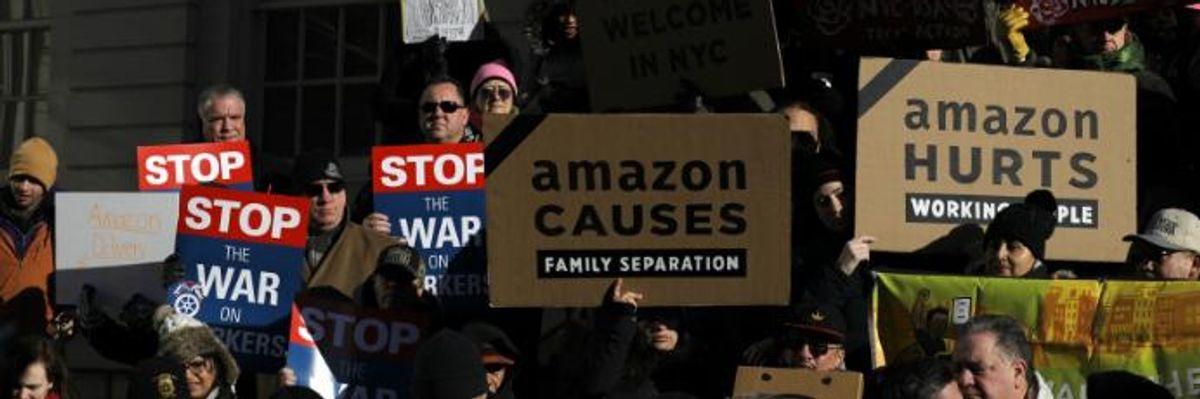
Protestors rally against Amazon and the company's plans to move their second headquarters to the Long Island City neighborhood of Queens, at New York City Hall, January 30, 2019 in New York City. (Photo by Drew Angerer/Getty Images)
Fearful of losing nearly $3 billion in subsidies for its expansion in New York City, Amazon has moved to a new strategy, one involving threats. The Washington Post (owned by Amazon CEO Jeff Bezos) reported on Friday that the company is "reconsidering" its plan to place an office facility for up to 25,000 employees in Long Island City, Queens. In doing so, Amazon is signaling that it will squeeze opponents of the deal politically unless they support the massive subsidy package.
New York City lawmakers who weren't intimately involved with the "HQ2" bid to bring in Amazon have been sharply critical of giving billions in taxpayer dollars to the world's most valuable corporation, so it can add to an already existing presence in the region. The deal bypassed city council approval, adding to the consternation.
"Whatever the outcome, Amazon's gambit shows how much the HQ2 sweepstakes has backfired."
Any major multinational would have multiple reasons to expand in New York City, given its highly skilled workforce and status as a hub for the technology, entertainment and advertising industries--all areas where Amazon is expanding. That makes the billions in subsidies seem gratuitous.
"Amazon has been growing into the largest company we'll ever see," says Jonathan Westin of New York Communities for Change, one of the groups leading the charge against the Amazon deal. "The idea that we need to subsidize them in any way blows our mind." Westin has helped rally opposition to the deal from labor unions, community groups and prominent politicians like Rep. Alexandria Ocasio-Cortez, whose district is adjacent to the proposed site.
Several other issues have inspired outrage over what critics call the #HQ2scam. Even before these subsidies, New York City has been struggling to fund acceptable public transportation and affordable housing. Plus, adding 25,000 high-paying jobs to this corner of Queens will only make gentrification worse, activists warn. "I think anyone who's middle class is not going to be able to live in Long Island City much longer," Westin says.
Finally, at a City Council meeting last week, the company refused to agree to remain neutral if Amazon workers attempted unionization in New York City, a red flag for a labor-friendly city. The HQ2 project has actually split the city's labor movement. The Retail, Wholesale, and Department Store Union and the Teamsters are against the project, while the Building and Construction Trades Council that would build the HQ2 facility, and the SEIU local 32BJ that would staff the building for security and custodial work, have come out in favor. Council Speaker Corey Johnson criticized Amazon last week for pitting workers against one another.
Amazon can see its grasp on $2.808 billion in subsidies slipping away. This week, the State Senate recommended the appointment of Sen. Michael Gianaris, a bitter critic of the deal, to the Public Authorities Control Board, which reviews and approves state-based economic development subsidies. About $1.5 billion of the grants for HQ2 come from the state and could go before this board, and the way the board is structured, Gianaris would have an effective veto over those funds.
Democratic Governor Andrew Cuomo, a supporter of the deal who offered to change his name to Amazon Cuomo if the company agreed to choose New York City, would have to approve Gianaris, but that would create a standoff between the governor and the legislature, reflecting the tensions that have accompanied the Amazon deal.
While all of that is happening, Amazon floated this pullback from New York, citing how "welcoming" politicians in Virginia and Nashville, Tennessee have been in handing over public money for its site locations. Embattled Virginia governor Ralph Northam, weathering a scandal over blackface pictures in his medical school yearbook, found time to quietly sign off on $750 million in subsidies for a 25,000-employee facility near Arlington, which the legislature advanced with little opposition. Nashville is getting a 5,000-person operations center, and though the city budget is so strapped public workers were denied a promised raise, this week officials passed a $15 million infrastructure grant for the area Amazon will occupy, the first of $117 million in subsidies for the project.
Amazon is likely threatening this pullout to concentrate minds among New York politicians, in an effort to pin blame on them for "losing" Amazon. The company is hiring lobbyists and a "community affairs manager" in New York, so it's clearly still committed to the deal at some level.
Amazon may also have a Plan B. One of the twenty finalists for HQ2 was Newark, New Jersey, just across the border from New York City. It was one of the richest subsidy offers of the entire process - up to $7 billion from the city and state to lure Amazon. The company could certainly skip over to Newark and re-open talks to place its offices there, if only to loosen resistance in New York City.
Whatever the outcome, Amazon's gambit shows how much the HQ2 sweepstakes has backfired. What started as a virtual celebration of Amazon's prominence has transformed into condemnation over a big company using its clout to extract taxpayer dollars and disrupt communities. Even Michael Bloomberg is denouncing tax gifts to Amazon.
More broadly, the Amazon farce has shone a spotlight on the sordid process of economic development deals, which cost cities and states up to $90 billion annually while local services suffer from a lack of funds. Deals that would receive almost no scrutiny, like U.S. Steel winning $47 million in tax breaks from impoverished Gary, Indiana, now make headlines. By making the spectacle so public, Amazon may have ruined this gravy train for the rest of corporate America.
Dear Common Dreams reader, It’s been nearly 30 years since I co-founded Common Dreams with my late wife, Lina Newhouser. We had the radical notion that journalism should serve the public good, not corporate profits. It was clear to us from the outset what it would take to build such a project. No paid advertisements. No corporate sponsors. No millionaire publisher telling us what to think or do. Many people said we wouldn't last a year, but we proved those doubters wrong. Together with a tremendous team of journalists and dedicated staff, we built an independent media outlet free from the constraints of profits and corporate control. Our mission has always been simple: To inform. To inspire. To ignite change for the common good. Building Common Dreams was not easy. Our survival was never guaranteed. When you take on the most powerful forces—Wall Street greed, fossil fuel industry destruction, Big Tech lobbyists, and uber-rich oligarchs who have spent billions upon billions rigging the economy and democracy in their favor—the only bulwark you have is supporters who believe in your work. But here’s the urgent message from me today. It's never been this bad out there. And it's never been this hard to keep us going. At the very moment Common Dreams is most needed, the threats we face are intensifying. We need your support now more than ever. We don't accept corporate advertising and never will. We don't have a paywall because we don't think people should be blocked from critical news based on their ability to pay. Everything we do is funded by the donations of readers like you. When everyone does the little they can afford, we are strong. But if that support retreats or dries up, so do we. Will you donate now to make sure Common Dreams not only survives but thrives? —Craig Brown, Co-founder |
Fearful of losing nearly $3 billion in subsidies for its expansion in New York City, Amazon has moved to a new strategy, one involving threats. The Washington Post (owned by Amazon CEO Jeff Bezos) reported on Friday that the company is "reconsidering" its plan to place an office facility for up to 25,000 employees in Long Island City, Queens. In doing so, Amazon is signaling that it will squeeze opponents of the deal politically unless they support the massive subsidy package.
New York City lawmakers who weren't intimately involved with the "HQ2" bid to bring in Amazon have been sharply critical of giving billions in taxpayer dollars to the world's most valuable corporation, so it can add to an already existing presence in the region. The deal bypassed city council approval, adding to the consternation.
"Whatever the outcome, Amazon's gambit shows how much the HQ2 sweepstakes has backfired."
Any major multinational would have multiple reasons to expand in New York City, given its highly skilled workforce and status as a hub for the technology, entertainment and advertising industries--all areas where Amazon is expanding. That makes the billions in subsidies seem gratuitous.
"Amazon has been growing into the largest company we'll ever see," says Jonathan Westin of New York Communities for Change, one of the groups leading the charge against the Amazon deal. "The idea that we need to subsidize them in any way blows our mind." Westin has helped rally opposition to the deal from labor unions, community groups and prominent politicians like Rep. Alexandria Ocasio-Cortez, whose district is adjacent to the proposed site.
Several other issues have inspired outrage over what critics call the #HQ2scam. Even before these subsidies, New York City has been struggling to fund acceptable public transportation and affordable housing. Plus, adding 25,000 high-paying jobs to this corner of Queens will only make gentrification worse, activists warn. "I think anyone who's middle class is not going to be able to live in Long Island City much longer," Westin says.
Finally, at a City Council meeting last week, the company refused to agree to remain neutral if Amazon workers attempted unionization in New York City, a red flag for a labor-friendly city. The HQ2 project has actually split the city's labor movement. The Retail, Wholesale, and Department Store Union and the Teamsters are against the project, while the Building and Construction Trades Council that would build the HQ2 facility, and the SEIU local 32BJ that would staff the building for security and custodial work, have come out in favor. Council Speaker Corey Johnson criticized Amazon last week for pitting workers against one another.
Amazon can see its grasp on $2.808 billion in subsidies slipping away. This week, the State Senate recommended the appointment of Sen. Michael Gianaris, a bitter critic of the deal, to the Public Authorities Control Board, which reviews and approves state-based economic development subsidies. About $1.5 billion of the grants for HQ2 come from the state and could go before this board, and the way the board is structured, Gianaris would have an effective veto over those funds.
Democratic Governor Andrew Cuomo, a supporter of the deal who offered to change his name to Amazon Cuomo if the company agreed to choose New York City, would have to approve Gianaris, but that would create a standoff between the governor and the legislature, reflecting the tensions that have accompanied the Amazon deal.
While all of that is happening, Amazon floated this pullback from New York, citing how "welcoming" politicians in Virginia and Nashville, Tennessee have been in handing over public money for its site locations. Embattled Virginia governor Ralph Northam, weathering a scandal over blackface pictures in his medical school yearbook, found time to quietly sign off on $750 million in subsidies for a 25,000-employee facility near Arlington, which the legislature advanced with little opposition. Nashville is getting a 5,000-person operations center, and though the city budget is so strapped public workers were denied a promised raise, this week officials passed a $15 million infrastructure grant for the area Amazon will occupy, the first of $117 million in subsidies for the project.
Amazon is likely threatening this pullout to concentrate minds among New York politicians, in an effort to pin blame on them for "losing" Amazon. The company is hiring lobbyists and a "community affairs manager" in New York, so it's clearly still committed to the deal at some level.
Amazon may also have a Plan B. One of the twenty finalists for HQ2 was Newark, New Jersey, just across the border from New York City. It was one of the richest subsidy offers of the entire process - up to $7 billion from the city and state to lure Amazon. The company could certainly skip over to Newark and re-open talks to place its offices there, if only to loosen resistance in New York City.
Whatever the outcome, Amazon's gambit shows how much the HQ2 sweepstakes has backfired. What started as a virtual celebration of Amazon's prominence has transformed into condemnation over a big company using its clout to extract taxpayer dollars and disrupt communities. Even Michael Bloomberg is denouncing tax gifts to Amazon.
More broadly, the Amazon farce has shone a spotlight on the sordid process of economic development deals, which cost cities and states up to $90 billion annually while local services suffer from a lack of funds. Deals that would receive almost no scrutiny, like U.S. Steel winning $47 million in tax breaks from impoverished Gary, Indiana, now make headlines. By making the spectacle so public, Amazon may have ruined this gravy train for the rest of corporate America.
Fearful of losing nearly $3 billion in subsidies for its expansion in New York City, Amazon has moved to a new strategy, one involving threats. The Washington Post (owned by Amazon CEO Jeff Bezos) reported on Friday that the company is "reconsidering" its plan to place an office facility for up to 25,000 employees in Long Island City, Queens. In doing so, Amazon is signaling that it will squeeze opponents of the deal politically unless they support the massive subsidy package.
New York City lawmakers who weren't intimately involved with the "HQ2" bid to bring in Amazon have been sharply critical of giving billions in taxpayer dollars to the world's most valuable corporation, so it can add to an already existing presence in the region. The deal bypassed city council approval, adding to the consternation.
"Whatever the outcome, Amazon's gambit shows how much the HQ2 sweepstakes has backfired."
Any major multinational would have multiple reasons to expand in New York City, given its highly skilled workforce and status as a hub for the technology, entertainment and advertising industries--all areas where Amazon is expanding. That makes the billions in subsidies seem gratuitous.
"Amazon has been growing into the largest company we'll ever see," says Jonathan Westin of New York Communities for Change, one of the groups leading the charge against the Amazon deal. "The idea that we need to subsidize them in any way blows our mind." Westin has helped rally opposition to the deal from labor unions, community groups and prominent politicians like Rep. Alexandria Ocasio-Cortez, whose district is adjacent to the proposed site.
Several other issues have inspired outrage over what critics call the #HQ2scam. Even before these subsidies, New York City has been struggling to fund acceptable public transportation and affordable housing. Plus, adding 25,000 high-paying jobs to this corner of Queens will only make gentrification worse, activists warn. "I think anyone who's middle class is not going to be able to live in Long Island City much longer," Westin says.
Finally, at a City Council meeting last week, the company refused to agree to remain neutral if Amazon workers attempted unionization in New York City, a red flag for a labor-friendly city. The HQ2 project has actually split the city's labor movement. The Retail, Wholesale, and Department Store Union and the Teamsters are against the project, while the Building and Construction Trades Council that would build the HQ2 facility, and the SEIU local 32BJ that would staff the building for security and custodial work, have come out in favor. Council Speaker Corey Johnson criticized Amazon last week for pitting workers against one another.
Amazon can see its grasp on $2.808 billion in subsidies slipping away. This week, the State Senate recommended the appointment of Sen. Michael Gianaris, a bitter critic of the deal, to the Public Authorities Control Board, which reviews and approves state-based economic development subsidies. About $1.5 billion of the grants for HQ2 come from the state and could go before this board, and the way the board is structured, Gianaris would have an effective veto over those funds.
Democratic Governor Andrew Cuomo, a supporter of the deal who offered to change his name to Amazon Cuomo if the company agreed to choose New York City, would have to approve Gianaris, but that would create a standoff between the governor and the legislature, reflecting the tensions that have accompanied the Amazon deal.
While all of that is happening, Amazon floated this pullback from New York, citing how "welcoming" politicians in Virginia and Nashville, Tennessee have been in handing over public money for its site locations. Embattled Virginia governor Ralph Northam, weathering a scandal over blackface pictures in his medical school yearbook, found time to quietly sign off on $750 million in subsidies for a 25,000-employee facility near Arlington, which the legislature advanced with little opposition. Nashville is getting a 5,000-person operations center, and though the city budget is so strapped public workers were denied a promised raise, this week officials passed a $15 million infrastructure grant for the area Amazon will occupy, the first of $117 million in subsidies for the project.
Amazon is likely threatening this pullout to concentrate minds among New York politicians, in an effort to pin blame on them for "losing" Amazon. The company is hiring lobbyists and a "community affairs manager" in New York, so it's clearly still committed to the deal at some level.
Amazon may also have a Plan B. One of the twenty finalists for HQ2 was Newark, New Jersey, just across the border from New York City. It was one of the richest subsidy offers of the entire process - up to $7 billion from the city and state to lure Amazon. The company could certainly skip over to Newark and re-open talks to place its offices there, if only to loosen resistance in New York City.
Whatever the outcome, Amazon's gambit shows how much the HQ2 sweepstakes has backfired. What started as a virtual celebration of Amazon's prominence has transformed into condemnation over a big company using its clout to extract taxpayer dollars and disrupt communities. Even Michael Bloomberg is denouncing tax gifts to Amazon.
More broadly, the Amazon farce has shone a spotlight on the sordid process of economic development deals, which cost cities and states up to $90 billion annually while local services suffer from a lack of funds. Deals that would receive almost no scrutiny, like U.S. Steel winning $47 million in tax breaks from impoverished Gary, Indiana, now make headlines. By making the spectacle so public, Amazon may have ruined this gravy train for the rest of corporate America.