

SUBSCRIBE TO OUR FREE NEWSLETTER
Daily news & progressive opinion—funded by the people, not the corporations—delivered straight to your inbox.
5
#000000
#FFFFFF
To donate by check, phone, or other method, see our More Ways to Give page.
Daily news & progressive opinion—funded by the people, not the corporations—delivered straight to your inbox.
The Turkish government's news media shutdown shows how the State of Emergency law is being used to deny the right to free speech beyond any legitimate aim of upholding public order today. The government ordered 131 newspapers, news agencies, publishers, television, and radio stations to close down.
The decree (no. 668) ordering the closures, published in the Official Gazette on July 27, 2016, comes after prosecutors issued arrest warrants for 89 journalists, media workers, and executives over two days. The closures and detentions demonstrate an accelerated campaign against media the government identifies as supportive of the Fethullah Gulen movement, which it blames for the violent coup attempt in Turkey on July 15.
"The government crackdown is on media outlets and journalists it accuses of being linked to the Fethullah Gulen movement, which it blames for the foiled military coup," said Emma Sinclair-Webb, Turkey director at Human Rights Watch. "In the absence of any evidence of their role or participation in the violent attempt to overthrow the government, we strongly condemn this accelerated assault on the media, which further undermines Turkey's democratic credentials."
The decree orders the closure of 45 newspapers, 15 magazines, 16 TV channels, 23 radio stations, 3 news agencies, and 29 publishers and distributors. Among them are the dailies Taraf and Ozgur Dusunce newspaper, the Cihan News Agency, and Can Erzincan TV.
Earlier on July 27, media reported that an Istanbul prosecutor had issued an arrest warrant for 47 journalists, media workers and executives who worked for the daily Zaman newspaper before it was taken over by government-appointed trustees in March 2016. Among those detained were former Zaman columnists Sahin Alpay and Mumtaz'er Turkone.
On July 25, the daily Sabah newspaper reported that another Istanbul prosecutor had issued arrest warrants for 42 journalists working for various other media. Among those detained were Bulent Mumay, former online editor for Hurriyet newspaper and a columnist with Birgun newspaper, and Nazli Ilicak, most recently a columnist for the daily Ozgur Dusunce. Several reporters for whom there is an arrest warrant have left Turkey, according to Sabah newspaper.
Human Rights Watch is one of the world's leading independent organizations dedicated to defending and protecting human rights. By focusing international attention where human rights are violated, we give voice to the oppressed and hold oppressors accountable for their crimes. Our rigorous, objective investigations and strategic, targeted advocacy build intense pressure for action and raise the cost of human rights abuse. For 30 years, Human Rights Watch has worked tenaciously to lay the legal and moral groundwork for deep-rooted change and has fought to bring greater justice and security to people around the world.
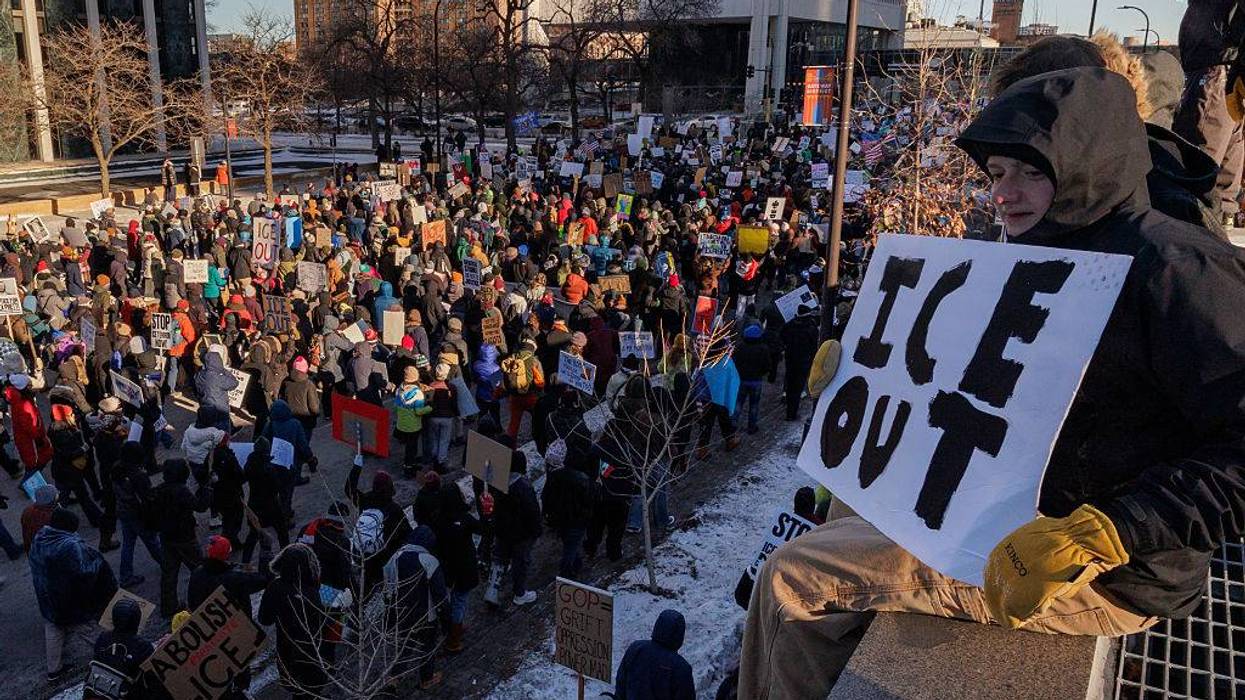
In an interview with the New York Times, Minneapolis Mayor Jacob Frey described "marauding gangs of guys just walking down the street indiscriminately picking people up."
Minneapolis Mayor Jacob Frey is warning that the Trump administration has crossed a "terrifying line" with its use of federal immigration enforcement agents to brutalize and abduct people in his city.
In an interview with the New York Times published Saturday, Frey described operations that have taken place in his city as "marauding gangs of guys just walking down the street indiscriminately picking people up," likening it to a military "invasion."
During the interview, Frey was asked what he made of Attorney General Pam Bondi's recent offer to withdraw immigration enforcement forces from his city if Minnesota handed over its voter registration records to the federal government.
"That is wildly unconstitutional," Frey replied. "We should all be standing up and saying that’s not OK. Literally, listen to what they’re saying. Active threats like, Turn over the voter rolls or else, or we will continue to do what we’re doing. That’s something you can do in America now."
Frey was also asked about Minnesota Gov. Tim Walz's comments from earlier in the week where he likened the administration's invasion of Minneapolis to the first battle that took place during the US Civil War in Fort Sumter.
"I don’t think he’s saying that the Civil War is going to happen," said Frey. "I think what he’s saying is that a significant and terrifying line is being crossed. And I would agree with that."
As Frey issued warnings about the federal government's actions in Minneapolis, more horror stories have emerged involving US Immigration and Customs Enforcement (ICE) agents in Minnesota.
The Associated Press reported on Saturday that staff at the Hennepin County Medical Center in Minneapolis have been raising red flags over ICE agents' claims about Alberto Castañeda Mondragón, a Mexican immigrant whom they treated after he suffered a shattered skull earlier this month.
ICE agents who brought Castañeda Mondragón to the hospital told staffers that he had injured himself after he "purposefully ran headfirst into a brick wall" while trying to escape their custody.
Nurses who treated Castañeda Mondragón, however, said that there is no way that running headfirst into a wall could produce the sheer number of skull fractures he suffered, let alone the internal bleeding found throughout his brain.
“It was laughable, if there was something to laugh about," one nurse at the hospital told the Associated Press. “There was no way this person ran headfirst into a wall."
According to a Saturday report in the New York Times, concern over ICE's brutality has grown to such an extent that many Minnesota residents, including both documented immigrants and US citizens, have started wearing passports around their necks to avoid being potentially targeted.
Joua Tsu Thao, a 75-year-old US citizen who came to the country after aiding the American military during the Vietnam War, said the aggressive actions of immigration officers have left him with little choice but to display his passport whenever he walks outside his house.
"We need to be ready before they point a gun to us," Thao explained to the Times.
CNN on Friday reported that ICE has been rounding up refugees living in Minnesota who were allowed to enter the US after undergoing "a rigorous, years-long vetting process," and sending them to a facility in Texas where they are being prepared for deportation.
Lawyers representing the abducted refugees told CNN that their clients have been "forced to recount painful asylum claims with limited or no contact with family members or attorneys."
Some of the refugees taken to Texas have been released from custody. But instead of being flown back home, they were released in Texas "without money, identification, or phones," CNN reported.
Laurie Ball Cooper, vice president for US legal programs at the International Refugee Assistance Project, told CNN that government agents abducting refugees who had previously been allowed into the US is part of "a campaign of terror" that "is designed to scare people."

"It’s one of those rare, unicorn films that doesn’t have a single redeeming quality," said one critic.
Critics have weighed in on Amazon MGM Studios' documentary about first lady Melania Trump, and their verdicts are overwhelmingly negative.
According to review aggregation website Metacritic, Melania—which Amazon paid $40 million to acquire and $35 million to market—so far has received a collective score of just 6 out of 100 from critics, which indicates "overwhelming dislike."
Similarly, Melania scores a mere 6% on Rotten Tomatoes' "Tomameter," indicating that 94% of reviews for the movie so far have been negative.
One particularly brutal review came from Nick Hilton, film critic for the Independent, who said that the first lady came off in the film as "a preening, scowling void of pure nothingness" who leads a "vulgar, gilded lifestyle."
Hilton added that the film is so terrible that it fails even at being effective propaganda and is likely to be remembered as "a striking artifact... of a time when Americans willingly subordinated themselves to a political and economic oligopoly."
The Guardian's Xan Brooks delivered a similarly scathing assessment, declaring the film "dispiriting, deadly and unrevealing."
"It’s one of those rare, unicorn films that doesn’t have a single redeeming quality," Brooks elaborated. "I’m not even sure it qualifies as a documentary, exactly, so much as an elaborate piece of designer taxidermy, horribly overpriced and ice-cold to the touch and proffered like a medieval tribute to placate the greedy king on his throne."
Donald Clarke of the Irish Times also discussed the film's failure as a piece of propaganda, and he compared it unfavorably to the work of Nazi propagandist Leni Riefenstahl.
"Melania... appears keener on inducing narcolepsy in its viewers than energizing them into massed marching," he wrote. "Triumph of the Dull, perhaps."
Variety's Owen Gleiberman argued that the Melania documentary is utterly devoid of anything approaching dramatic stakes, which results in the film suffering from "staggering inertia."
"Mostly it’s inert," Gleiberman wrote of the film. "It feels like it’s been stitched together out of the most innocuous outtakes from a reality show. There’s no drama to it. It should have been called 'Day of the Living Tradwife.'"
Frank Scheck of the Hollywood Reporter found that the movie mostly exposes Melania Trump is an empty vessel without a single original thought or insight, instead deploying "an endless number of inspirational phrases seemingly cribbed from self-help books."
Kevin Fallon of the Daily Beast described Melania as "an unbelievable abomination of filmmaking" that reaches "a level of insipid propaganda that almost resists review."
"It's so expected," Fallon added, "and utterly pointless."
"This memo bends over backwards to say that ICE agents have nothing but green lights to make an arrest without even a supervisor’s approval," said one former ICE official.
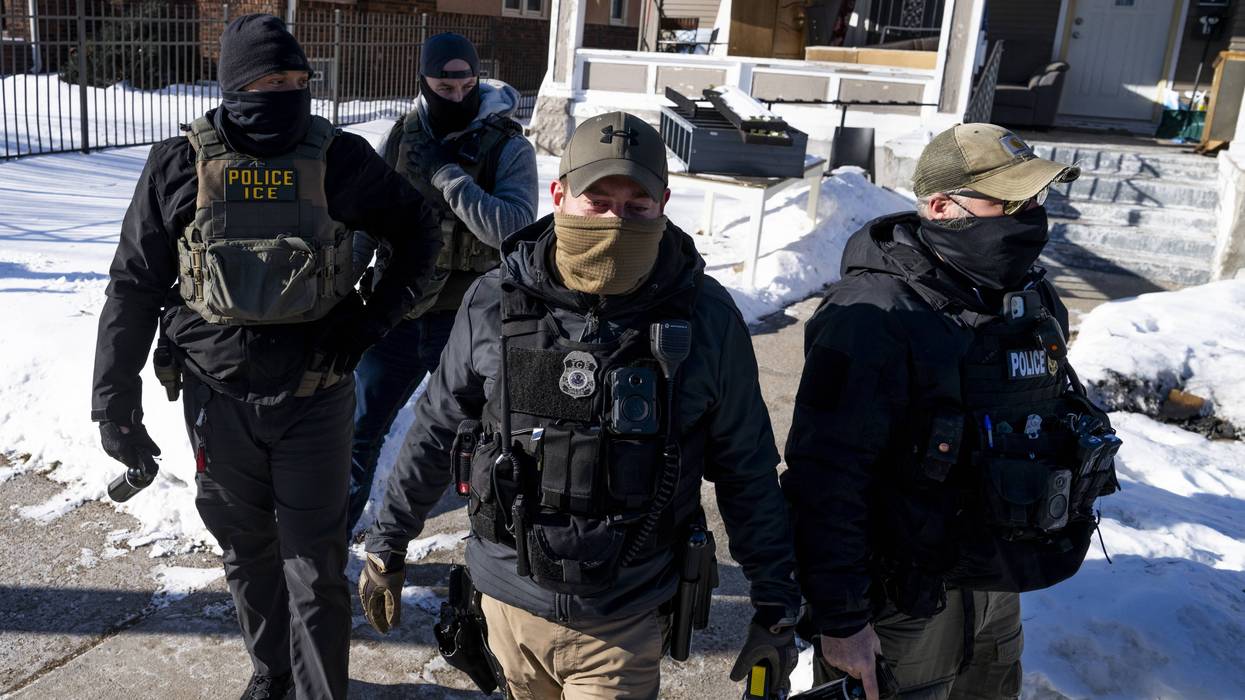
An internal legal memo obtained by the New York Times reveals that federal immigration enforcement agents are claiming broad new powers to carry out warrantless arrests.
The Times reported on Friday that the memo, which was signed by US Immigration and Customs Enforcement (ICE) Acting Director Todd Lyons, "expands the ability of lower-level ICE agents to carry out sweeps rounding up people they encounter and suspect are undocumented immigrants, rather than targeted enforcement operations in which they set out, warrant in hand, to arrest a specific person."
In the past, agents have been granted the power to carry out warrantless arrests only in situations where they believe a suspected undocumented immigrant is a "flight risk" who is unlikely to comply with obligations such as appearing at court hearings.
However, the memo declares this standard to be “unreasoned” and “incorrect,” saying that agents should feel free to carry out arrests so long as the suspect is "unlikely to be located at the scene of the encounter or another clearly identifiable location once an administrative warrant is obtained."
Scott Shuchart, former head of policy at ICE under President Joe Biden, told the Times that the memo appears to open the door to give the agency incredibly broad arrest powers.
"This memo bends over backwards," Shuchart said, "to say that ICE agents have nothing but green lights to make an arrest without even a supervisor’s approval."
Claire Trickler-McNulty, former senior adviser at ICE during the Biden administration, said the memo's language was so broad that "it would cover essentially anyone they want to arrest without a warrant, making the general premise of ever getting a warrant pointless."
Aaron Reichlin-Melnick, senior fellow at the American Immigration Council, noted in a social media post that the memo appears to be a way for ICE to "get around an increasing number of court orders requiring [US Department of Homeland Security] to follow the plain words of the law which says administrative warrantless arrests are only for people 'likely to escape.'"
The memo broadens the terms, Reichlin-Melnick added, so that "anyone who refuses to wait for a warrant to be issued" is deemed "likely to escape."
Stanford University political scientist Tom Clark questioned the validity of the memo, which appears to directly conflict with the Fourth Amendment of the US Constitution, which requires search warrants as a protection against "unreasonable searches and seizures."
"So, here’s how the law works," he wrote. "People on whom it imposes constraints don’t get to just write themselves a memo saying they don’t have to follow the law. Maybe I’ll write myself a memo saying that I don’t have to pay my taxes this year."