SUBSCRIBE TO OUR FREE NEWSLETTER
Daily news & progressive opinion—funded by the people, not the corporations—delivered straight to your inbox.
5
#000000
#FFFFFF
To donate by check, phone, or other method, see our More Ways to Give page.
Daily news & progressive opinion—funded by the people, not the corporations—delivered straight to your inbox.
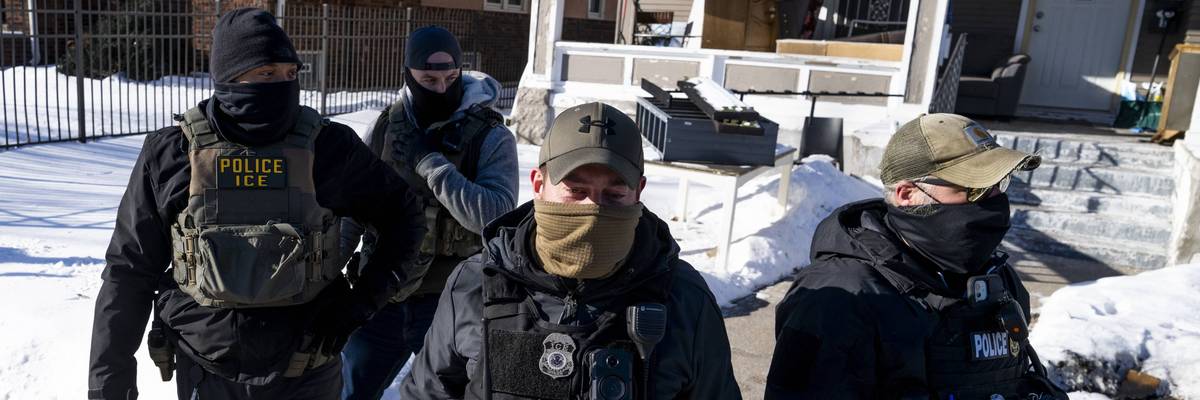
ICE agents leave a residence after knocking on the door on January 28, 2026 in Minneapolis, Minnesota.
"This memo bends over backwards to say that ICE agents have nothing but green lights to make an arrest without even a supervisor’s approval," said one former ICE official.
An internal legal memo obtained by the New York Times reveals that federal immigration enforcement agents are claiming broad new powers to carry out warrantless arrests.
The Times reported on Friday that the memo, which was signed by US Immigration and Customs Enforcement (ICE) Acting Director Todd Lyons, "expands the ability of lower-level ICE agents to carry out sweeps rounding up people they encounter and suspect are undocumented immigrants, rather than targeted enforcement operations in which they set out, warrant in hand, to arrest a specific person."
In the past, agents have been granted the power to carry out warrantless arrests only in situations where they believe a suspected undocumented immigrant is a "flight risk" who is unlikely to comply with obligations such as appearing at court hearings.
However, the memo declares this standard to be “unreasoned” and “incorrect,” saying that agents should feel free to carry out arrests so long as the suspect is "unlikely to be located at the scene of the encounter or another clearly identifiable location once an administrative warrant is obtained."
Scott Shuchart, former head of policy at ICE under President Joe Biden, told the Times that the memo appears to open the door to give the agency incredibly broad arrest powers.
"This memo bends over backwards," Shuchart said, "to say that ICE agents have nothing but green lights to make an arrest without even a supervisor’s approval."
Claire Trickler-McNulty, former senior adviser at ICE during the Biden administration, said the memo's language was so broad that "it would cover essentially anyone they want to arrest without a warrant, making the general premise of ever getting a warrant pointless."
Aaron Reichlin-Melnick, senior fellow at the American Immigration Council, noted in a social media post that the memo appears to be a way for ICE to "get around an increasing number of court orders requiring [US Department of Homeland Security] to follow the plain words of the law which says administrative warrantless arrests are only for people 'likely to escape.'"
The memo broadens the terms, Reichlin-Melnick added, so that "anyone who refuses to wait for a warrant to be issued" is deemed "likely to escape."
Stanford University political scientist Tom Clark questioned the validity of the memo, which appears to directly conflict with the Fourth Amendment of the US Constitution, which requires search warrants as a protection against "unreasonable searches and seizures."
"So, here’s how the law works," he wrote. "People on whom it imposes constraints don’t get to just write themselves a memo saying they don’t have to follow the law. Maybe I’ll write myself a memo saying that I don’t have to pay my taxes this year."
Dear Common Dreams reader, It’s been nearly 30 years since I co-founded Common Dreams with my late wife, Lina Newhouser. We had the radical notion that journalism should serve the public good, not corporate profits. It was clear to us from the outset what it would take to build such a project. No paid advertisements. No corporate sponsors. No millionaire publisher telling us what to think or do. Many people said we wouldn't last a year, but we proved those doubters wrong. Together with a tremendous team of journalists and dedicated staff, we built an independent media outlet free from the constraints of profits and corporate control. Our mission has always been simple: To inform. To inspire. To ignite change for the common good. Building Common Dreams was not easy. Our survival was never guaranteed. When you take on the most powerful forces—Wall Street greed, fossil fuel industry destruction, Big Tech lobbyists, and uber-rich oligarchs who have spent billions upon billions rigging the economy and democracy in their favor—the only bulwark you have is supporters who believe in your work. But here’s the urgent message from me today. It's never been this bad out there. And it's never been this hard to keep us going. At the very moment Common Dreams is most needed, the threats we face are intensifying. We need your support now more than ever. We don't accept corporate advertising and never will. We don't have a paywall because we don't think people should be blocked from critical news based on their ability to pay. Everything we do is funded by the donations of readers like you. When everyone does the little they can afford, we are strong. But if that support retreats or dries up, so do we. Will you donate now to make sure Common Dreams not only survives but thrives? —Craig Brown, Co-founder |
An internal legal memo obtained by the New York Times reveals that federal immigration enforcement agents are claiming broad new powers to carry out warrantless arrests.
The Times reported on Friday that the memo, which was signed by US Immigration and Customs Enforcement (ICE) Acting Director Todd Lyons, "expands the ability of lower-level ICE agents to carry out sweeps rounding up people they encounter and suspect are undocumented immigrants, rather than targeted enforcement operations in which they set out, warrant in hand, to arrest a specific person."
In the past, agents have been granted the power to carry out warrantless arrests only in situations where they believe a suspected undocumented immigrant is a "flight risk" who is unlikely to comply with obligations such as appearing at court hearings.
However, the memo declares this standard to be “unreasoned” and “incorrect,” saying that agents should feel free to carry out arrests so long as the suspect is "unlikely to be located at the scene of the encounter or another clearly identifiable location once an administrative warrant is obtained."
Scott Shuchart, former head of policy at ICE under President Joe Biden, told the Times that the memo appears to open the door to give the agency incredibly broad arrest powers.
"This memo bends over backwards," Shuchart said, "to say that ICE agents have nothing but green lights to make an arrest without even a supervisor’s approval."
Claire Trickler-McNulty, former senior adviser at ICE during the Biden administration, said the memo's language was so broad that "it would cover essentially anyone they want to arrest without a warrant, making the general premise of ever getting a warrant pointless."
Aaron Reichlin-Melnick, senior fellow at the American Immigration Council, noted in a social media post that the memo appears to be a way for ICE to "get around an increasing number of court orders requiring [US Department of Homeland Security] to follow the plain words of the law which says administrative warrantless arrests are only for people 'likely to escape.'"
The memo broadens the terms, Reichlin-Melnick added, so that "anyone who refuses to wait for a warrant to be issued" is deemed "likely to escape."
Stanford University political scientist Tom Clark questioned the validity of the memo, which appears to directly conflict with the Fourth Amendment of the US Constitution, which requires search warrants as a protection against "unreasonable searches and seizures."
"So, here’s how the law works," he wrote. "People on whom it imposes constraints don’t get to just write themselves a memo saying they don’t have to follow the law. Maybe I’ll write myself a memo saying that I don’t have to pay my taxes this year."
An internal legal memo obtained by the New York Times reveals that federal immigration enforcement agents are claiming broad new powers to carry out warrantless arrests.
The Times reported on Friday that the memo, which was signed by US Immigration and Customs Enforcement (ICE) Acting Director Todd Lyons, "expands the ability of lower-level ICE agents to carry out sweeps rounding up people they encounter and suspect are undocumented immigrants, rather than targeted enforcement operations in which they set out, warrant in hand, to arrest a specific person."
In the past, agents have been granted the power to carry out warrantless arrests only in situations where they believe a suspected undocumented immigrant is a "flight risk" who is unlikely to comply with obligations such as appearing at court hearings.
However, the memo declares this standard to be “unreasoned” and “incorrect,” saying that agents should feel free to carry out arrests so long as the suspect is "unlikely to be located at the scene of the encounter or another clearly identifiable location once an administrative warrant is obtained."
Scott Shuchart, former head of policy at ICE under President Joe Biden, told the Times that the memo appears to open the door to give the agency incredibly broad arrest powers.
"This memo bends over backwards," Shuchart said, "to say that ICE agents have nothing but green lights to make an arrest without even a supervisor’s approval."
Claire Trickler-McNulty, former senior adviser at ICE during the Biden administration, said the memo's language was so broad that "it would cover essentially anyone they want to arrest without a warrant, making the general premise of ever getting a warrant pointless."
Aaron Reichlin-Melnick, senior fellow at the American Immigration Council, noted in a social media post that the memo appears to be a way for ICE to "get around an increasing number of court orders requiring [US Department of Homeland Security] to follow the plain words of the law which says administrative warrantless arrests are only for people 'likely to escape.'"
The memo broadens the terms, Reichlin-Melnick added, so that "anyone who refuses to wait for a warrant to be issued" is deemed "likely to escape."
Stanford University political scientist Tom Clark questioned the validity of the memo, which appears to directly conflict with the Fourth Amendment of the US Constitution, which requires search warrants as a protection against "unreasonable searches and seizures."
"So, here’s how the law works," he wrote. "People on whom it imposes constraints don’t get to just write themselves a memo saying they don’t have to follow the law. Maybe I’ll write myself a memo saying that I don’t have to pay my taxes this year."