
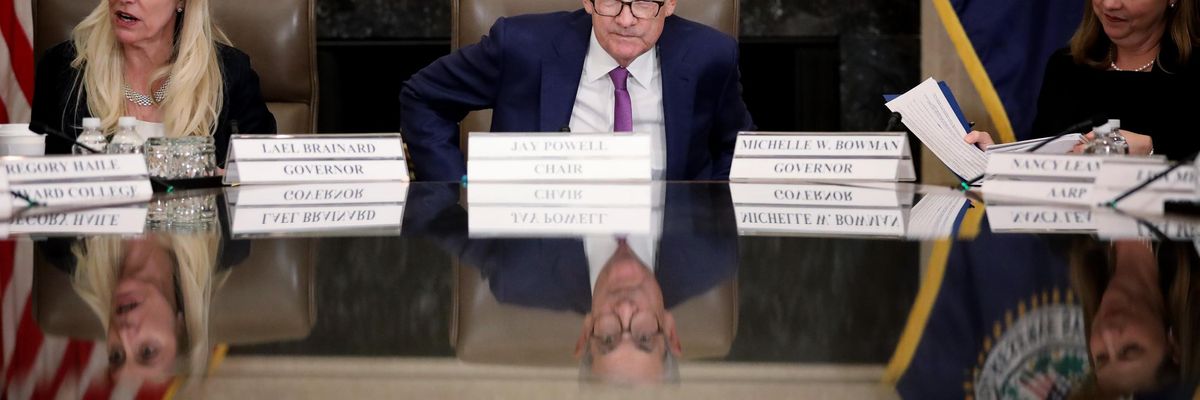
Federal Reserve Chair Jerome Powell (center) sits with Federal Reserve Govs. Lael Brainard (left) and Miki Bowman (right) at an October 4, 2019 event at the Fed's headquarters in Washington, D.C. (Photo: Win McNamee/Getty Images)
The Fed Is Making a Big, Big Mistake
If the Fed continues down this path—as it has signaled it will—the economy will be plunged into a recession
The Federal Reserve just raised interest rates by three-quarters of a percentage point, the biggest single increase in interest rates since 1994. It's another move in the Fed's effort to tackle the fastest inflation in four decades.
I understand the Fed's urgency, but it has entered dangerous territory. If the Fed continues down this path--as it has signaled it will--the economy will be plunged into a recession. Every time over the last half century the Fed has raised interest rates this much and this quickly, it has caused a recession.
Besides, interest rate increases will not remedy the major causes of the current inflation--huge pent-up worldwide demand from two years of pandemic, shortages of goods and services responding to that demand, Putin's war in Ukraine, and big profitable corporations with enough pricing power to use inflation as a cover for pushing up prices even further.
The Fed assumes that price increases are being driven by wage increases--so-called "wage-price inflation." That's incorrect. Wages are lagging behind inflation. A more accurate description of what we're now seeing might be called "profit-price inflation"--prices driven upward by corporations seeking increased profits. (See chart below, from the Economic Policy Institute.)
A recession will be especially harmful to people who are most vulnerable to downturns in the economy--who are the first to be fired (and last to be hired again when the economy turns upward): lower-wage workers, disproportionately women and people of color.
The Fed is making a big mistake.
We are at a crossroads
This country and this world are at a monumental crossroads. In a few short weeks, US voters will have an opportunity to beat back the forces of fascism and confront the billionaires who are rigging the economy, our media system, and our democracy, making it increasingly impossible for ordinary people to get by. We’re not just talking about the election. We’re talking about what must be done once these fascist elements are vanquished from power. We need a bolder set of solutions than what either major party has so far been willing to offer and a working-class movement ready to fight like hell for it. Trump didn't emerge from nowhere. The conditions that fueled MAGA authoritarianism were created by decades of radical neoliberal economic policies and a corrupt political system dominated by corporate interests. They slashed taxes on the super-rich, promising that the benefits would trickle down. They said giveaways to the corporate titans would make life more affordable for the rest of us. It was all bullshit. And when a bitter, betrayed populace searches for someone to blame, right-wing demagogues have little trouble finding scapegoats. People know when they're being lied to, but you won't hear any of this from the corporate media. Only independent journalism—powered and funded by people who believe in building a better world—can deliver truly trustworthy daily news. Our Fall Campaign is underway, and we need your help. To power our newsroom through the rest of the year, we need to raise $125,000 by midnight on October 31. So if you share our vision, please contribute whatever you can to sustain our work. |
The Federal Reserve just raised interest rates by three-quarters of a percentage point, the biggest single increase in interest rates since 1994. It's another move in the Fed's effort to tackle the fastest inflation in four decades.
I understand the Fed's urgency, but it has entered dangerous territory. If the Fed continues down this path--as it has signaled it will--the economy will be plunged into a recession. Every time over the last half century the Fed has raised interest rates this much and this quickly, it has caused a recession.
Besides, interest rate increases will not remedy the major causes of the current inflation--huge pent-up worldwide demand from two years of pandemic, shortages of goods and services responding to that demand, Putin's war in Ukraine, and big profitable corporations with enough pricing power to use inflation as a cover for pushing up prices even further.
The Fed assumes that price increases are being driven by wage increases--so-called "wage-price inflation." That's incorrect. Wages are lagging behind inflation. A more accurate description of what we're now seeing might be called "profit-price inflation"--prices driven upward by corporations seeking increased profits. (See chart below, from the Economic Policy Institute.)
A recession will be especially harmful to people who are most vulnerable to downturns in the economy--who are the first to be fired (and last to be hired again when the economy turns upward): lower-wage workers, disproportionately women and people of color.
The Fed is making a big mistake.