SUBSCRIBE TO OUR FREE NEWSLETTER
Daily news & progressive opinion—funded by the people, not the corporations—delivered straight to your inbox.
5
#000000
#FFFFFF
To donate by check, phone, or other method, see our More Ways to Give page.
Daily news & progressive opinion—funded by the people, not the corporations—delivered straight to your inbox.
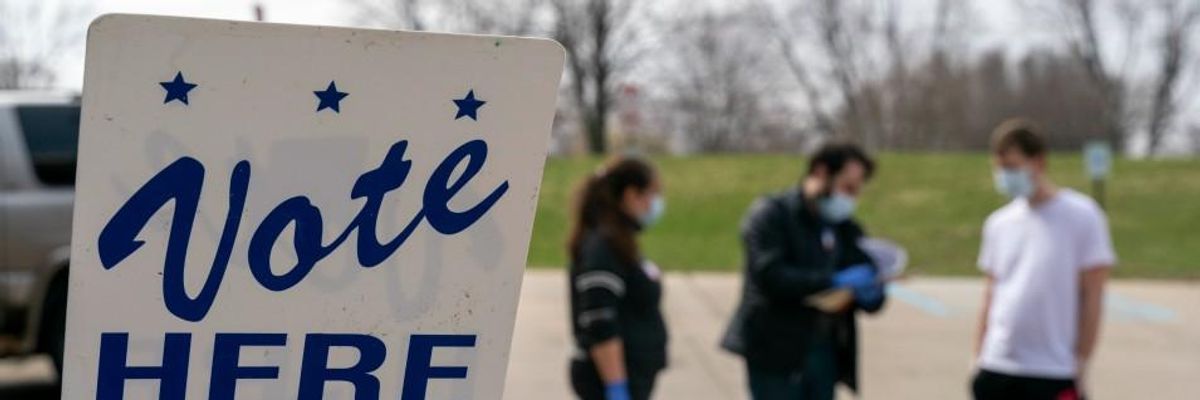
Poll worker talks to a voter on April 7, 2020 in Madison, Wisconsin. (Photo: Andy Manis/Getty Images)
The January 6th insurrection was one way to try to overthrow democracy: incite a mob to ransack the Capitol and threaten to kill key leaders who dared renounce Donald Trump's Big Lie that Joe Biden stole the 2020 election. People were killed and injured, public property was damaged, but Congress still counted the Electoral College votes, delayed by only about 12 hours. U.S. Attorney General Merrick Garland called the insurrection the most "dangerous threat to democracy" he has witnessed. "And in the FBI's view, the top domestic violent extremist threat we face comes from racially or ethnically motivated violent extremists, specifically those who advocate for the superiority of the white race."
Now, a more sophisticated effort to subvert democracy is underway. Across the country, voter suppression bills are being rushed through Republican-controlled state legislatures. These, coupled with partisan gerrymandering that will follow the 2020 U.S. Census results, could erase a century and a half of struggle and progress for voter rights in this country, potentially allowing permanent control of our government by a white supremacist minority.
Massive public pressure will be needed to get the For the People Act through the Senate.
The Brennan Center for Justice has been tracking these bills, and, as of April 1st, had counted an astounding 361 of them in 47 states. Georgia and Arizona have already enacted significant voter suppression laws. Both states were Republican strongholds for decades. In 2020, Joe Biden won them both, as did Democratic Senate candidates Mark Kelly in Arizona, and Jon Ossoff and Raphael Warnock in Georgia. Biden's win in those states, and the loss of those three senate seats, and thus, control of the U.S. Senate, was a devastating defeat for the Republican Party.
Senator Lindsey Graham, Republican of South Carolina, reacted on the Fox News Channel shortly after the election, saying, "If Republicans don't challenge and change the U.S. election system, there will never be another Republican president elected again." Republicans have heeded Graham's warning, flooding the country with strikingly similar bills designed to restrict and deter voting (with the help of the rightwing group ALEC, the American Legislative Exchange Council). "Our leverage in the elections goes up as the voting populace goes down," the late conservative activist Paul Weyrich said in 1980, articulating a longstanding tenet of GOP electoral strategy.
"The issue is not Democrats versus Republicans. The issue is Republicans versus democracy. They're making it harder for everybody to vote," journalist Ari Berman, the author of "Give Us the Ballot: The Modern Struggle for Voting Rights in America," said on the Democracy Now! news hour.
The bills target traditionally Democratic voters, primarily in communities of color in urban centers, through a range of tactics: from purging voter rolls and felon disenfranchisement to strict requirements for photo identification, imposing voter registration barriers, making drastic cuts to early, absentee and mail-in voting, and reducing or eliminating curbside voting, ballot drop box locations and the number and capacity of polling places. There is also a concerted effort to bring back the Jim Crow-era tactic of aggressive voter intimidation by partisan "poll watchers."
In Arizona, Republican Governor Doug Ducey just signed a bill that could purge over 100,000 voters from the early mail-in voting list. In Georgia, even more voters were purged prior to the 2018 election -- purged by the Republican candidate for Governor, Brian Kemp, who was then the Secretary of State, overseeing the very election he would later narrowly win. Senator Raphael Warnock, in his first floor speech as a U.S. Senator, said, "I hail from a state that purged 200,000 voters from the roll one Saturday night, in the middle of the night. We know what's happening here: Some people don't want some people to vote."
Georgia's new, draconian "election integrity" law delivered a slew of voter suppression methods, even criminalizing giving food or water to people waiting in line to vote. Florida enacted its voter suppression law, including the ban on providing voters with snacks and water. Republican Governor Ron DeSantis angered Florida news broadcasters by giving an exclusive, live interview to Fox & Friends, reportedly Trump's favorite program, as he signed the bill into law.
News of democracy's death may be greatly exaggerated, however, as grassroots activism to protect the right to vote gathers momentum. Public Citizen, Common Cause, Black Voters Matter, Indivisible and other groups are pushing Congress to pass historic, pro-democracy legislation this year. H.R.1/S.1, the For the People Act, would restore and expand the protections of the 1965 Voting Rights Act, gutted by the Supreme Court in a 5-4 decision in 2013. It would immediately render most of these voter suppression bills illegal.
Massive public pressure will be needed to get the For the People Act through the Senate. As the late voting rights icon, Congressmember John Lewis wrote, in his final essay published last summer on the day of his funeral, "Democracy is not a state. It is an act, and each generation must do its part...by getting in what I call good trouble, necessary trouble."
Dear Common Dreams reader, It’s been nearly 30 years since I co-founded Common Dreams with my late wife, Lina Newhouser. We had the radical notion that journalism should serve the public good, not corporate profits. It was clear to us from the outset what it would take to build such a project. No paid advertisements. No corporate sponsors. No millionaire publisher telling us what to think or do. Many people said we wouldn't last a year, but we proved those doubters wrong. Together with a tremendous team of journalists and dedicated staff, we built an independent media outlet free from the constraints of profits and corporate control. Our mission has always been simple: To inform. To inspire. To ignite change for the common good. Building Common Dreams was not easy. Our survival was never guaranteed. When you take on the most powerful forces—Wall Street greed, fossil fuel industry destruction, Big Tech lobbyists, and uber-rich oligarchs who have spent billions upon billions rigging the economy and democracy in their favor—the only bulwark you have is supporters who believe in your work. But here’s the urgent message from me today. It's never been this bad out there. And it's never been this hard to keep us going. At the very moment Common Dreams is most needed, the threats we face are intensifying. We need your support now more than ever. We don't accept corporate advertising and never will. We don't have a paywall because we don't think people should be blocked from critical news based on their ability to pay. Everything we do is funded by the donations of readers like you. When everyone does the little they can afford, we are strong. But if that support retreats or dries up, so do we. Will you donate now to make sure Common Dreams not only survives but thrives? —Craig Brown, Co-founder |
The January 6th insurrection was one way to try to overthrow democracy: incite a mob to ransack the Capitol and threaten to kill key leaders who dared renounce Donald Trump's Big Lie that Joe Biden stole the 2020 election. People were killed and injured, public property was damaged, but Congress still counted the Electoral College votes, delayed by only about 12 hours. U.S. Attorney General Merrick Garland called the insurrection the most "dangerous threat to democracy" he has witnessed. "And in the FBI's view, the top domestic violent extremist threat we face comes from racially or ethnically motivated violent extremists, specifically those who advocate for the superiority of the white race."
Now, a more sophisticated effort to subvert democracy is underway. Across the country, voter suppression bills are being rushed through Republican-controlled state legislatures. These, coupled with partisan gerrymandering that will follow the 2020 U.S. Census results, could erase a century and a half of struggle and progress for voter rights in this country, potentially allowing permanent control of our government by a white supremacist minority.
Massive public pressure will be needed to get the For the People Act through the Senate.
The Brennan Center for Justice has been tracking these bills, and, as of April 1st, had counted an astounding 361 of them in 47 states. Georgia and Arizona have already enacted significant voter suppression laws. Both states were Republican strongholds for decades. In 2020, Joe Biden won them both, as did Democratic Senate candidates Mark Kelly in Arizona, and Jon Ossoff and Raphael Warnock in Georgia. Biden's win in those states, and the loss of those three senate seats, and thus, control of the U.S. Senate, was a devastating defeat for the Republican Party.
Senator Lindsey Graham, Republican of South Carolina, reacted on the Fox News Channel shortly after the election, saying, "If Republicans don't challenge and change the U.S. election system, there will never be another Republican president elected again." Republicans have heeded Graham's warning, flooding the country with strikingly similar bills designed to restrict and deter voting (with the help of the rightwing group ALEC, the American Legislative Exchange Council). "Our leverage in the elections goes up as the voting populace goes down," the late conservative activist Paul Weyrich said in 1980, articulating a longstanding tenet of GOP electoral strategy.
"The issue is not Democrats versus Republicans. The issue is Republicans versus democracy. They're making it harder for everybody to vote," journalist Ari Berman, the author of "Give Us the Ballot: The Modern Struggle for Voting Rights in America," said on the Democracy Now! news hour.
The bills target traditionally Democratic voters, primarily in communities of color in urban centers, through a range of tactics: from purging voter rolls and felon disenfranchisement to strict requirements for photo identification, imposing voter registration barriers, making drastic cuts to early, absentee and mail-in voting, and reducing or eliminating curbside voting, ballot drop box locations and the number and capacity of polling places. There is also a concerted effort to bring back the Jim Crow-era tactic of aggressive voter intimidation by partisan "poll watchers."
In Arizona, Republican Governor Doug Ducey just signed a bill that could purge over 100,000 voters from the early mail-in voting list. In Georgia, even more voters were purged prior to the 2018 election -- purged by the Republican candidate for Governor, Brian Kemp, who was then the Secretary of State, overseeing the very election he would later narrowly win. Senator Raphael Warnock, in his first floor speech as a U.S. Senator, said, "I hail from a state that purged 200,000 voters from the roll one Saturday night, in the middle of the night. We know what's happening here: Some people don't want some people to vote."
Georgia's new, draconian "election integrity" law delivered a slew of voter suppression methods, even criminalizing giving food or water to people waiting in line to vote. Florida enacted its voter suppression law, including the ban on providing voters with snacks and water. Republican Governor Ron DeSantis angered Florida news broadcasters by giving an exclusive, live interview to Fox & Friends, reportedly Trump's favorite program, as he signed the bill into law.
News of democracy's death may be greatly exaggerated, however, as grassroots activism to protect the right to vote gathers momentum. Public Citizen, Common Cause, Black Voters Matter, Indivisible and other groups are pushing Congress to pass historic, pro-democracy legislation this year. H.R.1/S.1, the For the People Act, would restore and expand the protections of the 1965 Voting Rights Act, gutted by the Supreme Court in a 5-4 decision in 2013. It would immediately render most of these voter suppression bills illegal.
Massive public pressure will be needed to get the For the People Act through the Senate. As the late voting rights icon, Congressmember John Lewis wrote, in his final essay published last summer on the day of his funeral, "Democracy is not a state. It is an act, and each generation must do its part...by getting in what I call good trouble, necessary trouble."
The January 6th insurrection was one way to try to overthrow democracy: incite a mob to ransack the Capitol and threaten to kill key leaders who dared renounce Donald Trump's Big Lie that Joe Biden stole the 2020 election. People were killed and injured, public property was damaged, but Congress still counted the Electoral College votes, delayed by only about 12 hours. U.S. Attorney General Merrick Garland called the insurrection the most "dangerous threat to democracy" he has witnessed. "And in the FBI's view, the top domestic violent extremist threat we face comes from racially or ethnically motivated violent extremists, specifically those who advocate for the superiority of the white race."
Now, a more sophisticated effort to subvert democracy is underway. Across the country, voter suppression bills are being rushed through Republican-controlled state legislatures. These, coupled with partisan gerrymandering that will follow the 2020 U.S. Census results, could erase a century and a half of struggle and progress for voter rights in this country, potentially allowing permanent control of our government by a white supremacist minority.
Massive public pressure will be needed to get the For the People Act through the Senate.
The Brennan Center for Justice has been tracking these bills, and, as of April 1st, had counted an astounding 361 of them in 47 states. Georgia and Arizona have already enacted significant voter suppression laws. Both states were Republican strongholds for decades. In 2020, Joe Biden won them both, as did Democratic Senate candidates Mark Kelly in Arizona, and Jon Ossoff and Raphael Warnock in Georgia. Biden's win in those states, and the loss of those three senate seats, and thus, control of the U.S. Senate, was a devastating defeat for the Republican Party.
Senator Lindsey Graham, Republican of South Carolina, reacted on the Fox News Channel shortly after the election, saying, "If Republicans don't challenge and change the U.S. election system, there will never be another Republican president elected again." Republicans have heeded Graham's warning, flooding the country with strikingly similar bills designed to restrict and deter voting (with the help of the rightwing group ALEC, the American Legislative Exchange Council). "Our leverage in the elections goes up as the voting populace goes down," the late conservative activist Paul Weyrich said in 1980, articulating a longstanding tenet of GOP electoral strategy.
"The issue is not Democrats versus Republicans. The issue is Republicans versus democracy. They're making it harder for everybody to vote," journalist Ari Berman, the author of "Give Us the Ballot: The Modern Struggle for Voting Rights in America," said on the Democracy Now! news hour.
The bills target traditionally Democratic voters, primarily in communities of color in urban centers, through a range of tactics: from purging voter rolls and felon disenfranchisement to strict requirements for photo identification, imposing voter registration barriers, making drastic cuts to early, absentee and mail-in voting, and reducing or eliminating curbside voting, ballot drop box locations and the number and capacity of polling places. There is also a concerted effort to bring back the Jim Crow-era tactic of aggressive voter intimidation by partisan "poll watchers."
In Arizona, Republican Governor Doug Ducey just signed a bill that could purge over 100,000 voters from the early mail-in voting list. In Georgia, even more voters were purged prior to the 2018 election -- purged by the Republican candidate for Governor, Brian Kemp, who was then the Secretary of State, overseeing the very election he would later narrowly win. Senator Raphael Warnock, in his first floor speech as a U.S. Senator, said, "I hail from a state that purged 200,000 voters from the roll one Saturday night, in the middle of the night. We know what's happening here: Some people don't want some people to vote."
Georgia's new, draconian "election integrity" law delivered a slew of voter suppression methods, even criminalizing giving food or water to people waiting in line to vote. Florida enacted its voter suppression law, including the ban on providing voters with snacks and water. Republican Governor Ron DeSantis angered Florida news broadcasters by giving an exclusive, live interview to Fox & Friends, reportedly Trump's favorite program, as he signed the bill into law.
News of democracy's death may be greatly exaggerated, however, as grassroots activism to protect the right to vote gathers momentum. Public Citizen, Common Cause, Black Voters Matter, Indivisible and other groups are pushing Congress to pass historic, pro-democracy legislation this year. H.R.1/S.1, the For the People Act, would restore and expand the protections of the 1965 Voting Rights Act, gutted by the Supreme Court in a 5-4 decision in 2013. It would immediately render most of these voter suppression bills illegal.
Massive public pressure will be needed to get the For the People Act through the Senate. As the late voting rights icon, Congressmember John Lewis wrote, in his final essay published last summer on the day of his funeral, "Democracy is not a state. It is an act, and each generation must do its part...by getting in what I call good trouble, necessary trouble."