
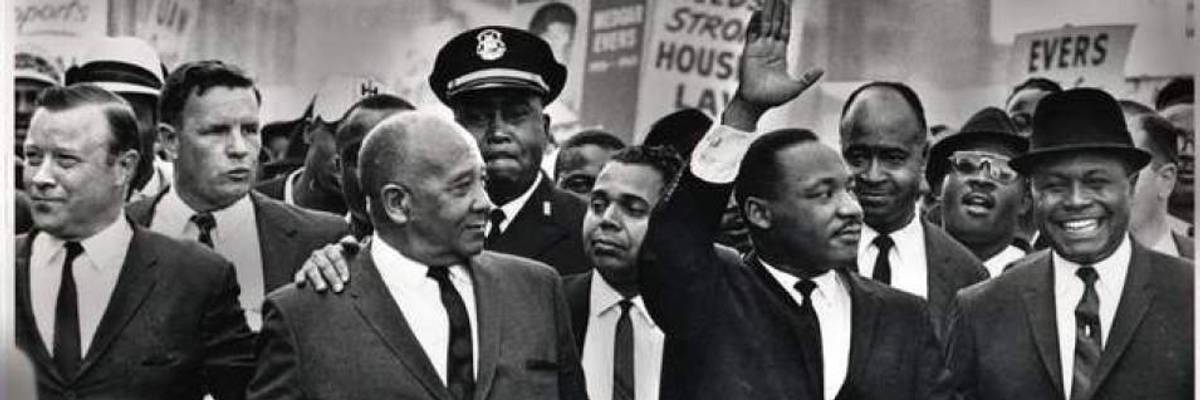
The Rev. Martin Luther King Jr. waves to onlookers while leading the 125,000 strong 'Walk to Freedom' on Woodward Avenue in Detroit in 1963. (Photo: Tony Spina / Detroit Free Press)
Has America Come Any Closer to MLK's Dream?
Dr. King would be marching with those who seek to make it easier to vote. He would be appalled by George Floyd’s murder, but not surprised.
Last weekend marked the 53d anniversary of Dr. Martin Luther King's assassination. Over half a century. Has America come any closer to his dream?
He would be pleased at some of our progress. Segregation is no longer the law of the land. The Voting Rights Act helped open doors. Dr. King would be pleased that a majority of Americans joined to elect and re-elect an African American president. Georgians just elected a black minister from Dr. King's own historic church to the U.S. Senate. There are now 60 African American members of Congress, 54 Latino members, 20 Asian American or Pacific Islander Americans and 5 native Americans.
Yet the reconstruction has brought reaction. By a 5-4 decision, right-wing judges on the Supreme Court gutted the Voting Rights Act, even after overwhelming majorities of both parties voted to reauthorize it. Now across the country, Republicans, fearful of the growing involvement of minorities and the young, are seeking to impose restrictions that make voting more difficult.
We've come a long way, yet we still have so far to go.
Dr. King would be marching with those who seek to make it easier to register and to vote. He'd be urging the Senate to pass S1, the For the People election reform bill that would go far to limit voter suppression, gerrymandering and counter the role of secret big money in politics. He surely would be delighted that African American business leaders of major corporations and banks have joined in urging the corporate community to speak out against efforts to suppress the vote.
George Floyd's murder would appall but not surprise Dr. King. The shameful mass incarceration of African Americans and the structural racial inequities of our criminal justice system demand reform. Again, Dr. King would be marching with the Black Lives Matter movement and would be encouraged by the multiracial outpouring of largely peaceful, nonviolent protests demanding reform.
Economic justice was the third movement of Dr. King's civil rights symphony--and the most incomplete. The pandemic has once more stripped the veil off of America's structural racial inequalities. African Americans and Latinos were the most likely to be infected, the most likely to lack health care, the most likely to be frontline workers, the least likely to be able to work from home.
When the economy shut down, African Americans and Latinos suffered the largest loss of jobs, and the greatest collapse of incomes. We are also vulnerable to the most evictions and foreclosures. The schools our children attend are the least likely to have adequate ventilation or space for social distancing.
The level of economic violence suffered daily by poor and low-income families is immoral and unnecessary. Millions of Americans still lack the basic right to adequate health care. Dr. King's legacy has helped to inspire a new Poor People's Campaign, giving voice to the 140 million low income and impoverished Americans who struggle to survive.
Dr. King protested as the War on Poverty was defeated in the jungles of Vietnam. He understood that a bloated military budget, constant interventions across the world, the arms race that threatened all humanity sapped the resources, energy and attention needed to make America better.
Today, the military budget is even higher--in comparable dollars--than it was at the height of the Cold War. The U.S. maintains nearly 800 military bases in more than 70 countries. We fight endless wars on the other side of the world. And worse, we seem headed into a new Cold War, this time with both Russia and China, and have launched a trillion-dollar program to build a new generation of nuclear weapons that we don't need and cannot use.
Our priorities remain distorted. There were no Republican votes for Biden's Rescue Plan to deal with the pandemic and the economic collapse. Many predict that there will be no Republican votes for Biden's American Jobs Plan to rebuild and modernize our infrastructure and begin to deal with the existential threat of catastrophic climate change. Yet there will be bipartisan support for a military budget far beyond our security needs.
Over half a century. We've come a long way, yet we still have so far to go. Hope is provided by a new generation--more diverse, more engaged, better educated, and increasingly on the march.
They are bringing new energy and new numbers to the struggle for justice and peace. About that, Dr. King surely would be pleased.
An Urgent Message From Our Co-Founder
Dear Common Dreams reader, It’s been nearly 30 years since I co-founded Common Dreams with my late wife, Lina Newhouser. We had the radical notion that journalism should serve the public good, not corporate profits. It was clear to us from the outset what it would take to build such a project. No paid advertisements. No corporate sponsors. No millionaire publisher telling us what to think or do. Many people said we wouldn't last a year, but we proved those doubters wrong. Together with a tremendous team of journalists and dedicated staff, we built an independent media outlet free from the constraints of profits and corporate control. Our mission has always been simple: To inform. To inspire. To ignite change for the common good. Building Common Dreams was not easy. Our survival was never guaranteed. When you take on the most powerful forces—Wall Street greed, fossil fuel industry destruction, Big Tech lobbyists, and uber-rich oligarchs who have spent billions upon billions rigging the economy and democracy in their favor—the only bulwark you have is supporters who believe in your work. But here’s the urgent message from me today. It's never been this bad out there. And it's never been this hard to keep us going. At the very moment Common Dreams is most needed, the threats we face are intensifying. We need your support now more than ever. We don't accept corporate advertising and never will. We don't have a paywall because we don't think people should be blocked from critical news based on their ability to pay. Everything we do is funded by the donations of readers like you. When everyone does the little they can afford, we are strong. But if that support retreats or dries up, so do we. Will you donate now to make sure Common Dreams not only survives but thrives? —Craig Brown, Co-founder |
Last weekend marked the 53d anniversary of Dr. Martin Luther King's assassination. Over half a century. Has America come any closer to his dream?
He would be pleased at some of our progress. Segregation is no longer the law of the land. The Voting Rights Act helped open doors. Dr. King would be pleased that a majority of Americans joined to elect and re-elect an African American president. Georgians just elected a black minister from Dr. King's own historic church to the U.S. Senate. There are now 60 African American members of Congress, 54 Latino members, 20 Asian American or Pacific Islander Americans and 5 native Americans.
Yet the reconstruction has brought reaction. By a 5-4 decision, right-wing judges on the Supreme Court gutted the Voting Rights Act, even after overwhelming majorities of both parties voted to reauthorize it. Now across the country, Republicans, fearful of the growing involvement of minorities and the young, are seeking to impose restrictions that make voting more difficult.
We've come a long way, yet we still have so far to go.
Dr. King would be marching with those who seek to make it easier to register and to vote. He'd be urging the Senate to pass S1, the For the People election reform bill that would go far to limit voter suppression, gerrymandering and counter the role of secret big money in politics. He surely would be delighted that African American business leaders of major corporations and banks have joined in urging the corporate community to speak out against efforts to suppress the vote.
George Floyd's murder would appall but not surprise Dr. King. The shameful mass incarceration of African Americans and the structural racial inequities of our criminal justice system demand reform. Again, Dr. King would be marching with the Black Lives Matter movement and would be encouraged by the multiracial outpouring of largely peaceful, nonviolent protests demanding reform.
Economic justice was the third movement of Dr. King's civil rights symphony--and the most incomplete. The pandemic has once more stripped the veil off of America's structural racial inequalities. African Americans and Latinos were the most likely to be infected, the most likely to lack health care, the most likely to be frontline workers, the least likely to be able to work from home.
When the economy shut down, African Americans and Latinos suffered the largest loss of jobs, and the greatest collapse of incomes. We are also vulnerable to the most evictions and foreclosures. The schools our children attend are the least likely to have adequate ventilation or space for social distancing.
The level of economic violence suffered daily by poor and low-income families is immoral and unnecessary. Millions of Americans still lack the basic right to adequate health care. Dr. King's legacy has helped to inspire a new Poor People's Campaign, giving voice to the 140 million low income and impoverished Americans who struggle to survive.
Dr. King protested as the War on Poverty was defeated in the jungles of Vietnam. He understood that a bloated military budget, constant interventions across the world, the arms race that threatened all humanity sapped the resources, energy and attention needed to make America better.
Today, the military budget is even higher--in comparable dollars--than it was at the height of the Cold War. The U.S. maintains nearly 800 military bases in more than 70 countries. We fight endless wars on the other side of the world. And worse, we seem headed into a new Cold War, this time with both Russia and China, and have launched a trillion-dollar program to build a new generation of nuclear weapons that we don't need and cannot use.
Our priorities remain distorted. There were no Republican votes for Biden's Rescue Plan to deal with the pandemic and the economic collapse. Many predict that there will be no Republican votes for Biden's American Jobs Plan to rebuild and modernize our infrastructure and begin to deal with the existential threat of catastrophic climate change. Yet there will be bipartisan support for a military budget far beyond our security needs.
Over half a century. We've come a long way, yet we still have so far to go. Hope is provided by a new generation--more diverse, more engaged, better educated, and increasingly on the march.
They are bringing new energy and new numbers to the struggle for justice and peace. About that, Dr. King surely would be pleased.
Last weekend marked the 53d anniversary of Dr. Martin Luther King's assassination. Over half a century. Has America come any closer to his dream?
He would be pleased at some of our progress. Segregation is no longer the law of the land. The Voting Rights Act helped open doors. Dr. King would be pleased that a majority of Americans joined to elect and re-elect an African American president. Georgians just elected a black minister from Dr. King's own historic church to the U.S. Senate. There are now 60 African American members of Congress, 54 Latino members, 20 Asian American or Pacific Islander Americans and 5 native Americans.
Yet the reconstruction has brought reaction. By a 5-4 decision, right-wing judges on the Supreme Court gutted the Voting Rights Act, even after overwhelming majorities of both parties voted to reauthorize it. Now across the country, Republicans, fearful of the growing involvement of minorities and the young, are seeking to impose restrictions that make voting more difficult.
We've come a long way, yet we still have so far to go.
Dr. King would be marching with those who seek to make it easier to register and to vote. He'd be urging the Senate to pass S1, the For the People election reform bill that would go far to limit voter suppression, gerrymandering and counter the role of secret big money in politics. He surely would be delighted that African American business leaders of major corporations and banks have joined in urging the corporate community to speak out against efforts to suppress the vote.
George Floyd's murder would appall but not surprise Dr. King. The shameful mass incarceration of African Americans and the structural racial inequities of our criminal justice system demand reform. Again, Dr. King would be marching with the Black Lives Matter movement and would be encouraged by the multiracial outpouring of largely peaceful, nonviolent protests demanding reform.
Economic justice was the third movement of Dr. King's civil rights symphony--and the most incomplete. The pandemic has once more stripped the veil off of America's structural racial inequalities. African Americans and Latinos were the most likely to be infected, the most likely to lack health care, the most likely to be frontline workers, the least likely to be able to work from home.
When the economy shut down, African Americans and Latinos suffered the largest loss of jobs, and the greatest collapse of incomes. We are also vulnerable to the most evictions and foreclosures. The schools our children attend are the least likely to have adequate ventilation or space for social distancing.
The level of economic violence suffered daily by poor and low-income families is immoral and unnecessary. Millions of Americans still lack the basic right to adequate health care. Dr. King's legacy has helped to inspire a new Poor People's Campaign, giving voice to the 140 million low income and impoverished Americans who struggle to survive.
Dr. King protested as the War on Poverty was defeated in the jungles of Vietnam. He understood that a bloated military budget, constant interventions across the world, the arms race that threatened all humanity sapped the resources, energy and attention needed to make America better.
Today, the military budget is even higher--in comparable dollars--than it was at the height of the Cold War. The U.S. maintains nearly 800 military bases in more than 70 countries. We fight endless wars on the other side of the world. And worse, we seem headed into a new Cold War, this time with both Russia and China, and have launched a trillion-dollar program to build a new generation of nuclear weapons that we don't need and cannot use.
Our priorities remain distorted. There were no Republican votes for Biden's Rescue Plan to deal with the pandemic and the economic collapse. Many predict that there will be no Republican votes for Biden's American Jobs Plan to rebuild and modernize our infrastructure and begin to deal with the existential threat of catastrophic climate change. Yet there will be bipartisan support for a military budget far beyond our security needs.
Over half a century. We've come a long way, yet we still have so far to go. Hope is provided by a new generation--more diverse, more engaged, better educated, and increasingly on the march.
They are bringing new energy and new numbers to the struggle for justice and peace. About that, Dr. King surely would be pleased.