
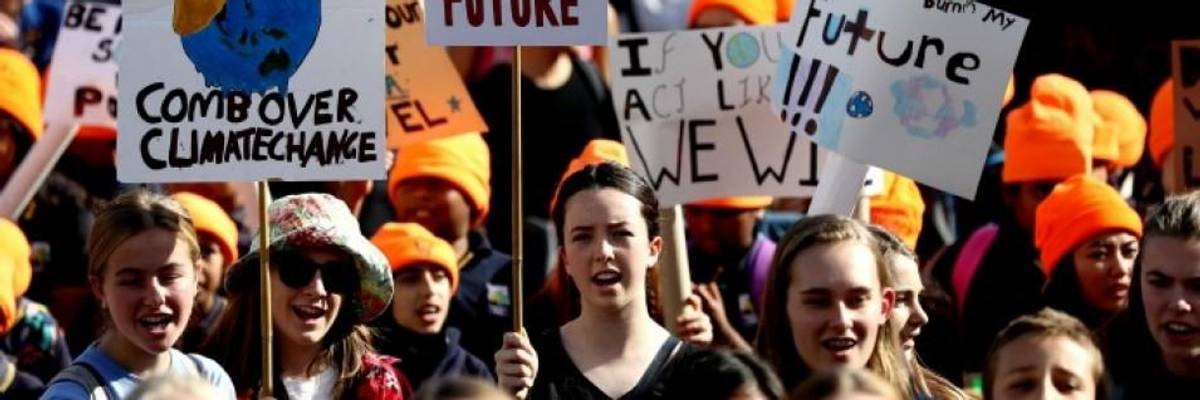
But four more years of Trump and all-out climate denial? If the world's largest economy is acting as a brake on climate progress, rather than accelerator, progress will be lurching at best. (Photo: Hannah Peters/Getty Images)
This Election Isn't About the Next Four Years. It's About the Next Four Millennia
Time is running out to act on global heating. Electing Donald Trump the first time cost us dearly; a second term would be catastrophic.
All American elections determine the character of the country for the next four years. And they have a lot to say about what the world will feel like too - that's what it means to be a superpower.
But this election may determine the flavor of the next four millennia - maybe the next 40.
That's because time is the one thing we can't recover, and time is the one thing we've just about run out of in the climate fight. The Intergovernmental Panel on Climate Change in its 2018 report made it clear that we had until 2030 to make fundamental transformations in our energy system - which they defined as cutting by half the amount of carbon that we pour into the atmosphere.
If we don't solve it soon, we will not solve it because we will move past tipping points from which we have no retreat.Read that sentence again. Because it carries deep political implications. Very few of the problems that government deals with are time limited in quite the same fashion. Issues like housing or education or healthcare last throughout our lifetimes, and we take bites out of them when we can, hopefully moving two steps forward for every one we retreat.
But climate change isn't like that. If we don't solve it soon, we will not solve it because we will move past tipping points from which we have no retreat. Some we've passed already: the news that Greenland is now in an irreversible process of melt should remind us that the biggest things on our planet can shift in the course of a very few human years.
Electing Donald Trump the first time cost us dearly. The momentum coming out of the Paris climate accord was completely undercut by the administration's insistence on rolling back environmental laws, favoring the oil industry, and removing the US from international negotiations.
But at least for the moment some of that momentum still exists: in the last few weeks we've watched the Chinese make new pledges and the state of California announce a prospective end to the era of internal combustion.
A Biden administration can join in those efforts; indeed it can lead them. Vice president Kamala Harris has announced that one of her first acts would be to convene a meeting of high-emitting nations, perhaps spurring more of them to ratchet up their ambition in anticipation of the next UN meetings in Scotland in 2021.
But four more years of Trump and all-out climate denial? If the world's largest economy is acting as a brake on climate progress, rather than accelerator, progress will be lurching at best. There will be no way to put any kind of pressure on leaders like Russia's Putin or Brazil's Bolsonaro.
The effective chance to halt the rise in temperature at anything like the targets envisioned in the Paris Accords will slip by forever. And the job of future presidents will increasingly involve responding to disasters that it's no longer possible to prevent.
The one degree celsius that we've already increased the planet's temperature has taken us into what is effectively a new geological era, one markedly less hospitable to human beings. But it still bears some resemblance to the world that our civilizations emerged from.
If we value those civilizations then a vote for Joe Biden isn't really about the next four years. It's about the long march of time that stretches out ahead of us. And about every creature and human being that will live in those misbegotten years.
An Urgent Message From Our Co-Founder
Dear Common Dreams reader, It’s been nearly 30 years since I co-founded Common Dreams with my late wife, Lina Newhouser. We had the radical notion that journalism should serve the public good, not corporate profits. It was clear to us from the outset what it would take to build such a project. No paid advertisements. No corporate sponsors. No millionaire publisher telling us what to think or do. Many people said we wouldn't last a year, but we proved those doubters wrong. Together with a tremendous team of journalists and dedicated staff, we built an independent media outlet free from the constraints of profits and corporate control. Our mission has always been simple: To inform. To inspire. To ignite change for the common good. Building Common Dreams was not easy. Our survival was never guaranteed. When you take on the most powerful forces—Wall Street greed, fossil fuel industry destruction, Big Tech lobbyists, and uber-rich oligarchs who have spent billions upon billions rigging the economy and democracy in their favor—the only bulwark you have is supporters who believe in your work. But here’s the urgent message from me today. It's never been this bad out there. And it's never been this hard to keep us going. At the very moment Common Dreams is most needed, the threats we face are intensifying. We need your support now more than ever. We don't accept corporate advertising and never will. We don't have a paywall because we don't think people should be blocked from critical news based on their ability to pay. Everything we do is funded by the donations of readers like you. When everyone does the little they can afford, we are strong. But if that support retreats or dries up, so do we. Will you donate now to make sure Common Dreams not only survives but thrives? —Craig Brown, Co-founder |
All American elections determine the character of the country for the next four years. And they have a lot to say about what the world will feel like too - that's what it means to be a superpower.
But this election may determine the flavor of the next four millennia - maybe the next 40.
That's because time is the one thing we can't recover, and time is the one thing we've just about run out of in the climate fight. The Intergovernmental Panel on Climate Change in its 2018 report made it clear that we had until 2030 to make fundamental transformations in our energy system - which they defined as cutting by half the amount of carbon that we pour into the atmosphere.
If we don't solve it soon, we will not solve it because we will move past tipping points from which we have no retreat.Read that sentence again. Because it carries deep political implications. Very few of the problems that government deals with are time limited in quite the same fashion. Issues like housing or education or healthcare last throughout our lifetimes, and we take bites out of them when we can, hopefully moving two steps forward for every one we retreat.
But climate change isn't like that. If we don't solve it soon, we will not solve it because we will move past tipping points from which we have no retreat. Some we've passed already: the news that Greenland is now in an irreversible process of melt should remind us that the biggest things on our planet can shift in the course of a very few human years.
Electing Donald Trump the first time cost us dearly. The momentum coming out of the Paris climate accord was completely undercut by the administration's insistence on rolling back environmental laws, favoring the oil industry, and removing the US from international negotiations.
But at least for the moment some of that momentum still exists: in the last few weeks we've watched the Chinese make new pledges and the state of California announce a prospective end to the era of internal combustion.
A Biden administration can join in those efforts; indeed it can lead them. Vice president Kamala Harris has announced that one of her first acts would be to convene a meeting of high-emitting nations, perhaps spurring more of them to ratchet up their ambition in anticipation of the next UN meetings in Scotland in 2021.
But four more years of Trump and all-out climate denial? If the world's largest economy is acting as a brake on climate progress, rather than accelerator, progress will be lurching at best. There will be no way to put any kind of pressure on leaders like Russia's Putin or Brazil's Bolsonaro.
The effective chance to halt the rise in temperature at anything like the targets envisioned in the Paris Accords will slip by forever. And the job of future presidents will increasingly involve responding to disasters that it's no longer possible to prevent.
The one degree celsius that we've already increased the planet's temperature has taken us into what is effectively a new geological era, one markedly less hospitable to human beings. But it still bears some resemblance to the world that our civilizations emerged from.
If we value those civilizations then a vote for Joe Biden isn't really about the next four years. It's about the long march of time that stretches out ahead of us. And about every creature and human being that will live in those misbegotten years.
All American elections determine the character of the country for the next four years. And they have a lot to say about what the world will feel like too - that's what it means to be a superpower.
But this election may determine the flavor of the next four millennia - maybe the next 40.
That's because time is the one thing we can't recover, and time is the one thing we've just about run out of in the climate fight. The Intergovernmental Panel on Climate Change in its 2018 report made it clear that we had until 2030 to make fundamental transformations in our energy system - which they defined as cutting by half the amount of carbon that we pour into the atmosphere.
If we don't solve it soon, we will not solve it because we will move past tipping points from which we have no retreat.Read that sentence again. Because it carries deep political implications. Very few of the problems that government deals with are time limited in quite the same fashion. Issues like housing or education or healthcare last throughout our lifetimes, and we take bites out of them when we can, hopefully moving two steps forward for every one we retreat.
But climate change isn't like that. If we don't solve it soon, we will not solve it because we will move past tipping points from which we have no retreat. Some we've passed already: the news that Greenland is now in an irreversible process of melt should remind us that the biggest things on our planet can shift in the course of a very few human years.
Electing Donald Trump the first time cost us dearly. The momentum coming out of the Paris climate accord was completely undercut by the administration's insistence on rolling back environmental laws, favoring the oil industry, and removing the US from international negotiations.
But at least for the moment some of that momentum still exists: in the last few weeks we've watched the Chinese make new pledges and the state of California announce a prospective end to the era of internal combustion.
A Biden administration can join in those efforts; indeed it can lead them. Vice president Kamala Harris has announced that one of her first acts would be to convene a meeting of high-emitting nations, perhaps spurring more of them to ratchet up their ambition in anticipation of the next UN meetings in Scotland in 2021.
But four more years of Trump and all-out climate denial? If the world's largest economy is acting as a brake on climate progress, rather than accelerator, progress will be lurching at best. There will be no way to put any kind of pressure on leaders like Russia's Putin or Brazil's Bolsonaro.
The effective chance to halt the rise in temperature at anything like the targets envisioned in the Paris Accords will slip by forever. And the job of future presidents will increasingly involve responding to disasters that it's no longer possible to prevent.
The one degree celsius that we've already increased the planet's temperature has taken us into what is effectively a new geological era, one markedly less hospitable to human beings. But it still bears some resemblance to the world that our civilizations emerged from.
If we value those civilizations then a vote for Joe Biden isn't really about the next four years. It's about the long march of time that stretches out ahead of us. And about every creature and human being that will live in those misbegotten years.