SUBSCRIBE TO OUR FREE NEWSLETTER
Daily news & progressive opinion—funded by the people, not the corporations—delivered straight to your inbox.
5
#000000
#FFFFFF
To donate by check, phone, or other method, see our More Ways to Give page.
Daily news & progressive opinion—funded by the people, not the corporations—delivered straight to your inbox.
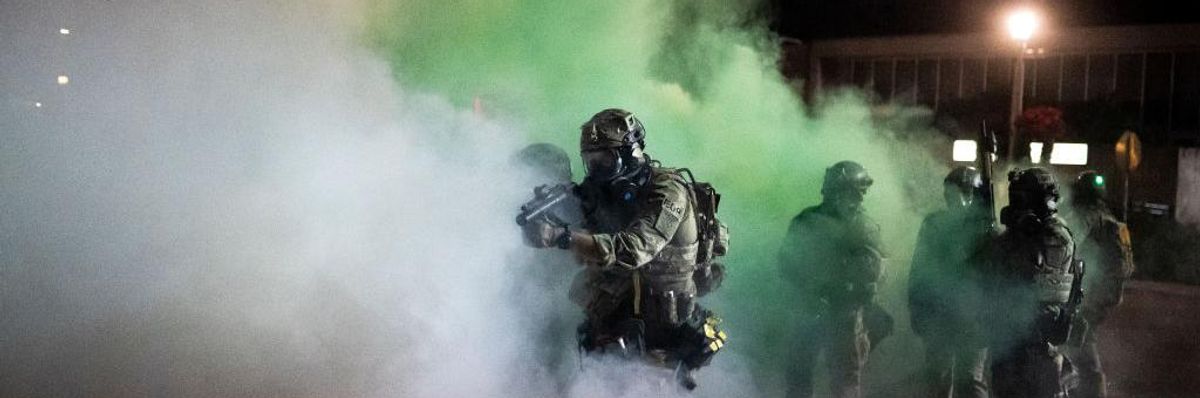
Federal officers walk through tear gas during a dispersal of about 300 protesters in front of the Immigration and Customs Enforcement (ICE) detention building on August 26, 2020 in Portland, Oregon. Protests continued for the 91st night in Portland as activist called for solidarity with rallies in Kenosha, Wisconsin. (Photo: Nathan Howard/Getty Images)
This summer, I watched from 3,000 miles away as my hometown of Portland, Ore. became the site of a military occupation. I saw photographs of unidentified federal agents in military fatigues brandishing weapons of war mere blocks from my high school. The sidewalks we used to run during cross country practice were hazy with tear gas. The concert hall where for years my choir sang with the Oregon Symphony, the library I've visited since I was born, and the Catholic church where we held my great-aunt's funeral are all footsteps away from the clashes between federal agents and Oregonians of all ages, races, and religions.
Acting-Deputy Secretary for the Department of Homeland Security Ken Cucinelli called anti-racist protesters in Portland "terrorists." They're the furthest thing from it. The people who came out to protest are people I know and love--classmates from elementary school, my teachers, fellow union members from my first job as a lifeguard, priests from my church, and my cousins. During one of many sleepless nights in July, I began thinking about the parallels between what I was seeing in Portland and decades of U.S. foreign policy: supporting militarized security forces who wreak violence on the places abroad where people call home, and disregarding human rights in the name of fighting "terrorists."
The deployment of federal agents to Portland was alarming partly for its chilling parallels with vicious crackdowns against protestors in authoritarian nations around the globe--especially since the United States often claims that what sets it apart from authoritarian regimes is the right to protest and openly criticize the government.
And yet, perhaps the events in Portland should not have been surprising to anyone. What happened in Portland was not an aberration or unprecedented, but a time-honored American foreign policy tactic, this time directed against American citizens. One can draw a direct line between the Trump administration's use of paramilitary forces to suppress protest domestically, and the tendency of security forces in foreign countries to violently suppress their own citizenry--security forces that for years have been backed, funded, trained, and armed by the United States government.
"One can draw a direct line between the Trump administration's use of paramilitary forces to suppress protest domestically, and the tendency of security forces in foreign countries to violently suppress their own citizenry--security forces that for years have been backed, funded, trained, and armed by the United States government." While Americans are increasingly calling to dismantle violent policing, our government's provision of military assistance to security forces abroad that abuse human rights often goes unchallenged. The examples are abundant: in Iraq, which received over a billion dollars in security aid from the United States last year, security forces killed over 500 civilians and injured 20,000 during protests last October. In Burkina Faso, which received $15 million in security aid, government forces recently murdered 200 people and left their bodies in mass graves. And in the Philippines, security forces have killed 27,000 people since 2016, yet in 2018, the United States spent $78 million to provide these same security forces with weapons and training.
U.S. government officials argue that foreign civilian casualties are a necessary evil, a side effect of arming foreign governments to combat terrorism. But these are the same arguments used for decades to justify the murder of Black Americans by police officers; that in the name of "security" our government somehow has the authority to extrajudicially execute people of color at home and abroad. The common thread between these phenomena is that our federal government is deeply invested in violent and coercive means to achieve its ends both at home and abroad.
Those who object to militarized policing and authoritarian crackdowns in the United States should also object to the human rights violations committed by foreign security forces who are trained, funded, and equipped by the United States. If the scenes out of Portland strike you as a violation of our basic human and civil rights, you should extend that same concern for rights and dignity to the citizens all over the world. For every person like myself who was horrified to see the city where she grew up and the places she loves occupied by federal paramilitary agents, tear-gassing her friends and family, there are thousands of people in foreign countries watching their own security forces do the same--and often much worse--with the funding and the explicit support of the United States.
Dear Common Dreams reader, It’s been nearly 30 years since I co-founded Common Dreams with my late wife, Lina Newhouser. We had the radical notion that journalism should serve the public good, not corporate profits. It was clear to us from the outset what it would take to build such a project. No paid advertisements. No corporate sponsors. No millionaire publisher telling us what to think or do. Many people said we wouldn't last a year, but we proved those doubters wrong. Together with a tremendous team of journalists and dedicated staff, we built an independent media outlet free from the constraints of profits and corporate control. Our mission has always been simple: To inform. To inspire. To ignite change for the common good. Building Common Dreams was not easy. Our survival was never guaranteed. When you take on the most powerful forces—Wall Street greed, fossil fuel industry destruction, Big Tech lobbyists, and uber-rich oligarchs who have spent billions upon billions rigging the economy and democracy in their favor—the only bulwark you have is supporters who believe in your work. But here’s the urgent message from me today. It's never been this bad out there. And it's never been this hard to keep us going. At the very moment Common Dreams is most needed, the threats we face are intensifying. We need your support now more than ever. We don't accept corporate advertising and never will. We don't have a paywall because we don't think people should be blocked from critical news based on their ability to pay. Everything we do is funded by the donations of readers like you. When everyone does the little they can afford, we are strong. But if that support retreats or dries up, so do we. Will you donate now to make sure Common Dreams not only survives but thrives? —Craig Brown, Co-founder |
This summer, I watched from 3,000 miles away as my hometown of Portland, Ore. became the site of a military occupation. I saw photographs of unidentified federal agents in military fatigues brandishing weapons of war mere blocks from my high school. The sidewalks we used to run during cross country practice were hazy with tear gas. The concert hall where for years my choir sang with the Oregon Symphony, the library I've visited since I was born, and the Catholic church where we held my great-aunt's funeral are all footsteps away from the clashes between federal agents and Oregonians of all ages, races, and religions.
Acting-Deputy Secretary for the Department of Homeland Security Ken Cucinelli called anti-racist protesters in Portland "terrorists." They're the furthest thing from it. The people who came out to protest are people I know and love--classmates from elementary school, my teachers, fellow union members from my first job as a lifeguard, priests from my church, and my cousins. During one of many sleepless nights in July, I began thinking about the parallels between what I was seeing in Portland and decades of U.S. foreign policy: supporting militarized security forces who wreak violence on the places abroad where people call home, and disregarding human rights in the name of fighting "terrorists."
The deployment of federal agents to Portland was alarming partly for its chilling parallels with vicious crackdowns against protestors in authoritarian nations around the globe--especially since the United States often claims that what sets it apart from authoritarian regimes is the right to protest and openly criticize the government.
And yet, perhaps the events in Portland should not have been surprising to anyone. What happened in Portland was not an aberration or unprecedented, but a time-honored American foreign policy tactic, this time directed against American citizens. One can draw a direct line between the Trump administration's use of paramilitary forces to suppress protest domestically, and the tendency of security forces in foreign countries to violently suppress their own citizenry--security forces that for years have been backed, funded, trained, and armed by the United States government.
"One can draw a direct line between the Trump administration's use of paramilitary forces to suppress protest domestically, and the tendency of security forces in foreign countries to violently suppress their own citizenry--security forces that for years have been backed, funded, trained, and armed by the United States government." While Americans are increasingly calling to dismantle violent policing, our government's provision of military assistance to security forces abroad that abuse human rights often goes unchallenged. The examples are abundant: in Iraq, which received over a billion dollars in security aid from the United States last year, security forces killed over 500 civilians and injured 20,000 during protests last October. In Burkina Faso, which received $15 million in security aid, government forces recently murdered 200 people and left their bodies in mass graves. And in the Philippines, security forces have killed 27,000 people since 2016, yet in 2018, the United States spent $78 million to provide these same security forces with weapons and training.
U.S. government officials argue that foreign civilian casualties are a necessary evil, a side effect of arming foreign governments to combat terrorism. But these are the same arguments used for decades to justify the murder of Black Americans by police officers; that in the name of "security" our government somehow has the authority to extrajudicially execute people of color at home and abroad. The common thread between these phenomena is that our federal government is deeply invested in violent and coercive means to achieve its ends both at home and abroad.
Those who object to militarized policing and authoritarian crackdowns in the United States should also object to the human rights violations committed by foreign security forces who are trained, funded, and equipped by the United States. If the scenes out of Portland strike you as a violation of our basic human and civil rights, you should extend that same concern for rights and dignity to the citizens all over the world. For every person like myself who was horrified to see the city where she grew up and the places she loves occupied by federal paramilitary agents, tear-gassing her friends and family, there are thousands of people in foreign countries watching their own security forces do the same--and often much worse--with the funding and the explicit support of the United States.
This summer, I watched from 3,000 miles away as my hometown of Portland, Ore. became the site of a military occupation. I saw photographs of unidentified federal agents in military fatigues brandishing weapons of war mere blocks from my high school. The sidewalks we used to run during cross country practice were hazy with tear gas. The concert hall where for years my choir sang with the Oregon Symphony, the library I've visited since I was born, and the Catholic church where we held my great-aunt's funeral are all footsteps away from the clashes between federal agents and Oregonians of all ages, races, and religions.
Acting-Deputy Secretary for the Department of Homeland Security Ken Cucinelli called anti-racist protesters in Portland "terrorists." They're the furthest thing from it. The people who came out to protest are people I know and love--classmates from elementary school, my teachers, fellow union members from my first job as a lifeguard, priests from my church, and my cousins. During one of many sleepless nights in July, I began thinking about the parallels between what I was seeing in Portland and decades of U.S. foreign policy: supporting militarized security forces who wreak violence on the places abroad where people call home, and disregarding human rights in the name of fighting "terrorists."
The deployment of federal agents to Portland was alarming partly for its chilling parallels with vicious crackdowns against protestors in authoritarian nations around the globe--especially since the United States often claims that what sets it apart from authoritarian regimes is the right to protest and openly criticize the government.
And yet, perhaps the events in Portland should not have been surprising to anyone. What happened in Portland was not an aberration or unprecedented, but a time-honored American foreign policy tactic, this time directed against American citizens. One can draw a direct line between the Trump administration's use of paramilitary forces to suppress protest domestically, and the tendency of security forces in foreign countries to violently suppress their own citizenry--security forces that for years have been backed, funded, trained, and armed by the United States government.
"One can draw a direct line between the Trump administration's use of paramilitary forces to suppress protest domestically, and the tendency of security forces in foreign countries to violently suppress their own citizenry--security forces that for years have been backed, funded, trained, and armed by the United States government." While Americans are increasingly calling to dismantle violent policing, our government's provision of military assistance to security forces abroad that abuse human rights often goes unchallenged. The examples are abundant: in Iraq, which received over a billion dollars in security aid from the United States last year, security forces killed over 500 civilians and injured 20,000 during protests last October. In Burkina Faso, which received $15 million in security aid, government forces recently murdered 200 people and left their bodies in mass graves. And in the Philippines, security forces have killed 27,000 people since 2016, yet in 2018, the United States spent $78 million to provide these same security forces with weapons and training.
U.S. government officials argue that foreign civilian casualties are a necessary evil, a side effect of arming foreign governments to combat terrorism. But these are the same arguments used for decades to justify the murder of Black Americans by police officers; that in the name of "security" our government somehow has the authority to extrajudicially execute people of color at home and abroad. The common thread between these phenomena is that our federal government is deeply invested in violent and coercive means to achieve its ends both at home and abroad.
Those who object to militarized policing and authoritarian crackdowns in the United States should also object to the human rights violations committed by foreign security forces who are trained, funded, and equipped by the United States. If the scenes out of Portland strike you as a violation of our basic human and civil rights, you should extend that same concern for rights and dignity to the citizens all over the world. For every person like myself who was horrified to see the city where she grew up and the places she loves occupied by federal paramilitary agents, tear-gassing her friends and family, there are thousands of people in foreign countries watching their own security forces do the same--and often much worse--with the funding and the explicit support of the United States.