SUBSCRIBE TO OUR FREE NEWSLETTER
Daily news & progressive opinion—funded by the people, not the corporations—delivered straight to your inbox.
5
#000000
#FFFFFF
To donate by check, phone, or other method, see our More Ways to Give page.
Daily news & progressive opinion—funded by the people, not the corporations—delivered straight to your inbox.
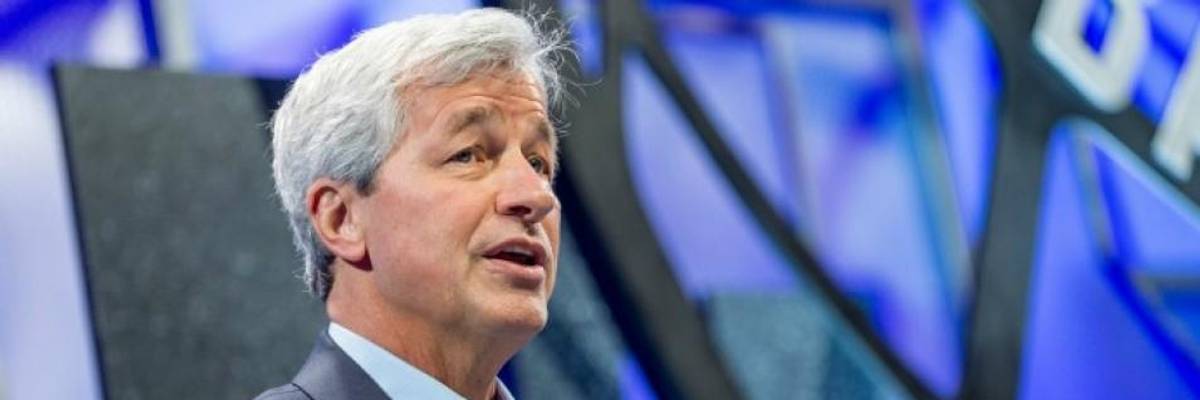
The chairman of the Business Roundtable is Jamie Dimon, CEO of Wall Street's largest bank, JPMorgan Chase. Dimon lobbied Congress personally and intensively for the biggest corporate tax cut in history, and got the Business Roundtable to join him. JPMorgan raked in $3.7 billion from the tax cut. Dimon alone made $31 million in 2018. . (Photo: FORTUNE Global Forum/flickr/cc)
Last August, the Business Roundtable--an association of CEOs of America's biggest corporations - announced with great fanfare a "fundamental commitment to all of our stakeholders" and not just their shareholders.
They said "investing in employees, delivering value to customers, and supporting outside communities" is now at the forefront of their business goals -- not maximizing profits.
Baloney. Corporate social responsibility is a sham.
Americans know this. A record 76 percent of U.S. adults believe major corporations have too much power.One Business Roundtable director is Mary Barra, CEO of General Motors. Just weeks after making the Roundtable commitment, and despite GM's hefty profits and large tax breaks, Barra rejected workers' demands that GM raise their wages and stop outsourcing their jobs. Earlier in the year GM shut its giant assembly plant in Lordstown, Ohio.
Nearly 50,000 GM workers then staged the longest auto strike in 50 years. They won a few wage gains but didn't save any jobs. Barra was paid $22 million last year. How's that for corporate social responsibility?
Watch:
Another prominent CEO who made the phony Business Roundtable commitment was AT&T's Randall Stephenson, who promised to use the billions in savings from the Trump tax cut to invest in the company's broadband network and create at least 7,000 new jobs.
Instead, even before the coronavirus pandemic, AT&T cut more than 23,000 jobs and demanded that employees train lower-wage foreign workers to replace them.
Let's not forget Jeff Bezos, CEO of Amazon and its Whole Foods subsidiary. Just weeks after Bezos made the Business Roundtable commitment, Whole Foods announced it would be cutting medical benefits for its entire part-time workforce.
The annual saving to Amazon from this cost-cutting move is roughly what Bezos - whose net worth is $117 billion - makes in a few hours. Bezos' wealth grows so quickly, this number has gone up since you started watching this video.
GE's CEO Larry Culp is also a member of the Business Roundtable. Two months after he made the commitment to all his stakeholders, General Electric froze the pensions of 20,000 workers in order to cut costs. So much for investing in employees.
Dennis Muilenburg, the former CEO of Boeing, also committed to the phony Business Roundtable pledge. Shortly after making the commitment to "deliver value to customers," Muilenburg was fired for failing to act to address the safety problems that caused the 737 Max crashes that killed 346 people. After the crashes, he didn't issue a meaningful apology or even express remorse to the victims' families and downplayed the severity of the fallout to investors, regulators, airlines, and the public. He was rewarded with a $62 million farewell gift from Boeing on his way out.
Oh, and the chairman of the Business Roundtable is Jamie Dimon, CEO of Wall Street's largest bank, JPMorgan Chase. Dimon lobbied Congress personally and intensively for the biggest corporate tax cut in history, and got the Business Roundtable to join him. JPMorgan raked in $3.7 billion from the tax cut. Dimon alone made $31 million in 2018.
That tax cut increased the federal debt by almost $2 trillion. This was before Congress spent almost $3 trillion fighting the pandemic - and delivering a hefty portion as bailouts to the biggest corporations, many of whom signed the Business Roundtable pledge.
As usual, almost nothing has trickled down to America's working class and poor.
The truth is, American corporations are sacrificing workers and communities as never before in order to further boost runaway profits and unprecedented CEO pay. And not even a tragic pandemic is changing that.
Americans know this. A record 76 percent of U.S. adults believe major corporations have too much power.
The only way to make corporations socially responsible is through laws requiring them to be--for example, giving workers a bigger voice in corporate decision making, requiring that corporations pay severance to communities they abandon, raising corporate taxes, busting up monopolies, and preventing dangerous products (including faulty airplanes) from ever reaching the light of day.
If the CEOs of the Business Roundtable and other corporations were truly socially responsible, they'd support such laws, not make phony promises they clearly have no intention of keeping. Don't hold your breath.
The only way to get such laws enacted is by reducing corporate power and getting big money out of our politics.
The first step is to see corporate social responsibility for the sham it is. The next step is to emerge from this pandemic and economic crisis more resolved than ever to rein in corporate power, and make the economy work for all.
Dear Common Dreams reader, It’s been nearly 30 years since I co-founded Common Dreams with my late wife, Lina Newhouser. We had the radical notion that journalism should serve the public good, not corporate profits. It was clear to us from the outset what it would take to build such a project. No paid advertisements. No corporate sponsors. No millionaire publisher telling us what to think or do. Many people said we wouldn't last a year, but we proved those doubters wrong. Together with a tremendous team of journalists and dedicated staff, we built an independent media outlet free from the constraints of profits and corporate control. Our mission has always been simple: To inform. To inspire. To ignite change for the common good. Building Common Dreams was not easy. Our survival was never guaranteed. When you take on the most powerful forces—Wall Street greed, fossil fuel industry destruction, Big Tech lobbyists, and uber-rich oligarchs who have spent billions upon billions rigging the economy and democracy in their favor—the only bulwark you have is supporters who believe in your work. But here’s the urgent message from me today. It's never been this bad out there. And it's never been this hard to keep us going. At the very moment Common Dreams is most needed, the threats we face are intensifying. We need your support now more than ever. We don't accept corporate advertising and never will. We don't have a paywall because we don't think people should be blocked from critical news based on their ability to pay. Everything we do is funded by the donations of readers like you. When everyone does the little they can afford, we are strong. But if that support retreats or dries up, so do we. Will you donate now to make sure Common Dreams not only survives but thrives? —Craig Brown, Co-founder |
Last August, the Business Roundtable--an association of CEOs of America's biggest corporations - announced with great fanfare a "fundamental commitment to all of our stakeholders" and not just their shareholders.
They said "investing in employees, delivering value to customers, and supporting outside communities" is now at the forefront of their business goals -- not maximizing profits.
Baloney. Corporate social responsibility is a sham.
Americans know this. A record 76 percent of U.S. adults believe major corporations have too much power.One Business Roundtable director is Mary Barra, CEO of General Motors. Just weeks after making the Roundtable commitment, and despite GM's hefty profits and large tax breaks, Barra rejected workers' demands that GM raise their wages and stop outsourcing their jobs. Earlier in the year GM shut its giant assembly plant in Lordstown, Ohio.
Nearly 50,000 GM workers then staged the longest auto strike in 50 years. They won a few wage gains but didn't save any jobs. Barra was paid $22 million last year. How's that for corporate social responsibility?
Watch:
Another prominent CEO who made the phony Business Roundtable commitment was AT&T's Randall Stephenson, who promised to use the billions in savings from the Trump tax cut to invest in the company's broadband network and create at least 7,000 new jobs.
Instead, even before the coronavirus pandemic, AT&T cut more than 23,000 jobs and demanded that employees train lower-wage foreign workers to replace them.
Let's not forget Jeff Bezos, CEO of Amazon and its Whole Foods subsidiary. Just weeks after Bezos made the Business Roundtable commitment, Whole Foods announced it would be cutting medical benefits for its entire part-time workforce.
The annual saving to Amazon from this cost-cutting move is roughly what Bezos - whose net worth is $117 billion - makes in a few hours. Bezos' wealth grows so quickly, this number has gone up since you started watching this video.
GE's CEO Larry Culp is also a member of the Business Roundtable. Two months after he made the commitment to all his stakeholders, General Electric froze the pensions of 20,000 workers in order to cut costs. So much for investing in employees.
Dennis Muilenburg, the former CEO of Boeing, also committed to the phony Business Roundtable pledge. Shortly after making the commitment to "deliver value to customers," Muilenburg was fired for failing to act to address the safety problems that caused the 737 Max crashes that killed 346 people. After the crashes, he didn't issue a meaningful apology or even express remorse to the victims' families and downplayed the severity of the fallout to investors, regulators, airlines, and the public. He was rewarded with a $62 million farewell gift from Boeing on his way out.
Oh, and the chairman of the Business Roundtable is Jamie Dimon, CEO of Wall Street's largest bank, JPMorgan Chase. Dimon lobbied Congress personally and intensively for the biggest corporate tax cut in history, and got the Business Roundtable to join him. JPMorgan raked in $3.7 billion from the tax cut. Dimon alone made $31 million in 2018.
That tax cut increased the federal debt by almost $2 trillion. This was before Congress spent almost $3 trillion fighting the pandemic - and delivering a hefty portion as bailouts to the biggest corporations, many of whom signed the Business Roundtable pledge.
As usual, almost nothing has trickled down to America's working class and poor.
The truth is, American corporations are sacrificing workers and communities as never before in order to further boost runaway profits and unprecedented CEO pay. And not even a tragic pandemic is changing that.
Americans know this. A record 76 percent of U.S. adults believe major corporations have too much power.
The only way to make corporations socially responsible is through laws requiring them to be--for example, giving workers a bigger voice in corporate decision making, requiring that corporations pay severance to communities they abandon, raising corporate taxes, busting up monopolies, and preventing dangerous products (including faulty airplanes) from ever reaching the light of day.
If the CEOs of the Business Roundtable and other corporations were truly socially responsible, they'd support such laws, not make phony promises they clearly have no intention of keeping. Don't hold your breath.
The only way to get such laws enacted is by reducing corporate power and getting big money out of our politics.
The first step is to see corporate social responsibility for the sham it is. The next step is to emerge from this pandemic and economic crisis more resolved than ever to rein in corporate power, and make the economy work for all.
Last August, the Business Roundtable--an association of CEOs of America's biggest corporations - announced with great fanfare a "fundamental commitment to all of our stakeholders" and not just their shareholders.
They said "investing in employees, delivering value to customers, and supporting outside communities" is now at the forefront of their business goals -- not maximizing profits.
Baloney. Corporate social responsibility is a sham.
Americans know this. A record 76 percent of U.S. adults believe major corporations have too much power.One Business Roundtable director is Mary Barra, CEO of General Motors. Just weeks after making the Roundtable commitment, and despite GM's hefty profits and large tax breaks, Barra rejected workers' demands that GM raise their wages and stop outsourcing their jobs. Earlier in the year GM shut its giant assembly plant in Lordstown, Ohio.
Nearly 50,000 GM workers then staged the longest auto strike in 50 years. They won a few wage gains but didn't save any jobs. Barra was paid $22 million last year. How's that for corporate social responsibility?
Watch:
Another prominent CEO who made the phony Business Roundtable commitment was AT&T's Randall Stephenson, who promised to use the billions in savings from the Trump tax cut to invest in the company's broadband network and create at least 7,000 new jobs.
Instead, even before the coronavirus pandemic, AT&T cut more than 23,000 jobs and demanded that employees train lower-wage foreign workers to replace them.
Let's not forget Jeff Bezos, CEO of Amazon and its Whole Foods subsidiary. Just weeks after Bezos made the Business Roundtable commitment, Whole Foods announced it would be cutting medical benefits for its entire part-time workforce.
The annual saving to Amazon from this cost-cutting move is roughly what Bezos - whose net worth is $117 billion - makes in a few hours. Bezos' wealth grows so quickly, this number has gone up since you started watching this video.
GE's CEO Larry Culp is also a member of the Business Roundtable. Two months after he made the commitment to all his stakeholders, General Electric froze the pensions of 20,000 workers in order to cut costs. So much for investing in employees.
Dennis Muilenburg, the former CEO of Boeing, also committed to the phony Business Roundtable pledge. Shortly after making the commitment to "deliver value to customers," Muilenburg was fired for failing to act to address the safety problems that caused the 737 Max crashes that killed 346 people. After the crashes, he didn't issue a meaningful apology or even express remorse to the victims' families and downplayed the severity of the fallout to investors, regulators, airlines, and the public. He was rewarded with a $62 million farewell gift from Boeing on his way out.
Oh, and the chairman of the Business Roundtable is Jamie Dimon, CEO of Wall Street's largest bank, JPMorgan Chase. Dimon lobbied Congress personally and intensively for the biggest corporate tax cut in history, and got the Business Roundtable to join him. JPMorgan raked in $3.7 billion from the tax cut. Dimon alone made $31 million in 2018.
That tax cut increased the federal debt by almost $2 trillion. This was before Congress spent almost $3 trillion fighting the pandemic - and delivering a hefty portion as bailouts to the biggest corporations, many of whom signed the Business Roundtable pledge.
As usual, almost nothing has trickled down to America's working class and poor.
The truth is, American corporations are sacrificing workers and communities as never before in order to further boost runaway profits and unprecedented CEO pay. And not even a tragic pandemic is changing that.
Americans know this. A record 76 percent of U.S. adults believe major corporations have too much power.
The only way to make corporations socially responsible is through laws requiring them to be--for example, giving workers a bigger voice in corporate decision making, requiring that corporations pay severance to communities they abandon, raising corporate taxes, busting up monopolies, and preventing dangerous products (including faulty airplanes) from ever reaching the light of day.
If the CEOs of the Business Roundtable and other corporations were truly socially responsible, they'd support such laws, not make phony promises they clearly have no intention of keeping. Don't hold your breath.
The only way to get such laws enacted is by reducing corporate power and getting big money out of our politics.
The first step is to see corporate social responsibility for the sham it is. The next step is to emerge from this pandemic and economic crisis more resolved than ever to rein in corporate power, and make the economy work for all.